
On this page
Start here
Quick answer
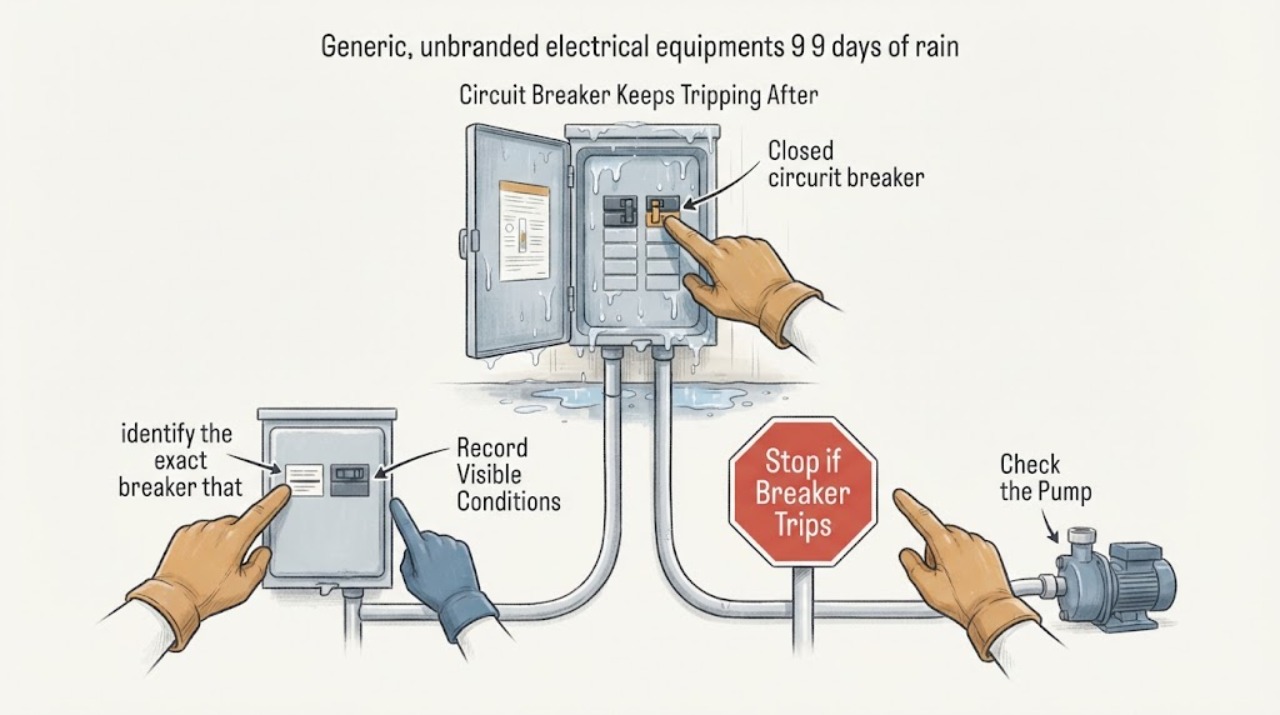
A breaker that started tripping after nine days of rain should be treated as a possible moisture or water-intrusion fault until a qualified electrician rules that out. Do not keep resetting it. From a dry location, note which breaker and connected area are affected, look only for safe external signs such as wet outlets or water near equipment, and leave the circuit off if the trip repeats or any water, heat, odor, buzzing, or damage is present.
Before you begin
Safety first
- The homeowner scope ends at dry, external observation and recording the event. Panel work, circuit isolation, insulation checks, protection-device evaluation, drying or replacement of water-damaged parts, and re-energization require a qualified professional.
Work through in order
Diagnostic checks
Use only checks that match the exact appliance or system and its official guide.
-
Check 1
From a dry position, identify the exact breaker that trips and leave it off after the next trip; do not touch the panel if the floor, panel, handle, or your hands are wet.
Expected result: The same labeled branch trips, the main device trips, or more than one breaker changes state.
Next step: Record the label and time, keep the affected circuit off, and give that pattern to a qualified electrician. If the panel or approach is wet, do not operate it.
Why this matters
Why: A repeatable branch fault is different from a home-wide supply problem, while a main or multi-breaker event can involve service equipment or broader water damage.
-
Check 2
Write down whether the trip occurs immediately after reset, only when a motor or heater starts, or after a period of rain or wind; do not repeatedly reset the breaker to reproduce the timing.
Expected result: It trips immediately with loads apparently idle, only as one appliance starts, or only during/after wet weather.
Next step: Stop at the first unsafe sign and have the electrician inspect the indicated branch and weather-exposed equipment rather than guessing from the timing alone.
Why this matters
Why: Immediate trips suggest a persistent fault; a load-linked trip points toward that equipment or its branch; a weather-linked trip raises concern about moisture, outdoor equipment, or a damaged enclosure.
-
Check 3
From a dry standing area and without unplugging anything wet, visually trace which rooms, outdoor receptacles, lights, pumps, or permanently connected equipment lost power when that breaker opened.
Expected result: An outdoor or damp-area device, a receptacle with moisture, a damaged cover, or a single appliance is in the affected group; alternatively, no obvious load is identified.
Next step: Do not handle the suspect device. Photograph or describe it from a safe distance and ask the electrician to isolate and assess the circuit.
Why this matters
Why: The first wet or weather-exposed point is a useful service clue, but a dry-looking cover does not prove the wiring is dry and an unidentified load may be concealed or permanently wired.
-
Check 4
Check only visible, dry, user-accessible appliance cords and outdoor covers for obvious cuts, looseness, displacement, or water tracks; do not open covers, move equipment, or reach into puddles.
Expected result: A cord, plug, cover, receptacle, or equipment cabinet is damaged or wet, or all visible items appear dry and intact.
Next step: Keep the affected circuit and suspect equipment out of service and report the observation. If nothing is visible, continue with professional diagnosis rather than escalating to invasive checks.
Why this matters
Why: Visible damage or water makes continued operation unsafe; an intact exterior does not exclude water behind a seal, in a conduit, or inside a device.
-
Check 5
Without touching the electrical system, note safety symptoms from a safe distance: sparks, sizzling or buzzing, a hot or discolored outlet or panel, burning or rubbery odor, smoke, or flickering lights.
Expected result: Any warning symptom is present, or the breaker trips with no visible warning.
Next step: Stop using the affected area, keep people away, and contact emergency services for active smoke or fire. For other warning signs, arrange urgent qualified electrical service and do not reset the breaker.
Why this matters
Why: These are potential shock or fire indicators, not signs to continue troubleshooting; absence of a visible symptom does not clear a moisture fault.
-
Check 6
Ask whether nearby lights, outlets, or neighbors lost power at the same time, using only dry, ordinary conversation or a safe view from indoors; do not inspect utility equipment or downed lines.
Expected result: Only one branch is affected, several circuits in the home are affected, or nearby properties are also without power.
Next step: Keep the affected circuit off and report a possible wider outage to the utility or building manager through their normal channel; never approach wet or damaged service equipment.
Why this matters
Why: A single branch supports a local load or wiring investigation; multiple properties or service-side symptoms may indicate a utility or building issue that is outside a homeowner repair.
-
Check 7
After recording the pattern, provide the electrician with the nine-day rain history, breaker label, trip timing, affected loads, visible water or damage, and any prior electrical work; do not provide a guessed cause as a diagnosis.
Expected result: The professional can correlate the weather-linked symptom with the branch, outdoor equipment, protection device, or building wiring.
Next step: Follow the professional's isolation, drying, replacement, and re-energization instructions; do not turn the circuit back on merely because the rain has stopped.
Why this matters
Why: A concise event history helps separate moisture intrusion, a faulty load, overload, ground-fault protection, and service-side problems without unsafe homeowner testing.
Use your observations
Decision map
Find the observation that best matches what you see, then follow the next safe action.
-
PATH 01Next step
What you see
The panel, breaker area, outlet, appliance, or floor is wet, or water has entered the building.
Do this next
Do not touch or operate the equipment. Leave the area if unsafe, keep power off only if it can be done without entering water or touching wet equipment, and arrange qualified inspection.
Why this path and its safety boundary
Why it matters: Water-damaged electrical parts may remain hazardous even after the surface looks dry.
-
PATH 02Next step
What you see
There is smoke, an active spark or arc, a burning smell, a hot or discolored panel/outlet, or a strong buzzing or sizzling sound.
Do this next
Stop troubleshooting, keep clear, and use emergency services for active smoke or fire. Do not reset the breaker or use water on energized equipment.
Why this path and its safety boundary
Why it matters: The symptom may indicate an active fire or shock hazard.
-
PATH 03Next step
What you see
The same breaker trips again immediately or will not remain on with ordinary loads left off.
Do this next
Leave it off and call a qualified electrician; do not substitute a higher-rated breaker or bypass protection.
Why this path and its safety boundary
Why it matters: A persistent branch fault, damaged protection device, or wiring problem is more likely than a one-time overload.
-
PATH 04Next step
What you see
The trip follows one appliance or permanently connected load, especially a pump, air-conditioning unit, outdoor device, or other equipment exposed to rain.
Do this next
Do not operate or unplug a wet suspect. Give the electrician the equipment and timing details for appliance-side and branch-side diagnosis.
Why this path and its safety boundary
Why it matters: That load or its connection is a leading suspect, but it must be isolated and evaluated safely.
-
PATH 05Next step
What you see
The trip is isolated to a single circuit, no unsafe symptoms are visible, and the area and controls are completely dry.
Do this next
Do not perform live measurements or open wiring. A qualified electrician should identify the load and check the circuit before it is returned to normal use.
Why this path and its safety boundary
Why it matters: An overload, a failing load, or a hidden moisture fault is still possible; a dry exterior does not prove the circuit is safe.
-
PATH 06Next step
What you see
Several household circuits or neighboring properties are affected at once.
Do this next
Avoid service equipment and downed lines, keep people away from wet areas, and contact the utility or building manager through a safe channel; use an electrician for the home's system.
Why this path and its safety boundary
Why it matters: The event may involve a building or utility supply problem rather than only the labeled branch.
Helpful context
Understand the symptom
Why the rain timing matters
Nine days of repeated rain can expose a weatherproofing failure, a wet outdoor receptacle or junction, water entering a cable path, or a water-damaged appliance. It can also be a coincidence: a failing appliance, a new load, or an existing wiring defect may trip at the same time. The useful clue is the pattern—whether the same breaker trips, whether it happens only when a particular load starts, and whether the circuit remains stable while the suspected loads stay disconnected. That pattern narrows the handoff for an electrician; it does not make a wet circuit safe to re-energize.
Safe scope for a homeowner
Stay on the dry, user-accessible side of the system. Do not remove the panel cover, open an outlet or junction box, handle wet plugs, enter standing water, touch a service meter, bypass a protective device, or install a larger breaker. If the breaker will not stay on, leave it off and arrange electrical service rather than making repeated reset attempts.
Safety boundary
Stop conditions
- Stop immediately for water in or around the panel, standing water, a wet body or floor, or a downed or damaged electrical line.
- Stop and keep clear for smoke, sparks, arcing, sizzling, strong buzzing, burning odor, hot or discolored electrical parts, or repeated immediate trips.
- Do not remove a panel or outlet cover, handle wet plugs, open junctions, bypass protection, install a larger breaker, or perform live electrical measurements.
- Do not keep resetting the breaker to test whether the rain-related fault has gone away.
- If the circuit serves critical equipment or the home cannot be kept safe, use the electrician's emergency process and follow local emergency guidance rather than improvising a repair.
When checks do not resolve it
Need a professional?
Call a qualified electrician for any repeated trip, any weather-linked trip that returns after nine days of rain, any suspected wet or damaged electrical equipment, or any warning symptom.
Safety scope: The homeowner scope ends at dry, external observation and recording the event. Panel work, circuit isolation, insulation checks, protection-device evaluation, drying or replacement of water-damaged parts, and re-energization require a qualified professional.
Common questions
FAQ
Should I keep resetting the breaker after the rain stops?
No. A breaker that trips repeatedly is a warning, and rain stopping does not prove that a receptacle, appliance, cable path, or protection device is dry and safe. Leave it off and arrange qualified electrical service.
Does a rain-related trip always mean the breaker itself is bad?
No. Moisture intrusion, a wet outdoor load, a damaged appliance, an overload, or a wiring fault can all produce similar symptoms. The breaker is doing its protective job until the circuit is evaluated.
Can I open the panel to see whether it is damp?
No. Do not remove the panel cover or inspect energized parts. A qualified electrician should assess the panel and any suspected water damage.
Read the exact guide
Official sources
- Electrical Safety: ChecklistNational Fire Protection Association · Residential electrical safety, frequent circuit breaker trips, warning signs, GFCI and AFCI context
- Severe Weather Fire Safety Image GalleryU.S. Fire Administration · Severe-weather electrical and flood safety reminders
- CPSC Guide to Home Wiring HazardsU.S. Consumer Product Safety Commission · Home wiring warning signs, electrical panels, branch circuits, breaker trips, and qualified professional boundaries
Community feedback
Share a repair observation
Share a plain-text repair observation. Accepted observations are published automatically; this page may take a moment to update.