
On this page
Start here
Quick answer
A breaker that trips only after a circuit has run for hours often indicates heat building from an overload, a worn or damaged load, or a high-resistance connection; an immediate trip points to a different fault. Stop resetting it repeatedly. From a dry, safe location, note what was running, turn off or unplug accessible loads without using extension cords, and perform at most the single reset allowed by the breaker or electrical guidance. If it trips again, or there is a warm or discolored plate, buzzing, burning odor, smoke, arcing, water, or a shock, leave the circuit off and contact a licensed electrician.
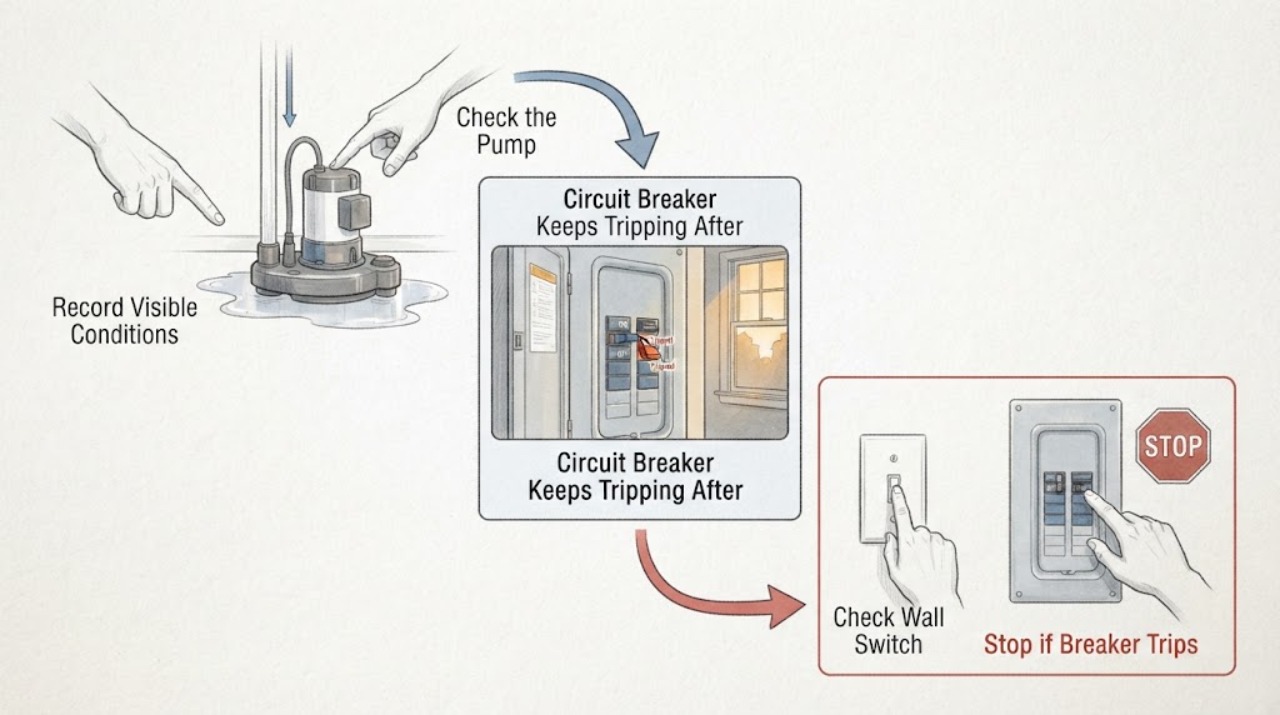
Work through in order
Diagnostic checks
Use only checks that match the exact appliance or system and its official guide.
-
Check 1
Stop using the affected circuit and record the time from startup to the trip, the room or circuit label, what was operating, and any flicker, dimming, smell, sound, heat, or moisture noticed from a safe distance.
Expected result: The breaker trips after hours of steady use, immediately when a device starts, only when several loads overlap, or even with ordinary loads turned off.
Next step: Keep the breaker off if any warning sign is present. Otherwise use the timing and load pattern to select the matching branch, without repeating the trip to collect more data.
Stop if: Stop immediately for smoke, sparks, arcing, a burning odor, buzzing or sizzling, a warm or discolored outlet or panel, water, a shock, or a breaker that will not stay off.
Why this matters
Why: A delayed trip is consistent with accumulated thermal load, while an immediate or load-independent trip needs a different fault investigation. Warning signs can indicate overheating, arcing, ground leakage, or damaged equipment.
-
Check 2
From a dry, safe location, list the accessible loads that share the circuit and note which ones run continuously or start later, such as heating, cooling, pumping, or motor-driven equipment; do not open an appliance or panel.
Expected result: The trip follows a second high-demand load turning on, a long-running heating or motor load, or a group of devices operating together.
Next step: Turn off or unplug only easy-to-reach loads without extension cords or power strips, leave major appliances on their intended wall connections, and arrange an electrician if the pattern returns or the circuit cannot carry its normal use.
Stop if: Do not redistribute a permanently wired appliance, change breaker size, or continue operating a load with heat, odor, damage, or another trip.
Why this matters
Why: The circuit may be exceeding its intended load or a connected device may be drawing more current as it heats or operates. A breaker is a protective device, not a capacity upgrade.
-
Check 3
Look only at the outside of reachable plugs, cords, receptacle plates, switches, and the breaker handle for darkening, melting, looseness, cracking, warmth, or an unusual sound; do not touch a suspect surface or remove a cover.
Expected result: A plate, plug, cord, or panel area is warm, discolored, damaged, buzzing, sizzling, or smells like hot insulation, or none of these signs are visible.
Next step: If any sign is present, stop using the circuit and call a licensed electrician. If no sign is visible, continue only with safe load history and a single manufacturer-permitted reset; never perform a live electrical test.
Stop if: Do not tighten terminals, push a loose plug back into a hot receptacle, handle melted insulation, or spray liquid near electrical equipment.
Why this matters
Why: These signs can indicate a high-resistance connection, damaged insulation, overload, or arcing. The absence of a visible sign does not clear concealed wiring or an internal appliance fault.
-
Check 4
If no hazard is visible and the area is dry, turn off or unplug accessible loads, then reset the breaker once using the normal handle procedure; do not stand in water or reach around a damaged panel.
Expected result: The breaker holds with the accessible loads off, or it trips again without those loads running.
Next step: Leave the circuit off if it trips again. If it holds, do not reconnect everything at once; document each load and have an electrician identify the safe circuit capacity and fault source.
Stop if: Do not reset repeatedly, bypass the protective device, use a larger-rated breaker, or use an extension cord or power strip as a workaround.
Why this matters
Why: Holding with loads removed makes a connected appliance or combined demand more likely, but it does not prove the remaining circuit is safe. Tripping with loads removed raises concern about wiring, a protective device, or a concealed load.
-
Check 5
Identify the visible device marking only from the front of the panel or receptacle, such as AFCI, GFCI, or another ground-leakage indicator, and record any trip light or message without pressing test controls or opening the enclosure.
Expected result: The protective device indicates an arc-fault or ground-fault event, or the device type and trip reason are not clear.
Next step: Photograph or write down the visible indication from a safe distance and leave the circuit off if the trip repeats. Ask a licensed electrician to test the circuit and connected equipment under the applicable local rules.
Stop if: Do not change the protective device, defeat an AFCI or GFCI, repeatedly press reset or test, or remove the dead-front or enclosure.
Why this matters
Why: Different protective devices respond to different hazards, including overload, short circuit, arc fault, or leakage. A trip indicator can help the electrician, but a generic breaker reset cannot diagnose the cause.
-
Check 6
Compare the trip with a normal operating event without deliberately reproducing it: note whether the circuit had been heating for hours, whether a thermostat or motor started, and whether rain, condensation, cleaning, or another moisture event preceded it.
Expected result: The event correlates with long operation, a motor or compressor start, an appliance cycle, or moisture; or no external event explains it.
Next step: Stop using the implicated load and give the sequence to an electrician. If moisture is present, keep people away and do not operate electrical equipment in or near the wet area.
Why this matters
Why: Long operation can expose a thermal overload or heat-related connection problem, while startup and moisture can point toward inrush, short-circuit, ground-fault, or equipment leakage. These are diagnostic categories, not user repair instructions.
-
Check 7
Prepare a service record with the breaker label, device type, approximate delay, connected loads, previous trips, visible symptoms, recent installation or renovation work, and whether the circuit remained off after the last trip.
Expected result: The pattern is repeatable after hours, has followed recent wiring or appliance changes, affects several outlets, or occurs with one particular device.
Next step: Leave the affected circuit off when trips recur or any hazard exists, and book a licensed electrician. Do not replace a breaker or alter wiring based only on the timing pattern.
Stop if: Stop all user diagnosis if access requires removing covers, entering a wet area, touching wiring, or restoring power after a second trip.
Why this matters
Why: A repeatable pattern helps separate a circuit-wide condition from a single connected load, but only qualified testing can establish the fault and verify the protective device and wiring.
Use your observations
Decision map
Find the observation that best matches what you see, then follow the next safe action.
-
PATH 01Next step
What you see
The breaker trips after the circuit has run for hours, especially when multiple loads overlap.
Do this next
Leave unnecessary loads off, do not increase the breaker rating, and arrange an electrician to evaluate demand, connections, wiring, and connected equipment.
Why this path and its safety boundary
Why it matters: Accumulated heat from an overload or a heat-related connection or device is more plausible than a momentary startup event.
-
PATH 02Next step
What you see
The breaker trips immediately when one device starts or is connected.
Do this next
Keep that device disconnected and do not reconnect it to another outlet for testing; have an electrician or qualified appliance technician diagnose it.
Why this path and its safety boundary
Why it matters: A short circuit, high starting current, ground fault, or fault in that device or its connection may be involved.
-
PATH 03Next step
What you see
The breaker trips again while accessible loads are off.
Do this next
Leave the circuit off and call a licensed electrician. Do not keep resetting it to locate the fault.
Why this path and its safety boundary
Why it matters: The cause may be a concealed load, fixed wiring, the protective device, or a fault not visible at the receptacle.
-
PATH 04Next step
What you see
The trip follows water, condensation, cleaning, or another wet condition.
Do this next
Stay out of the wet area, do not touch the equipment or breaker from there, and have the circuit and affected equipment made safe by a qualified professional.
Why this path and its safety boundary
Why it matters: Ground leakage or unsafe contact between electricity and moisture is possible.
-
PATH 05Next step
What you see
There is a warm or discolored plate, buzzing or sizzling, burning odor, smoke, sparks, arcing, or a shock.
Do this next
Stop using the circuit, leave it off from a safe location if possible, move people away, and contact emergency help for active smoke or fire and a licensed electrician for inspection.
Why this path and its safety boundary
Why it matters: This is an electrical fire or shock warning, not a normal nuisance trip.
-
PATH 06Next step
What you see
The breaker holds after one safe reset with accessible loads off, with no warning signs.
Do this next
Keep a written load and timing record, avoid extension-cord workarounds, reconnect nothing suspect, and seek electrician guidance if normal use causes another trip.
Why this path and its safety boundary
Why it matters: A connected load or combined demand may be contributing, but a temporary hold does not prove the circuit is sound.
Helpful context
Understand the symptom
Why after-hours tripping matters
The time between switching a circuit on and the trip is useful evidence. A trip after the circuit has carried load for a while is consistent with thermal protection responding to accumulated heat; an immediate trip is more consistent with a sudden fault or starting event. This timing does not identify the failed part by itself, and it is not a reason to open the panel or substitute a larger breaker.
What to record before touching anything
Write down the exact circuit or room, the approximate run time, what changed shortly before the trip, whether lights dimmed or flickered, and whether the breaker is a standard, ground-fault, or arc-fault protective device. Note the handle position and any visible label from outside the panel. Do not remove a panel cover, tighten a connection, or make live measurements.
Safe separation of a load from a wiring fault
Only from a dry, unobstructed location should you switch off or unplug ordinary appliances that are easy to reach. Do not enter a wet area, pull a damaged plug, use an extension cord as a test, or keep restoring power to see what happens. If the breaker holds with accessible loads off, the electrician still needs the circuit history; a temporary hold does not prove the wiring is safe.
When diagnosis ends
Repeated trips, heat, discoloration, buzzing or sizzling, an electrical smell, sparks, smoke, water, or any shock are professional-service boundaries. Leave the affected circuit off and tell the electrician whether the trip happened after hours, at startup, during a particular appliance cycle, or with loads disconnected.
Only after diagnosis
Potential parts
- circuit breaker
Consider replacement only after a licensed electrician confirms that the breaker itself is defective and the circuit, load, and protective requirements are correct.
Breaker type, rating, panel, protection function, and local rules must be confirmed by a qualified electrician; never substitute a larger rating. - receptacle or electrical connection
Consider only when an electrician identifies a damaged or overheated receptacle or connection as the source of the delayed trip.
Do not select or install a receptacle from visible symptoms alone; the circuit, protection, environment, and local requirements must be verified.
Common questions
FAQ
Why does my circuit breaker trip after several hours?
A trip after the circuit has run for a while is consistent with thermal protection responding to accumulated heat from overcurrent, a damaged load, or a high-resistance connection. It still needs professional diagnosis if it returns.
Is it safe to keep resetting a breaker that keeps tripping?
No. Turn off or unplug accessible loads only from a dry, safe location and use at most the normal single reset after the cause has been addressed. If it trips again, leave it off and call a licensed electrician.
What if the breaker trips with everything unplugged?
A concealed load, fixed wiring fault, protective-device problem, or equipment that is not easily disconnected may remain. Do not keep resetting it; leave the circuit off for an electrician.
Do buzzing or warm outlets change the urgency?
Yes. Buzzing, sizzling, warmth, discoloration, burning odor, sparks, or a shock are warning signs. Stop using the circuit and arrange urgent qualified inspection; active smoke or fire requires emergency help.
Can I replace the breaker with a higher-rated one?
No. A higher rating can remove protection intended for the existing wiring. Breaker type, rating, panel, load, and fault cause must be evaluated by a qualified electrician.
Read the exact guide
Official sources
- Electrical Safety Advice for the Home officeElectrical Safety First · Electrical product warning signs and safe stop guidance
- Home Wiring Safety TipsElectrical Safety Foundation International · Home wiring hazard signs and licensed electrician boundary
- Electronic Circuit Breaker Trip TroubleshootingABB Electrification U.S. · Circuit breaker overload, short circuit, arc fault, ground fault, and qualified troubleshooting boundaries
- Understanding Your Home Electrical SystemElectrical Safety Foundation International · Home circuit breaker overload protection and safe reset guidance
- How do you determine why a thermal-magnetic breaker nuisance trips?Schneider Electric USA · Thermal-magnetic circuit breaker trip timing and qualified diagnosis
- Don’t Overload Your HomeElectrical Safety Foundation International · Residential electrical overload warning signs and appliance connection safety
- Considerations for Installation of Smoke Alarms on Residential Branch CircuitsU.S. Consumer Product Safety Commission · Residential circuit breaker thermal and instantaneous trip mechanisms and electrical safety
Community feedback
Share a repair observation
Share a plain-text repair observation. Accepted observations are published automatically; this page may take a moment to update.