
On this page
Start here
Quick answer
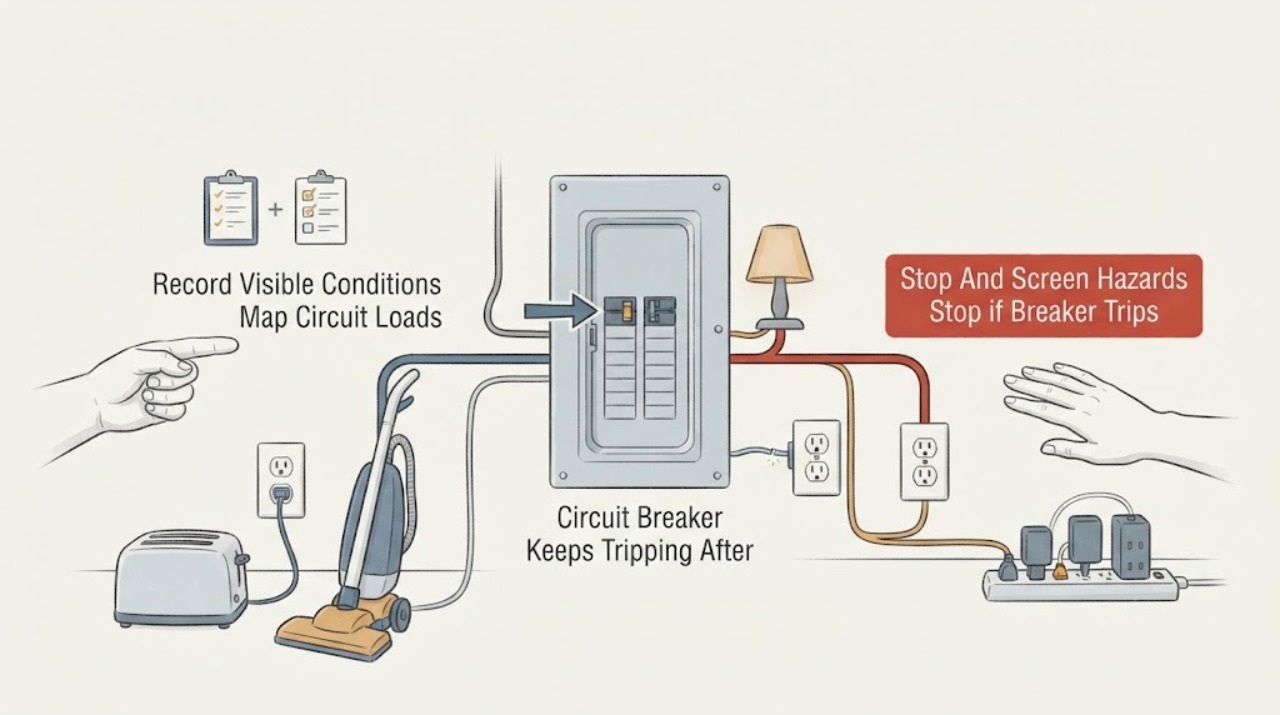
A breaker that trips after about 10 minutes is responding to a time-dependent condition, but the timing alone does not prove overload, a defective appliance, a wiring fault, or a bad breaker. Stop repeatedly resetting it. From a dry safe position, record the breaker, circuit, devices running, exact time to trip, whether the load cycles on, and any dimming, buzzing, warm or discolored plate, moisture, burning odor, smoke, or arcing. If there is no hazard, turn off or unplug only accessible portable loads and have one qualified electrician assess the circuit; do not open the panel, remove covers, bypass protection, or make energized measurements. Smoke, burning odor, sparks, a hot panel or outlet, shock or tingling, moisture, or another immediate trip requires stopping and using electrical emergency service.
Work through in order
Diagnostic checks
Use only checks that match the exact appliance or system and its official guide.
-
Check 1
Stop resetting the breaker and inspect from a safe position for smoke, flame, burning odor, buzzing or crackling, visible arcing, a hot or discolored panel or outlet, moisture, shock or tingling, a damaged cord, or a load that remains hot.
Expected result: One or more warning signs is present, or the circuit is cool, dry, quiet, and free of visible damage.
Next step: For a warning, keep clear and use electrical emergency or fire service as appropriate; isolate power only from a dry safe position if that can be done without approaching damaged equipment. If no warning exists, continue by recording the pattern.
Stop if: Do not touch wet equipment, open the panel, reset a hot or arcing circuit, or use water on an electrical fire.
Why this matters
Why: A fire, shock, arc, water, or thermal warning overrides load-tracking. The absence of a visible warning does not prove the circuit is safe, but it permits limited non-contact observation.
-
Check 2
Without restarting a hazardous circuit, record the breaker label or circuit area, devices connected, which devices are on at the start, whether a heater, compressor, pump, or motor starts later, and the elapsed time until the trip when it occurs naturally.
Expected result: The trip is close to ten minutes every time, varies with a device cycling on, changes when another load is used, or cannot be safely reproduced.
Next step: Give the time pattern and complete load list to a qualified electrician. Continue only with safe, non-energized load removal checks if no warning sign exists.
Stop if: Do not deliberately run the circuit for ten minutes, hold the breaker on, or repeat a trip to collect more data.
Why this matters
Why: A repeatable delay points to a load or temperature-dependent event; a load-dependent change helps identify a branch of investigation but does not distinguish appliance failure from wiring or breaker failure. An unsafe or unrepeatable event should not be recreated.
-
Check 3
From a dry safe position, map which rooms, receptacles, fixed appliances, and portable devices lose power when the breaker is off. Note heating appliances, motors, compressors, high-draw tools, and any recent new device or renovation on that circuit.
Expected result: Several high-demand loads share the circuit, one device is the only new or timed load, the circuit serves a wet area, or the connected load is uncertain.
Next step: Turn off or unplug only accessible portable loads with no damage or moisture, leaving fixed or suspect equipment isolated for the electrician. Do not move heavy or hardwired equipment.
Stop if: Do not use extension cords or multi-outlet converters to redistribute a high-demand load, and do not remove fixed-device covers.
Why this matters
Why: CPSC warns that too many products, a malfunctioning product, or a short circuit can cause a trip, and ESFI explains that breakers protect wires from overload and fire. A circuit map is needed before any electrician can separate those possibilities.
-
Check 4
Only if the circuit is cool, dry, quiet, and has no odor or damage, switch off and unplug accessible portable devices one at a time without touching wet or hot equipment. Leave the circuit de-energized or lightly loaded rather than reconnecting every device to test the limit.
Expected result: The breaker holds with portable loads removed, still trips with normal loads removed, or a particular device has a damaged cord, abnormal heat, odor, or a repeat relationship to the trip.
Next step: Keep the suspect device disconnected and give the comparison to a qualified electrician or appliance technician. Arrange electrical service for a fixed load or circuit that still trips.
Stop if: Do not reconnect the suspect device, use a damaged cord, or keep resetting to find the maximum number of loads.
Why this matters
Why: Holding with fewer loads is consistent with overload or a device contribution, but it does not clear the wiring or breaker. Continuing with normal loads removed points more strongly to a fixed load, wiring, breaker, or protective-device issue.
-
Check 5
If the circuit serves a kitchen, laundry, bathroom, garage, outdoor, or other damp area, inspect only for visible moisture, leaks, condensation, a tripped GFCI receptacle, or a wet appliance from a dry safe position. Do not press reset buttons on wet or damaged equipment.
Expected result: Moisture, a leak, a GFCI trip, wet equipment, or a damaged cord is present, or the area is dry and protection appears normal.
Next step: Keep the area out of use and arrange qualified electrical and plumbing or appliance service as indicated. If dry and normal, continue with documentation rather than opening a device.
Stop if: Do not touch wet receptacles or appliances, remove a GFCI cover, bypass a protective device, or reset a wet circuit.
Why this matters
Why: ESFI explains that GFCIs trip when ground-fault or leakage current is detected and are used where water may meet electrical products. A moisture-related trip needs the water and electrical source assessed, not repeated resets.
-
Check 6
From outside the panel and without touching conductors, note whether lights dim, a receptacle or switch buzzes, a wall plate is warm or discolored, an appliance seems underpowered, or the trip follows a fixed heater or motor starting.
Expected result: Thermal, sound, light, odor, or performance signs appear, the trip follows a fixed load, or none of those signs is present.
Next step: Stop using the affected circuit and arrange qualified electrician inspection. Keep the breaker off if the sign is active or the cause is uncertain.
Stop if: Do not touch a warm plate, tighten a terminal, remove a receptacle, or make a meter check on an energized circuit.
Why this matters
Why: ESFI identifies dimming, buzzing, discoloration, underpowered appliances, and frequent trips as overloaded-system warning signs; damaged, overheated, or stressed wiring can also produce arc faults. The visible pattern does not identify which conductor or component failed.
-
Check 7
If the circuit is cool, dry, quiet, undamaged, and all accessible portable loads are off or disconnected, reset the breaker only once using the normal handle motion described by the panel or device instructions; do not hold it on.
Expected result: The breaker resets and holds, trips immediately, or holds briefly and trips again near the ten-minute pattern.
Next step: If it trips again, leave it off and call a qualified electrician. If it holds with the portable load removed, do not reconnect the suspect load until it is assessed.
Stop if: Do not reset more than once, replace the breaker, substitute a fuse, or bypass AFCI or GFCI protection.
Why this matters
Why: A reset that holds does not prove the underlying problem is solved. An immediate or repeat trip is a protective response that needs diagnosis, not a larger breaker or repeated attempts.
-
Check 8
Prepare a handoff with the breaker rating and label, rooms and devices on the circuit, exact trip timing, what load changed, appliance model if relevant, recent installation or renovation, moisture or heat signs, and whether one safe reset was attempted.
Expected result: The electrician can reproduce the time pattern, the issue follows one device, the circuit trips with loads removed, or the event cannot be reproduced safely.
Next step: Leave the circuit or suspect appliance out of service until a qualified electrician confirms the cause and safe operation. Use appliance or plumbing service for a downstream device or moisture source.
Stop if: Do not conceal heat or odor, restore all loads before inspection, or treat a quiet interval as clearance.
Why this matters
Why: This record helps distinguish overload, a defective appliance, a fixed load, a protective-device issue, or wiring without asking the occupant to open the panel or recreate a hazard.
Use your observations
Decision map
Find the observation that best matches what you see, then follow the next safe action.
-
PATH 01Next step
What you see
Smoke, flame, burning odor, visible arcing, a hot or discolored panel or outlet, shock or tingling, moisture, or a damaged cord is present.
Do this next
Stop use and keep clear. Isolate power only from a dry safe position if possible without approaching the hazard, then use electrical or fire emergency service. Do not reset or retest.
-
PATH 02Next step
What you see
The breaker trips near ten minutes under a repeatable but otherwise non-hazardous load pattern.
Do this next
Treat the timestamp as evidence of a load or temperature-dependent event, not a diagnosis. Record what device cycles or heats near the trip and arrange qualified electrician inspection.
-
PATH 03Next step
What you see
Several high-demand devices share the circuit and the breaker holds when accessible portable loads are removed.
Do this next
Keep the circuit within its intended load and leave the suspect device disconnected. Have a qualified electrician assess circuit capacity and any fixed-load issue; never install a larger breaker.
-
PATH 04Next step
What you see
The trip follows one portable appliance or device, especially when it becomes warm or cycles on.
Do this next
Stop using and disconnect that device only if it is cool, dry, and safe to handle. Arrange competent appliance or electrical assessment rather than reconnecting it to confirm the pattern.
-
PATH 05Next step
What you see
The breaker trips with normal portable loads removed, or the circuit has dimming, buzzing, discoloration, heat, or an underpowered fixed appliance.
Do this next
Leave the circuit off and arrange qualified electrician inspection. Do not open the panel, receptacle, appliance, or wiring enclosure.
-
PATH 06Next step
What you see
The circuit serves a damp area or a GFCI trips with moisture, a leak, or wet equipment.
Do this next
Keep the area and equipment out of use and arrange qualified electrical service plus plumbing or appliance service as needed. Do not reset a wet protective device.
-
PATH 07Next step
What you see
The circuit is cool, dry, quiet, and undamaged, accessible loads are off, and one normal reset holds.
Do this next
Do not treat this as repaired. Keep suspect loads disconnected, document the event, and seek an electrician if the circuit trips again or the cause remains unclear.
-
PATH 08Next step
What you see
The breaker trips again, timing remains unexplained, or safe observation cannot identify the load.
Do this next
Leave it off and arrange qualified electrician diagnosis with the breaker, load list, ten-minute timing, and hazard history. Do not keep testing to improve the record.
Helpful context
Understand the symptom
The ten-minute pattern is evidence, not a diagnosis
A trip after roughly ten minutes may follow a heater or motor reaching operating temperature, several devices running together, a load cycling on, or a developing fault. A breaker can also trip promptly when a fault is severe. Treat the delay as a useful timestamp: note what changes in those minutes rather than assuming the breaker itself is the cause.
Separate overload from one-device and wiring branches
If removing accessible portable loads prevents the trip, the circuit may have been overloaded or one device may be contributing. If the breaker trips with normal loads removed, or if a fixed appliance, receptacle, moisture, or wiring sign is involved, the cause needs qualified electrical diagnosis. Never replace a breaker with a larger rating to keep it on.
Work around a panel only within the safe boundary
A breaker panel is not a user repair area. You may read labels and operate an identified breaker only from a dry, safe position when no hazard is present, but do not remove the panel cover, touch conductors, tighten terminals, test a circuit while energized, or bypass a breaker, AFCI, or GFCI.
Only after diagnosis
Potential parts
- circuit breaker or protective device
Consider only after a qualified electrician confirms the breaker, AFCI, or GFCI is defective rather than responding to overload, short circuit, ground fault, or a connected load.
Panel family, rating, pole configuration, interrupting capacity, and local code must be confirmed by the electrician; never substitute a larger rating. - receptacle, switch, or wiring repair
Consider only when qualified inspection identifies heat damage, loose connection, arcing, moisture damage, or another specific branch-circuit fault.
Device type, protection, enclosure, conductor, and code requirements are site-specific; do not open or replace energized wiring. - appliance power cord or internal appliance component
Consider only when the trip follows one appliance and a competent appliance or electrical assessment identifies a damaged cord or internal fault.
Match the exact appliance and electrical specifications; a ten-minute trip alone does not establish a replacement part.
When checks do not resolve it
Need a professional?
Arrange qualified electrician service after any repeat trip, an unexplained trip near ten minutes, a trip with normal portable loads removed, or any sign of overload, short circuit, ground fault, arc fault, heat, moisture, or wiring damage. Use competent appliance service for a device-specific fault and plumbing service when moisture is contributing.
Have this ready
- Provide the breaker label and rating, rooms and devices on the circuit, exact time to trip, devices that cycle or heat before the trip, one safe load-removal comparison, appliance details, recent work, moisture, heat, odor, sound, spark, and trip history.
Common questions
FAQ
Why does the breaker trip after about ten minutes instead of immediately?
The delay may follow a heater, motor, compressor, or load cycling on, but it does not identify the cause. Record what changes before the trip and arrange qualified electrician inspection; do not deliberately run the circuit to reproduce it.
Can I reset the breaker one more time to see whether it holds?
Only consider one normal reset when the circuit is cool, dry, quiet, undamaged, and accessible loads are off. If it trips again, leave it off. Never reset a circuit showing heat, odor, moisture, arcing, smoke, or a repeat fault.
How can I tell whether the problem is overload or wiring?
Safely removing accessible portable loads may show whether the pattern changes, but that does not clear the wiring or breaker. If it still trips, or if there is heat, buzzing, discoloration, moisture, or arcing, stop and use a qualified electrician.
Should I replace the breaker with a higher-amp model?
No. A breaker rating must match the circuit design and protection requirements. A larger rating can remove protection from the wiring. Have a qualified electrician identify the cause and the correct protective device.
What if the breaker only trips when one appliance is running?
Stop using and disconnect that appliance only if it is cool, dry, and safe to handle. The appliance may contribute, but the circuit and protective device still need assessment before reconnection.
Read the exact guide
Official sources
- Home Electrical SafetyElectrical Safety Foundation International · General household electrical-safety guidance; it does not identify a specific fault or authorize user repair.
- Don’t Overload Your HomeElectrical Safety Foundation International · General residential electrical guidance; circuit capacity and repairs require qualified assessment.
- Commission Closes Investigation Of FPE Circuit Breakers And Provides Safety Information For ConsumersU.S. Consumer Product Safety Commission · General precautions stated by CPSC for circuit breakers and fuses; not a diagnosis of any particular panel or device.
- Understanding Your Home Electrical SystemElectrical Safety Foundation International · General electrical-safety education; local electrical code and a qualified electrician control site-specific work.
Community feedback
Share a repair observation
Share a plain-text repair observation. Accepted observations are published automatically; this page may take a moment to update.