
On this page
Start here
Quick answer
A breaker that keeps tripping after an outage may be protecting against a fault, an overloaded circuit as appliances restart, damaged or wet equipment, or a problem with the utility supply. Wait until the outage is clearly over, then from a dry and safe position turn off or unplug accessible loads and note whether one circuit or the whole home is affected. Make no more than one normal reset only if there is no smoke, burning smell, buzzing, heat, water, visible damage, or arcing; if it trips again, leave it off. Do not open the panel, touch wet equipment, repeatedly reset the breaker, use a generator to backfeed the home, or test live wiring. A repeat trip, immediate trip with loads disconnected, multiple affected circuits, or any hazard sign needs a qualified electrician or utility response.
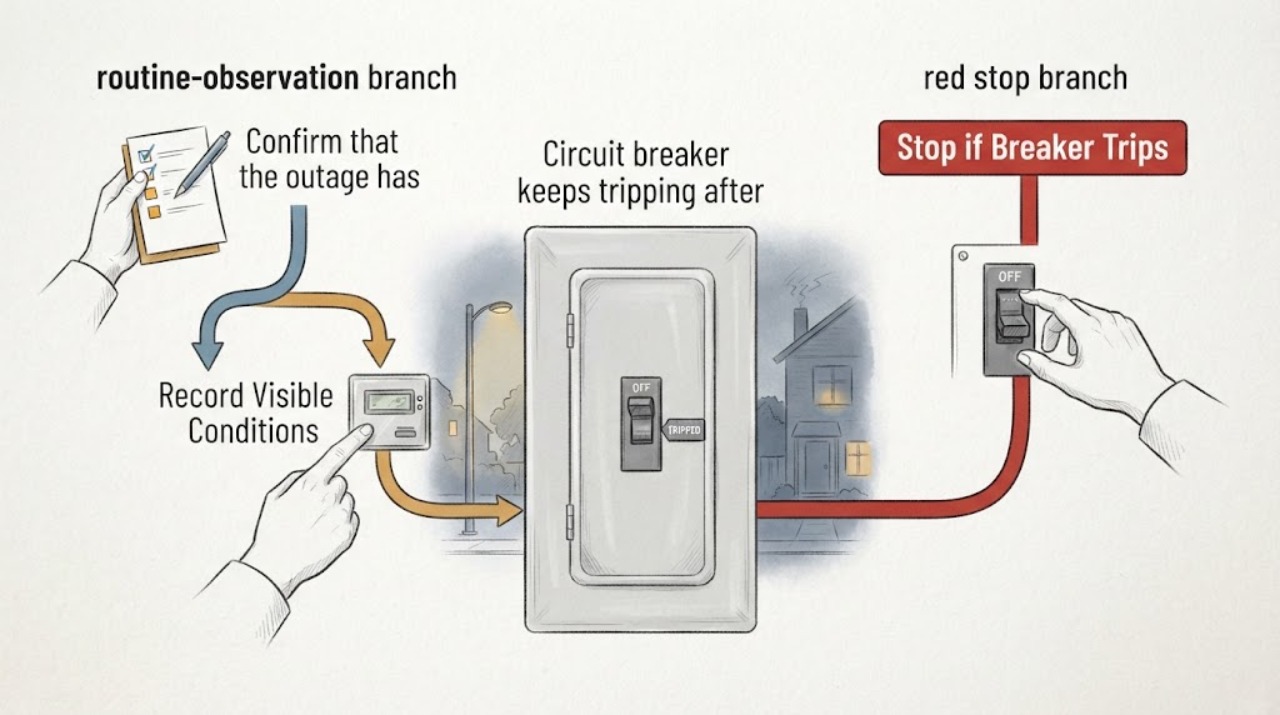
Work through in order
Diagnostic checks
Use only checks that match the exact appliance or system and its official guide.
-
Check 1
Confirm that the outage has ended from a safe position by checking whether nearby homes or common areas have power and whether the utility has announced an ongoing interruption; do not approach downed lines, damaged service equipment, or a flooded electrical area.
Expected result: If the neighborhood is still without power, the breaker may not be the cause. If the home alone loses power after service returns, or only one branch opens, the problem is more likely on the property or a particular circuit.
Next step: Leave the affected equipment off while the outage continues and contact the utility or building manager for a wider interruption. If service has returned elsewhere but the breaker keeps opening at the home, continue only with the safe external checks below.
Why this matters
Why: Separating a utility event from a property fault prevents repeated attempts to restore power while the supply is unstable or unsafe.
-
Check 2
From a dry, safe position, record which labeled breaker opens and whether it is a branch, a ground-fault or arc-fault protective device, or the main device; note whether one circuit, several circuits, or the whole home is affected. Do not remove the panel cover.
Expected result: One branch points toward a load or branch-circuit issue. Several breakers or the main device opening together points toward a wider supply, panel, or service problem. A device that will not remain set is not cleared.
Next step: Keep the device off if several circuits or the main supply are affected and request electrical or utility help. Do not operate unfamiliar protective equipment or continue resetting it.
Why this matters
Why: The scope of the trip determines whether an electrician should inspect one circuit or the service and panel, and it avoids treating a main interruption as an ordinary room-level reset.
-
Check 3
With the affected area dry and power still isolated, turn off appliance controls and unplug accessible loads on the affected circuit; pull each plug by its plug body and leave damaged, wet, hot, or questionable equipment disconnected.
Expected result: If one appliance, power strip, charger, or extension cord was connected when the outage ended, it is a useful suspect. If every accessible load is disconnected and the breaker still opens, the fault may remain in fixed wiring, an outlet, the protective device, or the service.
Next step: Keep any suspect item disconnected and label it for an electrician or appliance professional. Do not reconnect loads to see whether the breaker trips again if the item is wet, damaged, hot, or associated with an odor or noise.
Why this matters
Why: Removing loads distinguishes a restart surge or appliance fault from a circuit fault without touching live conductors.
-
Check 4
Look only at visible, dry surfaces for water entry, a wet appliance, a damaged cord, scorch marks, melted plastic, a hot outlet or panel area, smoke, burning odor, buzzing, or visible arcing; do not touch or move the affected equipment.
Expected result: Water, heat, discoloration, odor, noise, smoke, or arcing is a hazard sign rather than a reset branch. Outage-related flooding or surge damage can make equipment unsafe even when it appears to have power.
Next step: Keep people away and leave the area for smoke, flame, active arcing, or immediate danger. Isolate power only from a safe, clearly accessible control and request emergency or qualified electrical help; do not energize wet equipment until inspected.
Why this matters
Why: Energizing wet or damaged equipment can cause shock, fire, or further equipment damage; visual evidence is enough to stop.
-
Check 5
Only when the panel, floor, and equipment are dry and free of warning signs, make one normal reset of the labeled breaker according to its handle design; move an intermediate handle fully OFF before ON, and do not reset a fuse or use an improvised replacement.
Expected result: If the breaker holds with loads disconnected, the outage may have left a temporary load or appliance issue. If it trips immediately, will not latch, or opens again when the same load is restored, the underlying problem remains.
Next step: Leave the breaker OFF after any repeat or immediate trip and call a qualified electrician. Do not repeatedly reset it or restore equipment one item at a time when a warning sign is present.
Why this matters
Why: A reset restores a circuit but does not repair an overload, short, ground fault, arc fault, damaged equipment, or service problem.
-
Check 6
Prepare the service handoff with the outage start and restoration time, affected breaker label, number of circuits affected, connected loads, trip timing, reset result, water or surge exposure, visible damage, and any utility or building-wide information; keep the suspect circuit and equipment out of service.
Expected result: A trip tied to one appliance differs from an immediate trip with no load or a main-device event. A clear timeline helps the professional consider overload, appliance damage, wiring fault, protective-device operation, or utility-side instability.
Next step: Call a qualified electrician for any repeat, immediate, or load-independent trip, and contact the utility for a service-wide or neighborhood event. Have wet or surge-exposed equipment inspected before it is energized.
Why this matters
Why: The outage condition is important diagnostic context, but it does not make panel or equipment repair safe for an unqualified user.
Use your observations
Decision map
Find the observation that best matches what you see, then follow the next safe action.
-
PATH 01Next step
What you see
The neighborhood or building is still without power, or several homes lose power together.
Do this next
Arrange qualified service and follow the exact model guidance.
Why this path and its safety boundary
Why it matters: Treat it as an ongoing utility or building event. Keep major loads off, avoid damaged service equipment, and contact the utility or building manager rather than repeatedly resetting the home breaker.
-
PATH 02Next step
What you see
One branch breaker opens after a particular appliance, power strip, charger, or extension cord is restored.
Do this next
Arrange qualified service and follow the exact model guidance.
Why this path and its safety boundary
Why it matters: Leave that load disconnected and request electrical inspection; an appliance professional may be needed after the circuit is confirmed safe. Do not use the load to reproduce the trip.
-
PATH 03Next step
What you see
The breaker opens immediately with accessible loads disconnected or will not latch after one safe reset.
Do this next
Arrange qualified service and follow the exact model guidance.
Why this path and its safety boundary
Why it matters: Leave it OFF and call a qualified electrician for a possible branch wiring, outlet, protective-device, or service fault. Do not keep trying to reset it.
-
PATH 04Next step
What you see
A wet appliance, flooded area, surge damage, damaged cord, hot outlet, smoke, burning odor, buzzing, or arcing is present.
Do this next
Arrange qualified service and follow the exact model guidance.
Why this path and its safety boundary
Why it matters: Stop immediately, keep clear, isolate power only if safely accessible, and obtain emergency or qualified electrical help. Do not energize wet or damaged equipment until inspected.
-
PATH 05Next step
What you see
Several breakers or the main device open after service returns.
Do this next
Arrange qualified service and follow the exact model guidance.
Why this path and its safety boundary
Why it matters: Stop using major loads and request urgent electrician and utility assessment of the panel, service, and supply. Do not operate unfamiliar main equipment or repeatedly restore power.
Helpful context
Understand the symptom
Power restoration can bring several loads back at once, expose equipment that became wet or damaged during the outage, or reveal a fault on the branch circuit. A single breaker opening is not proof that the breaker itself is bad. The useful evidence is which circuit opens, what was connected, whether the trip happens immediately or after a load starts, and whether the problem affects other circuits.
These checks are limited to controls, unplugged loads, and visible conditions. The panel may still contain energized parts even when one breaker is off. Do not remove its cover, inspect wiring, measure voltage, or use a wet appliance as a test load.
Safety boundary
Stop conditions
- Stop immediately for smoke, flame, active arcing, burning odor, a hot or discolored panel or outlet, water or flooding near electrical equipment, shock, damaged service equipment, a downed line, or a breaker that opens again.
- Do not open the panel, touch wiring, measure live voltage, energize wet equipment, repeatedly reset the breaker, use a damaged cord, backfeed the home with a generator, or bypass a protective device.
- Leave the affected circuit off when the cause is uncertain, the trip is immediate or load-independent, multiple circuits are affected, or the utility has not confirmed that service is stable.
Common questions
FAQ
Why does my breaker keep tripping after the power comes back?
The outage may have left several loads restarting together, damaged an appliance, exposed water or surge damage, or revealed a circuit, panel, or supply fault. Note the affected circuit and disconnect accessible loads from a dry position; a repeat trip needs professional assessment.
Should I keep resetting the breaker after an outage?
No. If everything is dry and free of warning signs, one normal reset can document the symptom, but a second or immediate trip means leave it off and call a qualified electrician. Repeated resets can leave a fault energized.
What if an appliance got wet during the outage?
Do not energize or test it. Keep away from wet electrical equipment, isolate power only if the control is safely accessible, and have a qualified electrician inspect it before it is returned to service.
Read the exact guide
Official sources
- Understanding Your Home Electrical SystemElectrical Safety Foundation International · Home service panels, fuses, breakers, overload protection, and safe reset context
- CPSC Guide to Home Wiring HazardsU.S. Consumer Product Safety Commission · Residential overload, breaker and fuse protection, and qualified electrical escalation
- Electrical SafetyOccupational Safety and Health Administration · Electrical shock, wet equipment, damaged cords, and qualified inspection boundaries
Community feedback
Share a repair observation
Share a plain-text repair observation. Accepted observations are published automatically; this page may take a moment to update.