
On this page
Start here
Quick answer
A circuit breaker that keeps tripping is reporting a condition that needs diagnosis, not repeated resets. From a dry, safe position, record which breaker or circuit is affected, what load was connected, what operation preceded the trip, and whether the trip was immediate or delayed. Do not deliberately recreate the fault. If there is smoke, an electrical arc, a burning odor, a hot or discolored panel, outlet, or switch, a shock, moisture near electrical equipment, or a fire, move away and use the appropriate emergency or qualified-electrician response. If there is no hazard and it is safe to do so, turn off or unplug portable loads without touching hot, wet, damaged, or sparking equipment; one reset may be attempted only after the load is isolated. If it trips again, leave the circuit off. A single appliance points to that appliance or its connection, a trip when an outlet or switch is used points to that point or its wiring, and trips across multiple circuits need urgent electrician assessment.
Before you begin
Safety first
- This article supports safe external observation and, only when no hazard exists, isolation of portable loads and one normal reset. It does not authorize opening panels, removing covers, touching wiring, measuring, bypassing protection, reconnecting a suspect load, or repeating a trip.
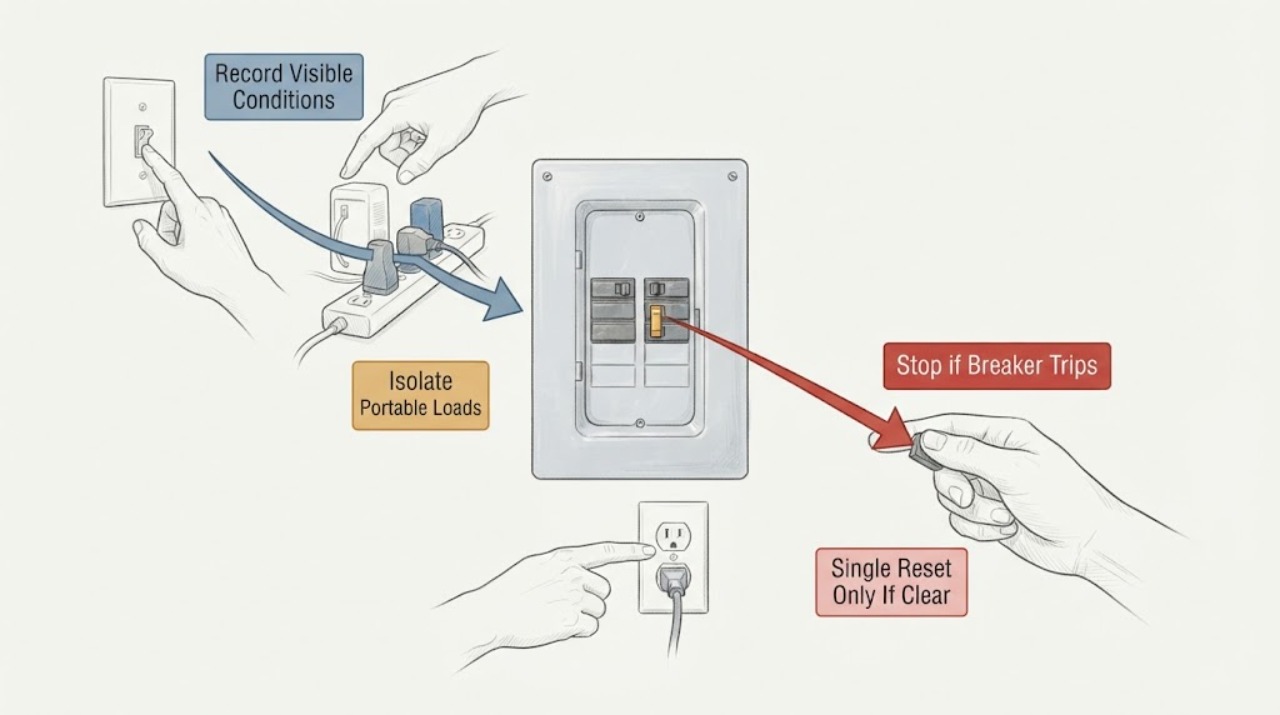
Work through in order
Diagnostic checks
Use only checks that match the exact appliance or system and its official guide.
-
Check 1
From a dry, stable position and without touching damaged equipment, record the breaker or protective device that moved, its room or circuit label, the outlet or switch involved, the load that was connected, the operation in progress, and whether the trip was immediate or delayed.
Expected result: Record one circuit or several circuits, one load or several loads, an outlet or switch operation, and any visible smoke, flash, heat, discoloration, buzzing, odor, moisture, shock, or fire.
Next step: If a hazard is present, move away and follow the relevant emergency boundary. If no hazard is present, keep the circuit off while making the remaining safe observations; do not intentionally recreate the trip.
Stop if: Stop immediately for smoke, flame, an arc or flash, burning odor, hot or discolored electrical parts, buzzing or crackling, a shock, water or dampness near electrical equipment, or a person in danger.
Why this matters
Why: A repeatable pattern can narrow the handoff to a load, outlet, switch, circuit, or broader supply issue, but the observation alone cannot prove which component is faulty. Any heat, odor, arc, shock, moisture, smoke, or fire is a hazard rather than a troubleshooting branch.
-
Check 2
Only from a dry, safe position and only when the plug, cord, appliance, outlet, and floor are cool, dry, intact, and reachable without strain, turn off or unplug portable loads that were connected when the breaker tripped; do not touch a hot, wet, damaged, smoking, or sparking item.
Expected result: Record whether one appliance was the only new load, several loads were operating together, or no portable load explains the trip; note any cord or plug damage visible without handling it.
Next step: Leave the suspected appliance disconnected and do not move it to another outlet as a test. If no load explains the event, leave the circuit off and proceed to an electrician handoff rather than adding or swapping loads.
Stop if: Do not unplug or handle anything that is hot, wet, damaged, arcing, smoking, or in standing water; do not use water on an electrical fire and do not approach a dangerous area.
Why this matters
Why: One appliance or cord associated with the trip should remain disconnected and may require appliance or electrician inspection. Several simultaneous loads make overload plausible, but a persistent trip with loads removed still needs professional diagnosis.
-
Check 3
Only when there is no smoke, odor, heat, arc, moisture, damage, shock, or other hazard and portable loads have been isolated, observe the manufacturer's or panel labeling and make at most one normal breaker reset; do not hold the handle on, bypass protection, or repeatedly reset it.
Expected result: Observe whether power returns and remains stable, or whether the breaker trips immediately or again when no portable load is connected.
Next step: If it trips again, leave it off and contact a qualified electrician. If it remains on, keep the suspected load disconnected and arrange assessment when the pattern is recurrent, unexplained, or associated with an outlet or switch.
Stop if: Do not reset when a hazard is present, do not repeatedly reset, and stop if the handle, panel, outlet, switch, cord, or appliance becomes hot, discolored, noisy, odorous, wet, smoky, or visibly damaged.
Why this matters
Why: A stable reset after an isolated load was removed does not prove the circuit is healthy; an immediate or repeat trip indicates that the protective device is still detecting a condition that needs diagnosis.
-
Check 4
Review the record without reconnecting or retesting the suspect appliance: identify whether its start, heat, motor, charger, or other operation was the only event immediately before the trip, and preserve its make, model, cord condition, and location for the service handoff.
Expected result: Classify the event as one appliance only, multiple simultaneous loads, or no identifiable load; note whether the appliance's plug, cord, or connected outlet had visible heat, damage, odor, or moisture.
Next step: Give the electrician the appliance identity and exact trigger without trying the appliance on another receptacle. Ask for the appliance to be evaluated separately if its cord, plug, or enclosure is damaged.
Stop if: Do not perform a known-good-outlet test, open the appliance, replace a fuse, remove a ground pin, or use an extension cord to continue operating a suspect load.
Why this matters
Why: A single appliance-specific event supports leaving that appliance disconnected for appliance/electrical evaluation. A no-load trip is not evidence that the appliance is safe; it shifts concern toward the circuit, outlet, switch, wiring, or protective device.
-
Check 5
Without removing a cover or touching the device, inspect the affected outlet or switch from ordinary safe access and record whether operation of that point preceded the trip, whether the plate is loose or leaning, and whether there is visible discoloration, cracking, heat, buzzing, crackling, or odor.
Expected result: Classify the point as visually and acoustically normal, or as warm/hot, discolored, loose, buzzing, crackling, odorous, damaged, damp, or associated with a shock.
Next step: Keep the point and circuit out of service and arrange qualified electrician inspection when the outlet or switch is involved or any warning sign exists; provide the observation record and photos taken from a safe distance.
Stop if: Do not touch, tighten, remove, open, probe, spray, or test the outlet, switch, plate, or wiring; stop and leave for a shock, heat, arc, smoke, odor, water, or fire.
Why this matters
Why: A trip tied to one outlet or switch, especially with a warning sign, can indicate a receptacle, switch, connection, or wiring problem. A normal-looking face does not clear concealed wiring or the circuit, because many electrical faults are not visible.
-
Check 6
From safe access, compare the incident record with the labeled circuit and other affected areas without switching additional loads on: note whether the same breaker alone moves, unrelated outlets or lights also lose power, or more than one breaker or circuit trips.
Expected result: Record a single-circuit event, multiple circuits, dimming or flicker elsewhere, or a whole-home or service-level symptom; do not create a load to see whether another circuit trips.
Next step: Leave affected circuits off as needed for safety and give the electrician the circuit map and sequence. If utility or building equipment may be involved, report the pattern to the responsible property or utility contact from a safe location as well as arranging electrical assessment.
Stop if: Do not open the panel, remove dead fronts, inspect service conductors, measure voltage or current, bypass a breaker, or keep operating loads during a multi-circuit event.
Why this matters
Why: A single isolated circuit can still have an overload, fault, outlet, switch, appliance, or wiring issue. Multiple circuits or unexplained whole-home symptoms broaden the concern to the panel, service, shared neutral, or supply and need electrician assessment.
-
Check 7
Prepare a service handoff containing the breaker label or position, room, outlet/switch identity, connected load, operation and timing, number of trips, reset result if any, affected circuits, and safe-distance photos of visible signs; do not make another test.
Expected result: Confirm that the record distinguishes a single load, a particular outlet or switch, one circuit with no load, or multiple circuits, and includes all hazard observations and the time they occurred.
Next step: Keep the suspect circuit, outlet, switch, or appliance out of service until the electrician advises otherwise; escalate to emergency services for active smoke, fire, arcing, or immediate danger.
Stop if: Do not restore service for convenience, repeatedly reset, or attempt panel, outlet, switch, wiring, or appliance repair without appropriate qualification and isolation.
Why this matters
Why: A precise sequence helps a qualified electrician choose a safe diagnostic path while preserving the protective device's evidence. Missing or conflicting labels are themselves useful information and should not be resolved by opening the panel.
Use your observations
Decision map
Find the observation that best matches what you see, then follow the next safe action.
-
PATH 01Safety boundary
What you see
Smoke, flame, an arc or flash, burning odor, hot or discolored panel/outlet/switch, buzzing or crackling, shock, moisture near electrical equipment, or immediate danger is present.
Do this next
Move people away without touching the equipment or using nearby switches. From a safe location contact emergency/fire services for active fire or danger, then use a qualified electrician for the electrical fault once the area is safe.
Why this path and its safety boundary
Why it matters: This is a safety incident, not a load-tracing exercise; the breaker may be preventing a more serious fault from continuing.
Safety stop: Do not approach, reset, unplug, open, test, or extinguish a live electrical fire with water.
-
PATH 02Safety boundary
What you see
One portable appliance or its operation preceded the trip, and the appliance, cord, plug, and outlet have not been declared safe.
Do this next
Leave the appliance disconnected and do not test it on another outlet; provide its identity and event sequence to an electrician or qualified appliance technician.
Why this path and its safety boundary
Why it matters: The appliance or its connection may be contributing, but the trip does not prove the appliance alone is at fault.
Safety stop: Do not reconnect a hot, wet, damaged, sparking, smoking, or odorous appliance or cord.
-
PATH 03Safety boundary
What you see
The trip occurs when a particular outlet or switch is used, or that point is loose, hot, discolored, noisy, odorous, damp, damaged, or associated with a shock.
Do this next
Keep the point and circuit out of service and arrange qualified electrician service, supplying the safe-distance observation record.
Why this path and its safety boundary
Why it matters: The outlet, switch, connection, or wiring is a professional inspection concern even if the face looks normal at another moment.
Safety stop: Do not remove the cover, tighten the device, probe it, or repeatedly operate the switch or outlet.
-
PATH 04Safety boundary
What you see
Portable loads are safely isolated, but the breaker trips again immediately or will not remain reset with no identified load.
Do this next
Leave the breaker off and arrange prompt qualified electrician diagnosis. Do not add a load or use another outlet to compare.
Why this path and its safety boundary
Why it matters: An unresolved circuit, wiring, outlet, switch, protective-device, or connected fixed-load fault remains possible; a reset is not a repair.
Safety stop: Do not hold the breaker on, replace it, bypass protection, open the panel, or attempt measurements.
-
PATH 05Safety boundary
What you see
Unrelated loads, several circuits, flickering or dimming elsewhere, or a whole-home symptom accompanies the trips.
Do this next
Stop operating affected loads, document the sequence from a safe position, and arrange urgent electrician assessment; report a possible supply or building issue through the responsible safe channel.
Why this path and its safety boundary
Why it matters: The pattern is broader than one outlet or portable load and may involve the panel, service, shared wiring, or utility/building supply.
Safety stop: Do not keep restoring circuits, open the service panel, inspect service conductors, or troubleshoot by adding loads.
-
PATH 06Safety boundary
What you see
No hazard is present, portable loads were safely isolated, and one normal reset remains stable without another load being added.
Do this next
Keep the suspected load disconnected, do not deliberately recreate the event, and arrange electrician assessment when the problem repeats or involved an outlet or switch.
Why this path and its safety boundary
Why it matters: Removing a load may have reduced an overload, but a stable reset does not prove the outlet, switch, appliance, or circuit is safe after recurrent trips.
Safety stop: Stop at the next trip or any heat, odor, sound, discoloration, smoke, arc, moisture, or shock; do not reset again.
Helpful context
Understand the symptom
Treat the trip as a protective signal
Breakers interrupt a circuit when current exceeds a safe level, and some protective devices also respond to ground-fault or arc-fault conditions. An overload is one possible explanation, but a damaged appliance, receptacle, switch, cord, connection, or wiring fault can look similar from the user's position. Frequent trips, buzzing, dimming, discoloration, or underpowered appliances are warning signs; the breaker itself does not identify the failed part. Keep the investigation to safe external observations and preserve the circuit state for an electrician.
Separate one load from an outlet or switch problem
The useful distinction is what preceded the trip. If one portable appliance is the only change, leave it disconnected and do not try it on another outlet as a test. If operating a particular switch or using a particular outlet precedes the trip, or that point is warm, loose, noisy, discolored, or smells unusual, treat the point and its wiring as a professional inspection issue. When unrelated loads or more than one circuit are affected, record the pattern without provoking another trip and arrange electrician service.
Make a small, safe handoff record
Write down the breaker label or position, the room and outlet or switch, the connected load, the operation in progress, the time to trip, any lights that dimmed, and whether other circuits were affected. A photo from a safe distance can preserve the breaker position and visible discoloration, but do not open a panel, remove an outlet cover, touch a hot surface, or make electrical measurements. This record helps an electrician distinguish a load-specific symptom from an outlet, switch, circuit, or broader supply problem.
Safety boundary
Stop conditions
- Stop and move away for smoke, flame, an electrical arc or flash, a strong burning odor, a hot or discolored panel/outlet/switch, buzzing or crackling, or immediate fire danger; use emergency or fire services from a safe location.
- Stop for a shock, wet equipment, standing water, dampness at the outlet/switch/panel, damaged insulation, or a hot, smoking, sparking, or damaged plug, cord, or appliance.
- Do not repeatedly reset a breaker, hold it on, replace it with a different rating, bypass protection, or add loads to reproduce the trip.
- Do not open the service panel, remove an outlet or switch cover, touch wiring, probe or measure voltage/current, or attempt an internal repair.
- Do not reconnect a suspect appliance or test it on another outlet; leave it disconnected until a qualified professional determines that it is safe.
- Leave the circuit off and arrange qualified electrician service for an immediate repeat trip, a trip with no identified load, a trip tied to an outlet or switch, or a multi-circuit pattern.
When checks do not resolve it
Need a professional?
Arrange prompt qualified electrician service for repeated trips, an immediate trip after a safe load isolation, a trip linked to an outlet or switch, any hot/loose/discolored/noisy/odorous point, unexplained trips with no load, or symptoms across multiple circuits. Use emergency or fire services from a safe location for active smoke, flame, arcing, a strong burning odor, shock danger, or an unsafe area.
Safety scope: This article supports safe external observation and, only when no hazard exists, isolation of portable loads and one normal reset. It does not authorize opening panels, removing covers, touching wiring, measuring, bypassing protection, reconnecting a suspect load, or repeating a trip.
Common questions
FAQ
Why does a circuit breaker keep tripping?
An overload is one possibility, but a damaged appliance, cord, outlet, switch, connection, wiring fault, arc-fault or ground-fault condition, or broader circuit problem can also be involved. Record what preceded the trip and leave repeated or unexplained trips for a qualified electrician rather than repeatedly resetting.
Can I reset a breaker that just tripped?
Only when there is no smoke, odor, heat, arc, damage, moisture, shock, or other hazard and portable loads have been safely isolated. Follow the panel or manufacturer's instructions for one normal reset; if it trips again, leave it off and arrange electrician diagnosis.
What if the trip happens when I use one outlet or switch?
Keep that outlet or switch and its circuit out of service. From a safe position record whether it is hot, loose, discolored, buzzing, crackling, odorous, damp, damaged, or associated with a shock, but do not remove the cover or test it. Arrange qualified electrician inspection.
What should I do if several circuits trip?
Do not add loads or keep restoring circuits to compare them. Move away from any hot, smoking, arcing, wet, or otherwise dangerous equipment, record the pattern from a safe position, and arrange urgent electrician assessment; use emergency services for active fire or immediate danger.
Read the exact guide
Official sources
- Home Electrical SafetyElectrical Safety Foundation International · General residential electrical-safety guidance; the installed system and local requirements control a specific property.
- Switch to SafetyElectrical Safety Foundation International · General residential switch and outlet safety guidance; it does not diagnose a particular device or circuit.
- Understanding Your Home Electrical SystemElectrical Safety Foundation International · General residential electrical-system guidance; panel labels and qualified professionals control a particular installation.
Community feedback
Share a repair observation
Share a plain-text repair observation. Accepted observations are published automatically; this page may take a moment to update.