
On this page
Start here
Quick answer
A breaker that keeps tripping is protecting against an overload, short circuit, ground fault, arc fault, or a problem with an appliance, cord, outlet, or wiring. First stop using the affected outlet and note whether the trip occurs when one device starts, when several loads run, immediately after reset, or across more than one circuit. If the outlet, plug, cord, or wall plate is hot, discolored, buzzing, smoking, sparking, damp, or smells burnt, leave the circuit off and call a qualified electrician; use fire support for smoke or flame. If everything is cool, dry, intact, and safe to reach, unplug only movable, undamaged loads and record which device was connected. Do not repeatedly reset the breaker, remove an outlet or panel, measure live voltage, increase the breaker rating, or bypass protection.
Before you begin
Safety first
- An electrician can safely distinguish overload, short or ground fault, arc fault, defective appliance, receptacle, wiring, breaker, or upstream supply issue without the user opening panels or bypassing protection.
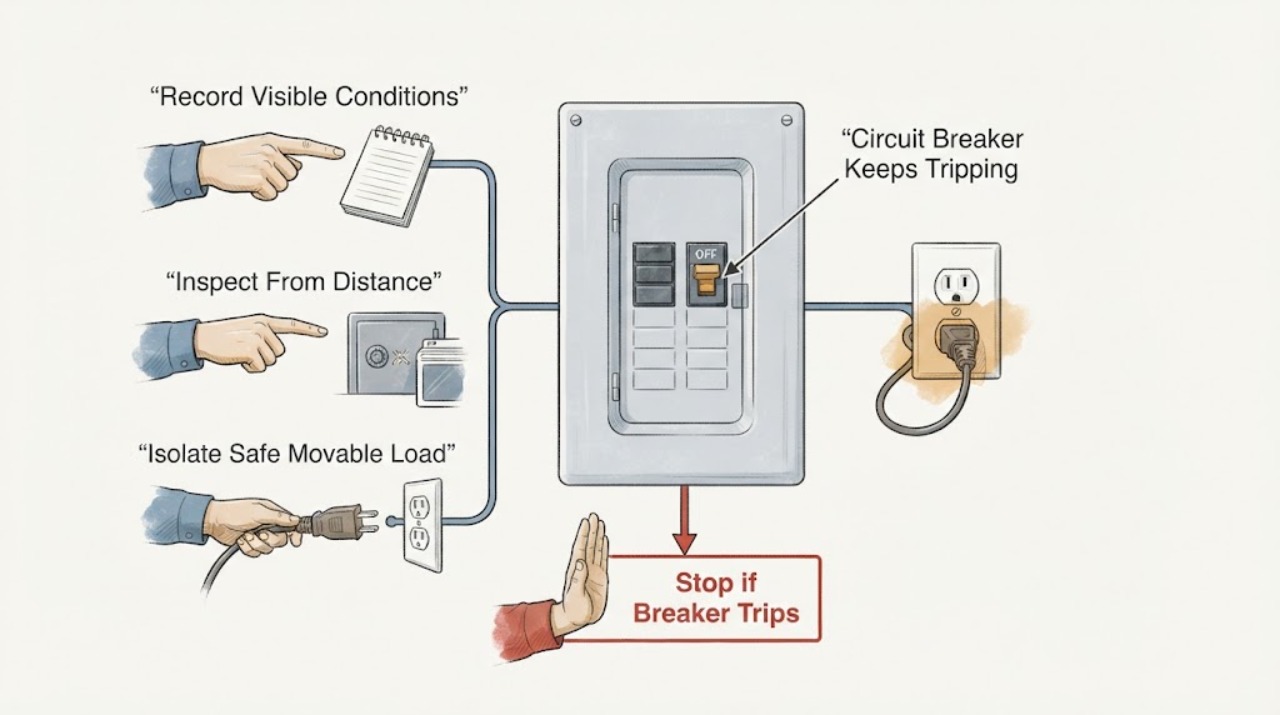
Work through in order
Diagnostic checks
Use only checks that match the exact appliance or system and its official guide.
-
Check 1
From a safe position, record the affected breaker or protective device, the outlet location, the connected loads, and exactly when the trip occurs: when one device starts, when several loads run, immediately after reset, or after a period of operation. Do not reset it just to reproduce the event.
Expected result: The trip may follow one device, combined use, moisture or weather, a particular outlet, or no visible load at all.
Next step: Leave the circuit off for an immediate trip, unknown pattern, or any warning sign. If no hazard is present, continue only with the safe visual check and movable-load isolation.
Why this matters
Why: A device-linked pattern narrows the concern to that device, cord, outlet, or branch circuit. A combined-load pattern suggests overload. An immediate or load-free trip leaves a circuit, outlet, breaker, ground fault, or arc fault that needs professional diagnosis.
-
Check 2
Without touching the outlet or plug, look for a warm or discolored wall plate, melted plastic, scorch marks, a loose-looking receptacle, smoke, moisture, exposed conductors, or a cord that is cracked, pinched, or damaged. Listen from a safe distance for buzzing, sizzling, or repeated clicking.
Expected result: The outlet and cord may look cool and intact, or there may be heat, color change, odor, sound, moisture, smoke, or visible damage.
Next step: If any warning sign is present, keep the breaker off, do not handle the plug, and call a qualified electrician or emergency fire support if smoke or flame is present. Otherwise continue without opening anything.
Why this matters
Why: Heat, discoloration, odor, sound, moisture, or visible damage is a stop signal for a possible connection, overload, ground-fault, or arc-fault hazard. A normal appearance does not clear hidden wiring or a failing device.
-
Check 3
Only when the plug, cord, outlet, and floor are cool, dry, and visibly undamaged, switch off the movable device and unplug it by holding the plug body. Do not unplug anything that is hot, smoking, wet, stuck, sparking, or connected to a damaged outlet; do not move a hard-wired load.
Expected result: The breaker may remain off with the device removed, or the device may be the only load associated with the trip pattern.
Next step: Tag the suspect device out of use and arrange appliance or electrical service. Do not plug it into another outlet as a test, and do not reconnect any load to a warm, damaged, wet, or arcing outlet.
Why this matters
Why: If the fault follows one device or its cord, that equipment may be defective and can present shock or fire risk. If the breaker trips with the device removed, the outlet, circuit, or protective device remains in question.
-
Check 4
Without moving appliances or opening the panel, note which nearby outlets, lights, or equipment are also without power and whether the problem spans one room, a damp area, an outdoor receptacle, or multiple circuits. Record whether a GFCI or AFCI indicator is visible from a dry, safe position, but do not repeatedly press reset.
Expected result: Only one outlet may be affected, several outlets on one branch may be off, or multiple circuits may trip or lose power.
Next step: Keep affected loads off and tell the electrician the exact scope. If the area is wet or an indicator will not reset, do not test it; use the electrical safety branch.
Why this matters
Why: One outlet points toward that receptacle, its connected load, or an upstream connection. A group of outlets points toward a branch or protective device. Multiple circuits or a whole-home symptom requires prompt electrician assessment and may indicate a broader supply or panel concern.
-
Check 5
List every device recently used on the affected circuit, including heating equipment, motors, chargers, power strips, extension cords, and equipment that was moved or exposed to moisture. Note which device was running when the trip occurred and whether any device has a damaged cord or unusual heat.
Expected result: One high-demand or motor load may coincide with the trip, several loads may share the outlet, or no connected device may explain the event.
Next step: Do not use extension cords or power strips to redistribute a suspected fault. Keep any suspect equipment disconnected and provide the list to the electrician.
Why this matters
Why: A combined demand or a defective load can overload or fault a circuit. No obvious load does not make a repeated trip harmless; it raises the priority of an electrician checking the branch, receptacle, protective device, and wiring.
-
Check 6
Do not perform a reset when there is heat, odor, moisture, smoke, arcing, visible damage, a stuck handle, or an unexplained immediate trip. If the circuit is cool, dry, intact, and the breaker has tripped once under a clear temporary overload, follow the local device instructions for one reset only after all movable loads are off and disconnected safely.
Expected result: The breaker may hold with the loads removed, or it may trip again immediately or when a particular load is restored.
Next step: Keep the circuit off after a repeat trip and arrange a qualified electrician. Never increase the breaker rating, bridge the device, or keep resetting it to restore convenience.
Why this matters
Why: A breaker that holds with no loads still needs cautious, limited observation; it does not prove the outlet or wiring is safe. A repeat trip confirms that protection is responding to an unresolved fault or overload.
Use your observations
Decision map
Find the observation that best matches what you see, then follow the next safe action.
-
PATH 01Next step
What you see
The outlet or plate is hot, discolored, loose, melted, smoky, buzzing, sizzling, or smells burnt.
Do this next
Stop using it and keep the breaker off if that can be done from a safe dry location without touching the hazard.
-
PATH 02Next step
What you see
The outlet, plug, appliance, floor, or wall is wet or has been exposed to water.
Do this next
Keep people away and do not touch, unplug, reset, or test the wet equipment.
-
PATH 03Next step
What you see
The trip occurs with one device or follows that device when it is connected, and the outlet and cord show no immediate hazard to touch.
Do this next
Leave the device disconnected and do not move it to another outlet as a test.
-
PATH 04Next step
What you see
The trip occurs only when multiple devices run together and there are no heat, odor, moisture, or damage signs.
Do this next
Keep high-demand devices off the affected outlet and do not use extension cords or power strips to shift the problem.
-
PATH 05Next step
What you see
The breaker trips immediately or continues to trip with all movable loads disconnected.
Do this next
Leave it off and do not attempt further resets, tests, or outlet removal.
-
PATH 06Next step
What you see
More than one circuit trips, multiple rooms lose power, or the symptom is not limited to the outlet branch.
Do this next
Keep affected equipment off and document the scope without opening the panel or testing live parts.
-
PATH 07Next step
What you see
The circuit trips again after one limited, safe reset or the cause cannot be confidently isolated.
Do this next
Leave the breaker off and keep the affected outlet and loads out of use.
Helpful context
Understand the symptom
Treat the pattern of the trip as evidence
The timing is more useful than the fact that the breaker moved. A trip when one appliance starts points toward that appliance, its cord, the outlet, or the circuit. A trip only when several loads run points toward combined demand. A trip immediately after reset, with all movable loads disconnected, leaves a wiring, outlet, breaker, ground-fault, or arc-fault concern. A fault that follows a device to another outlet should not be used as a reason to keep testing it.
The outlet is part of the fault path
An outlet can look ordinary while its plug grip is loose, its plate is warm or discolored, or a connection behind it is damaged. A breaker may trip because of the connected appliance, the receptacle, upstream wiring, or a protective device elsewhere on the circuit. Only an electrician can safely open and test those parts.
Water changes the risk
Outlets in kitchens, bathrooms, garages, laundry areas, and outdoors may have ground-fault protection because water and electricity can meet. Do not test or reset a damp device, wet outlet, or equipment that has been exposed to water. Keep people away and isolate power only from a dry, safe location when that can be done without touching the hazard.
What not to conclude
A breaker reset that holds for a few minutes does not prove the system is safe. A larger breaker is not a repair; it can allow wiring to overheat. A power strip does not create more circuit capacity. A single outlet working after reset does not clear a hot plate, loose plug, or damaged appliance.
Safety boundary
Stop conditions
- Stop immediately for smoke, flame, visible arcing, crackling, a burning smell, a hot or discolored outlet, a melted plate, or a hot plug. Keep away and use fire or electrical emergency support as appropriate.
- Stop immediately when water or dampness reaches the outlet, cord, plug, appliance, floor, wall, or panel area. Do not touch wet electrical equipment or use water on an electrical fire.
- Do not repeatedly reset a breaker, GFCI, or AFCI. Do not install a larger breaker, bridge protection, replace a fuse with a higher rating, or use a power strip to hide an overload.
- Do not remove an outlet plate or panel, test live voltage, probe a receptacle, tighten wiring, or replace a protective device. Electrical parts must be made safe and handled by a qualified professional.
- Do not pull a plug from a hot, wet, smoking, stuck, sparking, or damaged receptacle. Do not bend plug blades or use an appliance with a damaged cord.
- Stop after one safe, documented reset if the fault returns or the cause is unclear. Leave the circuit off until an electrician diagnoses it.
Only after diagnosis
Potential parts
- receptacle outlet
Consider only when a qualified electrician confirms that the receptacle is damaged, worn, or otherwise the source of the trip.
Rating, grounding, weather or damp-location protection, box condition, and local code must be confirmed by the electrician. - circuit breaker or protective device
Consider only after professional testing confirms a failed or unsuitable protective device rather than an overload or downstream fault.
Panel family, voltage, current rating, interrupt rating, AFCI or GFCI function, and local approval are model and installation specific. - appliance power cord
Consider only when the affected appliance cord is visibly damaged and qualified service confirms replacement is appropriate.
Use the appliance maker's approved cord and electrical specification; do not replace a cord near a damaged outlet or wet area.
When checks do not resolve it
Need a professional?
Arrange qualified electrician service for repeated or immediate trips, any outlet warning sign, water exposure, multiple circuits, a suspected branch fault, or any need to open or test electrical equipment.
Safety scope: An electrician can safely distinguish overload, short or ground fault, arc fault, defective appliance, receptacle, wiring, breaker, or upstream supply issue without the user opening panels or bypassing protection.
Have this ready
- Provide the breaker or protective-device label, outlet location, trip timing, devices connected, whether the fault follows one device, nearby outlets or lights affected, and any heat, odor, buzzing, moisture, arcing, cord damage, or prior electrical work.
Common questions
FAQ
Why does the breaker trip when I use one outlet?
The connected appliance or cord, the receptacle, the branch wiring, or the protective device may be involved. Record whether it trips at startup or after running, leave a suspect device disconnected, and have an electrician diagnose the circuit.
Can I keep resetting a breaker that trips?
No. Repeated trips are a warning that an overload or fault remains. If there is heat, odor, moisture, smoke, arcing, damage, or an immediate repeat trip, leave it off and call a qualified electrician.
What if the outlet feels warm but the breaker has not tripped?
Stop using the outlet. A warm or discolored plate, buzzing, sizzling, or burning odor can indicate a fire hazard even before the breaker moves. Do not remove the plate; arrange prompt electrician service.
Is it safe to plug the suspect appliance into another outlet?
No. If one appliance or cord is associated with the trip, keep it disconnected and have it checked. Moving it to another outlet can spread the hazard and does not identify whether the device or the original circuit is at fault.
Does a larger breaker fix a circuit that keeps tripping?
No. A larger protective rating can allow wiring to overheat and is not a repair. A qualified electrician must identify the load, wiring, outlet, protective device, or appliance fault.
Read the exact guide
Official sources
- Appliance and Electrical Fire SafetyU.S. Fire Administration · Residential appliance, cord, outlet, overload, and electrical fire prevention guidance
- Don’t Overload Your HomeElectrical Safety Foundation International · Electrical safety organization guidance on overload signs, warm plates, buzzing, burning odor, and qualified inspection
- 1910.333 - Selection and use of work practicesOccupational Safety and Health Administration · Electrical work practices near energized or deenergized parts and deenergizing requirements
- CPSC Guide to Home Wiring HazardsU.S. Consumer Product Safety Commission · Home receptacle, breaker, plug, cord, heat, shock, and arcing hazard guidance
Community feedback
Share a repair observation
Share a plain-text repair observation. Accepted observations are published automatically; this page may take a moment to update.