
On this page
Start here
Quick answer
A Feit LED fixture that buzzes near its driver may be reacting to an incompatible dimmer, loose installation or wiring, or a failing driver or fixture. First observe whether the sound changes with dimming, starts with power, comes from the wall control, or is accompanied by flicker, heat, odor, or visible damage. If there is smoke, sparking, a burning smell, abnormal heat, water, or a loose ceiling fixture, turn it off if safe, keep clear, and arrange qualified electrical service. Do not open the driver, touch wiring, replace components while energized, or assume a generic LED dimmer is compatible; use the exact Feit model and compatibility guidance.
Before you begin
Safety first
- Owner checks are limited to safe observation, reading visible item information, and documenting control behavior. A licensed electrician must isolate and verify the circuit before inspecting wiring, grounding, junction boxes, drivers, mounting, or controls and must handle any repair or replacement.
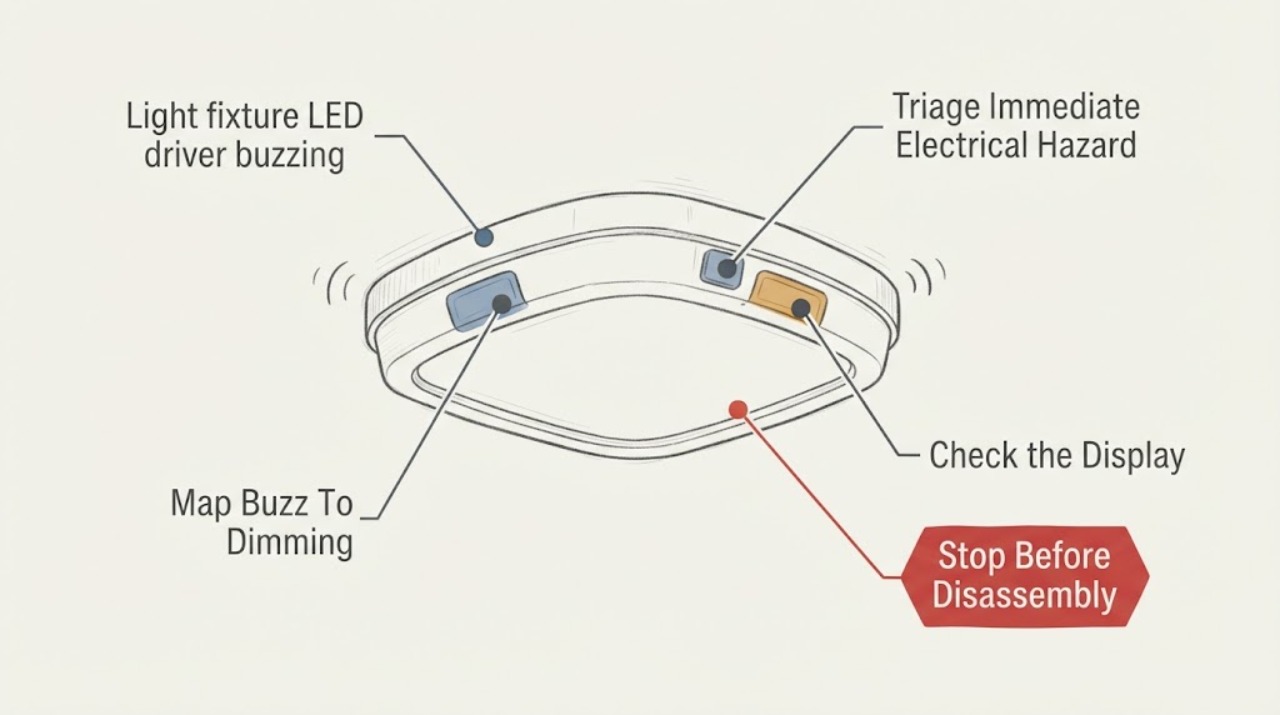
Work through in order
Diagnostic checks
Use only checks that match the exact appliance or system and its official guide.
-
Check 1
From the floor and without touching the fixture, look for smoke, sparks, crackling, a burning or electrical smell, visible arcing, a hot or discolored trim or driver area, water, exposed conductors, or a fixture that is loose or pulling away from the ceiling.
Expected result: The fixture is cool and stable with only a buzz; or there is odor, smoke, sparking, heat, discoloration, water, exposed wiring, or movement.
Next step: If smoke, fire, or active arcing is present, leave and contact emergency help from a safe location. Otherwise turn the light off at its normal switch if safe, keep people away, and arrange qualified electrical service; do not touch or restart it.
Stop if: Stop immediately for smoke, fire, sparks, crackling, burning smell, abnormal heat, water near electrical parts, exposed wiring, or a loose ceiling fixture.
Why this matters
Why: A sound without a safety symptom can be diagnosed cautiously. Heat, arcing, damage, water, or structural looseness changes the situation to an immediate fire, shock, or falling-fixture risk.
-
Check 2
From a safe position, note whether the buzz occurs at full brightness, only while dimming, at a low setting, when another load on the circuit starts, or whenever the switch supplies power. Observe whether the light flickers, drops out, changes color, or stays steady; do not repeatedly cycle a noisy or hot fixture.
Expected result: The buzz follows the dimmer position; starts with power even at full brightness; changes with other circuit loads; occurs with flicker or drop-out; or is steady and independent of dimming.
Next step: Record the pattern and stop testing if it worsens. Use the control-compatibility branch for dimming-related noise and the service branch for power-independent, flickering, hot, or persistent buzzing.
Stop if: Stop if the light flashes violently, goes out with a pop, the switch or fixture becomes warm, or reproduction requires touching the wall plate, fixture, or wiring.
Why this matters
Why: A dimming-dependent pattern makes driver-dimmer compatibility or minimum-load behavior more likely. A power-dependent or load-dependent pattern can involve wiring, grounding, the switch, or the driver. A steady buzz still does not prove that the driver alone is defective.
-
Check 3
Read the Feit item number from a safely visible label, package, paperwork, or manual, and identify the wall control as an on-off switch, LED-rated dimmer, smart control, motion sensor, or unknown type. Confirm from Feit's item-specific instructions whether the fixture is dimmable and which controls are listed; do not infer this from the word LED alone.
Expected result: The fixture is not listed as dimmable; the dimmer is incandescent-only or unlisted; the control was recently changed; the exact item number is unclear; or the fixture and control are documented as compatible.
Next step: If the fixture is not dimmable or compatibility is unconfirmed, stop using the dimming function and have a qualified electrician verify the control. Use Feit's manuals and compatibility information for the exact item; do not install a substitute based on appearance.
Stop if: Stop if identifying the item requires removing trim, opening a junction box, handling wires, or climbing unsafely, or if the control is warm, scorched, loose, or damaged.
Why this matters
Why: An LED fixture and dimmer can be individually functional yet buzz together when the load and control are not compatible. An unknown item number or control prevents a reliable fit decision and makes random replacement unsafe.
-
Check 4
With the light off and viewed from the floor, inspect whether the fixture or trim rattles, vibrates, sits unevenly, contacts the ceiling, or has a loose diffuser or visible mounting hardware. Do not support the fixture, remove the diffuser, or reach overhead unless the exact manual expressly permits a safe external check and power is isolated by a qualified person.
Expected result: The trim, diffuser, or fixture visibly vibrates or is loose; the fixture is uneven or damaged; or the exterior appears stable and the buzz seems internal.
Next step: Keep a loose or damaged fixture off and arrange service to secure or inspect it. If the exterior is stable, continue with documented control review rather than opening the fixture or tightening unknown hardware live.
Stop if: Stop for a cracked diffuser, fixture movement, missing hardware, visible gap at the ceiling, or any need to climb, hold the fixture, remove a cover, or touch wiring.
Why this matters
Why: A loose installation or rattling cover can transmit or amplify a driver sound. A stable exterior makes control, grounding, wiring, or internal driver noise more likely, but it cannot be safely distinguished by tapping the fixture.
-
Check 5
If an electrician is performing the inspection, require the fixture circuit to be isolated at the breaker and verified de-energized before any junction-box, driver, ground, wire-connector, or mounting inspection. As the owner, do not open the fixture or use a switch position as proof that hardwired conductors are safe.
Expected result: The circuit cannot be isolated or verified; the fixture is hardwired; wires are pinched or loose; grounding is uncertain; or a qualified inspection finds no visible connection issue.
Next step: If isolation or verification is uncertain, stop and call a licensed electrician. Do not repair, reterminate, bypass, or replace the driver yourself; have the technician match any remedy to the exact Feit item and installation.
Stop if: Stop if the breaker is unlabeled, the circuit is shared or unknown, a voltage check is needed, insulation is damaged, or inspection requires panel, junction-box, driver, or wiring access by an unqualified owner.
Why this matters
Why: A hardwired LED driver and its connections can remain hazardous even when the wall switch is off. Loose or pinched wiring and grounding issues can create buzzing or unstable operation, while a clear connection check shifts suspicion toward the driver or control.
-
Check 6
Prepare a service record with the Feit item number, fixture type, dimmable status, control brand and model if visible, when the buzz occurs, flicker or drop-out behavior, recent installation or switch work, visible looseness, heat or odor, and any breaker or circuit information that is safely known.
Expected result: The buzz stops with a documented compatible control; it remains at full brightness; it follows a dimmer or circuit load; it comes from a loose trim; or the cause remains uncertain.
Next step: Keep the fixture off for persistent or unsafe buzzing and arrange a licensed electrician or qualified lighting technician. Provide the exact item information so a driver or complete fixture is not selected by appearance alone.
Stop if: End owner troubleshooting when diagnosis requires energized measurements, junction-box or fixture access, driver testing, wiring, grounding, dimmer replacement, or component replacement.
Why this matters
Why: A control-specific change supports a compatibility issue but does not authorize an owner rewiring. Persistent full-power buzzing, internal sound, heat, flicker, or uncertain origin requires diagnosis of the driver, connections, grounding, or fixture.
Use your observations
Decision map
Find the observation that best matches what you see, then follow the next safe action.
-
PATH 01Next step
What you see
The buzz appears or becomes louder only when the light is dimmed, or flicker and drop-out happen at certain dimmer positions.
Do this next
Stop using the dimming function and verify the exact Feit item and tested control compatibility with a qualified electrician. Do not install a random LED dimmer or alter wiring.
Why this path and its safety boundary
Why it matters: A mismatch between the LED driver and dimmer method, rating, minimum load, or fixture dimmability is more likely than a loose trim alone.
-
PATH 02Next step
What you see
The buzz is present at full brightness and does not materially change with dimmer position, especially if the fixture is stable.
Do this next
Keep the light off if the buzz is persistent or worsening and have a licensed electrician inspect the de-energized fixture and connections. Do not open the driver or continue operating it to test duration.
Why this path and its safety boundary
Why it matters: Loose wiring, grounding, a resonating enclosure, a defective installation, or an internal driver fault is more likely; compatibility alone is not established.
-
PATH 03Next step
What you see
The fixture, trim, diffuser, or mounting point visibly rattles, vibrates, sits unevenly, or is pulling away from the ceiling.
Do this next
Turn the light off, keep people clear, and arrange qualified service to secure and inspect the mounting. Do not climb, support the fixture, or tighten unknown hardware while energized.
Why this path and its safety boundary
Why it matters: Mechanical looseness or an installation issue may be amplifying the driver noise and can create a falling-fixture hazard.
-
PATH 04Next step
What you see
Buzzing is accompanied by flicker, drop-out, visible arcing, heat, discoloration, a burning smell, smoke, or a damaged cord or housing.
Do this next
Stop using the fixture and keep clear. Leave for smoke, fire, or active arcing and contact emergency help; otherwise arrange prompt licensed electrical service without restarting the light.
Why this path and its safety boundary
Why it matters: The condition may involve overheating, loose or faulty wiring, grounding, the driver, or another electrical fault and is not a routine dimmer adjustment.
-
PATH 05Next step
What you see
The fixture and control are documented as compatible, the exterior is stable, and the buzz remains at normal operation without an obvious external cause.
Do this next
Keep the light off and have a qualified electrician or lighting technician test the de-energized fixture and select any replacement against the exact Feit item. Do not open or bypass the driver.
Why this path and its safety boundary
Why it matters: An internal driver, connection, grounding, or fixture fault is more likely and cannot be safely confirmed by owner observation.
Helpful context
Understand the symptom
The sound may be caused by the control, not only the LED driver
A buzz that changes as brightness changes points toward the interaction between the LED driver and wall dimmer. A buzz that begins at full power, stays the same at every setting, or comes from the fixture itself can also involve loose mounting, wiring, grounding, or an internal driver fault. Feit treats dimmer compatibility as a model- and load-specific question, so a generic replacement is not a diagnosis.
Use the exact Feit manual before touching a hardwired fixture
Feit provides manuals and wiring information by item number, and its setup guidance states that hardwired fixture work requires basic electrical knowledge or a licensed electrician. The driver may be inside the fixture or in a junction-box area, and access differs by model. Keep owner checks to external observation and model-approved settings unless a qualified person isolates and inspects the circuit.
Do not treat buzzing as a harmless way to test a driver
A buzzing driver can be a nuisance, but buzzing with heat, flicker, odor, sparks, or damaged insulation can signal an unsafe electrical condition. Do not bypass a dimmer, open the driver enclosure, swap wiring, or keep cycling a fixture that is hot or unstable. A licensed electrician can isolate the circuit and determine whether the control, connections, driver, or fixture needs attention.
Safety boundary
Stop conditions
- Stop and leave the area for smoke, fire, active sparking, crackling, or a strong burning or electrical smell; contact emergency help from a safe location.
- Turn the fixture off and keep clear for abnormal heat, discoloration, a loose or falling fixture, exposed conductors, water, a damaged cord, or a cracked housing or diffuser.
- Do not open the LED driver, fixture, junction box, wall switch, or panel; do not probe energized wires, bypass a driver or control, or reterminate connections as an owner test.
- Do not install a dimmer or driver based on appearance or the word LED alone. Verify the exact Feit item, dimmability, control method, and fit with the manual and a qualified professional.
- Call a licensed electrician or qualified lighting technician for persistent buzzing, full-power buzzing, flicker or drop-out, uncertain grounding, loose wiring, or any diagnosis requiring driver, fixture, control, mounting, or energized-circuit work.
Only after diagnosis
Potential parts
- Feit LED driver
Consider this only when a qualified technician confirms the driver is defective after checking control compatibility, wiring, grounding, mounting, and the LED load.
Verify exact Feit item, output characteristics, electrical ratings, connectors, enclosure, and manufacturer fit information; do not substitute a driver by voltage or appearance alone. - LED-compatible dimmer or wall control
Consider this only if the fixture is documented as dimmable and a technician confirms the existing control is incompatible or faulty.
Confirm exact fixture, dimmer method, minimum and maximum LED load, control wiring, and tested compatibility; an LED label alone does not prove a match. - Feit integrated LED fixture or LED light board
Consider this only when the model is not serviceable at driver level or a technician confirms the LED board or complete fixture has failed.
Verify exact item, dimensions, mounting, light output, driver arrangement, and installation rating; do not unmount or rewire a ceiling fixture as an experiment. - fixture wiring connector or mounting hardware
Consider this only when a qualified electrician finds a damaged connector, pinched conductor, or model-specific mounting component causing noise or instability.
Confirm exact fixture, conductor requirements, grounding, box support, hardware, and electrical code requirements; loose or generic hardware may not be safe.
When checks do not resolve it
Need a professional?
Call a licensed electrician or qualified lighting technician when a Feit LED driver buzzes at full power, persists with a documented compatible control, follows flicker or drop-out, or requires fixture, junction-box, grounding, driver, dimmer, or wiring access. Treat smoke, sparks, burning smell, abnormal heat, water, exposed conductors, and a loose fixture as urgent hazards; leave for fire or active arcing and contact emergency help.
Safety scope: Owner checks are limited to safe observation, reading visible item information, and documenting control behavior. A licensed electrician must isolate and verify the circuit before inspecting wiring, grounding, junction boxes, drivers, mounting, or controls and must handle any repair or replacement.
Common questions
FAQ
Why is my Feit LED fixture buzzing?
An incompatible dimmer, loose installation or wiring, grounding, enclosure resonance, or a failing driver can produce buzzing. Note whether it changes with dimming and stop for heat, odor, sparks, smoke, or visible damage.
Can a dimmer make an LED driver buzz?
Yes. Feit says a dimmer and LED driver must be compatible; mismatch can cause buzzing, flicker, drop-out, or limited dimming. Confirm the exact item and tested control instead of installing a random LED dimmer.
Is a buzzing LED driver dangerous?
Buzzing alone does not identify the risk, but buzzing with heat, burning smell, flicker, smoke, sparks, crackling, or damage is an electrical and fire concern. Turn it off if safe and arrange qualified service.
Why does the light buzz only when dimmed?
That pattern makes driver-dimmer compatibility, dimming method, or load-range mismatch more likely. Stop using the dimming function and have a qualified electrician verify the fixture's dimmability and control.
What if the Feit fixture buzzes at full brightness too?
A full-power buzz can involve loose mounting, wiring, grounding, enclosure resonance, or the driver itself. Keep it off if persistent or worsening and have the de-energized fixture inspected; do not open the driver.
Can loose wiring cause a Feit fixture to buzz?
Feit troubleshooting identifies loose wiring or poor installation as possible causes of unstable LED operation and noise. Wiring and grounding checks are electrical work; do not open the junction box unless handled by a licensed electrician.
Can I replace the LED driver myself?
Do not replace a hardwired driver as a first step. The exact output, connectors, enclosure, LED load, and installation must match, and the circuit must be safely isolated. A qualified technician should diagnose and select the part.
How do I find the right Feit manual for a buzzing fixture?
Use the safely visible Feit item number from the label, packaging, or paperwork in Feit's manuals and downloads area. Do not unmount the fixture or remove trim just to find the number.
Should I keep using a quiet buzzing light fixture?
Do not rely on volume alone. A new or persistent buzz, especially with flicker, heat, odor, or dimmer use, should be left off until the control and fixture are checked.
When should an electrician inspect my Feit light?
Call when the buzz persists at full power, follows dimming, comes with flicker or drop-out, or requires driver, wiring, grounding, fixture, or control access. Treat smoke, sparks, burning smell, abnormal heat, and a loose fixture as urgent.
Read the exact guide
Official sources
- LED Dimmer Compatibility - Dimmable Bulbs & Switch GuideFeit Electric · Feit guidance that LED-driver and dimmer compatibility can affect buzzing, flickering, drop-out, and dimming range; check the exact item and control.
- Why Isn’t My Vista 1x2 Flat Panel LED Skylight Not Working Properly?Feit Electric Help Center · Feit model-specific support example identifying incompatible dimmers, poor grounding, and installation conditions as possible causes; exact fixture manual controls applicability.
- Why Isn't My Vista 6" x 4' Flat Panel LED Skylight Not Working Correctly?Feit Electric Help Center · Feit model-specific troubleshooting connecting excess heat or buzzing with installation or dimmer conditions and advising compatible controls; exact item manual controls the repair.
- How Do I Set Up My Vista 1x2 Flat Panel LED Skylight?Feit Electric Help Center · Feit model-specific setup example supporting breaker-off electrical work, secure mounting, and compatible controls; exact fixture instructions control applicability.
- What Dimmers are Compatible with Feit Electric Dimmable Lights?Feit Electric Help Center · Feit guidance to confirm a dimmable product and use tested compatibility information; does not establish compatibility for an unspecified fixture.
- Indoor Light Fixture Manuals, Wiring Diagrams & DownloadsFeit Electric · Official Feit resource for locating the exact fixture manual by item number or SKU before installation, control, or repair decisions.
Community feedback
Share a repair observation
Share a plain-text repair observation. Accepted observations are published automatically; this page may take a moment to update.