
On this page
Start here
Quick answer
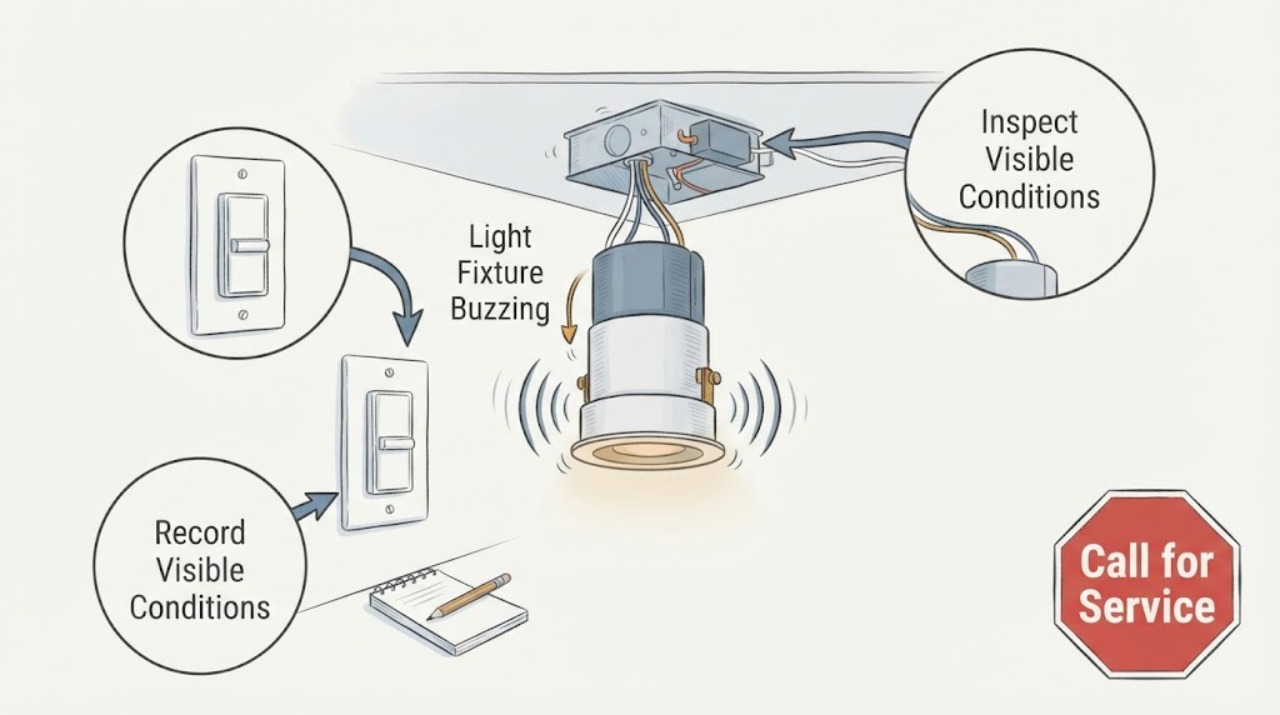
A light fixture buzz that changes as you move the dimmer is often a lamp-and-dimmer compatibility problem, especially with LED drivers, but it can also involve a vibrating fixture, an unsuitable load, or an electrical connection. First record whether the buzz is only at the low end, present across the range, or loudest at the wall control or fixture, then check the lamp and dimmer model markings and compatibility instructions without opening anything. A lamp marked non-dimmable should not be used with a dimmer. A model-specific low-end adjustment may help a compatible LED that buzzes only near minimum brightness, but persistent buzzing, buzzing at full output, or a hot, loose, discolored, odorous, crackling, sparking, wet, or shock-producing installation requires qualified electrical inspection. Do not remove the wall plate, open the fixture, touch wiring, or repeatedly move the dimmer to reproduce the noise.
Before you begin
Safety first
- Homeowner checks are limited to normal control operation, labels, visible exterior conditions, and sound notes from a safe position. Electrical access, rewiring, energized testing, and internal lamp, driver, dimmer, or fixture diagnosis require qualified personnel.
Work through in order
Diagnostic checks
Use only checks that match the exact appliance or system and its official guide.
-
Check 1
From a safe position, turn the light on at its normal control and listen briefly without touching the fixture, lamp, wall plate, or wiring. Move the dimmer only through ordinary use long enough to note whether the buzz is absent at full output, limited to the lowest setting, present throughout the range, or strongest at one control position.
Expected result: Record where the sound seems loudest, whether it follows the dimmer position immediately, whether it continues when the dimmer is not moving, and whether one lamp or the whole fixture buzzes.
Next step: Use the pattern to choose the compatibility or safety branch. Do not hold the dimmer at the noisiest point, cycle it repeatedly, or use the sound level as proof that a control is safe.
Why this matters
Why: A low-end-only buzz is consistent with a minimum-level or driver-range interaction; a full-range buzz is more consistent with a broad incompatibility or a fixture or control issue. A sound that persists at one location regardless of setting needs a different inspection path than a sound that follows the dimming curve.
-
Check 2
Turn the light off, allow it to cool, and read the lamp packaging, lamp body, or integrated fixture instructions. Look for a clear dimmable marking, a non-dimmable warning, the exact lamp or fixture model, and any stated control requirements; do not remove an integrated fixture cover to find a hidden driver label.
Expected result: Record an explicit non-dimmable marking, an explicit dimmable marking, or no clear marking or model information.
Next step: If the lamp is non-dimmable, leave the dimmer off and use a lamp and control arrangement approved by the relevant instructions or a qualified electrician. If it is dimmable or unidentified, record the model and continue without opening the fixture.
Why this matters
Why: A non-dimmable lamp is not intended for dimmer control and can buzz or flicker. A dimmable marking means the lamp was designed for dimming but does not prove compatibility with this dimmer. Missing identity prevents a reliable compatibility decision.
-
Check 3
From outside the wall box, read the dimmer brand, model, and visible LED or load marking. Count the lamps controlled and record each lamp's stated load or the integrated fixture model; compare these details with the manufacturer's compatibility guidance without removing the wall plate.
Expected result: Note whether the dimmer is documented for LED loads, the exact lamp-and-dimmer pair appears on a compatibility list, the load falls within the stated range, or the needed information is unavailable.
Next step: For an unlisted or out-of-range combination, stop trying random settings and obtain a compatible product recommendation. If the pair is documented yet buzzes, use the service branch rather than opening the control or fixture.
Why this matters
Why: A dimmer intended for another load type, an unlisted pair, or a load outside the documented range can produce buzzing, poor dimming, or early shutoff. A listed pair lowers the likelihood of a simple mismatch but does not rule out a loose connection or failing component.
-
Check 4
Without touching the installation, visually check the fixture and dimmer face for heat damage, discoloration, melting, a loose control, moisture, or a gap. Note any burning odor, crackling, sparking, shock, or breaker trip, and note whether other lights change when an appliance starts.
Expected result: Record a cool, dry, quiet, normal-looking exterior with no odor or a warning sign at the fixture, control, or wider circuit.
Next step: If any warning sign is present, stop using the light and arrange prompt qualified electrical inspection. If no warning sign is visible, keep the exact model and timing record and do not access energized parts.
Why this matters
Why: A clean, isolated buzz that follows the dimmer remains a compatibility question. Heat, damage, odor, sound from the wall control, shocks, trips, or load-linked changes raise concern for wiring, overload, or equipment failure beyond the lamp choice.
-
Check 5
If the lamp is clearly dimmable, the installation has no warning signs, and the buzz occurs only in a narrow low or high part of the range, check the exact dimmer instructions for a user-accessible range adjustment. Use only the procedure for that model and do not remove covers, change wiring, or apply a generic setting.
Expected result: After the permitted adjustment, record whether the light remains stable and quiet across its usable range, whether the buzz is unchanged, or whether flicker, drop-out, heat, or another warning appears.
Next step: Stop adjusting and request product support or an electrician when the model instructions do not provide an adjustment, the buzz persists, or the fixture is integrated and its driver cannot be identified externally.
Why this matters
Why: A quiet result only in the documented range supports a dimming-range interaction, not proof that every lamp or setting is compatible. An unchanged or worsening buzz, buzzing at full output, or any new warning means the cause remains unresolved.
-
Check 6
Prepare a service handoff with the lamp or fixture model, dimmer model, dimmable marking, lamp count and stated load, exact dimmer position when buzzing occurs, apparent sound location, recent replacement or installation work, and every visible or audible warning sign.
Expected result: A time-linked record distinguishes non-dimmable use, an untested lamp-control pair, low-end-only noise, a fixture vibration, and a broader electrical pattern.
Next step: Provide the record and photographs of visible labels without opening the wall box or fixture. Leave the light off if the buzzing is persistent or the cause remains uncertain.
Why this matters
Why: The record gives the electrician or manufacturer enough information to investigate compatibility, the fixture, the dimmer, and the circuit without requiring unsafe homeowner testing.
Use your observations
Decision map
Find the observation that best matches what you see, then follow the next safe action.
-
PATH 01Next step
What you see
The lamp is explicitly marked non-dimmable and the buzz follows the dimmer position, with no heat, damage, odor, or circuit warning.
Do this next
Arrange qualified service and follow the exact model guidance.
Why this path and its safety boundary
Why it matters: Treat the lamp-control mismatch as the leading explanation. Leave the dimmer off and use a confirmed compatible dimmable lamp or an electrician-approved on/off arrangement; do not keep dimming the lamp to test it.
-
PATH 02Next step
What you see
The lamp is dimmable, but the dimmer is not documented for LED loads, the pair is not listed, or the load is outside the documented range.
Do this next
Arrange qualified service and follow the exact model guidance.
Why this path and its safety boundary
Why it matters: A compatibility or load mismatch is more likely than a confirmed fixture failure. Obtain a tested combination or professional recommendation; do not open or rewire the dimmer.
-
PATH 03Next step
What you see
The lamp and dimmer are documented as compatible, but buzzing is limited to the lowest or highest part of the control range and the installation is otherwise cool and undamaged.
Do this next
Arrange qualified service and follow the exact model guidance.
Why this path and its safety boundary
Why it matters: A range interaction remains possible. Follow only the exact model instructions for a permitted range adjustment; if there is no adjustment or the buzz remains, request product support or qualified electrical diagnosis.
-
PATH 04Next step
What you see
Buzzing is present throughout the range, is loudest at the wall control or fixture, continues at full output, or began after installation or wiring work.
Do this next
Arrange qualified service and follow the exact model guidance.
Why this path and its safety boundary
Why it matters: A broad incompatibility, fixture vibration, loose connection, failing dimmer, or circuit issue is possible. Stop using the control and arrange an electrician inspection rather than replacing parts at random.
-
PATH 05Next step
What you see
The dimmer or fixture is hot, discolored, melting, wet, burning-smelling, crackling, sparking, shocking, or associated with a breaker trip or load-linked light change.
Do this next
Arrange qualified service and follow the exact model guidance.
Why this path and its safety boundary
Why it matters: Stop immediately and keep clear. If power can be isolated from a safe, undamaged, dry location, use the clearly labeled disconnect; otherwise leave the area and obtain urgent qualified electrical help. Do not reset and retest.
Helpful context
Understand the symptom
A dimmer-linked buzz is a clue, not a diagnosis
When the sound rises or falls with the dimmer position, the lamp driver and the control are interacting across the dimming range. An LED that is not designed for dimming can buzz, and even a dimmable LED can perform poorly with an incompatible control or outside its documented range. The sound may come from the lamp, fixture, dimmer, or nearby wiring, so its location and range matter more than naming a failed part from the room.
Low-end and full-range buzzing lead to different next steps
A buzz heard only near the lowest setting can indicate that the lamp is being driven below the range in which its driver remains quiet and stable. A buzz throughout the range or at full output makes a broader lamp-control mismatch, load issue, fixture vibration, or electrical fault more concerning. A quiet-looking switch does not prove that internal connections are sound, and changing a setting is not a substitute for compatibility information.
Stop when the sound comes with electrical warning signs
Buzzing together with a hot or discolored wall control, burning smell, crackling, sparks, moisture, a loose control, a shock, or a breaker trip is not a lamp-tuning problem. Keep the light off and arrange qualified electrical help. The safe homeowner contribution is a non-contact record of labels, timing, sound location, and visible conditions.
Safety boundary
Stop conditions
- Stop immediately for heat, melting, discoloration, smoke, burning odor, crackling, sparks, moisture near electrical parts, a shock, or a breaker that trips.
- Do not remove the wall plate or fixture cover, touch socket or driver parts, move wiring, measure energized conductors, bypass a protective device, or repeatedly move the dimmer to reproduce buzzing.
- Leave the light off and arrange qualified electrical help when buzzing persists with a confirmed compatible combination, occurs at full output, comes from the wall control, follows recent wiring work, or affects more than one light.
Only after diagnosis
Potential parts
- dimmable LED lamp
Consider this only when the current lamp is non-dimmable or the exact compatibility check identifies the lamp as the mismatch, with no electrical warning signs.
Match the socket or integrated-fixture requirements, enclosure and environment ratings, lamp form, and exact dimmer compatibility information before installation. - LED-compatible dimmer
Consider this only when the lamp is confirmed dimmable and qualified diagnosis or manufacturer information identifies the existing control as unsuitable.
Confirm the wiring arrangement, load type and range, fixture requirements, and local installation rules with the product instructions or a qualified electrician.
When checks do not resolve it
Need a professional?
Safety scope: Homeowner checks are limited to normal control operation, labels, visible exterior conditions, and sound notes from a safe position. Electrical access, rewiring, energized testing, and internal lamp, driver, dimmer, or fixture diagnosis require qualified personnel.
Common questions
FAQ
Why does the light fixture buzz only when I dim it?
The LED driver and dimmer may not be a compatible pair, or the lamp may become unstable at part of the dimming range. Check the lamp and dimmer markings and compatibility instructions before considering a replacement.
Is a buzzing LED lamp always dangerous?
No, but buzzing is not a reason to ignore the installation. A clean, low-end-only buzz may be a compatibility issue; heat, discoloration, odor, crackling, sparks, moisture, shock, or a breaker trip requires stopping use and qualified inspection.
Can I adjust the dimmer to stop the buzz?
Only if the exact dimmer instructions provide a user-accessible range adjustment and the installation has no warning signs. Do not remove a wall plate or use a generic setting; persistent or full-range buzzing needs product support or an electrician.
What if the LED lamp says dimmable but still buzzes?
Dimmable does not mean compatible with every dimmer. Check the exact lamp and control models, the LED load range, and whether the pair is documented. If the pair is confirmed and still buzzes, stop experimenting and arrange diagnosis.
Should I replace the dimmer or the fixture first?
Neither should be replaced at random. Identify the lamp and dimmer models, check compatibility, and have an electrician inspect persistent, full-range, wall-control, or hazard-linked buzzing before selecting a part.
Read the exact guide
Official sources
- Why Does My LED Bulb Flicker or Turn Off When Dimming?Leviton · LED and dimmer compatibility, low-end flicker, wiring and load clues, and model-specific dimming-range adjustments
- Can LED bulbs be dimmed?Philips Hue · Dimmable markings, non-dimmable LED behavior with dimmers, dimmer compatibility, and low-brightness limitations
- Flicker BasicsU.S. Department of Energy · LED driver behavior, dimmer-delivered electrical waveforms, and why LED output can respond rapidly to driver changes
- Electrical Safety DosElectrical Safety Foundation International · Buzzing, heat, discoloration, odor, flicker, and other electrical warning signs requiring qualified inspection
Community feedback
Share a repair observation
Share a plain-text repair observation. Accepted observations are published automatically; this page may take a moment to update.