
On this page
Start here
Quick answer
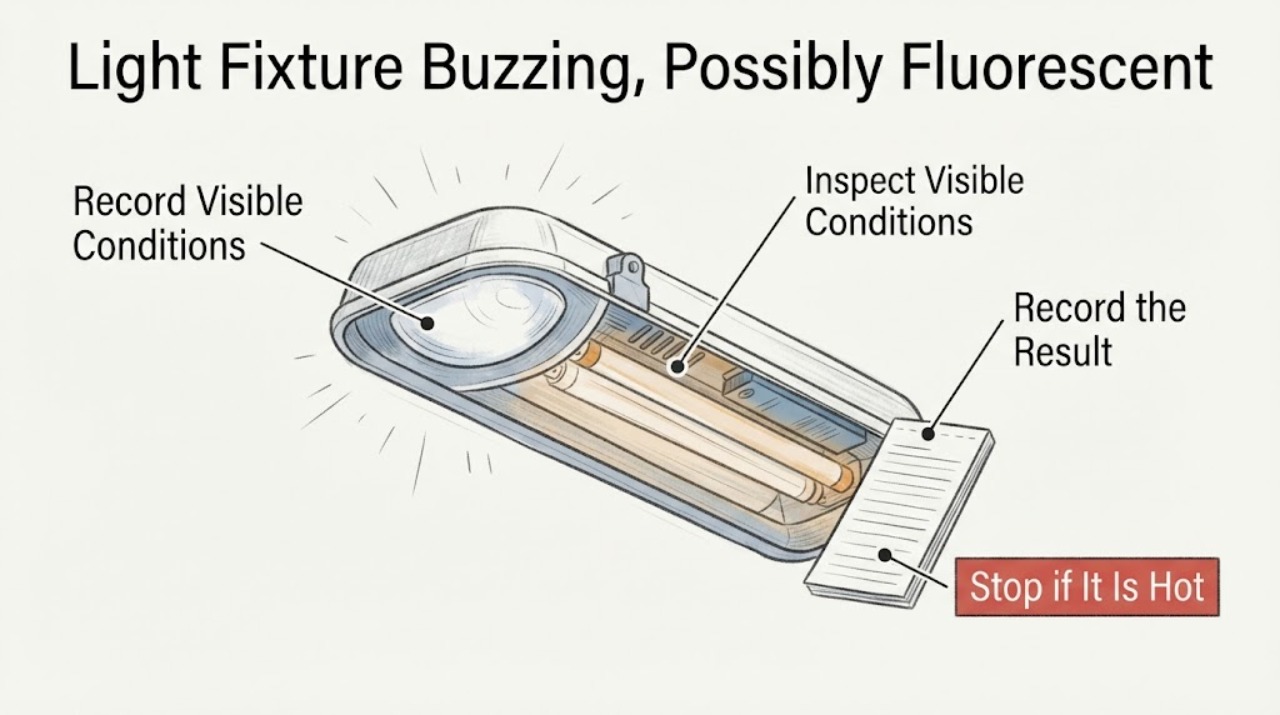
First identify whether the sound comes from a fluorescent tube fixture, an LED lamp or integrated LED fixture, a dimmer, or the switch or wiring—not just from the bulb. A mild steady hum can be amplified by a fluorescent ballast and the fixture or ceiling, while an LED can buzz when its electronic driver and dimmer are incompatible. With the light off, check only the accessible label, lamp type, dimmer setting and visible condition. Do not open the fixture, remove a ballast cover, bypass a ballast, rewire an LED tube, or test live parts. Turn the light off and arrange qualified electrical service immediately for heat, burning odor, discoloration, smoke, sparks, flicker with buzzing, a hot switch, or a sound that is getting louder.
Work through in order
Diagnostic checks
Use only checks that match the exact appliance or system and its official guide.
-
Check 1
From a safe position, locate the sound by listening near the lamp or tube, the fixture body, the dimmer and the wall switch without touching the energized equipment. Record whether the sound is a steady hum, a high buzz, a rattle, a crackle or intermittent clicking, and whether more than one fixture is affected.
Expected result: The sound is localized to a fluorescent fitting, an LED lamp or integrated fixture, a dimmer or switch, or several lights on one circuit.
Next step: Record the location and leave the fixture off if the source is uncertain or the sound is harsh, intermittent or worsening. Arrange electrical service rather than removing covers to listen closer.
Stop if: Stop immediately for sparks, crackling, smoke, burning odor, a hot switch or fixture, visible arcing, or any need to touch the fixture, switch plate or wiring.
Why this matters
Why: Localization helps separate ballast or driver noise from control or wiring noise, but it cannot prove which internal component is failing. A sound at a switch, several fixtures, or a crackle is more concerning than a quiet stable hum from one fitting.
-
Check 2
Observe one normal on/off cycle from a safe distance, then note whether the buzzing starts at switch-on, continues at full brightness, changes only while dimming, or stops when the light is off. Do not cycle the switch repeatedly and do not operate a control that feels hot, loose or damaged.
Expected result: The sound occurs only at low dimming levels, throughout the dimming range, only during fluorescent startup, or regardless of the selected brightness.
Next step: Write down the control position and light response for the electrician. Do not adjust internal trim, replace the dimmer, bypass a ballast or rewire the fixture as a test.
Stop if: Stop for flicker with buzzing, delayed or failed starting, a bang, visible light flashes, a hot control, smoke, odor or any repeated cycling that makes the symptom worse.
Why this matters
Why: Low-level LED-only noise suggests a dimmer and lamp compatibility or low-end adjustment issue. Persistent noise across the range can indicate the lamp or driver, while fluorescent startup or steady hum can involve the ballast or lamp. Noise independent of brightness keeps the fixture, switch and wiring in consideration.
-
Check 3
With the light switched off and cool, read only the accessible lamp, fixture or dimmer labels. Record whether the lamp is marked fluorescent or LED, whether the LED is marked dimmable, the fixture model if visible, and whether a dimmer or transformer is present; do not remove a tube, lens, ballast cover or trim.
Expected result: The lamp is fluorescent with a ballast, LED with a dimmer, an integrated LED fixture, or the lamp and control compatibility information cannot be identified.
Next step: Photograph the outside label and give the exact model information to a qualified electrician or the manufacturer. Do not install a replacement lamp or dimmer solely because it fits physically.
Stop if: Stop for a cracked lamp, loose socket, damaged label area, exposed conductors, a fixture that remains hot after being switched off, or any need to open the fixture to read a part number.
Why this matters
Why: Fluorescent systems depend on a matching ballast, and LED systems depend on a lamp or driver and compatible control. Missing or ambiguous labels mean compatibility cannot safely be inferred from the lamp shape, brightness or socket.
-
Check 4
From below and without a ladder, inspect the visible exterior for flicker, uneven or dim output, darkened tube ends, a swollen or discolored lamp housing, scorch marks, an overheated diffuser, insulation packed around a recessed fitting, or a hot switch or faceplate. Do not touch the fixture to measure temperature.
Expected result: The fixture is cool and intact with stable light, or it has darkened lamps, visible damage, discoloration, heat, insulation concerns, flicker or other abnormal operation.
Next step: Leave an abnormal fixture off and arrange qualified electrical inspection. Do not remove insulation, change lamp wattage, open a ballast compartment or keep using the fitting to see whether it fails.
Stop if: Stop immediately for smoke, burning odor, sparks, arcing, a hot fixture or switch, scorch marks, melting, loose glass or any need to climb or disturb insulation.
Why this matters
Why: Stable appearance lowers the urgency but does not identify the sound source. Darkened lamps, damaged ballast or driver housing, heat, insulation around a recessed fitting, flicker or discoloration raise the likelihood of an electrical or component fault and a potential overheating hazard.
-
Check 5
Use the fixture type, sound timing, dimmer relationship and visible safety observations to prepare an electrician handoff. Record the room, circuit or switch grouping, lamp or fixture model, whether the issue began after a lamp, dimmer or retrofit change, and any flicker, odor, heat or breaker activity.
Expected result: The sound is a quiet, stable fluorescent hum without warning signs, an LED buzz linked to dimming, persistent noise with abnormal light behavior, or noise with overheating or electrical damage.
Next step: Keep the fixture off when the sound is persistent, worsening or accompanied by abnormal operation, and give the record to a qualified electrician. Restore use only after the electrician identifies the condition as safe.
Stop if: Stop at once for arcing, smoke, burning odor, hot or discolored parts, repeated breaker trips, exposed wiring, or any request to perform live testing or internal rewiring.
Why this matters
Why: A stable hum may be a ballast or mounting resonance issue, and an LED dimming-only buzz may be a compatibility issue; persistent abnormal operation or safety signs require diagnosis of the fixture, controls and circuit rather than a cosmetic lamp swap.
Use your observations
Decision map
Find the observation that best matches what you see, then follow the next safe action.
-
PATH 01Next step
What you see
One fluorescent fixture has a quiet, steady hum, stable light and no heat, odor, flicker, darkened tube ends or discoloration.
Do this next
Record the sound and fixture model and schedule a qualified lighting assessment if the hum is new, intrusive or increasing. Do not open the fixture; ballast construction and mounting can amplify sound, but safe condition still needs to be confirmed.
-
PATH 02Next step
What you see
An LED buzzes only at low dimming levels, the light is otherwise stable, and the lamp and dimmer labels can be read without opening anything.
Do this next
Check the manufacturer's compatibility information with an electrician or lighting professional. Do not assume that a lamp marked dimmable works with every dimmer, and do not replace or rewire the control as a live experiment.
-
PATH 03Next step
What you see
Buzzing persists across brightness settings or is accompanied by flicker, delayed starting, uneven output, darkened fluorescent tube ends, or a new increase in sound.
Do this next
Leave the fixture off and arrange qualified electrical service to assess the lamp, ballast or LED driver, control and wiring. Do not remove a ballast cover, test with a different wiring arrangement or continue cycling the light.
-
PATH 04Next step
What you see
The buzz occurs with a hot switch or fixture, scorch marks, melting, discoloration, burning odor, smoke, sparks, visible arcing or repeated breaker trips.
Do this next
Stop using the light immediately, keep people away and obtain qualified electrical help. Use a safe remote circuit isolation only if it can be reached without approaching hot, wet or damaged equipment; do not reset and resume the light.
Helpful context
Understand the symptom
The fixture type changes the likely explanation. A fluorescent fitting normally has one or more tubes and a ballast; a screw-in LED has electronics in the lamp, and an integrated LED fixture has a driver that may not be visible. A low hum from a fluorescent ballast can be normal for that design but should not be assumed harmless if it is new, increasing, or accompanied by flicker, delayed starting, dark tube ends, heat or discoloration. LED noise often changes with a dimmer, and a non-dimmable LED or incompatible dimmer can buzz or flicker.
Use non-contact observations only. Record when the sound occurs, whether it changes with brightness, and whether the light flickers or starts slowly. Read the lamp or fixture label from the outside if it is safely visible. Do not remove a lens, open a ceiling fixture, handle a tube, loosen a socket, or rely on a wall switch as proof that the circuit is de-energized.
A buzzing fixture with a hot switch or faceplate, burning smell, smoke, scorch marks, sparks or visible arcing is an electrical safety problem. Turn the light off if it can be done without approaching a damaged or hot control, keep people away, and have a qualified electrician assess the fixture and circuit. CPSC guidance specifically directs that a fixture with these overheating signs not be used until corrected.
Safety boundary
Stop conditions
- Stop immediately for sparks, crackling, smoke, burning odor, scorch marks, melting, discoloration, a hot switch or fixture, visible arcing or repeated breaker trips.
- Do not rely on a wall switch alone to prove the circuit is de-energized, and do not touch lamps, sockets, ballast covers, drivers, wiring or insulation to investigate the noise.
- Stop any check requiring a ladder, opening a ceiling or fixture cover, removing a ballast, bypassing a control, changing wiring, or measuring live electrical parts.
Only after diagnosis
Potential parts
- fluorescent ballast
Only consider this category after a qualified electrician confirms that a fluorescent ballast is the source of the buzz and specifies an approved replacement for the fixture and lamp.
Confirm fixture type, lamp type, voltage, wiring, grounding and manufacturer-approved ballast specification before selecting a component. - LED driver or integrated LED fixture
Only consider this category after diagnosis confirms a driver or integrated LED fault and identifies whether the fixture permits a driver replacement or requires a complete fixture.
Confirm the exact fixture model, driver output, control method, enclosure and electrical requirements with the manufacturer or electrician before ordering.
When checks do not resolve it
Need a professional?
Arrange qualified electrical service for persistent, worsening or unexplained buzzing, especially with flicker, delayed starting, dim output, darkened fluorescent tube ends, a hot switch or any control or circuit symptom., Have an electrician assess LED and dimmer compatibility before changing a dimmer, ballast, driver or retrofit wiring; physical fit does not establish electrical compatibility., Stop using the fixture immediately for smoke, burning odor, sparks, arcing, discoloration, melting, a hot fixture or switch, exposed wiring or repeated breaker trips., Do not open the fixture, remove a ballast cover, bypass a ballast, rewire an LED tube, remove insulation around a recessed fitting or perform live electrical tests as a homeowner.
Common questions
FAQ
Is a buzzing fluorescent light always dangerous?
No. A mild steady hum can be amplified by a fluorescent ballast and the fixture or room. Treat it as a service clue if it is new, louder, or accompanied by flicker, slow starting, darkened tube ends, heat, odor or discoloration; do not open the fixture yourself.
Why does an LED light buzz with a dimmer?
A non-dimmable LED or an LED and dimmer combination that is not compatible can buzz, flicker or behave unstably. Read the labels and consult the manufacturer or an electrician; do not assume every dimmable LED works with every dimmer.
Should I replace the bulb when a light fixture starts buzzing?
Do not use a bulb swap as the only diagnosis. First record the fixture type, dimmer relationship and visible safety signs. If the buzz persists, the light flickers, or there is heat, odor or discoloration, leave it off and have a qualified electrician check the lamp, ballast or driver and circuit.
What if the buzzing light has a hot switch or burning smell?
Stop using it immediately and keep people away. Do not touch the hot or damaged control, reset the circuit and resume use, or open the fixture. Arrange qualified electrical help and treat smoke, sparks or visible arcing as an urgent safety condition.
Read the exact guide
Official sources
- How to Check If the Ballast Is Bad in a Fluorescent Light?LEDVANCE · LEDVANCE manufacturer guidance on fluorescent ballast role, buzzing or humming, flicker, delayed start, visual damage and electrician boundary
- Ballast SoundPhilips Advance / Signify · Philips Advance manufacturer guidance on audible fluorescent ballast hum, magnetic core and coil action, fixture mounting and room resonance
- DIMMABLE LED LIGHT BULBS: INFORMATIVE GUIDE FOR YOUR BUSINESS UPGRADELEDVANCE · LEDVANCE manufacturer guidance on non-dimmable LEDs, buzzing or flicker with dimmers, driver and dimmer compatibility and product-label identification
- CPSC Guide to Home Wiring HazardsU.S. Consumer Product Safety Commission · CPSC home-wiring hazard guidance on buzzing, odors, discoloration, overheating lighting fixtures and qualified electrician correction
Community feedback
Share a repair observation
Share a plain-text repair observation. Accepted observations are published automatically; this page may take a moment to update.