
On this page
Start here
Quick answer
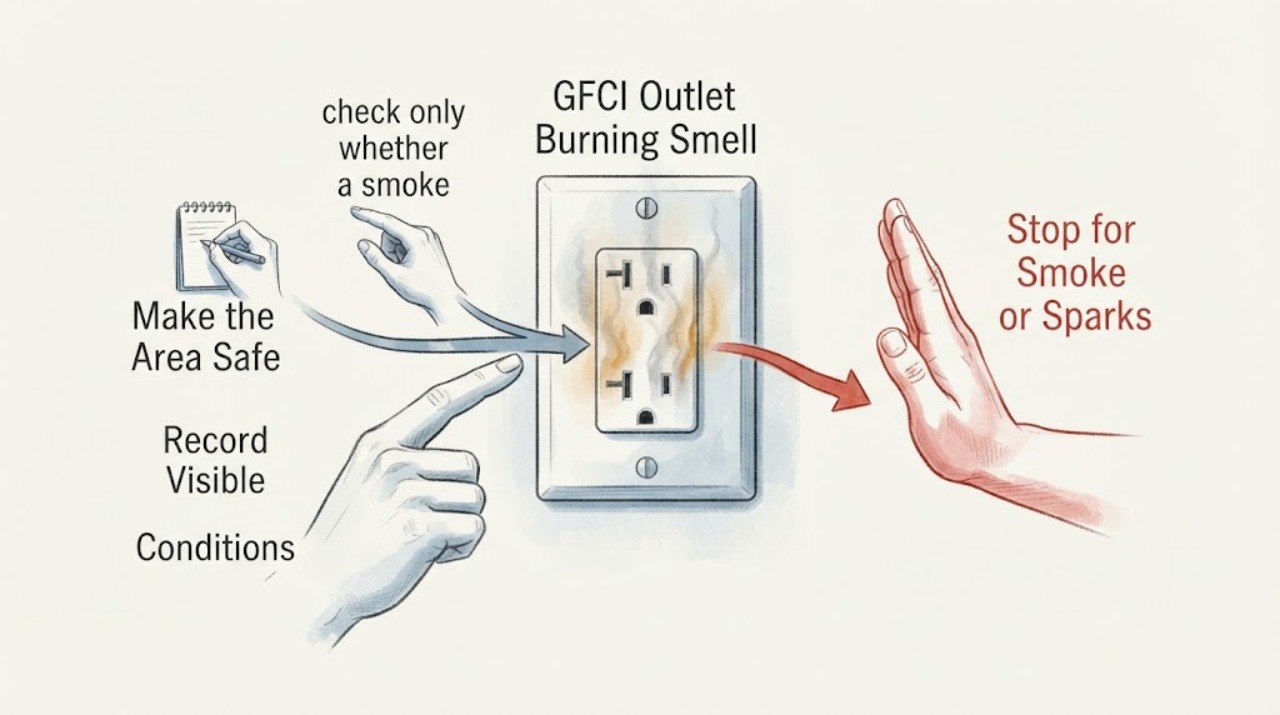
A burning smell from a GFCI outlet is an electrical-fire warning, not a reason to press TEST or RESET. Stop using the outlet and keep people away without touching the receptacle, plug, cord, switch, breaker panel, or nearby equipment. From a safe position, note whether there is smoke, flame, crackling, heat distortion, water, or a smell spreading through the room. Evacuate and contact emergency services if smoke or fire is present or increasing. If there is no active fire, arrange a qualified electrician to inspect the GFCI, its upstream or downstream wiring, and the connected load; do not restore power, unplug a device, open the outlet, or test voltage yourself.
Work through in order
Diagnostic checks
Use only checks that match the exact appliance or system and its official guide.
-
Check 1
Stop where you are and move people, children, and pets away from the GFCI area without touching the outlet, faceplate, cord, plug, switch, breaker panel, or nearby appliance. Do not press TEST or RESET and do not pull a plug.
Expected result: The smell is faint and no smoke or flame is visible, or the odor is strong or increasing, the outlet is visibly discolored or warped, crackling is audible, smoke is present, or something is burning.
Next step: Keep away and continue only from a safe location. If smoke, flame, or an increasing odor is present, evacuate and contact emergency services; otherwise arrange a qualified electrician and leave the outlet unused.
Stop if: Stop all inspection immediately if smoke, flame, popping, arcing, crackling, heat radiation, or rapidly worsening odor appears; do not approach to shut anything off.
Why this matters
Why: Any burning odor at a receptacle is an electrical warning; smoke, flame, crackling, visible damage, or increasing heat indicates a possible active fire or energized fault.
-
Check 2
From outside the hazard area, check only whether a smoke alarm is sounding, smoke is spreading, flames are visible, or the room or exit path is becoming unsafe. Do not re-enter to investigate the source or collect belongings.
Expected result: There is no smoke or flame and the route out is clear, or smoke or flame is visible, the alarm is sounding, or the exit path is compromised.
Next step: For smoke, flame, or an unsafe route, evacuate, close doors only while leaving if safe, stay outside, and contact emergency services. For no active fire, keep the area isolated and arrange an electrician from a safe location.
Stop if: Do not attempt to extinguish an electrical fire with water, approach the outlet, or return inside until emergency responders or a qualified professional says it is safe.
Why this matters
Why: The second result is a fire emergency rather than a troubleshooting problem; smoke and fire can spread before an outlet can be safely identified.
-
Check 3
From a safe distance, record the outlet's room and position, whether the smell is localized or spreading, whether the GFCI indicator or buttons appear changed, and whether smoke, discoloration, moisture, buzzing, or a damaged cord is visible without approaching or touching.
Expected result: The smell is localized to the receptacle, appears to come from a connected device or cord, is associated with moisture, or cannot be localized safely.
Next step: Keep every device and outlet in that area out of use and give the observations to the electrician. Do not unplug the device, move it, wipe moisture, or open any cover.
Stop if: Stop recording and leave the area if the odor strengthens, the faceplate changes color or shape, water moves toward electrical equipment, or any sound changes to popping or sizzling.
Why this matters
Why: The source may be the GFCI, a connected load, water-related leakage, or wiring elsewhere on the circuit; visual distance observations cannot prove which component is safe.
-
Check 4
From a safe location, make a written list of what was connected to the GFCI and what changed immediately before the smell began, including water exposure, a recently used high-load appliance, a trip, flicker, or an unusual sound. Do not reproduce the symptom.
Expected result: A connected appliance or cord was wet, damaged, hot, overloaded, or operating when the odor began, or no connected cause is known.
Next step: Tell the electrician the exact load and sequence. Keep the suspected device and the GFCI unused; do not move, plug in, unplug, or test either one.
Stop if: Stop if anyone feels a shock or tingling, if water is present, or if the connected item shows smoke, heat, melted plastic, or cord damage; evacuate for smoke or fire.
Why this matters
Why: A damaged or wet load and an overloaded or loose receptacle can both create electrical risk; the absence of a known trigger does not clear the outlet.
-
Check 5
Prepare a service handoff without touching the electrical system: record the outlet type and location, visible markings from a safe distance, the time and duration of the smell, any GFCI trip or loss of power, affected downstream outlets, water exposure, connected load, and smoke or heat observations.
Expected result: The odor has stopped but the outlet remains unused, or it returns, the GFCI will not operate, nearby outlets are also affected, or any warning sign persists.
Next step: Arrange qualified electrician service and provide the record. Do not restore power or perform a GFCI test after a burning smell unless the electrician has inspected the condition and gives model-appropriate instructions.
Stop if: Stop and evacuate for smoke or fire; do not return until emergency responders or a qualified professional confirms the area is safe.
Why this matters
Why: A temporary loss of odor does not establish a safe repair; a recurring odor, failed GFCI function, or wider circuit symptom requires electrical diagnosis.
Use your observations
Decision map
Find the observation that best matches what you see, then follow the next safe action.
-
PATH 01Next step
What you see
Smoke, flame, visible arcing, popping, rapidly increasing burning odor, or an unsafe exit path is present.
Do this next
Evacuate, stay out, and contact emergency services from a safe location. Do not approach the outlet, use water, operate switches, or re-enter for belongings.
-
PATH 02Next step
What you see
There is a burning smell but no visible smoke or flame.
Do this next
Keep the GFCI and connected loads unused, isolate the area without touching anything, and arrange a qualified electrician to inspect before any reset, unplugging, or reuse.
-
PATH 03Next step
What you see
The area is wet, the smell followed water exposure, or a connected appliance or cord is damaged.
Do this next
Stay away from the wet or damaged electrical equipment and do not move or unplug it. Tell the electrician the water or damage sequence; treat any smoke, heat, or spreading odor as an emergency.
-
PATH 04Next step
What you see
The GFCI has tripped, will not reset, or nearby outlets have also lost power after the odor.
Do this next
Do not press RESET or repeatedly restore power. Leave the circuit and outlet unused and have a qualified electrician evaluate the GFCI, connected load, and upstream or downstream wiring.
-
PATH 05Next step
What you see
The odor has disappeared and no visible damage remains.
Do this next
Do not treat that as clearance. Keep the outlet unused and arrange inspection because intermittent heating or a loose connection can recur without an obvious mark.
Helpful context
Understand the symptom
Treat a burning or rubbery smell at a GFCI as a stop condition even if the outlet still appears to work. GFCIs interrupt power when they detect ground-fault current, but they do not eliminate every overload, loose connection, damaged cord, or failed receptacle. A warm or discolored outlet, sizzling or buzzing, sparks, or a burning odor warrants qualified electrical inspection.
The safe homeowner role here is observation and evacuation, not a functional test. Do not press TEST or RESET, pull a plug, touch the faceplate, spray or wipe the outlet, move furniture near it, open the panel, or measure voltage. If the area is wet, smoke is visible, or the smell is getting stronger, stay away and keep others away.
A qualified electrician must determine whether the heat originated at the GFCI, a connected appliance or cord, an upstream or downstream connection, or a circuit overload. Give the electrician the outlet location, what was connected, when the smell began, whether the GFCI had tripped, and any safe-distance observations. Do not reuse the outlet until it has been inspected and cleared.
Safety boundary
Stop conditions
- Stop immediately and evacuate for smoke, flame, visible arcing, popping, rapidly increasing odor, or a compromised exit path; contact emergency services from a safe location.
- Stop all contact if the area is wet, the receptacle or plug is hot or discolored, a cord is damaged, or anyone feels shock or tingling. Keep people away and arrange qualified electrical help.
- Do not press TEST or RESET, pull a plug, operate a nearby switch or breaker, remove a faceplate, open a panel, measure voltage, or reproduce the fault.
When checks do not resolve it
Need a professional?
Arrange qualified electrician service for any burning smell, warmth, discoloration, buzzing, crackling, sparks, damaged cord, repeated GFCI trip, or failed GFCI operation., Contact emergency services immediately for smoke, flame, visible arcing, rapidly worsening odor, or an unsafe evacuation route; evacuate and stay out., Do not touch, reset, unplug, open, spray, wipe, or voltage-test the GFCI or connected equipment after a burning smell. Do not restore power until the condition has been professionally inspected.
Common questions
FAQ
Should I press RESET on a GFCI that smells like burning?
No. A burning smell is a stop condition. Keep away without touching the outlet or connected equipment and arrange qualified electrical inspection; smoke, flame, arcing, or a worsening odor requires evacuation and emergency services.
Can a GFCI still be dangerous if it has tripped?
Yes. GFCI protection is intended to reduce shock risk, but a trip or loss of power does not identify or remove a hot connection, damaged load, moisture problem, overload, or failed receptacle. Do not reset it after a burning smell until it has been inspected.
What should I do if there is smoke from the GFCI outlet?
Leave the area, keep others out, and contact emergency services from a safe location. Do not approach the outlet, use water, operate switches, unplug equipment, or re-enter until responders confirm it is safe.
What information should I give the electrician?
Share the outlet location, what was connected, when the smell began, whether the GFCI tripped or nearby outlets lost power, any water or cord damage, and only the observations made from a safe distance. Keep the outlet and connected loads unused until inspection.
Read the exact guide
Official sources
- Don’t Overload Your HomeElectrical Safety Foundation International · Electrical overload warning signs at receptacles and safe loading guidance
- Ground Fault Circuit Interrupters (GFCI)Electrical Safety Foundation International · GFCI purpose, ground-fault risk, water proximity, and qualified installation guidance
- Home Fire Escape PlansU.S. Fire Administration · U.S. Fire Administration evacuation and fire emergency guidance
- Appliance and Electrical Fire SafetyU.S. Fire Administration · U.S. Fire Administration outlet and electrical fire-prevention guidance
- Electrical Safety: ChecklistNational Fire Protection Association · NFPA residential electrical hazard warning signs and qualified electrician guidance
- GFCI Fact SheetU.S. Consumer Product Safety Commission · CPSC GFCI shock and fire protection, ground faults, moisture, and qualified service boundaries
Community feedback
Share a repair observation
Share a plain-text repair observation. Accepted observations are published automatically; this page may take a moment to update.