
On this page
Start here
Quick answer
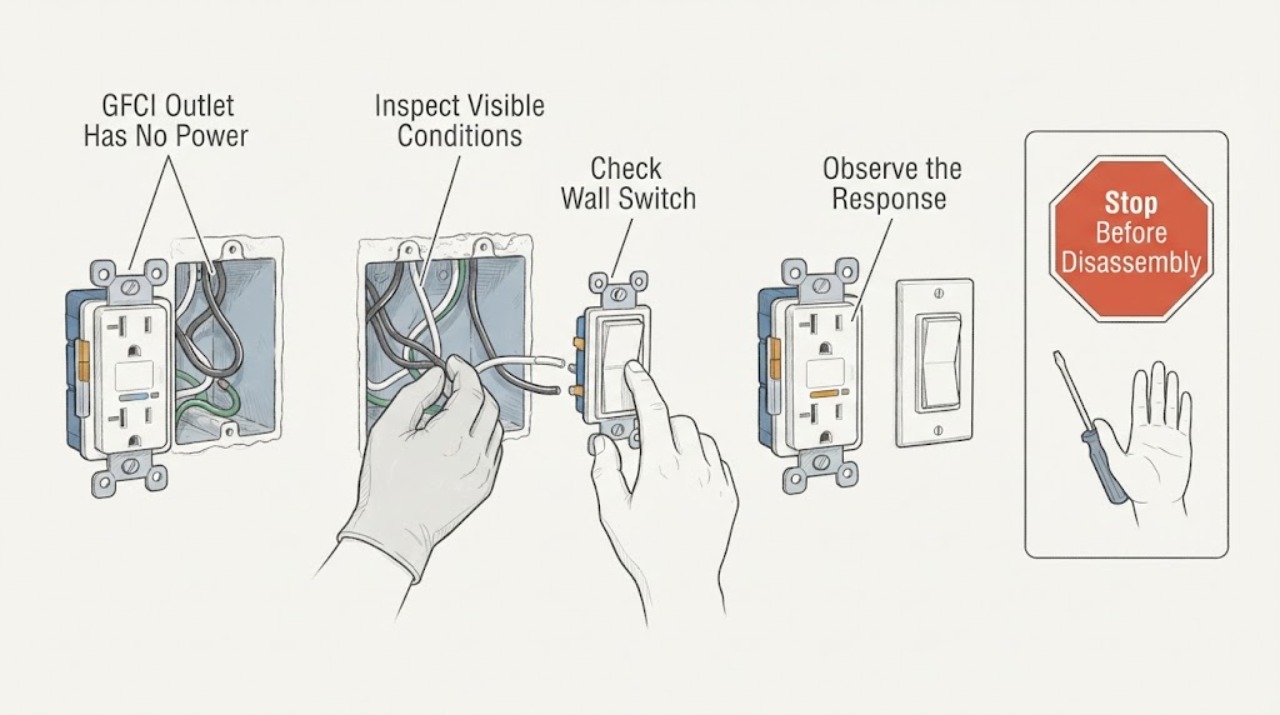
A GFCI outlet with no power may be tripped, unpowered because an upstream breaker is off, affected by a switch or upstream GFCI, unable to reset because of a continuing ground fault, or faulty or incorrectly wired. From a dry, safe position, record the RESET position and indicator, map which outlets or lights are affected, and check only the visible state of the related breaker. If the receptacle and area are dry, cool, intact, and its instructions allow it, one normal RESET may be tried. If power does not return, RESET will not stay in, or there is water, heat, discoloration, buzzing, smoke, arcing, exposed wiring, or a repeated breaker trip, leave it off and call a qualified electrician. Do not remove the outlet, switch, faceplate, or panel cover, touch wiring, measure voltage, bypass protection, or keep resetting.
Work through in order
Diagnostic checks
Use only checks that match the exact appliance or system and its official guide.
-
Check 1
From a dry, safe position, look at the GFCI face without touching it and record the RESET-button position and visible indicator state.
Expected result: Record RESET in or out, indicator green/off/red/abnormal, and whether the faceplate or cover appears wet, cracked, loose, discolored, melted, or warm-looking.
Next step: If the receptacle is wet, hot, damaged, smoking, buzzing, or arcing, do not touch or reset it. Keep clear and call an electrician.
Why this matters
Why: RESET out with no light can be a tripped or unpowered state; a red or abnormal indicator or damaged face makes the receptacle a safety concern rather than a routine no-power symptom.
-
Check 2
Map which outlets, lights, and switch-controlled loads are without power, using only normal visual observation and controls that are dry and safe to operate.
Expected result: Record only this receptacle, several nearby outlets, an entire room, an outdoor or wet-area group, or multiple circuits affected.
Next step: Keep the map for an electrician. Do not remove another faceplate or open a switch to trace line and load wiring.
Why this matters
Why: Several dead outlets may be downstream of the GFCI. A room-wide or multi-circuit loss can involve an upstream breaker or supply issue; the nearest outlet is not necessarily the protective device.
-
Check 3
Identify the loads and switches that were in use before power disappeared, and visually note whether the loss followed a plug-in, appliance start, switch operation, rain, cleaning, or no clear event.
Expected result: Record any wet, damaged, hot, or frayed cord and leave it untouched and disconnected only if it can be separated safely by its intact plug body from a dry position.
Next step: Do not test a suspect load on another outlet. If any cord or equipment is wet or damaged, leave the circuit off and arrange electrical service.
Why this matters
Why: A repeatable load or moisture association keeps a connected device or ground fault in consideration; no trigger leaves the GFCI, switch, upstream supply, or wiring unresolved.
-
Check 4
Without removing the electrical-panel cover, read the visible breaker handle or indicator associated with the area. Do not touch a wet, hot, buzzing, smoking, or damaged panel.
Expected result: Record on, off, or tripped-looking status and whether the breaker changed at the same time as the GFCI lost power.
Next step: Only when the area is dry, cool, intact, and free of warnings, and the product or panel instructions allow it, make no more than one normal reset of the visible protective device. If it trips again, leave it off.
Why this matters
Why: A breaker that is off or tripped-looking can remove supply to the GFCI; a normal-looking handle does not prove the circuit or neutral is safe.
-
Check 5
If the outlet, floor, and nearby equipment are dry and intact, disconnect accessible loads and make no more than one normal RESET attempt according to the GFCI instructions.
Expected result: Record power restored and held, RESET will not stay in, the indicator remains abnormal, or the outlet remains dead.
Next step: If power does not return or disappears again, leave the GFCI off and call an electrician. Do not press RESET repeatedly or use TEST as a search method.
Why this matters
Why: A no-reset or no-power result can reflect absent upstream supply, a continuing ground fault, failed protection, or an installation or wiring issue; a successful reset does not certify a connected load.
-
Check 6
From a safe position, check whether another visible GFCI or a switch-controlled device upstream appears to be off or tripped, without removing plates or operating an unknown device.
Expected result: Record an identifiable upstream GFCI, a visible switch that controls a light or load, no upstream device found, or an unclear arrangement.
Next step: If an identifiable upstream GFCI is dry and intact, follow its product instructions for no more than one normal reset; if the downstream outlet remains dead or the device trips again, call an electrician.
Why this matters
Why: A downstream receptacle may have no power because an upstream GFCI or breaker interrupted the branch. An unclear arrangement requires professional tracing rather than opening wiring.
-
Check 7
Prepare a service note with the outlet location, RESET and indicator state, breaker state, switch and upstream-device observations, affected scope, connected loads, moisture context, and any single reset result.
Expected result: The record shows whether the loss is local, downstream, switch-related, branch-wide, load-linked, moisture-linked, or unexplained.
Next step: Keep the affected outlet or circuit off when the cause is unknown, the reset fails, or the loss returns, and provide the note to the electrician.
Why this matters
Why: A precise map helps an electrician diagnose the outlet, protective device, switch, supply, or wiring without repeated energizing or guessed replacement.
Use your observations
Decision map
Find the observation that best matches what you see, then follow the next safe action.
-
PATH 01Safety boundary
What you see
Do this next
Disconnect safe accessible loads and make no more than one normal reset according to the product instructions. If power does not return, leave it off and call an electrician.
Why this path and its safety boundary
Safety stop: Use the hazard, no-reset, or upstream-power branch instead of repeating a reset.
-
PATH 02Safety boundary
What you see
Do this next
Leave it off and call an electrician. Possible causes include absent upstream power, persistent ground fault, failed protection, or wiring or installation trouble; do not open the outlet.
Why this path and its safety boundary
Safety stop: Do not reconnect every load at once. Restore only known-safe loads according to their instructions and stop if power disappears again.
-
PATH 03Safety boundary
What you see
Do this next
Record the branch scope. One normal reset is allowed only when dry and free of warnings; if the upstream device trips again or the downstream outlet stays dead, obtain electrical service.
Why this path and its safety boundary
Safety stop: A local outlet, switch, load, or wiring issue remains possible; preserve the visible-state map.
-
PATH 04Safety boundary
What you see
Do this next
Stop immediately. Do not touch the equipment or operate the switch, outlet, or breaker. Keep clear; isolate power only from a dry, safe location if possible and call an electrician for the hazard.
Why this path and its safety boundary
Safety stop: Continue only with dry, non-contact observations and stop if any warning sign appears.
-
PATH 05Safety boundary
What you see
Do this next
Leave the suspect load disconnected when it can be separated safely by its intact plug body. Do not test it on another outlet; call an electrician if the GFCI remains dead or trips again.
Why this path and its safety boundary
Safety stop: Treat the no-power event as unexplained and request electrical service if one safe reset does not restore stable power.
Helpful context
Understand the symptom
No power is not the same as a dead outlet until the protection path is mapped
The visible GFCI may be downstream of another GFCI or supplied through a breaker. A nearby switch may control only a light or appliance and may not supply the receptacle. A GFCI receptacle can also remove power from outlets farther along its branch. The RESET position, indicator, breaker state, and affected-outlet map describe the symptom without proving that the wiring is safe.
Restore power only once and only without warning signs
If the device and surroundings are dry, cool, intact, and the product instructions allow it, one normal user RESET can distinguish a simple tripped state from a no-power or fault state. If power stays off or disappears again, stop. Repeated resets can re-energize a fault, and opening an outlet or switch to find the cause is professional electrical work.
Safety boundary
Stop conditions
- Stop immediately for water or moisture, smoke, sparks, arcing, burning odor, heat, discoloration, melting, buzzing, shock, exposed wiring, or another breaker trip.
- Do not remove the GFCI outlet, switch, faceplate, panel cover, or wiring; do not touch terminals, inspect LINE/LOAD connections, or measure voltage.
- Do not bypass the GFCI, repeatedly press RESET or TEST, repeatedly reconnect a suspect load, hold a tripping device in, or replace the outlet as a guess.
- Stop if the floor or equipment is wet, the panel is damaged, or observing the device requires approaching a hazard.
When checks do not resolve it
Need a professional?
Call a qualified electrician when the GFCI outlet remains without power after one safe manufacturer-approved reset, will not reset, affects several outlets, has an unclear upstream device, or shows a wiring or switch concern. Call immediately for moisture, heat, discoloration, burning odor, buzzing, smoke, arcing, shock, exposed wiring, or a repeated breaker trip.
Common questions
FAQ
Why is there no power at my GFCI outlet?
The outlet may be tripped, supplied by an upstream GFCI or breaker with no power, affected by a continuing ground fault, or faulty. Record RESET and indicator state and the affected scope; if one safe reset does not restore stable power, call an electrician.
Can I press RESET when the GFCI has no power?
Only when the device and area are dry, cool, and intact, no warning sign is present, and the product instructions allow a normal reset. Make no more than one reset for diagnosis. If it will not reset or power disappears again, leave it off and call an electrician.
Could a switch or another outlet be upstream of the dead GFCI?
Yes. A switch may control a load, another GFCI may supply downstream outlets, and a breaker may remove power from the branch. Map visible effects without opening plates; an electrician should trace wiring or diagnose an unclear supply path.
Should I replace a GFCI outlet that has no power?
Not as a guess. No power can come from the breaker, upstream protection, wiring, a persistent ground fault, or the receptacle. Do not remove or replace the outlet yourself; have an electrician inspect and test the circuit.
Read the exact guide
Official sources
- GFCI Outlets & ReceptaclesLeviton Safety Devices · GFCI outlet and breaker forms, downstream protection, LED and RESET states, no-power behavior, and wiring-related lockout indications.
- GFCI Fact SheetU.S. Consumer Product Safety Commission · GFCI shock protection, receptacle and breaker forms, branch and downstream protection, and qualified electrician safety boundaries.
- There is no power at my Smart GFCI Outlet and the Indicator LED is offLeviton Product Support · No-power and indicator-off behavior on a Smart GFCI outlet, one reset instruction, and electrician escalation for continuing trips.
Community feedback
Share a repair observation
Share a plain-text repair observation. Accepted observations are published automatically; this page may take a moment to update.