
On this page
Start here
Quick answer
A GFCI outlet with no power may be tripped, supplied by a tripped upstream breaker or GFCI, affected by moisture or a damaged connected device, incorrectly wired after recent work, or internally failed. Treat the loss of power as a protective response: do not remove a cover, touch wiring, measure voltage, bypass protection, or keep resetting devices. From a dry, safe distance, look for smoke, arcing, heat, discoloration, water, or a shock/tingle history and note the outlet's indicator and button positions. If there is no hazard and the product instructions permit it, one single RESET attempt may be made without opening anything; if it will not hold or power does not return, leave it off and have a qualified electrician trace the circuit.
Before you begin
Safety first
- Do not operate the outlet, open the panel, touch wiring, perform a live measurement, bypass the GFCI, or repeatedly reset it while waiting for service.
Work through in order
Diagnostic checks
Use only checks that match the exact appliance or system and its official guide.
-
Check 1
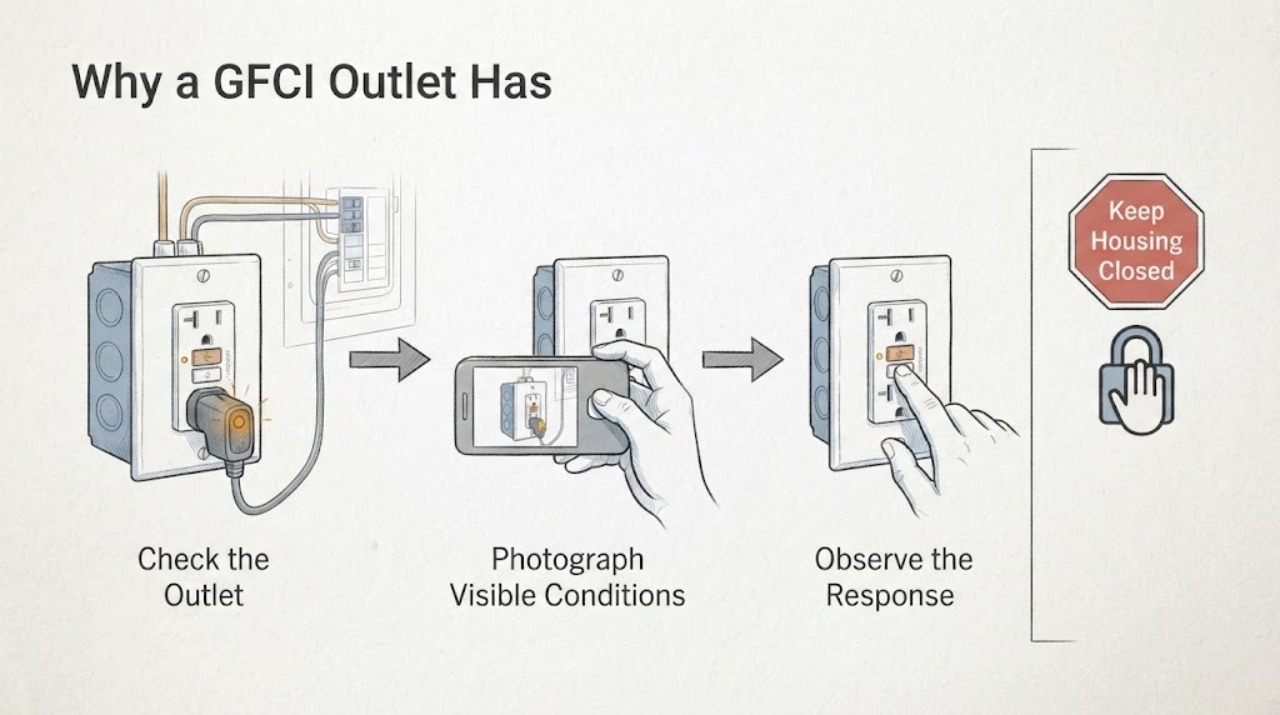
Stand on a dry surface at a safe distance and visually scan the GFCI face, cover plate, surrounding wall, nearby floor, and visible cords. Do not touch the outlet, plug, cord, panel, or any water.
Expected result: Look for smoke, flame, visible arcing, a glowing spot, a warm or discolored face or plate, cracking, melted plastic, water, dampness, or a recent shock/tingle.
Next step: If any hazard is present, keep away, do not operate the GFCI or breaker, and follow the emergency branch below. If the area is dry, cool, intact, and odor-free, continue with observation only.
Stop if: Stop immediately for smoke, flame, arcing, burning or rubber odor, heat, water near the electrical equipment, damaged plastic, or any shock/tingle.
Why this matters
Why: Any of these signs can indicate an active shock or fire hazard rather than an ordinary loss of power.
-
Check 2
Without pressing either button, record the GFCI RESET and TEST button positions and any indicator-light state or pattern. Photograph the face only if doing so can be done from a dry, safe distance.
Expected result: The RESET button may appear out, the indicator may be off, red, green, or flashing, or there may be no visible indication at all; note the exact state and whether the condition changes without anyone touching it.
Next step: Use the exact device instructions or give the observation to the electrician; do not infer a wiring repair from an LED alone and do not open the box to investigate.
Stop if: Stop if the indicator is accompanied by heat, odor, smoke, arcing, water, or a shock/tingle, or if getting closer would require touching the outlet or cover.
Why this matters
Why: An out RESET with no indicator may mean the device is tripped or is not receiving upstream power. A red or fault indication can mean a self-test fault or an unsafe condition. Indicator meanings are model-specific.
-
Check 3
From a safe position, identify which other outlets, lights, or fixed loads lost power at the same time. Do not remove plugs, move appliances, use an extension cord, or enter a wet area to reach another outlet.
Expected result: Only this GFCI is dead, several nearby outlets are dead, or a wider room/branch is without power. Note whether the outage began during rain, cleaning, appliance use, or another specific event.
Next step: Record the affected area and timing for a qualified electrician. Do not repeatedly reset any GFCI or breaker to map the circuit.
Stop if: Stop if the affected area includes wet flooring, exposed conductors, a hot/discolored outlet, smoke, arcing, or a load that is making unusual noise or odor.
Why this matters
Why: A single dead point can be a local GFCI or downstream issue; several dead points suggest an upstream GFCI, breaker, supply, or branch-wiring problem. Timing with moisture or a load makes a ground fault more plausible, but does not identify the failed component.
-
Check 4
Visually inventory connected equipment and any visible cord damage without handling the equipment. Note whether a particular load was operating when the GFCI went dead, and whether the equipment is near water or outdoors.
Expected result: A damaged cord, wet equipment, outdoor exposure, a power strip, an extension cord, or one particular appliance coincides with the outage; alternatively, no load or event is obvious.
Next step: Leave the suspected load and the dead GFCI unused. Do not unplug or test it if doing so requires contact with a wet, hot, damaged, or energized-looking item; let an electrician isolate it safely.
Stop if: Stop for water, frayed or crushed insulation, melted parts, smoke, burning odor, heat, arcing, or any shock/tingle.
Why this matters
Why: Damaged or wet equipment can create a ground-fault path. If no load explains the event, concealed downstream wiring, a supply problem, a miswired device, or a failed GFCI remains possible.
-
Check 5
Only when the area and device are dry, cool, intact, odor-free, and free of any shock or arcing history, consult the exact GFCI instructions. If those instructions permit a reset and no danger is present, make at most one single RESET attempt with dry hands; do not press TEST and do not operate a breaker to experiment.
Expected result: The button holds and power returns, the button will not hold, the outlet immediately trips again, or the indicator shows a fault/no-power state.
Next step: If it trips, will not hold, shows a fault, or remains dead, stop using the circuit and arrange qualified electrical diagnosis. Never repeat the reset or bypass the GFCI.
Stop if: Do not attempt this action at all if there is moisture, heat, damage, odor, smoke, arcing, a shock/tingle, uncertainty about the model instructions, or any need to open or touch wiring.
Why this matters
Why: A successful single reset only shows that the device accepted power at that moment; it does not prove the branch is safe or repaired. A failed or repeated trip indicates a continuing ground fault, no upstream supply, incorrect wiring, a failed device, or another circuit problem.
-
Check 6
Prepare a service handoff without further testing: record the outlet location, indicator/button state, affected outlets, time and trigger, recent plumbing or electrical work, visible moisture or damage, and whether a single permitted reset changed anything.
Expected result: The electrician receives a repeatable symptom history instead of an altered circuit, repeated trips, or an unverified part diagnosis.
Next step: Leave the GFCI and affected branch unused until a qualified electrician inspects it, especially when the cause is unclear or the outlet protects a wet location.
Stop if: Stop all homeowner troubleshooting if the cause is unclear after the safe observations, if the fault returns, or if any electrical hazard appears.
Why this matters
Why: The component identity is not established by no power alone. A professional may need to distinguish an upstream supply/breaker issue, a downstream load fault, wiring/termination fault, or GFCI failure under controlled conditions.
Use your observations
Decision map
Find the observation that best matches what you see, then follow the next safe action.
-
PATH 01Safety boundary
What you see
Smoke, flame, visible arcing, burning/rubbery odor, hot or discolored outlet/plate, water near the equipment, damaged plastic, or a shock/tingle is present.
Do this next
Do not touch the GFCI, breaker, cords, or wiring. Move people away; if there is fire or smoke, leave the building and contact emergency services from a safe location. Have a qualified electrician assess the circuit after the area is safe.
Why this path and its safety boundary
Safety stop: Emergency withdrawal; no reset, unplugging, cover removal, or inspection from close range.
-
PATH 02Safety boundary
What you see
The area is dry and intact, but several outlets or loads lost power together.
Do this next
Leave the branch unused and provide the affected-area map to a qualified electrician. Do not repeatedly reset a GFCI or breaker to locate the upstream device.
Why this path and its safety boundary
Safety stop: Stop if any hazard appears or if tracing would require opening a panel, touching wiring, or entering a wet area.
-
PATH 03Safety boundary
What you see
A specific wet, damaged, or suspicious load was operating when the GFCI went dead.
Do this next
Keep that load and the protected outlet out of service. Do not handle, unplug, dry, or retest the load if contact could expose you to electricity or water; tell the electrician exactly what was running.
Why this path and its safety boundary
Safety stop: Stop for moisture, cord damage, heat, odor, smoke, arcing, or a shock/tingle.
-
PATH 04Safety boundary
What you see
No hazard is visible, the device is dry/cool/intact, and the exact instructions allow one reset.
Do this next
A single reset may be attempted once. If it does not hold or power does not return, stop and call a qualified electrician; do not repeat the attempt.
Why this path and its safety boundary
Safety stop: Any trip, fault indication, heat, odor, moisture, arcing, or uncertainty ends the reset branch.
-
PATH 05Safety boundary
What you see
The GFCI was recently installed or replaced and now has no power or will not reset.
Do this next
Do not remove the cover or swap conductors. Tell the electrician the installation date and device indicator state; incorrect line/load connections, missing supply, or a device fault require qualified diagnosis.
Why this path and its safety boundary
Safety stop: No DIY wiring correction, breaker-panel work, or live measurement.
Helpful context
Understand the symptom
A GFCI is intended to remove power when it detects a ground fault, such as current taking an unintended path through moisture, damaged equipment, or a person. The loss of power is therefore useful evidence, not a reason to defeat the device. The same GFCI may also protect outlets farther downstream, so another dead receptacle does not prove that its own wiring is the source.
The safe homeowner task is limited to observation and documentation. Keep hands, tools, and test equipment away from the receptacle, cover plate, breaker panel, and conductors. Do not restore power merely to see whether a fault returns; a qualified electrician can isolate the protected circuit and inspect wiring, terminations, connected equipment, and the GFCI itself.
If the outlet is in a bathroom, kitchen, laundry area, garage, basement, outdoor location, or another damp area, moisture becomes a higher-priority possibility. Keep the area dry and keep people away until the source of the water and the electrical fault have been assessed.
Safety boundary
Stop conditions
- Smoke, flame, visible arcing, burning/rubbery odor, heat, melting, or a hot/discolored outlet or cover plate.
- Water or dampness near the outlet, cords, appliances, floor, wall, or panel; do not touch electrical equipment in or near water.
- A shock, tingle, spark, repeated trip, fault indication, or a RESET button that will not hold.
- Any need to remove a cover, open a panel, touch conductors or wiring, measure voltage, bypass protection, unplug a wet/damaged load, or repeatedly reset a device.
When checks do not resolve it
Need a professional?
Call a qualified electrician when the GFCI remains dead, will not reset, trips again, shows a fault, or the cause is not obvious., Arrange prompt electrical service for frequent trips, multiple dead outlets, a warm/discolored plate, flickering, sparks, a burning/rubbery smell, or tingling., Treat water, a wet location, damaged equipment, or any history of shock as a reason to leave the circuit unused until it is assessed.
Safety scope: Do not operate the outlet, open the panel, touch wiring, perform a live measurement, bypass the GFCI, or repeatedly reset it while waiting for service.
Common questions
FAQ
Why is a GFCI outlet dead when the breaker looks on?
The local GFCI or another upstream GFCI may be tripped, the outlet may not be receiving supply power, or a continuing ground fault, wiring issue, moisture problem, or failed device may be keeping it locked out. Observe only; do not open the panel or repeatedly reset devices.
Can another outlet cause this GFCI to have no power?
Yes. A GFCI can protect downstream outlets on the same branch, so a fault or trip elsewhere can leave more than one location dead. Record the affected area and have an electrician trace it rather than using repeated resets to map the circuit.
Should I keep pressing RESET if the GFCI will not stay on?
No. At most, follow the exact device instructions for one reset only when the area and device are dry, cool, intact, and free of odor, smoke, arcing, or shock history. If it will not hold or trips again, leave the circuit unused and call a qualified electrician.
Is a GFCI with no power safe to replace myself?
No assumption about safe replacement should be made from the symptom alone. Replacement or wiring diagnosis requires de-energized verification and correct line/load identification; if you are not a qualified electrician, leave the device untouched and arrange professional service.
Read the exact guide
Official sources
- How to Use GFCIsElectrical Safety Foundation International · General GFCI safety guidance; device-specific instructions control.
- GFCI Fact SheetU.S. Consumer Product Safety Commission · Consumer GFCI safety information for residential electrical equipment.
- GFCI Outlets & Receptacles | Leviton Safety DevicesLeviton · General Leviton GFCI guidance; exact indicator behavior remains model-specific.
- Appliance and Electrical Fire SafetyU.S. Fire Administration · General residential electrical fire safety.
- Home Fire Escape PlansU.S. Fire Administration · Emergency response if smoke or fire is present.
- How to Reset a GFCI Outlet After Lockout: A Step-by-Step GuideLeviton · General Leviton reset-lockout explanation; follow the installed device instructions.
- Electrical Safety: ChecklistNational Fire Protection Association · General home electrical safety checklist.
Community feedback
Share a repair observation
Share a plain-text repair observation. Accepted observations are published automatically; this page may take a moment to update.