
On this page
Start here
Quick answer
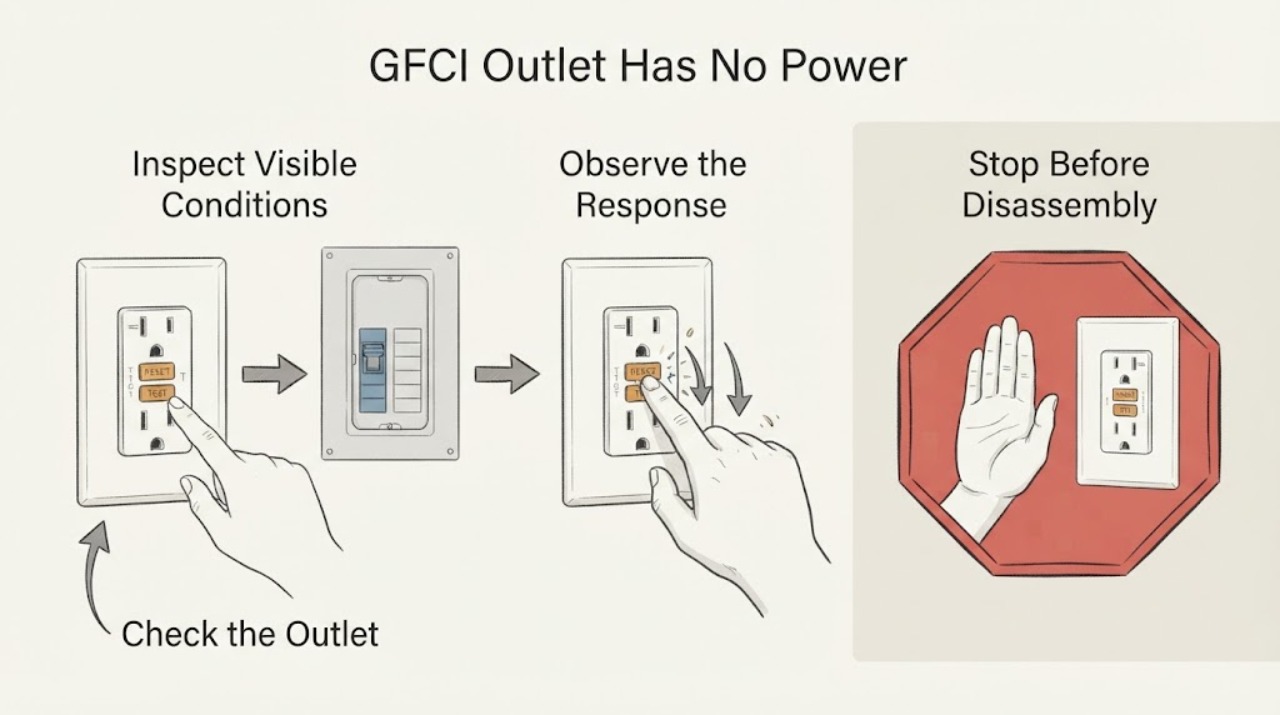
A GFCI outlet with no power may have a popped RESET button, a tripped circuit breaker, another GFCI upstream that opened, a disconnected or failed load path, or a wiring or device fault. From a dry position, inspect the outlet's TEST and RESET buttons, check nearby and downstream outlets, and look only at the external position of a clearly labeled breaker. If there is no visible damage or moisture and the device instructions allow it, make one normal reset of the GFCI and one normal reset of the breaker if needed. If the outlet will not reset, loses power again, or is warm, discolored, wet, sparking, smoking, or damaged, leave the circuit off and call a qualified electrician. Do not remove covers, test live voltage, loosen wires, bypass GFCI protection, or repeatedly reset the breaker.
Work through in order
Diagnostic checks
Use only checks that match the exact appliance or system and its official guide.
-
Check 1
Look at the GFCI face without removing its plate. Note whether the RESET button is popped, whether TEST and RESET are present, whether an indicator looks normal or shows a warning, and whether the outlet has power after a known-safe visual check. Do not touch a wet, hot, discolored, loose, or damaged device.
Expected result: A popped RESET button suggests the receptacle's ground-fault protection opened. A RESET button that will not stay in, a warning indicator, or no power with no visible button change can indicate a failed device, upstream protection, lost supply, or a wiring fault.
Next step: If the device is dry and undamaged and its instructions allow it, make one normal RESET attempt. If it will not reset or immediately opens again, leave it alone and call an electrician.
Why this matters
Why: The outlet face identifies the first protection point but cannot prove that the circuit behind it is safe.
-
Check 2
Check other visible outlets and fixtures in the room, nearby wet areas, and the likely downstream path without unplugging or opening anything. Note whether one outlet, several outlets, or an entire room has lost power, and whether another GFCI with TEST and RESET controls is present.
Expected result: A GFCI receptacle can protect outlets downstream on the same branch. Several dead outlets with one popped GFCI point toward that protective device; one dead outlet with other outlets normal points toward a local receptacle or connection issue. Multiple rooms affected points toward the panel or branch circuit.
Next step: If another GFCI is clearly identified and is dry and undamaged, follow its instructions for one normal RESET attempt. If the affected area remains dead or the controlling device is unclear, leave the circuit alone and arrange electrical diagnosis.
Why this matters
Why: The extent of the outage helps locate the protection device without a live electrical test.
-
Check 3
From a dry, safe position, inspect the electrical panel only for the external position of a clearly labeled branch breaker or GFCI breaker. Note an OFF or middle position, a label that does not match the outlet, visible heat or damage, or a breaker that has moved again. Do not remove the panel cover.
Expected result: A tripped breaker can remove power from the GFCI and its downstream outlets. A breaker that is already on, will not stay on, or shows heat or damage is not a simple reset situation; the fault may be an overload, short, ground fault, or defective device.
Next step: Only when the area is dry and free of odor, smoke, heat, water, damage, and exposed wiring, make one normal breaker reset if the panel instructions allow it. If it trips again, leave it off and call an electrician.
Why this matters
Why: A breaker position is a safe external clue, but it does not identify whether the fault is in the outlet, appliance, or wiring.
-
Check 4
Without touching a suspect item, visually inspect appliances, plugs, cords, and downstream loads that were connected when power disappeared. Look for fraying, melted plastic, scorch marks, water, a loose plug fit, or an appliance that was warm before the outage; do not reconnect a damaged load.
Expected result: One damaged or wet load can create a ground-fault path and leave the GFCI without power. A normal-looking load does not clear the branch circuit, because a fault can be inside the device, cord, receptacle, or downstream wiring.
Next step: Keep a suspect appliance out of service and arrange appliance or electrician evaluation. Do not move the test to an extension cord, defeat the GFCI, or reconnect the appliance to see whether it trips again.
Why this matters
Why: The connected load may be the trigger, but visual inspection cannot replace an electrical safety check.
-
Check 5
Inspect the outlet surroundings from a dry position for a sink splash path, condensation, active leak, wet cabinet or wall, standing water, or water entering a plug or appliance. Note whether the loss of power follows rain, cleaning, a leak, or a delayed appliance cycle; do not reach into water.
Expected result: Moisture can create the unintended current path that GFCI protection is intended to interrupt. A wet box or cabinet, an active leak, or water near a plug is unsafe even if the outlet face appears normal.
Next step: Leave the circuit off and obtain qualified electrical help; arrange plumbing help for the water source. Do not dry, open, relocate, or re-energize wet equipment as a test.
Why this matters
Why: A water-related pattern changes the task from restoring power to controlling an electrical and possibly plumbing hazard.
-
Check 6
Prepare a service handoff with the outlet location, TEST/RESET and indicator state, panel breaker state, other outlets affected, connected loads, elapsed time and operating stage, visible damage or moisture, recent electrical work, and whether one safe reset was attempted.
Expected result: This record can distinguish an upstream GFCI event, branch breaker trip, load-specific ground fault, water path, failed receptacle, or circuit wiring problem without asking the household to perform a live test.
Next step: Leave the circuit off when the cause is unclear, power returns only briefly, or the device trips again, and call a qualified electrician. Keep covers and wiring untouched.
Why this matters
Why: The protective device's state and outage pattern are more useful than guessing that the receptacle itself needs replacement.
Use your observations
Decision map
Find the observation that best matches what you see, then follow the next safe action.
-
PATH 01Next step
What you see
The GFCI RESET button is popped, the device is dry and undamaged, and no load or circuit hazard is visible.
Do this next
Arrange qualified service and follow the exact model guidance.
Why this path and its safety boundary
Why it matters: Make one normal RESET attempt according to the device instructions. If it will not reset or power disappears again, leave it off and call an electrician.
-
PATH 02Next step
What you see
Another GFCI outlet appears to control several dead outlets downstream.
Do this next
Arrange qualified service and follow the exact model guidance.
Why this path and its safety boundary
Why it matters: Use one manufacturer-allowed RESET attempt only when the device is dry and undamaged. A failed or repeated trip needs electrical diagnosis; do not reset every nearby device repeatedly.
-
PATH 03Next step
What you see
The clearly labeled branch or GFCI breaker is in the OFF or middle position and there are no hazard signs.
Do this next
Arrange qualified service and follow the exact model guidance.
Why this path and its safety boundary
Why it matters: Make one normal external breaker reset if the panel instructions allow it. If it trips again or will not stay on, leave it off and call a qualified electrician.
-
PATH 04Next step
What you see
The breaker is on but the GFCI will not reset or remains without power.
Do this next
Arrange qualified service and follow the exact model guidance.
Why this path and its safety boundary
Why it matters: Do not remove the outlet or panel cover. An upstream GFCI, failed receptacle, open connection, wiring fault, or protective-device issue needs an electrician.
-
PATH 05Next step
What you see
A connected appliance, cord, plug, outlet, cabinet, wall, or floor is wet, warm, discolored, melted, scorched, or damaged.
Do this next
Arrange qualified service and follow the exact model guidance.
Why this path and its safety boundary
Why it matters: Stop immediately and keep people away. Do not touch or move the suspect equipment; obtain qualified electrical help and address any water source separately.
-
PATH 06Next step
What you see
Only one load appears associated with the outage and the circuit trips when that load is used.
Do this next
Arrange qualified service and follow the exact model guidance.
Why this path and its safety boundary
Why it matters: Keep the load disconnected when safe and arrange appliance and electrical diagnosis. Do not use an extension cord or another outlet to recreate the fault.
-
PATH 07Next step
What you see
Several rooms are dead, the controlling device is unclear, or there is no obvious load but power remains absent.
Do this next
Arrange qualified service and follow the exact model guidance.
Why this path and its safety boundary
Why it matters: Leave the circuit alone and call a qualified electrician to trace the branch and protection device. Do not perform a live test or open the panel.
Helpful context
Understand the symptom
No power at one GFCI outlet does not necessarily mean that receptacle is defective. The protective device may have opened because of a ground fault, the circuit breaker may have tripped, or another GFCI on the same branch may control the outlet. Start by identifying which visible protection device changed state and whether other outlets are affected.
Keep the inspection visual and external. A GFCI outlet near a sink, counter, garage, outdoor area, or other wet location must be treated as a shock hazard if water, heat, discoloration, a loose plug, or cord damage is present. Do not open the box or panel to find the cause.
One safe reset can restore a nuisance trip, but a second loss of power is a fault signal. Leave the protection in place and preserve the appliance, timing, moisture, and breaker information for the electrician rather than using repeated resets as a test.
Safety boundary
Stop conditions
- Stop immediately for smoke, flame, sparking, an electrical odor, a hot or discolored outlet, melting, exposed wiring, water near electrical equipment, or a person at risk of shock.
- Do not repeatedly reset the GFCI or breaker, remove an outlet or panel cover, loosen wires, test live voltage, bypass protection, use an extension cord to defeat the trip, or reconnect a damaged appliance.
- Leave the circuit off after one allowed reset fails, the device trips again, the cause is unclear, or power returns only briefly; call a qualified electrician.
Only after diagnosis
Potential parts
- GFCI receptacle
Consider this only when a qualified electrician identifies the receptacle as defective or unable to reset after the circuit and downstream loads are checked.
The electrician must confirm device rating, location, protection arrangement, wiring, and applicable local requirements; a no-power symptom alone does not establish fit. - branch circuit breaker
Consider this only when an electrician diagnoses a defective breaker or confirms the correct protective device for the panel and circuit.
Match the panel system, breaker type, rating, and local requirements through qualified electrical work; do not substitute a higher-rated device to stop trips.
Common questions
FAQ
Why does my GFCI outlet have no power?
The GFCI, an upstream GFCI, or the panel breaker may have opened because of a ground fault, overload, damaged load, moisture, or a device fault. Check only visible TEST/RESET and breaker states, then make one safe reset if allowed.
Can I reset the breaker for a dead GFCI outlet?
Only once, when the breaker is clearly labeled and there is no water, smoke, odor, heat, damage, or exposed wiring. If it trips again or power disappears again, leave it off and call a qualified electrician.
Can another GFCI control the outlet with no power?
Yes. One GFCI can protect downstream outlets on the same branch. Look for another dry, undamaged GFCI with TEST and RESET controls, but do not repeatedly reset devices or open any outlet.
What if the GFCI has no power after the breaker is on?
An upstream GFCI, failed receptacle, open connection, or branch fault may be involved. Do not remove covers or test live voltage; leave the circuit alone and arrange electrical diagnosis.
Read the exact guide
Official sources
- GFCI Trips: What to do when your GFCI tripsLeviton Manufacturing Co., Inc. · GFCI visual inspection, connected and downstream loads, moisture-related ground faults, and electrician escalation
- Appliance Safety TipsElectrical Safety Foundation International · Repeated breaker trips, damaged appliances, electrical equipment near water, and stop-use safety boundaries
- GFCI Fact SheetU.S. Consumer Product Safety Commission · GFCI ground-fault protection, downstream outlet coverage, water-adjacent electrical safety, and qualified electrician boundaries
Community feedback
Share a repair observation
Share a plain-text repair observation. Accepted observations are published automatically; this page may take a moment to update.