
On this page
Start here
Quick answer
A GFCI outlet with no power is commonly tripped, without incoming power, protecting against a continuing ground fault, or unable to reset because the device or its wiring has a problem. With dry hands and no cover removal, unplug connected loads, press RESET once, check for a tripped breaker and other upstream GFCIs, then test the receptacle with a small lamp or nightlight. If RESET will not stay in, TEST/RESET does not behave correctly, the circuit trips again, the outlet is wet or damaged, or there is heat, smoke, arcing, or a shock, stop using it and have a qualified electrician diagnose it.
Before you begin
Safety first
- Do not remove the cover, touch terminals, probe live wiring, bypass the GFCI, repeatedly reset a tripping circuit, or replace it with a standard receptacle just to restore power.
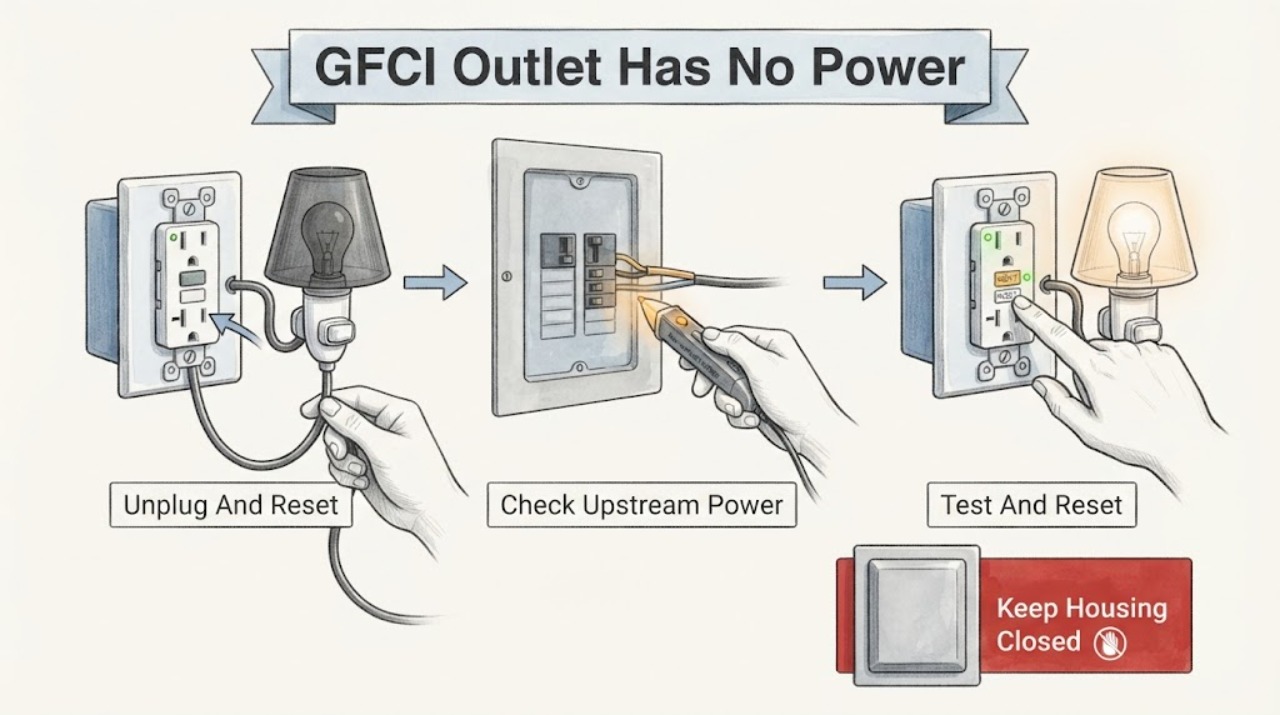
Work through in order
Diagnostic checks
Use only checks that match the exact appliance or system and its official guide.
-
Check 1
Keep hands dry, unplug the devices connected to the GFCI and any nearby receptacles it may protect, then press the RESET button firmly once. Do not remove the cover or touch anything inside the box.
Expected result: RESET clicks and stays in, RESET will not stay in, the button feels jammed, or the outlet is wet, cracked, hot, or discolored.
Next step: If RESET stays in, continue with a controlled test. If it will not stay in or the device is wet or damaged, leave loads unplugged and arrange qualified electrical service.
Stop if: Stop immediately for moisture, heat, cracking, scorch marks, buzzing, a shock, or a reset button that repeatedly releases.
Why this matters
Why: A successful reset indicates that the device can restore load power under the present conditions. A refusal to reset can mean no incoming power, a continuing ground fault, a miswired or failed GFCI, or a mechanical problem. Physical damage or moisture makes the receptacle unsafe to use.
-
Check 2
Look at the electrical panel for a breaker that is off or sitting in a trip position, and check other nearby GFCI receptacles for a popped RESET button. Reset a breaker or upstream GFCI only once using its normal handle or button, without opening the panel or removing a cover.
Expected result: A breaker or another GFCI is tripped, the panel appears normal but this outlet remains dead, or the same breaker or GFCI trips again.
Next step: If one reset restores stable power, return to the outlet and perform the controlled test. If the breaker or upstream GFCI trips again, leave the circuit off when safe and call a qualified electrician.
Stop if: Stop for repeated trips, a panel that is hot or sparking, an unknown breaker condition, or any need to work inside the panel.
Why this matters
Why: An upstream interruption can leave this receptacle without line power, so its own RESET may not work. A repeat trip indicates an unresolved overload, ground fault, moisture problem, device fault, or wiring issue and should not be repeatedly reset.
-
Check 3
Plug a small lamp or nightlight into the GFCI, switch it on, press TEST, and observe that the light turns off; then press RESET and verify that the light comes back on. Keep the test dry and do not use a damaged appliance as the test load.
Expected result: The test light turns off on TEST and returns on RESET, the light never turns on, TEST does not interrupt it, or RESET does not restore it.
Next step: If the sequence fails, stop using the receptacle and have a qualified electrician evaluate or replace the GFCI and verify the circuit. Do not continue plugging appliances into a device that cannot complete the test.
Stop if: Stop for a failed TEST/RESET sequence, an outlet that crackles or heats, or a test load that is damaged or wet.
Why this matters
Why: The expected sequence shows that the GFCI is switching the test load. No power before TEST points toward incoming power or the device; TEST failing to interrupt or RESET failing to restore means the protective function cannot be trusted.
-
Check 4
If the GFCI passes the test with its loads unplugged, reconnect devices one at a time while watching for a trip. Inspect only the outside of cords and plugs for water, cuts, crushed insulation, scorch marks, or a loose fit; do not use or test a suspect device again.
Expected result: The GFCI trips when one particular device is connected, trips with no devices connected, or remains on with the known-safe test load and appliances.
Next step: Unplug and isolate the device associated with the trip. If the GFCI trips empty, or any cord or plug is damaged, use a qualified electrician or repair professional rather than bypassing protection.
Stop if: Stop for moisture, damaged insulation, a hot plug, burning odor, smoke, sparks, or any electrical shock.
Why this matters
Why: A trip tied to one device suggests that device, its cord, or moisture is creating the fault. A trip with no connected load shifts attention to the receptacle, fixed wiring, or upstream circuit. Stable operation with loads does not excuse a damaged cord or worn outlet.
-
Check 5
Ask whether the GFCI was recently installed, replaced, or affected by renovation, and record any indicator light behavior or button position. Do not pull the receptacle out or rearrange conductors; provide that history to the electrician.
Expected result: The no-power condition began immediately after replacement or wiring work, the indicator shows a fault or no power, or nothing changed before the failure.
Next step: Leave the GFCI unused and have a qualified electrician verify line power, wiring, grounding, device condition, and the connected circuit. Do not perform live troubleshooting or rely on a jumper or bypass.
Stop if: Stop before any terminal or wiring work, especially if the box is wet, crowded, damaged, or the circuit identity is uncertain.
Why this matters
Why: A post-installation failure can be consistent with an incorrect line/load connection or a device that is not receiving power. An indicator alone is not a safe diagnosis, and an unchanged installation with a continuing fault may require circuit or device testing.
Use your observations
Decision map
Find the observation that best matches what you see, then follow the next safe action.
-
PATH 01Next step
What you see
A breaker or another GFCI is tripped, or power returns only after an upstream reset.
Do this next
Reset the upstream device once through its normal control, then test the receptacle; do not repeatedly reset a device that trips again.
-
PATH 02Next step
What you see
The GFCI trips again with a connected device or will not reset after the load is unplugged.
Do this next
Keep the suspected device disconnected and leave the GFCI unused; inspect cords only from the outside for visible damage or moisture.
-
PATH 03Next step
What you see
TEST does not turn a test light off, or RESET does not restore it.
Do this next
Stop using the receptacle and have a qualified electrician evaluate the GFCI and circuit.
-
PATH 04Next step
What you see
The failure began after GFCI replacement or other wiring work.
Do this next
Record the installation timing and indicator behavior, but do not open the box; line/load reversal or another wiring error needs professional verification.
-
PATH 05Next step
What you see
The outlet or cord is wet, hot, scorched, cracked, buzzing, sparking, or has shocked someone.
Do this next
Stop using it, keep people away, and turn off the circuit only if that can be done without approaching a hazard.
Helpful context
Understand the symptom
A GFCI protects people by disconnecting power when it detects current leaving the intended path. “No power” therefore has two useful meanings: the device may be doing its job after a trip, or it may not be receiving power or able to operate. Diagnose from the outside and preserve the protection; never bypass the GFCI just to make an appliance run.
The outlet you see may protect other receptacles downstream, and another GFCI or the circuit breaker may be upstream. A reset that works with all loads unplugged but trips when one device is connected points toward that device, moisture, or its cord. A reset that never works with stable incoming power points toward the GFCI or its wiring.
Do not remove the wallplate, touch terminals, probe exposed conductors, or replace the receptacle based only on a symptom. Water, a tingling shock, scorch marks, heat, buzzing, or repeated trips are reasons to stop and use a qualified electrician.
Safety boundary
Stop conditions
- RESET will not stay in, or TEST/RESET does not switch a known-safe test light as expected.
- The breaker or GFCI trips again after one normal reset.
- The receptacle, plug, or cord is wet, hot, cracked, scorched, buzzing, smoking, or sparking.
- Anyone feels a shock or tingling from the outlet, appliance, or nearby metal.
- The next step would require removing the cover, touching conductors, probing live wiring, or opening the electrical panel.
- The fault began after installation or renovation and the wiring has not been professionally verified.
Only after diagnosis
Potential parts
- GFCI receptacle
Consider only when the protective test fails or the device is damaged and an electrician confirms the receptacle is the failed component.
A qualified electrician must confirm the device rating, wiring configuration, grounding, location, and applicable requirements; do not substitute a standard receptacle to bypass protection. - GFCI circuit breaker
Consider only when the panel-mounted protective device is identified as failed after circuit diagnosis, not merely because a receptacle has no power.
Breaker fit and panel compatibility are model-specific and require qualified electrical work. - Receptacle cover or box hardware
Consider only when the cover or box is physically damaged after power is made safe and the receptacle itself is assessed.
Hardware must maintain enclosure and moisture protection; it does not correct a ground fault or failed GFCI.
When checks do not resolve it
Need a professional?
Call a qualified electrician when the GFCI will not reset, fails its TEST/RESET sequence, or trips with no connected load., Arrange service for a wet, damaged, hot, sparking, or loose receptacle, or for any shock or tingling sensation., Use professional diagnosis after replacement or renovation when line/load connections, grounding, or upstream wiring may be involved.
Safety scope: Do not remove the cover, touch terminals, probe live wiring, bypass the GFCI, repeatedly reset a tripping circuit, or replace it with a standard receptacle just to restore power.
Common questions
FAQ
Why will my GFCI outlet not reset?
It may not be receiving incoming power, may still detect a ground fault, or may be miswired or failed. Unplug loads, check for an upstream breaker or GFCI, and try RESET once. If it still will not reset, stop using it and call a qualified electrician.
How can I tell if a GFCI outlet is working?
With a dry, known-safe lamp or nightlight connected, press TEST and verify the light turns off; press RESET and verify it returns. If either step fails, do not trust the receptacle to provide protection and arrange service.
Could another GFCI cause this outlet to have no power?
Yes. A GFCI can protect downstream receptacles, so another device or the circuit breaker may have interrupted the branch. Check nearby GFCIs and the panel from the outside, resetting only once; a repeat trip needs an electrician.
Is it safe to replace a GFCI myself if it has no power?
No diagnosis should be based only on no power. Replacement involves circuit identification, line/load connections, grounding, box condition, and protective testing. Keep the device unused and have a qualified electrician handle wiring or replacement, especially after a recent installation or renovation.
Read the exact guide
Official sources
- CPSC Guide to Home Wiring HazardsU.S. Consumer Product Safety Commission · CPSC home electrical hazard warnings, circuit interruptions, damaged cords, overheating, shocks, and GFCI purpose
- GFCI Outlets & ReceptaclesLeviton · Leviton GFCI reset-lockout, indicator states, TEST/RESET behavior, and line/load wiring guidance
- How to Use GFCIsElectrical Safety Foundation International · GFCI purpose, safe test sequence with a small light, and professional boundary for failed TEST/RESET
Community feedback
Share a repair observation
Share a plain-text repair observation. Accepted observations are published automatically; this page may take a moment to update.