
On this page
Start here
Quick answer
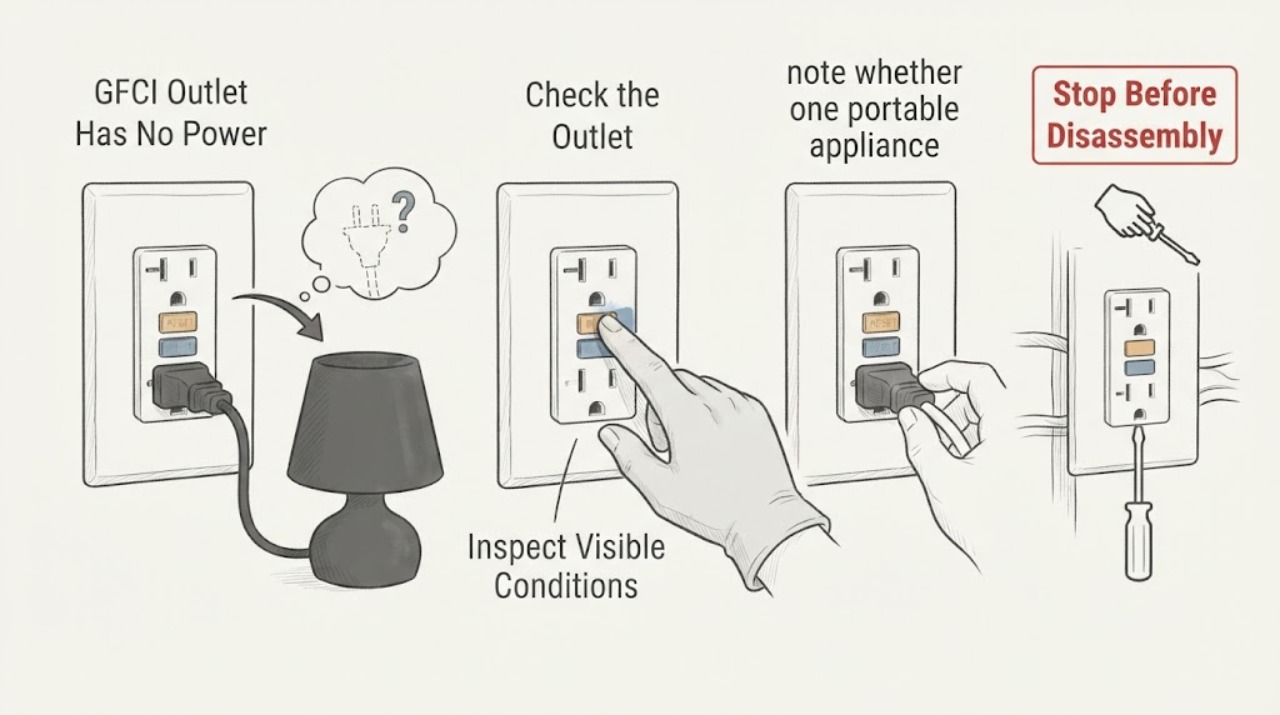
A GFCI outlet with no power may be tripped, may have lost upstream power, or may be locked out because it detects a fault, is damaged, or was wired incorrectly. Do not open the outlet or panel. From a dry position, check the TEST/RESET position, indicator state, visible moisture or heat, and whether nearby or downstream outlets are also dead. Only when the device is dry, cool, undamaged, and the product instructions allow it should you disconnect an obvious safe portable load and attempt one normal reset. If the outlet will not reset, trips again, has no expected indicator, or shows water, warmth, discoloration, odor, buzzing, smoke, or arcing, leave it off and call a qualified electrician.
Work through in order
Diagnostic checks
Use only checks that match the exact appliance or system and its official guide.
-
Check 1
From a dry standing position, identify the device as a GFCI receptacle with TEST/RESET buttons and note whether RESET is extended, whether the indicator is off, green, red, or otherwise abnormal, and which room or downstream outlets lost power.
Expected result: An extended RESET with no indicator may mean the GFCI is tripped or has no upstream power. A red or abnormal indicator, or a reset that will not stay engaged, keeps device failure, wiring, or a continuing fault in scope. If the device cannot be identified without opening anything, stop.
Next step: Continue only with dry external checks. Leave the outlet off and arrange electrician service when the indicator is abnormal, the reset is impossible, or the protected area is unclear.
Why this matters
Why: The face state is a safe first distinction between a normal trip indication and an unknown wiring or power condition.
-
Check 2
Visually inspect the outlet face, plug fit, nearby wall, cords, and accessible downstream outlets without touching them. Look for moisture, water marks, discoloration, melting, warmth, loose plugs, frayed insulation, buzzing, smoke, or burning odor.
Expected result: Any water, heat, discoloration, loose connection, damaged cord, buzzing, smoke, odor, or visible arc is an electrical hazard. A cool, dry, undamaged-looking outlet permits only the limited instruction-authorized reset path; it does not prove the wiring is safe.
Next step: For a hazard, move away, keep others away, do not restore power, and seek emergency or qualified electrician help from a safe location. If no hazard is visible, note what was in use when power disappeared.
Why this matters
Why: The hazard gate must be passed before any load isolation or reset.
-
Check 3
If the area and equipment are dry and undamaged, note whether one portable appliance was running or had just been plugged in. Disconnect only that obvious portable load by its plug; do not unplug a hot, wet, sparking, fixed, or damaged device.
Expected result: If power returns only after one portable load is separated, that load or cord becomes a leading suspect. If the outlet remains dead with no portable load, upstream power, downstream wiring, moisture, the GFCI, or another fixed load remains in scope.
Next step: Keep a suspected load disconnected and do not try it on another outlet. If there is no obvious load or the outlet remains dead, leave it off and call an electrician.
Why this matters
Why: The timing of the loss can identify a likely load without requiring electrical measurements or disassembly.
-
Check 4
Only when the GFCI is dry, cool, visibly intact, free of odor, smoke, buzzing, arcing, and water, follow its product instructions for one normal RESET operation. Do not press through resistance or repeat the operation if it does not engage.
Expected result: A reset that holds with the suspected load disconnected may restore power, but it does not prove the circuit or load is safe. An immediate trip, no reset, or abnormal indicator indicates a continuing fault, no upstream power, incorrect wiring, or failed device.
Next step: If it remains dead or trips again, leave it off and request qualified electrician diagnosis. Do not replace the receptacle, change a breaker rating, or bypass protection.
Why this matters
Why: One controlled reset can separate a simple tripped state from a continuing fault while preserving the protective boundary.
-
Check 5
From a dry position, check whether a nearby GFCI or panel device that visibly controls the same area is tripped, and whether other outlets or lights in the room or downstream area are also without power. Do not open the panel or operate an unidentified control repeatedly.
Expected result: Several dead outlets can indicate a downstream GFCI trip or upstream circuit interruption rather than a failed face receptacle. A panel device that will not hold, a repeat trip, or an unknown protected route keeps the circuit in electrician scope.
Next step: Record the affected outlets and leave the circuit off if the condition persists. Call a qualified electrician for upstream, downstream, breaker, or wiring diagnosis.
Why this matters
Why: GFCIs can protect downstream outlets, so the dead outlet may not be the source of the fault.
-
Check 6
Prepare a service note without further testing: record the outlet location, reset and indicator state, connected loads, timing, moisture or outdoor exposure, downstream outlets affected, visible damage, and whether the single instruction-authorized reset held.
Expected result: A dead outlet with no indicator and no upstream response suggests a power-path question; a trip tied to one appliance suggests a load branch; a red indicator or no-reset condition suggests device, wiring, or protection failure.
Next step: Give the note to a qualified electrician and keep the affected outlet or circuit off when the reset failed, power remains absent, or any hazard was observed.
Why this matters
Why: Safe observations give the electrician a usable branch without exposing the writer to live conductors.
Use your observations
Decision map
Find the observation that best matches what you see, then follow the next safe action.
-
PATH 01Safety boundary
What you see
The outlet, plug, cord, wall, or nearby equipment is wet, warm, discolored, melted, buzzing, smoking, arcing, or smells burned.
Do this next
Move away, keep others away, do not restore power, and seek emergency or qualified electrician help from a safe location.
Why this path and its safety boundary
Why it matters: This is an immediate electrical shock or fire-risk boundary, not a no-power reset problem.
Safety stop: Do not touch the outlet, unplug a hot or damaged cord, press RESET, apply water, or open a cover.
-
PATH 02Safety boundary
What you see
The GFCI is dry, cool, visibly intact, and its RESET state indicates a trip, with no hazard visible.
Do this next
Disconnect only an obvious safe portable load and follow the product instructions for one normal reset. Leave the outlet off if it does not hold.
Why this path and its safety boundary
Why it matters: The outlet may have interrupted power because of a transient or connected-load fault, but its protection must not be defeated.
Safety stop: Do not reset repeatedly or reconnect a suspected load to test it.
-
PATH 03Safety boundary
What you see
The indicator is off, RESET will not engage, and other outlets or the visible panel status suggest the circuit has no upstream power.
Do this next
Leave the outlet alone and call a qualified electrician to identify the upstream device and circuit condition.
Why this path and its safety boundary
Why it matters: The outlet cannot restore power without a functioning upstream supply; a tripped breaker, open connection, or circuit fault may be involved.
Safety stop: Do not open the panel, remove the receptacle, or attempt line/load checks.
-
PATH 04Safety boundary
What you see
The outlet or downstream circuit lost power when one identifiable portable appliance was connected, and no visible hazard is present.
Do this next
Keep the appliance disconnected and arrange electrician or appliance service as appropriate. Do not move it to another outlet for testing.
Why this path and its safety boundary
Why it matters: The appliance or cord may have caused a ground fault, but the circuit and GFCI still require safe confirmation.
Safety stop: Do not use an adapter to bypass protection or retry a suspected load.
-
PATH 05Safety boundary
What you see
The indicator remains red or abnormal, RESET will not stay engaged, or the outlet remains dead after one safe instruction-authorized reset.
Do this next
Leave the circuit off and call a qualified electrician for device and wiring diagnosis.
Why this path and its safety boundary
Why it matters: A continuing ground fault, failed device, incorrect wiring, or missing upstream power remains possible.
Safety stop: Do not replace the outlet, change a breaker rating, alter line/load conductors, or bypass the GFCI.
-
PATH 06Safety boundary
What you see
Several outlets or fixtures in the same area are dead, but the face GFCI shows no obvious damage.
Do this next
Record which outlets are affected and have an electrician trace the protected circuit from safe, de-energized conditions.
Why this path and its safety boundary
Why it matters: The face device may be protecting downstream receptacles, or an upstream GFCI/breaker may have interrupted the circuit.
Safety stop: Do not open another outlet or panel to search for the upstream device.
Helpful context
Understand the symptom
No power at the face of a GFCI does not identify the fault by itself. A receptacle can be tripped, have no power arriving from upstream, protect a downstream fault, or refuse reset because its self-test or lockout logic detects a problem. First observe the device and circuit scope without touching wiring.
Keep this diagnosis non-contact. Do not remove the wall plate, pull the receptacle, open the electrical panel, probe the slots, touch conductors, or change line/load connections. A bathroom, kitchen, basement, garage, or outdoor GFCI deserves extra caution because water and electricity may be close together.
If the device looks normal and a single portable load clearly preceded the loss of power, disconnect that load only when its plug and cord are dry, cool, and intact. Do not move a suspected appliance to another outlet for testing; repeated trips are a service signal, not a reset challenge.
Safety boundary
Stop conditions
- Stop immediately for moisture, standing water, warmth, discoloration, melting, damaged plugs or cords, buzzing, burning odor, smoke, visible arcing, or a repeat trip.
- Do not open the receptacle, wall plate, panel, or downstream boxes; do not touch wiring, take live measurements, change a breaker rating, alter line/load connections, replace the device, or bypass GFCI protection.
- Do not repeatedly press RESET or retry a suspected appliance. Leave the outlet or circuit off and call a qualified electrician when power remains absent or one safe reset fails.
Only after diagnosis
Potential parts
- GFCI receptacle
Consider replacement only after a qualified electrician confirms the receptacle is failed or damaged and the protected circuit and wiring are understood.
Device type, ratings, location requirements, line/load arrangement, and downstream protection must be confirmed by a qualified person; do not choose or install by appearance alone. - GFCI circuit breaker
Consider this only when a qualified electrician identifies the panel device as the failed or incompatible protection point.
Panel compatibility, rating, conductors, and local requirements must be verified professionally; never change the rating or bypass protection.
Common questions
FAQ
Why does a GFCI outlet have no power?
It may be tripped, have no upstream power, protect a downstream fault, be locked out by a continuing fault or incorrect wiring, or have failed. Use only dry external observations and do not open the outlet or panel.
Can I reset a GFCI outlet that has no power?
Only when it is dry, cool, visibly intact, and free of water, odor, heat, smoke, buzzing, or arcing, and the product instructions allow it. Disconnect an obvious safe portable load first and try no more than one normal reset.
What does an indicator light that is off or red mean?
It can indicate no upstream power, a tripped state, a continuing fault, or a device problem depending on the model. If the indicator remains abnormal or the outlet will not reset, leave it off and call an electrician.
Why are several outlets dead when only one GFCI has no power?
That GFCI may protect downstream outlets, or an upstream GFCI or breaker may have interrupted the circuit. Record the affected outlets and have a qualified electrician trace the circuit without opening boxes yourself.
Read the exact guide
Official sources
- What is Reset/Lockout?Leviton · GFCI reset lockout when the device is damaged, incorrectly wired, or unable to respond to a ground fault
- GFCI Outlets & ReceptaclesLeviton · GFCI purpose, downstream protection, reset lockout, indicator status, and no-power conditions
- What To Do When Your GFCI Outlet TripsLeviton · Visual inspection, connected-load clues, water-related ground-fault risk, and electrician escalation
- There is no power at my Smart GFCI Outlet and the Indicator LED is off. What do I do?Leviton · No-power indicator state, reset boundary, continuing trips, and electrician escalation
- GFCI Trips: What to do when your GFCI tripsLeviton · GFCI ground-fault safety, visual inspection, damaged cords or plugs, load isolation, and electrician escalation
Community feedback
Share a repair observation
Share a plain-text repair observation. Accepted observations are published automatically; this page may take a moment to update.