
On this page
Start here
Quick answer
A faint buzz that changes with dimming can come from bulb-and-dimmer incompatibility, but buzzing from the fixture or switch can also signal a loose, overheating, or failing electrical component. Stay at floor level and do not remove the cover, touch wiring, or perform a live test. If the fixture or switch is hot, discolored, flickering, sparking, smoking, tripping the breaker, or smells burned, stop using it, shut off the circuit from a dry safe location if you can identify it without approaching a hazard, and call a qualified electrician.
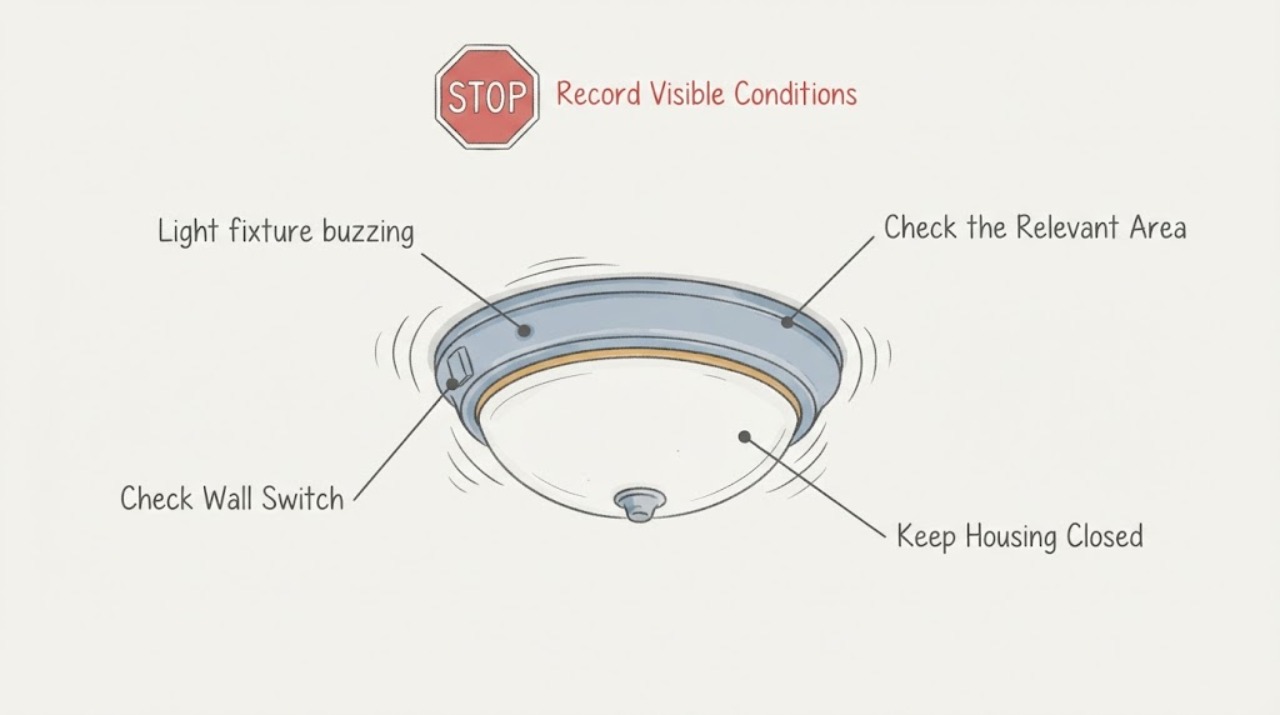
Work through in order
Diagnostic checks
Use only checks that match the exact appliance or system and its official guide.
-
Check 1
From a dry floor-level position, listen without touching the fixture or switch. Note whether the buzz is continuous, begins only when the light is on, changes with an already-used dimmer position, or is accompanied by flicker, shimmer, visible arcing, or a change in brightness.
Expected result: The sound is limited to a dimming range, occurs at full output, continues with flicker, or is accompanied by a hot, discolored, sparking, or otherwise abnormal fixture or switch.
Next step: Record the pattern and stop using the light if it is persistent or abnormal. Do not repeat live tests or change the dimmer setting to chase the sound.
Stop if: Stop immediately if you see sparks or smoke, hear crackling, smell burning, feel heat from a safe nearby surface, or see discoloration or a breaker trip.
Why this matters
Why: A dimming-range-only buzz can be a bulb-and-dimmer compatibility issue. A continuous buzz or buzz with flicker or physical warning signs can indicate a fixture, switch, connection, or overheating problem that cannot be diagnosed by sound alone.
-
Check 2
From a safe distance, inspect the visible fixture, shade, switch plate, and nearby ceiling or wall for discoloration, melting, soot, looseness, water marks, or a fixture that appears to sag. Do not touch the fixture, climb, remove a shade, or open a cover.
Expected result: The visible parts look normal, or there is discoloration, melting, soot, moisture, looseness, sagging, or another physical change near the sound.
Next step: Keep people clear and arrange a qualified electrician’s assessment. If a hazard is present and the circuit can be identified and switched off from a dry location without approaching the fixture, isolate it; do not touch the affected hardware.
Stop if: Stop all inspection if the fixture is wet, hot, smoking, sparking, unstable, or close enough that you would need a ladder or physical contact.
Why this matters
Why: A normal appearance does not rule out an internal fault, but physical change raises the urgency and makes a bulb-only explanation unsafe. Moisture near a fixture adds shock and fire risk.
-
Check 3
After the circuit has been isolated by a qualified person, or after the electrician confirms a safe de-energized condition, read visible labels and existing documentation without removing parts. Record bulb type, dimmer marking, fixture type, and whether the fixture is recessed or enclosed.
Expected result: The bulb is marked dimmable or non-dimmable, the light is controlled by a dimmer, the fixture is enclosed or recessed, or the labels and circuit details are unknown.
Next step: Give the label and fixture information to the electrician or manufacturer support channel. Do not remove the bulb, change the dimmer, or alter the wiring as a compatibility experiment.
Stop if: Stop if isolation cannot be confirmed, a label requires reaching energized hardware, or access would involve a ladder, ceiling cavity, or exposed conductors.
Why this matters
Why: A non-dimmable bulb on a dimmer or an unverified bulb-and-dimmer pairing can cause buzz or unstable operation. Enclosed or recessed fixtures have additional heat and rating considerations. Unknown details are a reason to defer selection and ask for model-specific advice.
-
Check 4
Use prior observations to locate the sound without approaching the hardware: compare whether it seemed loudest at the bulb or shade, the fixture body, the wall switch or dimmer, or above the ceiling. Note whether it began after a bulb, dimmer, fixture, or control change.
Expected result: The sound follows a recent bulb or dimmer change, seems to come from the dimmer area, seems to come from a fluorescent fixture, or appears to come from a ceiling or wall connection.
Next step: Leave the circuit isolated when a hazard or persistent buzz is present and provide the timeline and location to a qualified electrician. Do not remove the switch plate or fixture housing.
Stop if: Stop if the sound is accompanied by flicker, heat, odor, arcing, repeated trips, or water; escalate without further testing.
Why this matters
Why: A recent control or bulb change supports a compatibility question, while a sound from a switch, ballast area, or concealed connection requires professional inspection. Location alone cannot prove which component is failing.
-
Check 5
Prepare a service record from a dry location: fixture and room, sound type and duration, dimmer position if already observed, bulb and fixture labels, flicker or heat, breaker behavior, recent changes, and photos taken without touching or opening the equipment.
Expected result: The record shows a repeatable dimming-only buzz with no warning signs, a persistent buzz at full output, or any electrical safety warning.
Next step: Send the record to a qualified electrician and ask for a safe diagnosis of the fixture, control, wiring, and bulb compatibility before choosing a replacement part.
Stop if: Stop and leave the area if the warning signs progress or anyone would need to make a live measurement or remove electrical hardware.
Why this matters
Why: A clean dimming-only pattern can help confirm a compatibility review after the circuit is deemed safe. Persistent or warning-associated noise should be treated as an electrical defect until professionally assessed.
Use your observations
Decision map
Find the observation that best matches what you see, then follow the next safe action.
-
PATH 01Next step
What you see
Buzzing occurs only at a dimmer setting and there is no heat, odor, flicker, discoloration, or arcing
Do this next
Keep the circuit work de-energized and ask a qualified electrician or the product manufacturer to verify bulb-and-dimmer compatibility. Do not swap wiring or perform a live comparison.
-
PATH 02Next step
What you see
Buzzing continues at full output or comes from the fixture, switch, ballast area, or ceiling
Do this next
Stop using the light and request electrical service. Provide the sound location, timing, fixture type, and recent changes.
-
PATH 03Next step
What you see
The fixture or switch is hot, discolored, wet, smoking, sparking, or smells burned
Do this next
Do not touch or approach the hardware. From a dry safe location, isolate the circuit only if it can be identified without entering a hazard, then call a qualified electrician or emergency service as appropriate.
-
PATH 04Next step
What you see
The breaker trips when this light or switch is used, or lights flicker across the home
Do this next
Leave the circuit off and arrange qualified electrical inspection. Do not repeatedly reset the breaker or install a higher-rated protective device.
-
PATH 05Next step
What you see
The bulb and dimmer details are unknown, or access requires a ladder, cover removal, or live work
Do this next
Stop the homeowner check and provide photos and visible labels to a qualified electrician for safe identification and compatibility review.
Helpful context
Understand the symptom
First separate a dimming-related hum from a safety warning. A bulb may buzz only at a particular dim setting, while an unusual sound accompanied by heat, discoloration, odor, flicker, arcing, or a tripped breaker needs electrical service. The sound’s location and timing are useful evidence, but they do not make it safe to open the fixture or switch.
All checks here are visual or auditory and are performed from a dry floor-level position. Do not remove a fixture cover, pull a bulb from a hot socket, loosen a switch plate, probe a conductor, measure voltage, change wiring, or work inside a ceiling or wall. Power being off at the wall switch alone is not a substitute for professional electrical isolation.
Once a qualified electrician confirms the circuit and fixture are safe, the likely remedy may be a compatible bulb, a compatible dimmer, or service to a ballast or other fixture component. Compatibility and installation depend on the exact product and circuit, so do not select a part from the sound alone.
Only after diagnosis
Potential parts
- LED bulb
Consider this only after a qualified assessment confirms the current bulb is non-dimmable, incompatible, or otherwise the likely source of a dimming-only buzz.
Confirm the fixture type, enclosure rating, dimming behavior, and exact dimmer compatibility before selection; do not use a bulb swap to bypass a safety warning. - LED dimmer
Consider this only if an electrician confirms the control is incompatible or defective and the circuit is suitable for a model-specific LED dimmer.
Wiring, load, control topology, and local requirements must be verified by a qualified electrician; the Writer does not claim universal fit. - fluorescent ballast
Consider this only after professional diagnosis identifies the ballast as the source of buzzing in a fluorescent fixture.
Confirm fixture, lamp, ballast type, and de-energized service procedure with the electrician; do not open the fixture to test it.
When checks do not resolve it
Need a professional?
Call a qualified electrician for a persistent or unexplained buzz, any buzz with heat, odor, discoloration, flicker, arcing, moisture, instability, or a breaker trip, and whenever diagnosis would require opening the fixture, switch, ceiling, or wall.
Have this ready
- Provide the room and fixture location, whether the sound is continuous or dimmer-dependent, visible bulb and dimmer labels, fixture type, timing of recent changes, flicker or heat, breaker behavior, and safe photos.
Common questions
FAQ
Can a dimmer make a light fixture buzz?
Yes. Bulb-and-dimmer incompatibility can cause buzzing or humming, especially at certain dimming ranges. Verify compatibility with the product information or a qualified electrician; do not alter wiring or perform a live test.
Is a buzzing light dangerous?
It can be a compatibility symptom, but buzzing with heat, odor, discoloration, flicker, sparks, moisture, or a breaker trip is a safety warning. Stop using the light, isolate the circuit only from a safe dry location if possible, and call a qualified electrician.
Should I remove the bulb or fixture cover to find the cause?
No. Keep the circuit de-energized and do not remove covers, touch wiring, pull a hot bulb, or work inside the fixture. A qualified electrician should inspect the fixture and control safely.
What information should I give the electrician?
Give the room and fixture location, whether buzzing changes with dimming, bulb and dimmer labels, fixture type, timing of recent changes, flicker or heat, breaker behavior, and safe photos.
Read the exact guide
Official sources
- CPSC Guide to Home Wiring HazardsU.S. Consumer Product Safety Commission · General residential electrical safety guidance; it is not a repair manual and specific defects require qualified electrical professionals.
- NEMA DimmingLeviton Manufacturing · General LED and dimmer compatibility guidance; verify the exact product combination before selection.
Community feedback
Share a repair observation
Share a plain-text repair observation. Accepted observations are published automatically; this page may take a moment to update.