
On this page
Start here
Quick answer
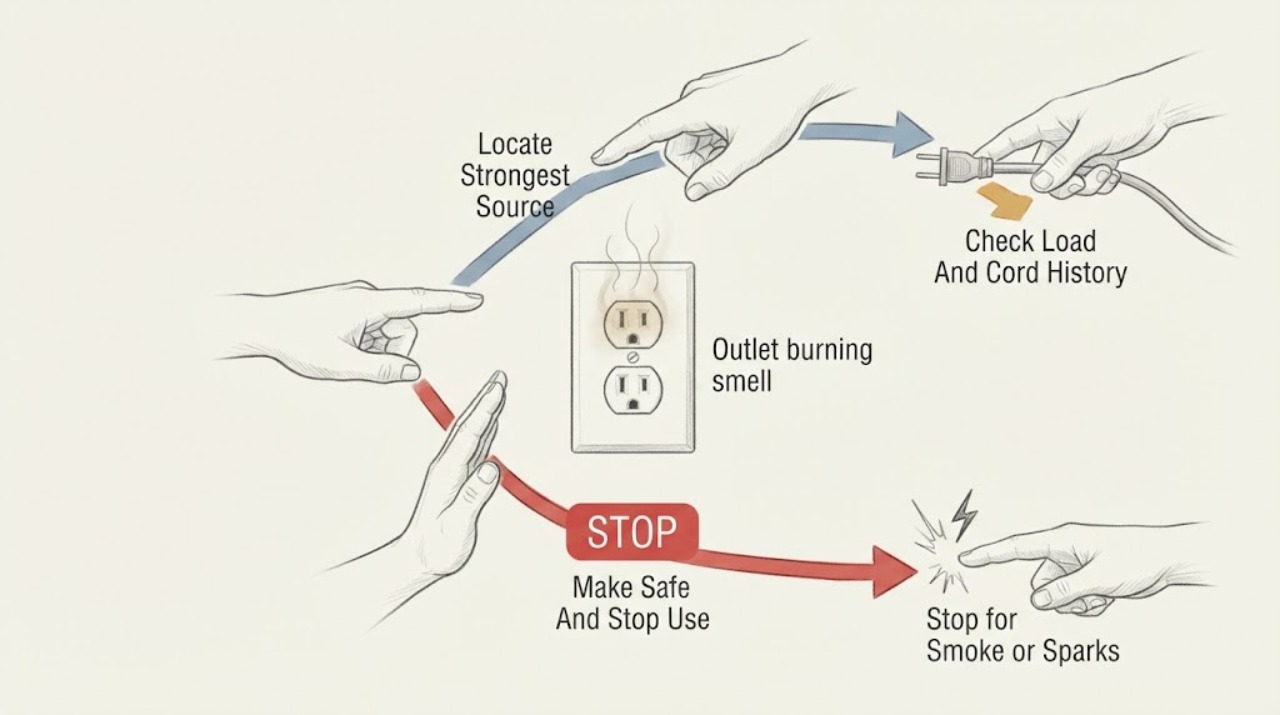
A burning smell from an outlet is a warning of overheating, a loose or arcing connection, an overloaded circuit, or a failing plug or appliance—not a condition to test by plugging something else in. Turn off and stop using the appliance or outlet if you can do so without touching anything hot, smoking, wet, sparking, or damaged; keep people away, never use water on an electrical fire, and call emergency services if there is smoke or fire. A qualified electrician should inspect any burning odor, warm or discolored outlet, buzzing or crackling, flickering, shock or tingle, damaged cord, or repeated breaker trip.
Work through in order
Diagnostic checks
Use only checks that match the exact appliance or system and its official guide.
-
Check 1
Stop using the outlet and any connected appliance immediately. If the plug or appliance is cool, dry, and undamaged and you can reach it without touching the hot outlet or cord, switch the appliance off and unplug it by the plug body; otherwise leave it in place and move away.
Expected result: There is smoke, flame, sparking, a hot or wet outlet, a damaged cord, a shock or tingle, or only a past odor with no current visible symptom.
Next step: Keep people and combustible items away, call emergency services for smoke or fire, and call a qualified electrician for any burning smell or other warning sign. Do not use water on suspected electrical fire and do not resume use to see whether the smell returns.
Stop if: Stop immediately and leave the area for smoke, flame, escalating heat, popping, sparks, or an alarm; never touch a wet or energized-looking outlet.
Why this matters
Why: Smoke, flame, heat, moisture, damage, or shock indicates an active hazard; a past odor still indicates that the circuit or connected equipment needs inspection even if the visible symptom has stopped.
-
Check 2
From a safe distance and without removing the faceplate, compare where the odor is strongest: the receptacle or wall plate, the plug and cord, the appliance body, or a nearby switch, cable, or wall area. Look only for visible discoloration, melted plastic, scorch marks, smoke residue, or a plug that no longer fits snugly.
Expected result: The outlet or faceplate is warm or discolored, the plug or cord is damaged, the appliance smells or is hot, or the odor seems to come from inside the wall or a nearby device.
Next step: Leave the affected outlet and appliance unused and give the electrician the strongest source and visible observations. Do not touch, scrape, tighten, open, or remove the faceplate or receptacle.
Stop if: Stop observing if the outlet is hot, wet, sparking, smoking, loose, or in a damaged wall, or if getting closer requires touching the cord or faceplate.
Why this matters
Why: A receptacle or wall source points toward the branch wiring or receptacle; a plug, cord, or appliance source may be a failed load; an odor from the wall or adjacent device may involve concealed wiring. Location narrows the inspection but does not identify the failed part.
-
Check 3
Without reconnecting the suspect load, record what was plugged in, whether an extension cord, power strip, adapter, or multi-outlet device was involved, whether the plug fit tightly, and whether other lights or outlets flickered, dimmed, buzzed, or lost power.
Expected result: Several loads shared the outlet, a heat-producing or major appliance used an extension device, the plug was loose, the cord is cracked or pinched, or the circuit has flickered or tripped.
Next step: Keep all suspect equipment disconnected and have a qualified electrician assess the load, receptacle, circuit protection, cord, and wiring. Do not substitute an extension cord, power strip, higher-rated fuse or breaker, or another outlet as a workaround.
Stop if: Stop for a melted extension device, visible conductor, a hot power strip, repeated tripping, or any need to handle a damaged cord or open the electrical panel.
Why this matters
Why: Overloading, poor plug contact, damaged cords, or a broader circuit symptom can create heat or arcing; the observation does not show whether the outlet, cord, appliance, or branch wiring is the root cause.
-
Check 4
From outside the panel and without opening it or repeatedly resetting anything, note whether the circuit breaker, fuse, GFCI, or AFCI has tripped and whether the outlet's status indicator is abnormal. Do not reset a device while smoke, heat, moisture, or burning odor remains.
Expected result: A breaker or fuse has operated, a GFCI or AFCI will not remain reset, the outlet has a test/reset indication, or no protective device appears to have operated.
Next step: Leave the affected circuit or outlet unused and provide the protective-device behavior to the electrician. Do not replace a fuse with a larger one, hold a breaker on, bypass protection, or use a reset as a repair.
Stop if: Stop for heat, smoke, sparks, a wet panel or outlet, a breaker that trips again, or any need to remove the panel cover or touch internal wiring.
Why this matters
Why: Protective-device operation can accompany a fault or overload, but a device that has not tripped does not rule out overheating or arcing; repeated reset attempts can re-energize a hazardous circuit.
-
Check 5
Without touching the suspect outlet, look at nearby outlets, switches, plugs, cords, and lights for matching discoloration, warmth, buzzing, crackling, flickering, or a burning odor. Check only from a safe, dry position and do not insert a tester or tool.
Expected result: The warning sign is isolated to one outlet or appears at multiple outlets, switches, or lights on the same area or circuit.
Next step: Stop use of all affected points and tell the electrician which locations show the same symptom. Do not remove covers, move wires, or continue using an apparently normal outlet on a suspected circuit.
Stop if: Stop for any heat, smoke, crackling, sparking, wetness, damaged plate, or symptom that spreads while you are observing.
Why this matters
Why: An isolated sign may be a receptacle, plug, appliance, or connection issue; multiple locations or lighting changes suggest a broader circuit or wiring problem and require professional assessment.
-
Check 6
Prepare a service record with the outlet location, odor description and timing, connected appliance and cord type, visible marks or warmth, breaker/GFCI/AFCI response, flicker or buzzing, recent installation or load change, and whether anyone felt a shock. Photograph only from a safe distance after power is left unused.
Expected result: The record separates the outlet, plug, appliance, wall, and circuit symptoms and identifies any immediate fire or shock condition.
Next step: Arrange qualified electrical inspection before reuse. If smoke, flame, persistent heat, or an unexplained burning smell continues, leave the home or area as appropriate and follow emergency fire guidance.
Stop if: Do not continue when the next observation requires touching the outlet, opening a box or panel, energizing the circuit, or moving hot, wet, smoking, or damaged equipment.
Why this matters
Why: A precise record helps the electrician inspect the correct receptacle, branch circuit, load, connections, and protective devices without requiring the homeowner to make a live diagnosis.
Use your observations
Decision map
Find the observation that best matches what you see, then follow the next safe action.
-
PATH 01Next step
What you see
Smoke, flame, active sparking, popping, or rapidly increasing heat is present.
Do this next
Leave the area, keep others out, call emergency services, and tell responders the fire may be electrical. Do not use water and do not re-enter until it is safe.
-
PATH 02Next step
What you see
The receptacle or wall plate is warm, discolored, scorched, melted, loose, or smells strongest at the wall.
Do this next
Leave the outlet and its circuit unused and arrange qualified electrician inspection. Do not remove the faceplate, tighten screws, insert a tester, or move the conductors.
-
PATH 03Next step
What you see
The plug, cord, or connected appliance is the strongest source and shows heat, damage, odor, or loose contact.
Do this next
Stop using and leave the item unplugged only if it is cool, dry, and safe to handle. Have the appliance or cord evaluated and have the outlet inspected before any reuse; do not test the item elsewhere.
-
PATH 04Next step
What you see
The outlet shared multiple loads, a power strip or adapter was overloaded, or a major or heat-producing appliance used an extension cord.
Do this next
Disconnect use without handling hot or damaged equipment and arrange electrical inspection. Do not replace the extension device with another one or add a higher-rated protective device.
-
PATH 05Next step
What you see
A breaker, fuse, GFCI, or AFCI has operated, will not stay reset, or trips again after the smell.
Do this next
Leave the affected circuit unused and call a qualified electrician. Do not repeatedly reset it, hold it on, change the fuse or breaker rating, or bypass protection.
-
PATH 06Next step
What you see
Anyone felt a shock or tingle, or water is near the outlet, cord, switch, or electrical panel.
Do this next
Do not touch or unplug the equipment. Keep clear, leave the circuit unused if it can be isolated without approaching the wet area, and obtain qualified electrical assessment; seek medical help for any injury.
Helpful context
Understand the symptom
Treat the smell as an electrical warning
A hot-plastic, rubbery, or burning smell can come from the receptacle, faceplate, plug, cord, appliance, or wiring inside the wall. The smell may remain after visible smoke stops, so do not dismiss it because the outlet later feels cooler. ESFI identifies burning odor, warm or discolored outlets, flickering or dimming lights, buzzing, and tingling as warning signs of an overload or wiring problem; NFPA lists burning or rubbery smell, warmth, discoloration, sparks, and repeated breaker problems as reasons to call a qualified electrician.
Separate the outlet from the connected load without retesting it
If the odor is strongest at a plug or appliance and the item is cool, dry, and safe to handle, stop using it and leave it unplugged; do not move a damaged or hot plug. If the outlet or wall plate is the warm, discolored, buzzing, or scorched location, leave the outlet unused and have the circuit inspected. Do not test the theory by plugging the appliance into another outlet, adding an extension cord, pressing reset repeatedly, or opening the receptacle.
Do not turn a warning sign into a do-it-yourself wiring repair
The safe homeowner contribution is to stop use, keep the area dry and clear, record what happened, and arrange qualified electrical inspection. USFA advises against overloaded outlets and damaged cords and says plugs should fit securely; ESFI recommends a qualified, licensed electrician for home electrical work. A cool faceplate or a breaker that has not tripped does not prove that the receptacle, wiring, appliance, or protective device is safe.
Only after diagnosis
Potential parts
- electrical receptacle
Consider this category only after a qualified electrician confirms that the receptacle itself is damaged and the branch circuit and load are suitable for the replacement.
Confirm the wiring method, grounding, protection, device configuration, location requirements, and applicable local code; a receptacle swap does not correct hidden wiring or overload causes. - plug or appliance power cord
Consider this category only when the appliance or cord is confirmed as the source and the manufacturer or qualified repair technician specifies a replaceable cord.
Confirm the exact appliance model, cord construction, strain relief, grounding, current rating, and manufacturer instructions; do not repair a damaged cord with tape or improvised parts. - GFCI or AFCI protective device
Consider this category only after a qualified electrician diagnoses a failed or required protective device rather than treating a trip as the cause of the burning smell.
Confirm the circuit, protection type, wiring, load, panel or receptacle compatibility, and local code; never bypass or up-rate protection to stop nuisance trips.
When checks do not resolve it
Need a professional?
Any burning odor from an outlet, plug, appliance, switch, or nearby wall., The outlet or plate is warm, discolored, scorched, melted, loose, buzzing, or crackling., A cord or plug is damaged, the plug fits loosely, or the appliance smells hot., Lights flicker or dim, a breaker/fuse/GFCI/AFCI operates, or someone feels a shock or tingle., Diagnosis would require removing a faceplate, opening a panel or box, testing live voltage, changing wiring, or replacing protective devices.
Common questions
FAQ
Is a burning smell from an outlet an emergency?
It can be. Smoke, flame, sparks, increasing heat, popping, or an alarm calls for immediate evacuation and emergency help. Even without visible smoke, stop using the outlet and arrange qualified electrical inspection because the fault may be inside the receptacle, cord, appliance, or wall wiring.
Can I unplug the appliance that smells hot?
Only if the plug and appliance are cool, dry, and undamaged and you can reach the plug body without touching the hot outlet or cord. Otherwise leave it in place, keep clear, and get professional or emergency help as appropriate. Do not test it in another outlet.
Should I reset the breaker or GFCI after an outlet smells burnt?
No, not while there is heat, odor, moisture, visible damage, smoke, or an unexplained trip. Re-energizing can repeat the fault. Leave the affected point unused and have a qualified electrician find the cause before any reset or repair.
Could an overloaded power strip cause the smell?
Yes, overload, poor contact, a damaged cord, or a failing appliance can create heat, but the smell does not identify which part failed. Stop using the outlet and extension device, do not substitute another strip or cord, and have the load and circuit inspected.
Can I replace the outlet myself if it looks scorched?
Do not treat a scorched outlet as a simple replacement. The heat may involve loose connections, branch wiring, overload, grounding, or a connected appliance, and the circuit must be made safe before inspection. Use a qualified electrician for diagnosis and repair.
Read the exact guide
Official sources
- Electrical Safety DosElectrical Safety Foundation International · Electrical warning signs and qualified electrician boundary
- Electrical Safety: ChecklistNational Fire Protection Association · Electrical outlet fire and shock warning signs
- Home Safety - Electrical Safety Foundation InternationalElectrical Safety Foundation International · Home electrical warning signs, overload, outlet, and protective-device safety
- Appliance and Electrical Fire SafetyU.S. Fire Administration, FEMA · U.S. household appliance, outlet, cord, and electrical-fire safety
Community feedback
Share a repair observation
Share a plain-text repair observation. Accepted observations are published automatically; this page may take a moment to update.