
On this page
Start here
Quick answer
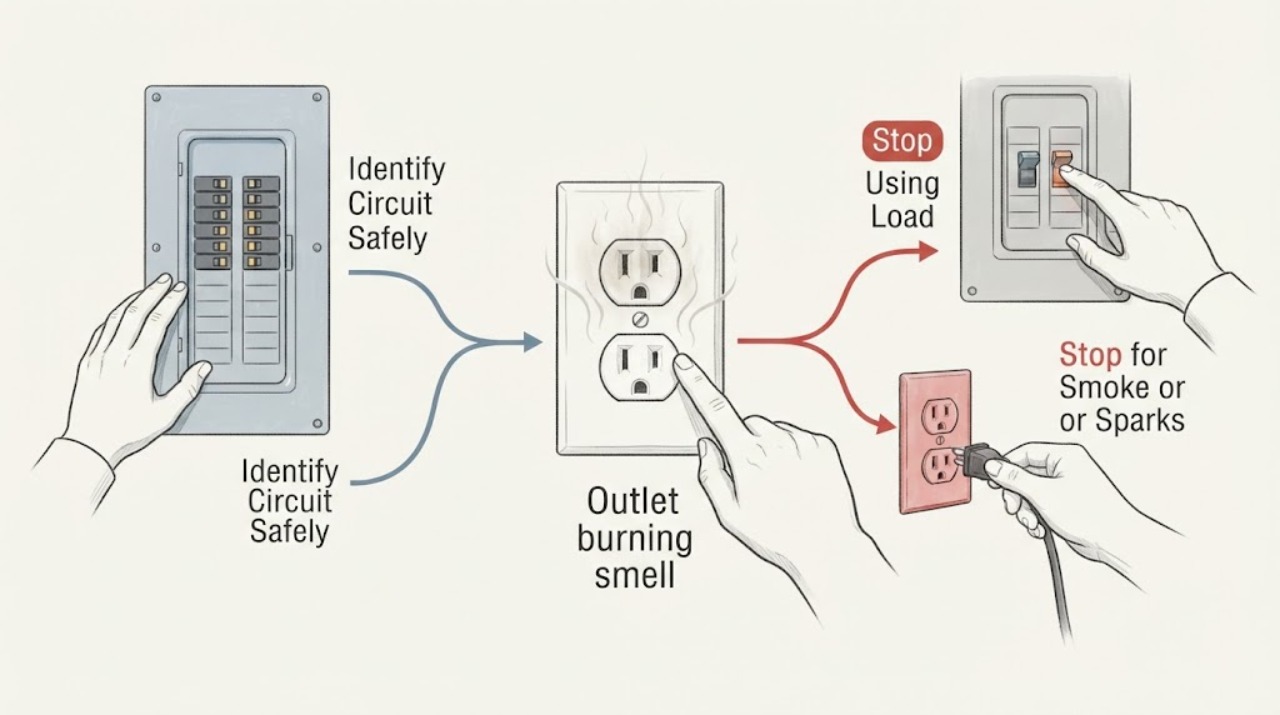
Treat a burning or rubbery smell from an outlet, plug, appliance cord, wall plate, or breaker area as an electrical fire warning. Stop using the outlet and do not unplug a hot, loose, smoking, or discolored plug. If there is no smoke, flame, sizzling, heat, water, or visible damage and the panel can be reached from a dry safe position, switch off the suspected circuit breaker once; otherwise keep your distance and call emergency services or the utility as appropriate. Do not reset the breaker, open the panel, remove the outlet, test voltage, or use the circuit again until a qualified electrician has inspected the outlet, breaker, wiring, and connected load.
Before you begin
Safety first
- This article permits only safe-distance observation, load identification, and leaving the suspected circuit unused. A qualified electrician must handle de-energized verification, panel or receptacle access, wiring, breaker, load, and equipment testing.
Work through in order
Diagnostic checks
Use only checks that match the exact appliance or system and its official guide.
-
Check 1
From a safe distance, look and listen without touching the outlet, plug, cord, appliance, wall, or breaker panel; check for smoke, flame, glow, sparks, sizzling, popping, or a surface that appears hot.
Expected result: Record whether there is active smoke or fire, visible arcing, a strong or worsening odor, heat, discoloration, or only a past odor with no current sign.
Next step: Leave the area for active fire or smoke and call emergency services from a safe location. For a past odor without active fire, keep the outlet and suspected load out of service and continue only with safe-distance identification.
Stop if: Do not approach, touch, spray water, open the panel, or attempt to extinguish a spreading electrical fire; evacuate and follow emergency instructions.
Why this matters
Why: Active smoke, flame, arcing, or rapidly worsening heat is an emergency and is not a troubleshooting situation. A past odor with no visible sign still indicates a possible overheated or damaged connection and must not be retested.
-
Check 2
Stop using the outlet and any connected appliance; do not unplug a hot, loose, melted, smoking, or discolored plug, and do not move the appliance if doing so would touch damaged insulation or a wet surface.
Expected result: Record whether the odor follows the appliance or cord, stays at the outlet or wall plate, is present at a power strip or extension cord, or is strongest near the panel.
Next step: Leave the suspected load disconnected only when it can be removed without touching a hazardous plug or surface; otherwise leave it in place, keep people away, and tell the electrician exactly where the odor was strongest.
Stop if: Stop for heat, smoke, sparks, exposed conductors, melted plastic, water, a loose plug, or any need to pull on a cord or touch the outlet.
Why this matters
Why: An odor at the appliance or cord can be a device fault; an odor at the outlet or wall suggests the receptacle or branch wiring; an odor at the panel points toward circuit protection or service equipment. The location is evidence, not permission to operate the load again.
-
Check 3
Only if there is no smoke, flame, heat, water, arcing, or damaged panel and the electrical panel is reachable from a dry safe position, read the existing breaker labels and note whether the suspected breaker is in its normal position or visibly tripped; do not remove the cover.
Expected result: Record the labeled circuit, breaker position, nearby heat or odor, and whether other outlets or lights lost power; do not touch the breaker to test it.
Next step: If the panel area is completely cool, dry, and free of odor or damage, a qualified electrician can use the label and affected outlets to isolate the circuit. If the breaker is hot, smells burned, is damaged, or the label is unclear, leave it alone and request urgent electrical service.
Stop if: Do not reset, cycle, pull, tighten, remove, or replace a breaker; do not open the panel or stand in water to reach it.
Why this matters
Why: A tripped breaker can mark an overload or fault, while a normal-looking breaker does not clear a burning odor. Several affected outlets may indicate a branch-circuit issue; a single outlet may still have a local connection fault.
-
Check 4
From the plug and cord exterior only, record what was connected and whether the outlet shared a strip, adapter, extension cord, heater, kitchen appliance, air conditioner, charger, or other high-load device; do not reconnect any item.
Expected result: Classify the event as one device only, several devices together, a power strip or extension cord, an appliance startup, or an unknown load; note any damaged cord, loose plug fit, discoloration, or warmth visible without contact.
Next step: Keep every suspected item out of service and provide the load list and photographs taken from a safe distance to the electrician; do not substitute another outlet or extension cord as a test.
Stop if: Do not handle a damaged cord, use a power strip to bypass the outlet, plug the appliance into another circuit, or continue testing after an odor or heat event.
Why this matters
Why: A combination of loads, loose fit, damaged cord, or extension device can contribute to overheating, but the observed pattern cannot identify which connection failed. A single device can also be faulty even when the circuit was not overloaded.
-
Check 5
From dry safe access, look for discoloration, bubbling, dampness, or odor at neighboring outlets, switches, the wall, ceiling, floor, and the panel area; do not remove covers or probe the wall.
Expected result: Record whether the sign is confined to one receptacle, appears on several outlets or lights, follows a wall or ceiling path, or is associated with a leak, condensation, or recent cleaning.
Next step: Keep the affected area out of service and request an electrician; if active water is present, avoid the area and have the water source isolated only by a safe route before electrical inspection.
Stop if: Do not touch wet electrical surfaces, remove a faceplate, drill or open a wall, or use water to clean soot or residue.
Why this matters
Why: One outlet suggests a local receptacle or connection issue but does not rule out the branch circuit. Multiple points, wall-path odor, moisture, flickering, or dimming can indicate a larger wiring or service problem and raise the urgency.
-
Check 6
Prepare a safe report for a qualified electrician: outlet location, breaker label and visible position, connected load, odor timing, sounds, smoke or heat, affected outlets, moisture, and photographs taken without touching anything.
Expected result: Record whether the smell began during use, after a breaker trip, after plugging in a device, after cleaning or water exposure, or without a known trigger; preserve the original plug and cord condition.
Next step: Tell the electrician that the outlet produced a burning smell and that the circuit has remained unused; request inspection of the outlet, breaker, wiring, load, and any connected appliance before restoring service.
Stop if: Do not take measurements, open equipment, remove the outlet, test continuity or voltage, or restore power for the visit.
Why this matters
Why: Timing and location help distinguish an appliance or cord fault from a receptacle, branch wiring, breaker, overload, or moisture fault, but only an electrician can confirm the source with safe de-energized inspection and appropriate testing.
Use your observations
Decision map
Find the observation that best matches what you see, then follow the next safe action.
-
PATH 01Safety boundary
What you see
Smoke, flame, glow, active arcing, popping, or rapidly worsening heat is present.
Do this next
Evacuate or move away, call emergency services from a safe location, and follow fire-department instructions; do not return to reset power or retrieve the appliance.
Why this path and its safety boundary
Why it matters: The condition may be an active electrical fire or imminent ignition hazard.
Safety stop: Do not touch the outlet or panel, use water, open walls, or attempt a spreading electrical fire with improvised equipment.
-
PATH 02Safety boundary
What you see
The receptacle, plug, cord, wall plate, or nearby wall is warm, discolored, melted, loose, cracked, or smells burned without active smoke.
Do this next
Keep the circuit and load out of service and arrange qualified electrician inspection; do not unplug a hazardous plug or use a replacement appliance as a test.
Why this path and its safety boundary
Why it matters: An overheated connection, damaged receptacle, cord, appliance, or wiring fault is possible even if the breaker has not tripped.
Safety stop: Do not touch, tighten, tape, replace, clean, or cover the damaged part.
-
PATH 03Safety boundary
What you see
The suspected circuit breaker is visibly tripped or the outlet lost power after the odor event.
Do this next
Leave the breaker in its present state, keep the load disconnected, and have an electrician diagnose the circuit before any reset.
Why this path and its safety boundary
Why it matters: The protection device may have responded to overload, short circuit, arcing, moisture, or equipment failure; the trip does not identify the failed point.
Safety stop: Do not repeatedly reset the breaker, substitute a larger breaker, bypass protection, or use an extension cord to restore the load.
-
PATH 04Safety boundary
What you see
The breaker appears normal, but the outlet or plug produced a burning smell.
Do this next
Keep the outlet unused and request electrician inspection of the receptacle, load, branch wiring, and protection; preserve the event details.
Why this path and its safety boundary
Why it matters: A normal breaker position does not rule out a local loose connection, damaged receptacle, appliance cord, overload, or arcing fault.
Safety stop: Do not use the breaker position as permission to restore power or perform a live test.
-
PATH 05Safety boundary
What you see
The odor began while one appliance or cord was connected, and the outlet is not visibly damaged from a safe distance.
Do this next
Keep both the appliance and outlet out of service, do not test the appliance elsewhere, and ask the electrician to assess the load and outlet before the device is evaluated by its manufacturer or a qualified repair provider.
Why this path and its safety boundary
Why it matters: The appliance or cord may be faulty, but the receptacle and circuit may also have been stressed or damaged.
Safety stop: Do not reconnect, substitute a new cord, use an adapter, or move the suspected appliance to another circuit as a test.
-
PATH 06Safety boundary
What you see
Several loads, a power strip, adapter, extension cord, or heat-producing appliance were connected when the odor appeared.
Do this next
Leave all related loads disconnected and have the circuit inspected; afterward, follow USFA guidance for direct wall connection and avoiding overloaded outlets or inappropriate extension use.
Why this path and its safety boundary
Why it matters: The load arrangement may have contributed to overheating, but it does not prove that the outlet or wiring is undamaged.
Safety stop: Do not spread the same load across another outlet, add a strip, or restore power before inspection.
-
PATH 07Safety boundary
What you see
The odor or discoloration appears at multiple outlets, lights, the wall or ceiling, or any point affected by water.
Do this next
Avoid the affected area, keep electrical equipment untouched, isolate the water source only if safe, and request urgent electrician assessment; use emergency services for smoke or fire.
Why this path and its safety boundary
Why it matters: A branch-circuit, concealed wiring, service, or moisture fault may be involved and the risk is broader than one receptacle.
Safety stop: Do not touch wet surfaces, open walls or panels, or restore power to check whether the odor is gone.
Helpful context
Understand the symptom
A burning smell is a stop signal, not a test condition
The odor may come from the receptacle, wall plate, plug, cord, appliance, or the circuit protection area. Heat, a loose connection, overload, damaged cord, moisture, or arcing can have the same first symptom. The safe goal is to remove the load from service and preserve evidence for an electrician, not to plug the device back in to see whether the smell returns. NFPA specifically groups burning odor, warm or discolored outlets, sparks, and repeated breaker trips with conditions that need qualified electrical inspection.
Separate the outlet from the breaker without opening either one
From a safe position, note whether the smell is strongest at one outlet, a plug or appliance, a wall cavity, or the breaker panel. A breaker that has tripped may be responding to a fault, but a breaker that has not tripped does not prove that the outlet and wiring are safe. Do not remove a faceplate, panel cover, receptacle, or breaker, and do not touch a warm or wet surface.
Leave the repair to a qualified electrician
Once the circuit is isolated safely, the electrician can determine whether the cause is the receptacle, breaker, cord, appliance, branch wiring, overload, moisture, or another connection. USFA advises not overloading outlets, fully inserting plugs, replacing damaged cords, and avoiding extension cords for major appliances. Those prevention rules do not make a previously hot or burned outlet safe; the damaged circuit needs inspection before reuse.
Safety boundary
Stop conditions
- Treat burning odor, warm or discolored outlets, sparks, sizzling, smoke, or repeated breaker trips as stop-use signals; do not operate the outlet or connected load again.
- Do not repeatedly reset the breaker, replace it with a larger rating, bypass protection, open the panel, remove a faceplate, or perform a live voltage or continuity test.
- Do not unplug a hot, loose, melted, smoking, wet, or arcing plug; do not pull the cord, spray water, tape damage, or move a hazardous appliance.
- Do not use another outlet, adapter, power strip, or extension cord to reproduce the event or work around the affected circuit.
- Leave active smoke, flame, or spreading heat and call emergency services; otherwise arrange qualified electrician inspection before restoring power.
Only after diagnosis
Potential parts
- electrical receptacle
Consider this category only when a qualified electrician confirms that the receptacle is heat-damaged, loose, worn, or otherwise failed.
The electrician must confirm circuit, voltage, grounding, protection, box, environment, and local requirements; do not choose a receptacle from appearance alone. - circuit breaker
Consider this category only when professional diagnosis confirms that the breaker is damaged or unsuitable for the identified panel and circuit.
Panel listing, circuit conductors, protection type, rating, and local requirements must be confirmed by a qualified electrician; never substitute a larger rating or bypass protection. - branch-circuit wiring repair
Consider this service category only when inspection finds a loose, overheated, damaged, wet, or otherwise unsafe connection beyond the receptacle or appliance cord.
Wiring method, conductor, enclosure, protection, and repair scope are installation-specific and must be selected and completed by a qualified electrician.
When checks do not resolve it
Need a professional?
Arrange qualified electrician service for any burning or rubbery smell from an outlet, plug, cord, appliance, wall, or circuit breaker, even if the smell stopped and the breaker did not trip. Request urgent help for a hot or discolored outlet, sparks, sizzling, flickering, repeated trips, water exposure, smoke, or a suspected panel fault. Leave active smoke or fire and use emergency services from a safe location.
Safety scope: This article permits only safe-distance observation, load identification, and leaving the suspected circuit unused. A qualified electrician must handle de-energized verification, panel or receptacle access, wiring, breaker, load, and equipment testing.
Common questions
FAQ
Is a burning smell from an outlet an emergency?
Treat it as an electrical warning. Smoke, flame, visible arcing, popping, or rapidly worsening heat requires leaving the area and calling emergency services from a safe location. If the odor stopped, keep the circuit unused and arrange qualified electrician inspection rather than testing it again.
Should I reset the breaker after an outlet smells burnt?
No. A tripped breaker may mark an overload or fault, but a normal breaker position does not prove the outlet is safe. Leave the breaker in its present state, keep the load disconnected when safe, and have an electrician diagnose the circuit before restoring power.
Can the appliance be the source instead of the outlet?
Yes, the appliance or cord may be faulty, but the receptacle and circuit can also be damaged or overheated. Do not test the appliance in another outlet. Record where the odor was strongest and have the electrical connection inspected first.
Can I unplug a hot or melted plug?
Do not touch a hot, loose, melted, smoking, wet, or arcing plug. Keep people away and request emergency or qualified electrical help as appropriate. Pulling the cord or forcing the plug can worsen the fault or expose live parts.
What should an electrician check?
Provide the outlet location, breaker position, connected load, timing, odor location, heat or discoloration, affected outlets, and any moisture. The electrician should determine whether the source is the receptacle, breaker, cord, appliance, overload, branch wiring, or moisture before safe restoration.
Read the exact guide
Official sources
- Appliance and Electrical Fire SafetyU.S. Fire Administration · U.S. Fire Administration household fire-safety guidance; it does not replace emergency instructions or qualified electrical inspection.
- Electrical Safety DosElectrical Safety Foundation International · ESFI household electrical-safety education; use it for warning-sign recognition, not for live electrical work.
- Electrical Safety: ChecklistNational Fire Protection Association · NFPA household electrical safety checklist; it is safety guidance, not permission for unqualified electrical repair.
Community feedback
Share a repair observation
Share a plain-text repair observation. Accepted observations are published automatically; this page may take a moment to update.