
On this page
Start here
Quick answer
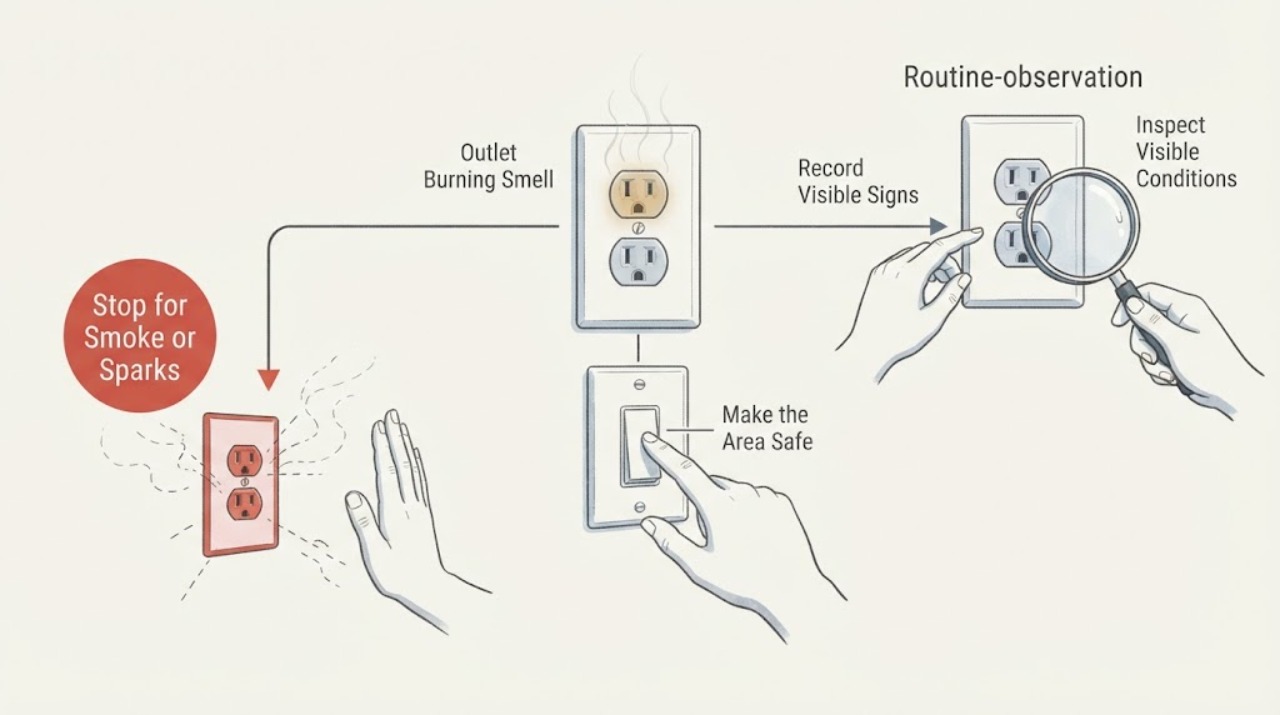
A burning smell from an outlet, wall switch, plug, or nearby wall is a warning of overheating or an electrical fault, not a normal operating odor. Stop using the switch and outlet immediately, keep people away, and do not plug in another device, operate the switch to test it, reset a tripped breaker repeatedly, remove the cover, or take live measurements. If there is smoke, flame, crackling, visible arcing, a hot or discolored plate, a melted plug, or a rapidly worsening odor, leave the area and contact emergency help from a safe location. If there is no immediate fire hazard and it can be done without approaching heat, water, or exposed wiring, a qualified electrician can isolate the circuit and inspect the switch, receptacle, wiring, load, and protective device.
Work through in order
Diagnostic checks
Use only checks that match the exact appliance or system and its official guide.
-
Check 1
Stop using the suspect outlet and switch. Keep hands away from the plate, plug, cord, and wall, and move children or pets away. Do not operate the switch, unplug a hot or smoking plug, or plug in another device.
Expected result: There is smoke, flame, visible arcing, sizzling, a rapidly spreading odor, a hot or painful plate, or a melted plug; or the odor is present without those immediate signs.
Next step: Use the emergency branch immediately if smoke, flame, arcing, or rapidly worsening heat is present. Otherwise leave the outlet and switch unused and arrange a qualified electrician inspection.
Why this matters
Why: Visible fire, arcing, or intense heat is an active hazard. A smell without visible damage is still evidence of possible overheating and cannot be cleared by a normal-looking faceplate.
-
Check 2
From a safe position, identify the first location of the odor: switch plate, receptacle opening, plug or cord, nearby wall, ceiling, or an appliance. Do not touch the surface to compare temperatures.
Expected result: The odor is strongest at the switch, at the receptacle, at the appliance cord or plug, or in the wall or ceiling away from the outlet.
Next step: Tell the electrician the strongest location and whether the odor began when the switch was operated or when an appliance was running. Keep every suspected point out of use.
Why this matters
Why: A switch-specific odor makes switch contacts or their connections possible; a receptacle or plug odor can involve loose contact, load, or cord damage; a wall or ceiling odor may indicate concealed wiring or another heat source. Location alone does not prove the failed part.
-
Check 3
Without touching damaged material, look for external signs such as a darkened or warped plate, melted plastic, a loose-looking switch, scorch marks, a plug that no longer sits firmly, a cracked cord jacket, or a missing cover.
Expected result: Any discoloration, melting, looseness, damage, missing cover, or visible conductor is present; or the outside looks normal.
Next step: Do not straighten, tighten, tape, replace, or cover the damaged item. Keep the area unused and ask an electrician to isolate and inspect it; do not remove the faceplate.
Why this matters
Why: Heat or mechanical damage supports an overheating, arcing, loose-contact, or wiring fault. A normal exterior does not rule out heat inside the box or at another device on the same circuit.
-
Check 4
Record what was connected and what was happening when the smell appeared: a heater or other high-load appliance, a lamp, a motor, a charger, a dimmer, a switched appliance, or nothing at all. Do not reconnect the load to reproduce the odor.
Expected result: The odor follows one appliance or cord, follows operation of the wall switch, occurs only when several loads run, or occurs even with no known load.
Next step: Keep the appliance and the suspect circuit out of service until the electrician determines whether the device, switch, receptacle, branch wiring, or circuit protection is at fault. Never substitute a larger protective device.
Why this matters
Why: A load-specific odor can involve an appliance cord or plug, while a switch-specific or no-load odor raises concern about the switch, receptacle, branch wiring, or a connection feeding nearby devices. Multiple loads can also overload a circuit.
-
Check 5
From a dry, safe position and only if there is no smoke, heat, water, arcing, or gas odor nearby, note whether the electrical panel shows a tripped breaker or whether a GFCI or AFCI device has opened. Do not reset it repeatedly or open the panel.
Expected result: A breaker or protective device is tripped, it trips again, or no protective device appears open.
Next step: Do not repeatedly reset the breaker or protective device. Report the circuit label and trip timing to an electrician, who can determine whether isolation or emergency service is needed.
Why this matters
Why: A trip can indicate overload, a fault in the appliance, or a fault in the switch, outlet, or wiring. A device that has not tripped does not make a burning odor safe; heat can develop before protection operates.
-
Check 6
Check the surrounding area from a safe distance for water, dampness, a recent leak, combustible material, or a smell that could be coming from another appliance or fuel source. Do not approach a wet electrical point or use a switch near a gas odor.
Expected result: Water or dampness is present, the odor is near a gas or fuel appliance, the smell is from another device, or the area is dry and the source remains the switch or outlet.
Next step: Keep clear and use emergency help for smoke, fire, gas odor, or water reaching electrical equipment. Otherwise isolate the area and schedule qualified electrical inspection; do not use fans, heaters, or switches to disperse or test the smell.
Why this matters
Why: Water can create shock and fault risk, while a gas odor is an emergency path separate from an electrical diagnosis. A nearby appliance can be the source, but the suspect outlet or switch remains unsafe until cleared.
Use your observations
Decision map
Find the observation that best matches what you see, then follow the next safe action.
-
PATH 01Next step
What you see
Smoke, flame, visible arcing, sizzling, a rapidly worsening odor, or a hot or melting plate or plug is present.
Do this next
Arrange qualified service and follow the exact model guidance.
Why this path and its safety boundary
Why it matters: Leave the area, keep others away, and contact emergency services from a safe location. Do not touch the device, operate switches, pull a hot plug, or re-energize the circuit.
-
PATH 02Next step
What you see
The smell is strongest when the wall switch is operated, or the switch is warm, discolored, loose, buzzing, or gives a shock or tingle.
Do this next
Arrange qualified service and follow the exact model guidance.
Why this path and its safety boundary
Why it matters: Stop using the switch and arrange prompt qualified electrician inspection. Do not remove the cover, tighten terminals, replace the switch, or test it under load.
-
PATH 03Next step
What you see
The smell is strongest at a plug or cord, the plug is loose in the receptacle, or the cord is cracked, melted, or discolored.
Do this next
Arrange qualified service and follow the exact model guidance.
Why this path and its safety boundary
Why it matters: Do not use or move the affected appliance if doing so requires touching heat or damage. Keep the outlet unused and have the appliance cord and receptacle assessed by qualified personnel.
-
PATH 04Next step
What you see
A breaker, GFCI, or AFCI has opened, or it opens again after the event.
Do this next
Arrange qualified service and follow the exact model guidance.
Why this path and its safety boundary
Why it matters: Do not repeatedly reset it or install a larger fuse or breaker. Record the circuit and event, keep the load off, and call an electrician to find the fault before power is restored.
-
PATH 05Next step
What you see
Water or dampness reaches the outlet, switch, wall, floor, or connected equipment.
Do this next
Arrange qualified service and follow the exact model guidance.
Why this path and its safety boundary
Why it matters: Do not touch the wet electrical point or operate a nearby switch. Keep people away and obtain qualified electrical help; use emergency help if there is smoke, arcing, or fire.
-
PATH 06Next step
What you see
There is a gas or fuel odor, or the smell may be from a fuel-burning appliance rather than the outlet or switch.
Do this next
Arrange qualified service and follow the exact model guidance.
Why this path and its safety boundary
Why it matters: Treat it as a fuel emergency: leave as appropriate, avoid flames and electrical switching near the odor, and contact the gas utility or emergency service from a safe location. Do not return to test the outlet.
-
PATH 07Next step
What you see
There is no immediate smoke, heat, water, arcing, or gas odor, but a burning smell occurred at the switch or outlet.
Do this next
Arrange qualified service and follow the exact model guidance.
Why this path and its safety boundary
Why it matters: Keep the switch and outlet unused and schedule a qualified electrician inspection. A normal-looking plate or a circuit that still has power does not clear hidden overheating.
Helpful context
Understand the symptom
Treat the location as energized even if the device no longer works. A smell may come from the switch contacts, the receptacle behind the plate, a loose connection in the box, an overloaded circuit, or a cord and plug. The visible wall plate is only an external clue; it cannot show whether heat has damaged wiring behind it.
The safest homeowner role is to stop use, move people away, and report what happened. Do not use the suspect switch or outlet as a test point, and do not move a plug if the plate or plug is hot, smoking, wet, melted, or sparking. An electrician should identify the circuit and inspect the switch, receptacle, conductors, load, and protective device.
A warm odor from a high-load appliance, a loose-feeling plug, a switch that smells only when operated, and a smell that remains after the device is off can lead to different diagnostic paths. Record these distinctions without opening the box or repeatedly energizing the circuit.
Safety boundary
Stop conditions
- Smoke, flame, visible arcing, crackling or sizzling, a rapidly worsening burning smell, or a hot, painful, melting, or discolored plate or plug: leave the area and contact emergency help from a safe location.
- Water or dampness at electrical equipment, a shock or tingle, exposed conductor, missing cover, or a breaker that trips again: stop contact and obtain qualified electrical help; do not reset or test repeatedly.
- Gas or fuel odor near the outlet or switch: avoid flames and electrical switching near the odor, leave as appropriate, and contact the relevant emergency or gas service from a safe location.
Only after diagnosis
Potential parts
- wall switch
Consider only after an electrician confirms the switch itself is heat-damaged or faulty; a burning odor can instead come from a connection, receptacle, cord, load, or branch wiring.
The electrician must confirm the switch type, rating, wiring method, enclosure, and local requirements; do not order or install by appearance alone. - receptacle outlet
Consider only after qualified inspection finds a damaged or worn receptacle or heat-affected connection at the outlet location.
Confirm grounding, protection, rating, box condition, and local code with a qualified electrician; this is not a safe live homeowner replacement.
Common questions
FAQ
Is a faint burning smell from a switch ever normal?
No. A burning or rubbery odor from an outlet, switch, plug, or nearby wall should be treated as a warning of overheating or an electrical fault. Stop using it and arrange qualified inspection, even if the smell later disappears.
Should I reset the breaker to see whether the smell returns?
No. Re-energizing a suspect circuit can worsen an electrical fault. Do not repeatedly reset a breaker, GFCI, or AFCI; report the event to a qualified electrician and keep the load off.
Can I remove the switch plate to see what is burning?
No. The box may remain energized, and the plate can be hiding heat-damaged or loose connections. Keep the cover in place and have a qualified electrician isolate and inspect the circuit.
What should I do if there is smoke or visible sparking?
Leave the area, keep others away, and contact emergency help from a safe location. Do not touch the outlet or switch, operate nearby electrical controls, pull a hot plug, or return to test it.
Read the exact guide
Official sources
- Electrical Safety: ChecklistNational Fire Protection Association · Burning odors, warm or discolored outlets, sparks, cords, GFCI/AFCI protection, overload prevention, and qualified electrician guidance
- CPSC Guide to Home Wiring HazardsU.S. Consumer Product Safety Commission · Electrical warning signs, hot or discolored switches and receptacles, odors, arcing, repeated trips, and qualified-service boundaries
Community feedback
Share a repair observation
Share a plain-text repair observation. Accepted observations are published automatically; this page may take a moment to update.