
On this page
Start here
Quick answer
A persistent buzz from an outlet, switch, wall plate, plug, light, or breaker area is not a normal user-repair signal. Stop using the point and connected load. From a safe, dry position, note whether the sound changes with a switch or appliance, and whether there is heat, discoloration, flickering, burning smell, sizzling, sparks, water, or a breaker trip. If the panel is cool, dry, and free of smoke or damage, a qualified person may isolate the suspected circuit from the panel; do not reset or cycle it to test. Never open the panel, switch, or receptacle, measure live voltage, or use another outlet to reproduce the noise. Arrange a qualified electrician inspection before restoring power.
Before you begin
Safety first
- This article permits only safe-distance observation, load identification, and leaving the affected point or circuit unused. A qualified electrician must handle de-energized verification, panel access, receptacle or switch access, wiring, breaker, load, and protective-device testing.
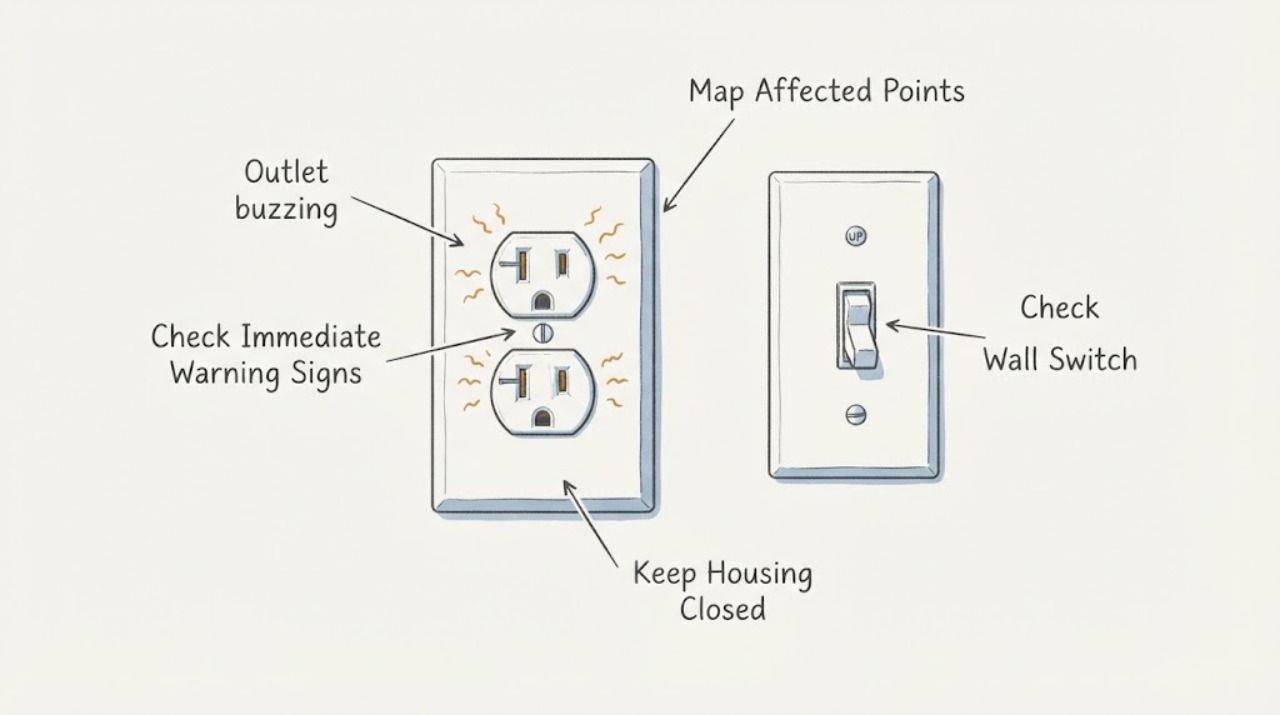
Work through in order
Diagnostic checks
Use only checks that match the exact appliance or system and its official guide.
-
Check 1
From a safe distance, look and listen without touching the outlet, switch, plate, plug, cord, appliance, wall, or panel; check for smoke, flame, sparks, sizzling, popping, glow, heat, burning smell, or visible discoloration.
Expected result: Record whether the buzz is continuous or intermittent and whether any heat, odor, smoke, arcing, flicker, or damage is present.
Next step: Leave active smoke or fire and call emergency services from a safe location. For a non-active warning, stop using the point and continue only with safe-distance identification.
Stop if: Do not approach an active fault, touch a hot or smoking surface, spray water, open a panel, or attempt to extinguish a spreading electrical fire.
Why this matters
Why: Smoke, flame, arcing, or rapidly worsening heat is an emergency. Buzzing without those signs is still an electrical warning that needs inspection, not a reason to keep testing.
-
Check 2
Stop operating the buzzing switch and stop using any appliance or lamp connected to the buzzing outlet; do not unplug a hot, loose, melted, wet, or smoking plug.
Expected result: Record whether the buzz is strongest at the switch, receptacle, plug, appliance, power strip, or cord, and whether it began only when one load was connected.
Next step: Keep the point and any related load out of service, preserve the plug and cord in place when touching them is unsafe, and give the sound location and timing to the electrician.
Stop if: Do not move a hazardous appliance, pull a cord, press the switch again, or use an adapter, power strip, or another outlet as a test.
Why this matters
Why: A load-specific sound can involve the appliance, cord, switch, receptacle, or circuit under load. A sound when no load is connected makes a local connection, control, or branch-circuit issue more concerning.
-
Check 3
From ordinary safe access, observe nearby outlets, switches, lights, and appliances without opening covers; note whether the same buzz, dimming, flickering, or loss of power appears at more than one point.
Expected result: Classify the event as one outlet, one switch, one appliance, a room, several points on a circuit, or a wider part of the home; note whether the sound changes when another device starts, without starting devices for the test.
Next step: Keep all affected points unused and provide the map to a qualified electrician; do not search inside walls or move loads around the home.
Stop if: Stop for water exposure, wall or ceiling damage, widespread flicker, a hot plate, odor, sparks, or any need to remove a cover or open a wall.
Why this matters
Why: One point can still have a branch-wiring fault, while several affected points or light changes suggest a broader circuit or load problem. Do not infer safety from a single quiet neighboring outlet.
-
Check 4
Only if there is no smoke, heat, odor, water, or panel damage and the panel can be reached from a dry safe position, read existing labels and note whether the suspected breaker is in its normal position or visibly tripped; do not touch it.
Expected result: Record the labeled circuit, breaker position, nearby panel sound or odor, and whether the buzzing point lost power; do not cycle the breaker.
Next step: Leave the breaker as found and request electrician inspection; use emergency services for smoke or fire, and do not restore power to reproduce the buzz.
Stop if: Do not reset, cycle, pull, replace, or size a breaker, and do not remove the panel cover or stand in water to reach it.
Why this matters
Why: A tripped breaker may indicate overload or a fault, but a normal position does not clear a buzzing switch, outlet, load, or wire. A hot, damaged, or noisy breaker area is a separate urgent panel hazard.
-
Check 5
Write down what was connected to the point and circuit when the buzzing began, including any heat-producing appliance, motor, dimmer, power strip, extension cord, charger, or recent installation; do not reconnect any item.
Expected result: Record whether the event follows one load, several loads, a switch action, an appliance startup, a recent change, or no known trigger; note visible cord damage without touching the cord.
Next step: Keep the load arrangement out of service and give the electrician the list, timing, and safe-distance photos; do not relocate the load for comparison.
Stop if: Do not use an extension cord or power strip to bypass the point, operate a heater to reproduce the noise, or handle damaged insulation.
Why this matters
Why: Overload, a damaged cord, a failing appliance, an incompatible control, or a loose connection can create noise under load. The pattern narrows the inspection but cannot prove which part failed.
-
Check 6
From across the room, inspect the switch or outlet plate and surrounding wall for darkening, melting, gaps, a leaning switch, moisture, or exposed wiring; do not touch or remove the plate.
Expected result: Record whether the plate is intact, discolored, cracked, loose-looking, warm by visual indication, wet, or associated with wall damage; do not confirm heat by hand.
Next step: Keep the point unused and arrange qualified electrician service; isolate a water source only by a safe route and never while touching electrical equipment.
Stop if: Do not touch warm or wet electrical parts, tape a plate, tighten hardware, open the wall, or clean soot or residue.
Why this matters
Why: Discoloration, a damaged plate, exposed wiring, or moisture can indicate heat or shock risk and increases urgency. An intact plate does not rule out a hidden loose connection or wiring fault.
-
Check 7
Prepare a report for a qualified electrician with the point location, sound timing, affected loads and points, breaker position, flicker or trip history, odor or heat, water exposure, and safe-distance photos.
Expected result: Record whether the buzz occurs with no load, only under load, only when a switch changes state, after a storm or water event, or after electrical work; preserve the existing condition.
Next step: Tell the electrician that the point has been left unused and request inspection before any breaker reset, cover removal, outlet replacement, or load reconnection.
Stop if: Do not use a voltage tester, remove a device, open a panel, or restore power to verify the report.
Why this matters
Why: Timing and location help separate a switch, receptacle, appliance, cord, breaker, overload, branch wiring, or moisture issue, while only qualified inspection can establish the failed point.
Use your observations
Decision map
Find the observation that best matches what you see, then follow the next safe action.
-
PATH 01Safety boundary
What you see
Smoke, flame, glow, arcing, popping, or rapidly worsening heat is present.
Do this next
Evacuate or move away, call emergency services from a safe location, and follow official instructions; do not return to cycle the breaker.
Why this path and its safety boundary
Why it matters: The electrical fault may be active and can ignite nearby material.
Safety stop: Do not touch the point, open the panel, use water, or attempt a spreading electrical fire with improvised equipment.
-
PATH 02Safety boundary
What you see
The switch or outlet is warm, discolored, melted, cracked, loose-looking, or accompanied by burning odor.
Do this next
Keep the point out of service and request prompt electrician inspection; do not touch or operate it to confirm the sound.
Why this path and its safety boundary
Why it matters: An overheated connection, damaged device, overloaded circuit, or wiring fault is possible.
Safety stop: Do not remove the plate, tighten a screw, cover the damage, or unplug a hazardous cord.
-
PATH 03Safety boundary
What you see
The circuit breaker is visibly tripped or the affected point lost power after the buzz.
Do this next
Leave it in its present position, keep the load disconnected, and have an electrician diagnose the circuit before any reset.
Why this path and its safety boundary
Why it matters: The protection device may have responded to overload, short circuit, arcing, moisture, or equipment failure.
Safety stop: Do not repeatedly reset, substitute, bypass, or up-rate the breaker.
-
PATH 04Safety boundary
What you see
The breaker appears normal, but a switch or outlet still buzzes.
Do this next
Keep the point unused and request electrician inspection of the switch, outlet, connected load, branch wiring, and protection.
Why this path and its safety boundary
Why it matters: A normal breaker position does not rule out a local loose connection, failing device, load fault, or arcing that has not reached the trip threshold.
Safety stop: Do not cycle the breaker or use the normal position as permission to restore the load.
-
PATH 05Safety boundary
What you see
The buzz began only when one appliance, lamp, dimmer, motor, or power strip was connected or switched on.
Do this next
Keep both the load and point out of service and provide the timing and load details to the electrician; do not test the load elsewhere.
Why this path and its safety boundary
Why it matters: The load or control may be involved, but the receptacle, switch, cord, and circuit may also have been stressed.
Safety stop: Do not reconnect, substitute a cord, change a bulb or control, or use another circuit as a test.
-
PATH 06Safety boundary
What you see
Several switches, outlets, or lights buzz, flicker, dim, or change when another device operates.
Do this next
Stop using the affected points and request prompt electrician assessment; do not redistribute loads or run a comparison test.
Why this path and its safety boundary
Why it matters: A broader load, branch-circuit, wiring, or service issue may be involved.
Safety stop: Stop for widespread flicker, odor, heat, water, sparks, or any need to access wiring or the service panel.
-
PATH 07Safety boundary
What you see
Water, dampness, exposed conductors, wall damage, or a recent leak is associated with the buzzing point.
Do this next
Avoid the area, isolate water only from a safe route, and request urgent electrician service; use emergency services for smoke or fire.
Why this path and its safety boundary
Why it matters: Moisture and exposed wiring increase shock and fire risk and make ordinary observation unsafe.
Safety stop: Do not touch wet surfaces, remove covers, operate the switch, or restore power to see if the buzz stops.
Helpful context
Understand the symptom
Buzzing is a stop-use warning
A switch or outlet can buzz because of a loose connection, arcing, overload, a failing device, or a control that is not compatible with its load. The sound may travel through a wall, so the loudest point is useful evidence but not proof of the failed component. Warmth, discoloration, flickering, sizzling, odor, or a breaker trip increases the urgency. Do not keep operating the switch or plugging in a load to reproduce the sound.
Separate a switch, receptacle, load, and circuit
From a safe distance, record whether the sound occurs only when a light or appliance is on, whether it comes from one switch or outlet, and whether nearby lights or outlets also flicker or lose power. A device or cord can be the source, but a quiet device does not clear the receptacle or branch wiring. A breaker that has not tripped also does not prove that the connection is safe.
Leave access and testing to an electrician
Electrical safety guidance treats unusual buzzing, hot or discolored plates, and repeated trips as reasons for qualified inspection. The electrician can de-energize the correct circuit and assess the switch, receptacle, load, breaker, wiring, and protective devices. Do not remove a cover plate, tighten a terminal, replace a breaker, or use a tester as a live troubleshooting method.
Safety boundary
Stop conditions
- Stop using any buzzing switch, outlet, plug, cord, appliance, or circuit; treat heat, discoloration, burning odor, sizzling, sparks, flicker, and trips as urgent warning signs.
- Do not reset or cycle the breaker, replace it with a larger rating, bypass protection, open the panel, remove a faceplate, or perform a live measurement.
- Do not press the switch again, unplug a hot or damaged plug, use another outlet, add a power strip, or use an extension cord to reproduce or bypass the noise.
- Do not touch wet electrical parts, exposed wiring, melted plastic, or a warm plate; do not use water on an electrical fire.
- Leave active smoke, flame, arcing, or spreading heat and call emergency services; otherwise arrange qualified electrician inspection before restoring power.
Only after diagnosis
Potential parts
- electrical switch or receptacle
Consider this category only when a qualified electrician confirms that the buzzing device is heat-damaged, loose, worn, incompatible, or otherwise failed.
The electrician must confirm circuit, voltage, grounding, load, box, protection, device type, and local requirements; do not select a replacement from appearance alone. - circuit breaker
Consider this category only when professional diagnosis confirms that the breaker is damaged or unsuitable for the identified panel and circuit.
Panel listing, circuit conductors, protection type, rating, and local requirements must be confirmed by a qualified electrician; never substitute a larger rating or bypass protection. - branch-circuit wiring repair
Consider this service category only when inspection finds a loose, overheated, damaged, wet, or otherwise unsafe connection beyond the device or cord.
Wiring method, conductor, enclosure, protection, and repair scope are installation-specific and must be selected and completed by a qualified electrician.
When checks do not resolve it
Need a professional?
Arrange qualified electrician service for any persistent buzz from an outlet, switch, plug, wall, appliance, or breaker area, even if the sound stops. Request prompt or urgent service for heat, discoloration, burning smell, sizzling, sparks, flickering, repeated trips, water exposure, exposed wiring, or a panel-area noise. Leave active smoke or fire and use emergency services from a safe location.
Safety scope: This article permits only safe-distance observation, load identification, and leaving the affected point or circuit unused. A qualified electrician must handle de-energized verification, panel access, receptacle or switch access, wiring, breaker, load, and protective-device testing.
Common questions
FAQ
Is buzzing from an outlet normal?
Persistent buzzing from an outlet, switch, wall plate, plug, or breaker area is a warning sign, especially with heat, discoloration, flickering, odor, sizzling, sparks, or trips. Stop using the point and arrange qualified electrician inspection.
Should I turn the buzzing switch on and off to find the cause?
No. Repeated operation can worsen a loose or arcing connection. Record whether the sound was linked to a switch or load only if that information is already known, then leave the point unused for inspection.
Should I reset the breaker when an outlet buzzes?
Do not cycle it to test the sound. A tripped breaker may indicate a fault, and a normal breaker position does not clear the outlet or wiring. Leave it as found and have an electrician diagnose the circuit.
Can a power strip cause outlet buzzing?
A power strip or several connected loads can contribute to overload or a load-specific fault, but the outlet and branch circuit may also be damaged. Stop using the strip and connected loads; do not move them to another outlet as a test.
When is buzzing an emergency?
Smoke, flame, visible arcing, popping, glow, or rapidly worsening heat requires leaving the area and calling emergency services from a safe location. Heat, burning smell, water, exposed wiring, or repeated trips also require prompt electrical service without further testing.
Read the exact guide
Official sources
- Electrical Safety: ChecklistNational Fire Protection Association · NFPA household electrical safety checklist; it is safety guidance, not a homeowner repair procedure.
- Appliance and Electrical Fire SafetyU.S. Fire Administration · U.S. Fire Administration household fire-safety guidance; it does not replace emergency instructions or qualified inspection.
- Home Electrical SafetyElectrical Safety Foundation International · ESFI household electrical-safety education; it is warning-sign guidance, not permission for live electrical work.
Community feedback
Share a repair observation
Share a plain-text repair observation. Accepted observations are published automatically; this page may take a moment to update.