
On this page
Start here
Quick answer
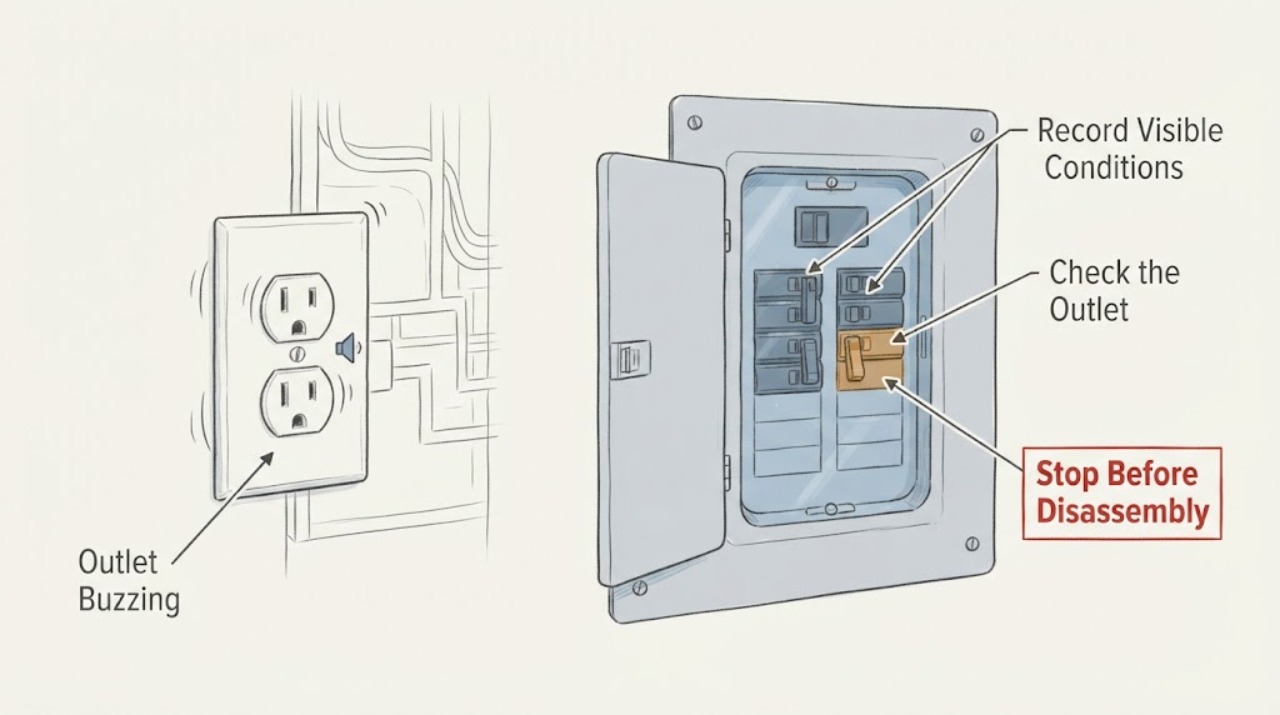
A buzzing outlet is not a normal noise to test repeatedly, and the assigned circuit breaker is a possible clue rather than a confirmed source. From a safe distance, stop using the outlet, note whether the sound comes from the receptacle, a plugged-in cord or appliance, the wall, or the breaker panel, and record whether it changes with an existing load or nearby light. Do not touch the faceplate, plug, cord, breaker, wiring, or panel if there is heat, moisture, discoloration, burning odor, smoke, sparks, arcing, shock, or a loose outlet. Do not remove an outlet or panel, measure voltage, reset the breaker repeatedly, or plug the load back in to reproduce the buzz. Leave the affected circuit off if it has already tripped and arrange a licensed electrician to inspect the receptacle, circuit, breaker, connections, and load.
Work through in order
Diagnostic checks
Use only checks that match the exact appliance or system and its official guide.
-
Check 1
From a safe position, stop using the outlet and listen without touching it, its faceplate, the plug, the cord, or the wall. Record whether the buzz is continuous, intermittent, or limited to an appliance starting or stopping.
Expected result: Note the exact room and outlet, whether the sound is loud enough to hear across the room, and whether it continues after the connected appliance is no longer operating without approaching the outlet.
Next step: Leave the outlet unused and arrange electrical inspection. If the sound changes to sizzling, crackling, arcing, or a louder buzz, move away and use the urgent safety branch.
Why this matters
Why: A sound that persists at a receptacle or wall is an electrical safety concern; a sound that tracks one appliance may involve the load or cord, but it is still not safe to reconnect it for a test. Timing helps the electrician separate outlet, load, and circuit symptoms.
-
Check 2
Without touching the outlet or panel, compare the apparent sound location with other safe locations: the outlet face, a nearby appliance, a wall or ceiling, and the closed breaker-panel area. Do not place an ear or hand against any surface.
Expected result: Record whether the noise is strongest at the receptacle, the appliance or cord, the wall, or the breaker enclosure, and whether nearby lights flicker or dim.
Next step: Do not remove a cover or open the panel to confirm the source. Give the location comparison to the electrician and keep the suspected circuit or outlet out of service.
Why this matters
Why: The loudest location can distinguish a receptacle or connected-load symptom from a breaker or branch-circuit clue, but sound can travel through walls. Flicker, heat, or a panel buzz increases the need for prompt electrician inspection.
-
Check 3
From a dry distance, visually inspect the outlet cover, plug, and cord insulation without touching them. Do not pull on a loose plug, push it in, rotate it, or move a damaged cord.
Expected result: Record discoloration, melting, soot, cracks, moisture, a loose or partially inserted plug, frayed insulation, an outlet that looks displaced, or a cover that appears warm or damaged.
Next step: Keep clear and request urgent electrical service for heat, melting, smoke, sparks, or exposed conductors. Do not cover the outlet with tape, tighten screws, or replace the receptacle yourself.
Why this matters
Why: Heat, discoloration, moisture, damage, or a loose connection raises fire and shock risk and means the outlet should not be used. A normal-looking cover does not prove the wiring or breaker is sound.
-
Check 4
Record what was connected immediately before the buzzing started, including any high-load appliance, power strip, extension cord, charger, heater, motor, or device that had just switched on. Do not plug that item into another outlet to compare.
Expected result: Note whether the buzz began with one load, several loads, a light or motor starting, a rain or moisture event, or no identifiable change.
Next step: Keep the implicated load disconnected only if it can be left untouched safely; do not handle a wet, hot, sparking, or damaged plug. Have the electrician inspect both the load and the circuit.
Why this matters
Why: A load-related pattern can point the electrician toward an appliance, cord, overload, receptacle, or branch-circuit connection; it does not prove the outlet is safe or that moving the load will solve the hazard.
-
Check 5
From outside the electrical panel, record the visible breaker state and whether another outlet, light, or appliance on the same side of the room also lost power. Do not open the panel, touch a breaker, or reset it while the outlet is buzzing or shows any warning sign.
Expected result: Record a breaker that is visibly tripped or out of its normal position, frequent trips, a normal-looking breaker with a buzzing outlet, and the number and location of affected devices.
Next step: Leave a tripped or suspicious circuit off and call an electrician. Never repeatedly reset protection or use another outlet to bypass the affected circuit.
Why this matters
Why: A tripped or frequently resetting breaker can be a protective response to an overload, short, ground fault, or equipment problem. A breaker that remains on does not clear a buzzing receptacle or branch-circuit connection.
-
Check 6
Check from a safe, dry position whether the buzzing coincides with flickering or dimming lights, a switch action, a GFCI or AFCI indication, a storm, water entry, or a recent electrical change. Do not press TEST or RESET, operate the noisy switch, or recreate the condition.
Expected result: Record the event context and whether the warning affects one receptacle, several outlets, a room, or the whole home.
Next step: Keep the area unused and request electrician assessment. If smoke, heat, odor, arcing, or water is present, follow the urgent stop branch instead of collecting more observations.
Why this matters
Why: A wider affected scope or flicker can indicate an upstream protective device, service, or branch issue; moisture and a recent change add possible fault paths. Context is useful evidence, not a homeowner test plan.
-
Check 7
Prepare a non-contact service report with the outlet location, exact sound pattern, sound source comparison, connected load, visible warning signs, breaker state, affected scope, and any safe photo or recording taken without approaching the hazard.
Expected result: Include whether buzzing is continuous or load-triggered, whether the outlet or plug looks hot or discolored, whether lights flicker, and whether the breaker has tripped or needed prior resets.
Next step: Request a licensed electrician to inspect and test the circuit and connected equipment. Do not accept a diagnosis based only on silencing the noise or swapping a cover plate.
Why this matters
Why: This record helps an electrician inspect the outlet, load, branch connections, protective device, and panel in the right order without the homeowner opening or energizing the circuit.
Use your observations
Decision map
Find the observation that best matches what you see, then follow the next safe action.
-
PATH 01Safety boundary
What you see
Do this next
Stop using the receptacle, do not touch or open it, and arrange prompt electrician inspection of the receptacle, box, branch connections, and breaker.
Why this path and its safety boundary
Safety stop: Use the connected-load, breaker-panel, or urgent warning branch based on the safe observation.
-
PATH 02Safety boundary
What you see
Do this next
Leave the load disconnected if it is safe to do so without touching heat, moisture, damage, or exposed conductors, and have an electrician assess both the load and the outlet. Do not test it at another outlet.
Why this path and its safety boundary
Safety stop: Treat an unexplained receptacle or branch-circuit buzz as an electrical fault and keep the outlet unused.
-
PATH 03Safety boundary
What you see
Do this next
Do not reset the breaker or open the panel. Keep clear and request urgent electrician help; use emergency response for smoke, fire, or immediate danger.
Why this path and its safety boundary
Safety stop: A breaker that looks normal does not clear the buzzing outlet. Leave the outlet unused and arrange inspection.
-
PATH 04Safety boundary
What you see
Do this next
Do not touch, unplug, tape, tighten, or reuse it. Keep people away and request prompt electrical service from a safe location.
Why this path and its safety boundary
Safety stop: Continue only non-contact documentation; a clean appearance cannot establish that hidden connections are safe.
-
PATH 05Safety boundary
What you see
Do this next
Stop immediately, move away, do not operate switches or breakers, and use emergency help for fire or immediate danger. Do not use water on energized equipment.
Why this path and its safety boundary
Safety stop: Keep the outlet out of service and schedule a qualified electrician rather than repeating the noise or reset test.
Helpful context
Understand the symptom
The circuit breaker is a clue, not a diagnosis
The breaker component in this topic matters because an outlet is supplied through a branch circuit protected by one or more devices, but the sound may originate at the receptacle, a plug or appliance, a wall connection, or the panel. A breaker may remain on while a loose or failing connection buzzes, or it may trip when a fault becomes severe. Do not infer safety from a breaker that looks normal. The safe homeowner contribution is a non-contact description of the sound, affected outlet, load, and warning signs.
Stop the experiment when the outlet makes the warning sound
Buzzing, sizzling, crackling, heat, discoloration, an overheated-plastic odor, sparks, or a loose-fitting plug can indicate an unsafe wiring or overload condition. A buzzing outlet should not be silenced by pushing the plug, tightening a cover, moving a load to another receptacle, or repeatedly resetting protection. If the area is wet, smoking, arcing, hot, or damaged, keep clear and seek urgent help from a safe location.
Safety boundary
Stop conditions
- Stop immediately for smoke, sparks, arcing, burning or overheated-plastic odor, heat, melting, discoloration, exposed wiring, water or moisture, shock or tingling, a hot outlet or panel, or fire.
- Stop using the outlet and leave a tripped or suspicious circuit off. Do not repeatedly reset a breaker, GFCI, or AFCI, and do not plug the load into another outlet to reproduce the buzz.
- Do not remove the receptacle or faceplate, open the breaker panel, touch wiring or terminals, measure voltage, tighten electrical connections, or operate a noisy switch or protective device.
- Do not use tape, a new cover, a power strip, an extension cord, or a replacement outlet as a workaround for buzzing. Keep away from wet areas and energized equipment.
When checks do not resolve it
Need a professional?
Call a licensed electrician for any buzzing outlet, especially when the sound persists, follows a load, affects a circuit or breaker, or is accompanied by flickering, warmth, discoloration, a loose plug, or prior trips. Seek urgent help for smoke, burning odor, sparks, arcing, water, shock, or a hot or melted outlet or panel. Do not wait for the outlet to fail completely and do not attempt a repair from the visible symptom alone.
Common questions
FAQ
Is a buzzing outlet always caused by the circuit breaker?
No. The noise may come from the receptacle, a connected appliance or cord, a branch-circuit connection, or the breaker or another protective device. Record where it is loudest and when it occurs, but do not open or test the outlet or panel to identify the source.
Should I unplug the device from a buzzing outlet?
Do not touch the plug or outlet if there is heat, moisture, damage, odor, smoke, sparks, arcing, shock, or a loose connection. Keep clear and call an electrician. If the area is completely dry, cool, intact, and safe to approach, stop using the outlet and disconnect only by the intact plug body without testing it elsewhere; otherwise leave it alone.
Can I reset the breaker to see whether the buzzing stops?
No, not while the outlet is buzzing or any warning sign is present. Do not repeatedly reset a breaker, GFCI, or AFCI, and leave a tripped or suspicious circuit off until an electrician inspects it. A normal-looking breaker does not prove the outlet is safe.
What information should I give the electrician?
Give the exact room and outlet, sound type and location, whether it is continuous or load-triggered, connected loads, visible heat or discoloration, flickering lights, affected outlets, breaker state, moisture or storm context, and whether the circuit was left unused. Do not provide a guessed failed part as the diagnosis.
Read the exact guide
Official sources
- Electrical Safety DosElectrical Safety Foundation International · Electrical safety warning signs for home occupants, including buzzing, warm outlets, discoloration, flicker, and burning odor, with qualified-electrician escalation.
- Electrical Safety Month PosterU.S. Consumer Product Safety Commission · CPSC electrical-system hazard warning signs, including buzzing sounds, overheated-plastic odor, sparks, hot outlet covers, and frequent breaker resets.
Community feedback
Share a repair observation
Share a plain-text repair observation. Accepted observations are published automatically; this page may take a moment to update.