
On this page
Start here
Quick answer
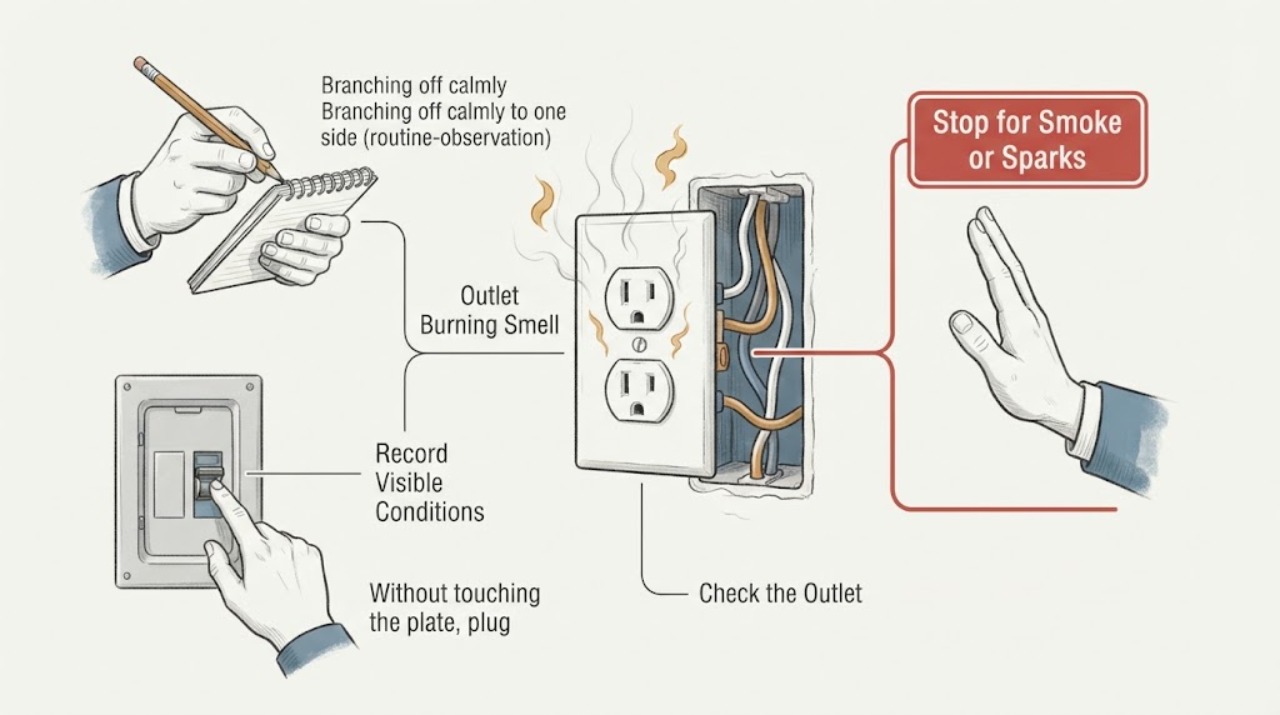
A burning or hot-plastic smell at an outlet is a stop-use warning, not a symptom to reproduce. From a safe, dry position, note the outlet location, whether there is smoke, heat, discoloration, buzzing, crackling, sparking, moisture, or a tripped breaker, and whether other outlets or lights are affected. Do not touch, open, remove, reset, test, or replace the outlet, breaker, or wiring. Leave the area and obtain emergency help for smoke, fire, arcing, rapid heating, or shock; otherwise keep the circuit and outlet unused and call a qualified electrician.
Before you begin
Safety first
- Keep the outlet, circuit, and involved load unused. Do not touch or open the outlet, panel, meter, service equipment, or wiring; do not reset repeatedly, bypass protection, or perform energized electrical testing.
Work through in order
Diagnostic checks
Use only checks that match the exact appliance or system and its official guide.
-
Check 1
From a safe, dry position, record the exact outlet location and whether the smell is strongest at the face, plug, cord, nearby wall, or another appliance. Do not approach a hot, smoking, sparking, or damaged outlet to identify the source.
Expected result: Note whether the odor is faint or strong, continuous or intermittent, and whether smoke, visible heat, discoloration, melting, or arcing is present.
Next step: Keep the outlet and connected load unused. If smoke, sparks, rapid heating, or fire is present, leave the area and obtain emergency help without investigating further.
Why this matters
Why: The apparent source changes the electrician's inspection scope, but odor location alone cannot distinguish a receptacle, plug, appliance, wiring, or breaker fault.
-
Check 2
Without touching the plate, plug, cord, or wall, look from a safe distance for blackening, brown marks, melted plastic, cracks, moisture, or a displaced cover. Listen only from that distance for buzzing, sizzling, crackling, or popping.
Expected result: Any mark, deformation, water, unusual sound, or visible flash is a stop signal; a normal-looking surface does not prove hidden connections are safe.
Next step: Do not touch, dry, cover, open, tighten, or replace anything. Keep people away and arrange urgent electrical service; use emergency help for smoke or fire.
Why this matters
Why: These signs are compatible with overheating, arcing, damaged equipment, or a loose connection in the outlet or wiring.
-
Check 3
From a safe position, note whether the outlet's circuit breaker or another protective device is visibly tripped, whether the smell started before or after the trip, and whether other outlets or lights lost power. Do not reset or repeatedly cycle the device.
Expected result: A trip, repeated trip, or loss of several outlets changes the event into a circuit or fault investigation rather than a single-outlet replacement decision.
Next step: Leave the affected circuit unused and call an electrician. If the panel itself is hot, smoking, sparking, or producing the odor, move away and obtain emergency help.
Why this matters
Why: Protective-device status can reflect overload or fault, but it does not reveal whether the cause is the outlet, appliance, wiring, breaker, or supply.
-
Check 4
Record what was connected and what was operating when the smell appeared, including heaters, motors, chargers, adaptors, extension devices, or a recently moved appliance. Do not reconnect or substitute a load to compare results.
Expected result: The smell may occur only under load, after a device warms, or after an extension device is used; note the sequence without recreating it.
Next step: Keep the outlet and the involved load out of service and tell the electrician the exact load and sequence. Do not use another outlet as a workaround until the load is cleared.
Why this matters
Why: A load-related event may involve overload, a damaged plug or cord, a faulty appliance, an outlet connection, or branch wiring. The load is a clue, not a confirmed cause.
-
Check 5
Note whether moisture, a leak, damp wall or floor, storm exposure, recent construction, or a new outlet or appliance preceded the odor. Observe only; do not enter a wet area or handle an electrical item to dry it.
Expected result: Water, a wet enclosure, or recent work increases the risk and may involve concealed wiring or a damaged protective path even if the smell has stopped.
Next step: Keep the affected area unused and provide the history to an electrician. If water is near energized equipment, move away and obtain urgent help rather than touching the equipment.
Why this matters
Why: Moisture and installation history change the safe isolation and inspection plan; they do not authorize opening the outlet or panel.
-
Check 6
From a safe position, check whether the smell or electrical symptom is limited to this outlet or appears at nearby outlets, lights, switches, or rooms. Do not use a neighboring outlet to test the suspect load.
Expected result: One location suggests a local inspection; several locations, flicker, broad power variation, or weather-linked changes suggest branch, panel, service, or utility involvement.
Next step: Keep the affected circuit unused and contact an electrician; contact the utility from a safe position for a broad or weather-related supply pattern. Do not touch service equipment or exposed conductors.
Why this matters
Why: A broad pattern can be more urgent and cannot be resolved by changing one receptacle. Outside service equipment is not an occupant repair area.
-
Check 7
Prepare a service note with the outlet location, odor description and timing, connected load, breaker status if safely visible, affected locations, recent work or moisture, and every heat, mark, sound, smoke, spark, or shock observation.
Expected result: A complete account lets the electrician plan isolation and inspection without asking the occupant to open energized equipment or recreate the odor.
Next step: Keep the outlet, circuit, and involved load out of service until qualified electrical service confirms a safe return to use.
Why this matters
Why: The breaker and wiring are possible causes, but a safe diagnosis requires professional inspection of the full path from load to supply.
Use your observations
Decision map
Find the observation that best matches what you see, then follow the next safe action.
-
PATH 01Next step
What you see
There is smoke, fire, a visible spark or arc, rapid heating, melting, or a strong burning odor.
Do this next
Stop immediately, leave the area, keep others away, and obtain emergency help. Do not touch the outlet, operate nearby electrical controls, investigate, or attempt to extinguish an energized fire with water.
-
PATH 02Next step
What you see
The outlet or nearby plug has scorch marks, deformation, moisture, buzzing, crackling, or a hot surface.
Do this next
Keep it unused and obtain urgent electrician service. Do not touch, dry, remove, or replace the plate, plug, receptacle, or wiring.
-
PATH 03Next step
What you see
The breaker is tripped, trips again, will not stay engaged, or several outlets lose power.
Do this next
Do not keep resetting it. Leave the circuit unused and have an electrician identify the overload, fault, breaker issue, wiring issue, or connected load before restoration.
-
PATH 04Next step
What you see
The smell began while a high-demand load, adaptor, extension device, or appliance was operating.
Do this next
Keep both the outlet and involved load out of service. Tell the electrician the load and timing; do not reconnect it in another outlet to compare.
-
PATH 05Next step
What you see
Water, dampness, storm exposure, recent construction, or recent electrical work is involved.
Do this next
Do not enter the wet or damaged area to handle equipment. Keep away and obtain urgent electrical assessment; report the water path and work history.
-
PATH 06Next step
What you see
The smell has stopped and there are no visible warning signs, but the cause is still unexplained.
Do this next
Do not assume the outlet is safe. Keep it unused, preserve the timing and load history, and arrange qualified inspection of the outlet, breaker, wiring, and connected equipment.
Helpful context
Understand the symptom
Treat the smell as an active hazard
Burning odor can come from a plug, connected appliance, receptacle, switch, branch wiring, breaker, or a concealed connection. The smell may fade while the damaged part remains energized, so a quiet outlet is not cleared. Do not sniff closely, touch the plate, move a plug, or switch the load on and off to locate the source. Record observations from a safe position and keep people away.
What the visible pattern can and cannot tell you
A mark limited to one outlet suggests a local fitting, plug, or connection, while several outlets, lights, or protective devices suggest a broader circuit or supply issue. These patterns only set the inspection scope; they do not identify a replacement part. The assigned circuit-breaker and wiring components need safe isolation and professional inspection.
Do not turn a warning sign into a test
Repeated resets, reconnecting a load, removing a cover, tightening a terminal, and meter checks can expose an occupant to shock or arc energy. A qualified electrician can isolate the affected circuit and check the outlet, connected load, breaker, wiring, neutral and grounding paths, and any moisture or overheating before deciding on repair.
Safety boundary
Stop conditions
- Stop immediately for smoke, fire, visible arcing or sparks, rapid heating, melting, crackling, a strong burning odor, shock, or exposed conductor. Leave the area and obtain emergency help when appropriate.
- Stop using the outlet, connected load, and affected circuit for any scorch mark, discoloration, moisture, damaged cord, deformation, unusual sound, or protective-device trip.
- Do not open or remove the outlet, plug, switch, breaker panel, meter, or service equipment; do not touch wiring, tighten connections, dry an energized device, replace a breaker, use a meter, or perform an energized test.
- Do not reconnect the load, cycle the switch, reset the breaker repeatedly, or use another outlet to reproduce or compare the burning smell.
Only after diagnosis
Potential parts
- receptacle outlet
Consider only if a qualified electrician confirms the receptacle is damaged and the underlying load, circuit, and wiring are safe to repair.
The device type, rating, protection, wiring method, box, and local requirements must be verified by a qualified electrician. - circuit breaker
Consider only after the electrician confirms the breaker is faulty and has addressed any overload or downstream fault.
Breaker type, rating, panel family, and installation method must be verified; never substitute a higher rating. - branch wiring connection
Consider only when professional inspection identifies a damaged conductor, connection, or concealed wiring fault causing heat or odor.
Wiring repair is site-specific electrical work and must be designed and completed by a qualified electrician.
When checks do not resolve it
Need a professional?
Call immediately after recording safe observations, and use urgent emergency help for smoke, fire, arcing, rapid heat, shock, water near equipment, or a hot or smoking panel.
Safety scope: Keep the outlet, circuit, and involved load unused. Do not touch or open the outlet, panel, meter, service equipment, or wiring; do not reset repeatedly, bypass protection, or perform energized electrical testing.
Common questions
FAQ
Is a burning smell from an outlet always the outlet itself?
No. The source can be a plug, connected load, receptacle, switch, branch wiring, breaker, panel, or concealed connection. Keep the outlet and load unused and have the complete path inspected.
Can I reset the breaker after an outlet smells hot?
Do not repeatedly reset it. Record its visible status from a safe position and leave the circuit unused; an electrician must identify the fault or overload before restoration.
Should I unplug the appliance connected to the smelly outlet?
Do not approach or touch a hot, smoking, sparking, wet, melted, or damaged outlet, plug, or cord. Move away and obtain urgent help. A qualified professional can isolate the load safely.
What if the smell disappeared?
A fading smell does not prove the fault is gone. Preserve the timing and load history, keep the outlet unused, and arrange inspection of the receptacle, breaker, wiring, and connected equipment.
When is an outlet odor an emergency?
Smoke, fire, sparks, visible arcing, rapid heating, melting, shock, water near electrical equipment, or a hot or smoking panel requires immediate stop, leaving the area, and emergency help. Do not investigate or use water on energized equipment.
Read the exact guide
Official sources
- Fire safety in the home (accessible version)Home Office, GOV.UK · Fire-safety guidance for England; local emergency arrangements vary.
- Electrical Safety Advice for Extension Leads, Cable Reels and Block AdaptosElectrical Safety First · General household electrical safety guidance; it does not identify the fault in a particular outlet.
- Electrical Safety Advice for Living RoomsElectrical Safety First · General household guidance; room and socket examples are not a site-specific diagnosis.
- CPSC Guide to Home Wiring HazardsU.S. Consumer Product Safety Commission · General residential hazard education; it is not a replacement for a site-specific electrical inspection.
Community feedback
Share a repair observation
Share a plain-text repair observation. Accepted observations are published automatically; this page may take a moment to update.