
On this page
Start here
Quick answer
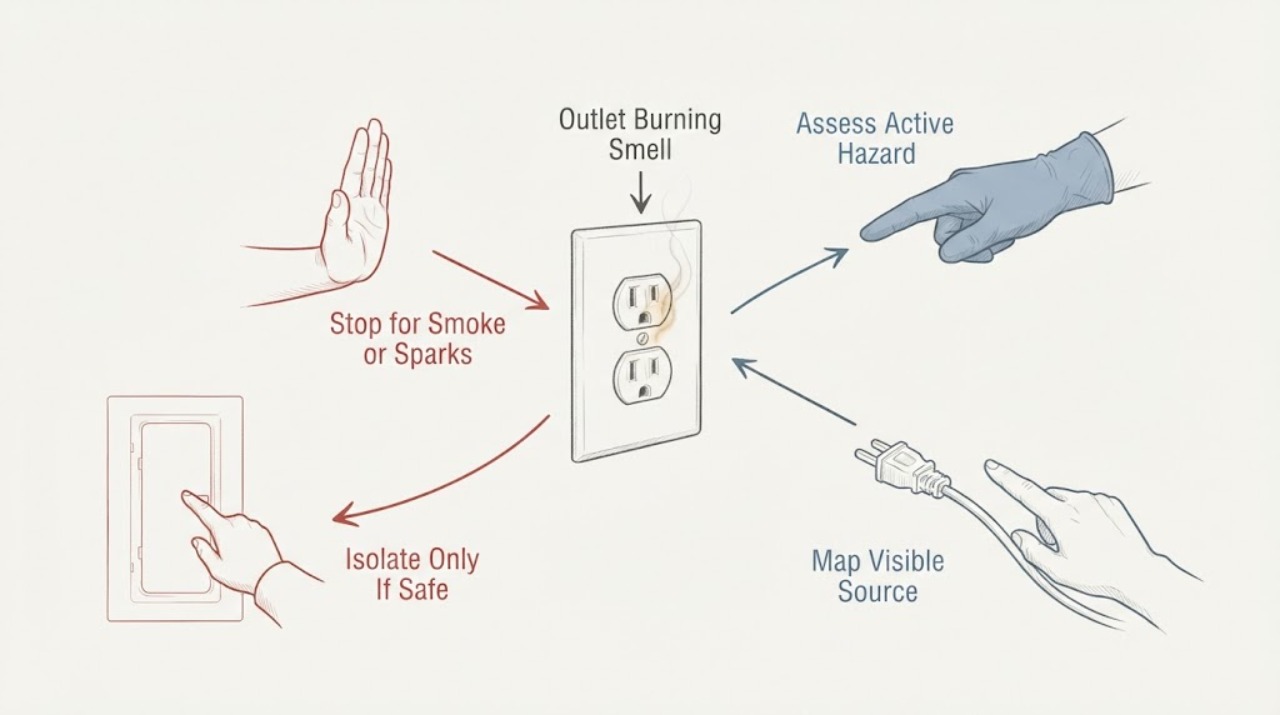
A burning smell from a wall outlet, plug, or nearby wiring is a stop-use warning, not a fault to test by plugging the appliance back in. Keep people away and do not touch a hot, discolored, loose, wet, sparking, or damaged outlet, plug, cord, or faceplate. If there is smoke, flame, arcing, rapid heating, or a spreading odor, leave the area and contact emergency services from a safe location. If the hazard is not immediately active, have a licensed electrician inspect the outlet and circuit before it is energized again; do not open the receptacle or electrical panel, touch wiring, take live measurements, or repeatedly reset the breaker.
Before you begin
Safety first
- This article supports non-contact observation and safe stop-use decisions only. Do not open an outlet or panel, touch wiring, unplug a hazardous connection, make live measurements, reset repeatedly, or re-energize the circuit for diagnosis.
Work through in order
Diagnostic checks
Use only checks that match the exact appliance or system and its official guide.
-
Check 1
From a stable position away from the outlet, look and listen without touching anything: note smoke, flame, visible arcing, crackling, a hot-looking or melting faceplate, water, or an odor that is getting stronger.
Expected result: There is an active sign such as smoke, flame, arcing, rapid heating, crackling, water at the electrical area, or a spreading odor; or the smell is present without those signs.
Next step: For smoke, flame, arcing, rapid heating, or water near energized equipment, keep away, leave the area when needed, and contact emergency services from a safe location. Otherwise keep the outlet and any connected equipment unused and continue only with remote, non-contact documentation.
Stop if: Do not touch the outlet, plug, cord, faceplate, nearby metal, or water; do not approach to smell more closely or attempt a test plug-in.
Why this matters
Why: An active sign can indicate an immediate fire or shock hazard. An odor without visible activity is still a warning of possible overheating or damaged insulation and is not a safe invitation to test the outlet.
-
Check 2
If no smoke, flame, arcing, water, or active heat is present and the normal disconnect is reachable without approaching the hazard, stop using the affected circuit or appliance from that safe position; otherwise leave it alone and wait for emergency or electrical help.
Expected result: The affected circuit can remain de-energized without approaching the damaged area, or the disconnect is not safely reachable or the breaker trips again.
Next step: Keep the circuit off when it can be left off safely, mark the area out of use without touching the equipment, and arrange a licensed electrician. If the source is actively smoking or burning, use emergency procedures instead.
Stop if: Do not open the electrical panel, remove a cover, reach behind furniture, cross water, touch a hot disconnect, reset repeatedly, or re-energize the circuit to see whether the smell returns.
Why this matters
Why: A safe isolation prevents another heating event, but an inaccessible or repeatedly tripping protection device indicates that the hazard must be handled by a professional rather than by more reset attempts.
-
Check 3
From a safe distance, record the apparent location of the strongest odor and any visible discoloration, cracking, melting, looseness, damaged insulation, or scorch mark on the outlet area, plug, cord, appliance, or nearby wall.
Expected result: The mark appears concentrated at the outlet or faceplate, at the plug or cord, at the appliance, or cannot be localized without touching or moving something.
Next step: Take a photo only from a safe position, note whether the outlet is warm-looking or discolored, and give the location and observations to the electrician; do not remove the faceplate or move a damaged load.
Stop if: Do not touch, press, wiggle, tighten, unplug, scrape, remove, or move a hot, melted, wet, loose, or damaged item.
Why this matters
Why: A fixed outlet or faceplate clue supports an electrician's circuit and receptacle inspection; a cord or appliance clue may require appliance service as well. An unlocalized source still requires the circuit to remain out of service because heat can travel or be concealed.
-
Check 4
Without restoring power or opening the panel, record what else was operating and whether other outlets, switches, lights, or appliances on the same area were flickering, warm-looking, discolored, sparking, or losing power.
Expected result: Only one outlet or load was involved, several outlets or lights were affected, a breaker or protective device had already opened, or the scope is unknown.
Next step: Keep every affected point unused, write down the timing and loads, and request an electrician to inspect the circuit and connections. Do not add a load elsewhere as a comparison.
Stop if: Do not operate the breaker repeatedly, plug in a tester or appliance, use an extension cord or adapter, or perform live voltage or continuity measurements.
Why this matters
Why: A single location can still have a failed receptacle or termination. Several affected points, flicker, or repeated protective trips raise concern for a circuit-level or upstream fault and should not be narrowed to one replaceable outlet without inspection.
-
Check 5
From a dry, safe position, note whether there was a spill, condensation, leak, outdoor exposure, recent outlet replacement, renovation, new high-load appliance, loose plug, or extension-cord use before the smell appeared.
Expected result: Moisture, recent electrical work, a high-load appliance, a loose-fitting plug, or an extension cord is associated with the event; or no precipitating change is known.
Next step: Keep the area dry only by staying away from the electrical hazard, preserve the appliance and cord state, and give the history to the electrician. Arrange building or appliance service too when the electrician finds the load is involved.
Stop if: Do not wipe inside the outlet, use water or cleaner, pull a plug from a damaged receptacle, remove an extension cord from a hot connection, or energize a wet area.
Why this matters
Why: Moisture and recent changes can alter the urgency and inspection scope, while a high-load or loose connection can overheat without proving which component failed. None of these observations justifies reopening or reusing the circuit.
-
Check 6
Prepare a service record without disturbing the area: write the outlet location, odor description, exact time and duration, devices connected, breaker or GFCI behavior already observed, visible changes, moisture history, and any recent electrical work.
Expected result: The record identifies a repeatable timing or load association, a prior protective trip, visible damage, or an unknown pattern.
Next step: Send the record and safe-distance photos when arranging electrical service, and keep the affected circuit and equipment unused until the professional has inspected and cleared it.
Stop if: Do not test the theory by reconnecting the load, replacing the receptacle yourself, opening a box or panel, or measuring energized wiring.
Why this matters
Why: These observations help the electrician decide whether to inspect the receptacle, terminations, branch circuit, connected cord or appliance, protective devices, or moisture exposure. They do not establish that one part is safe to replace without testing by a qualified professional.
Use your observations
Decision map
Find the observation that best matches what you see, then follow the next safe action.
-
PATH 01Safety boundary
What you see
Smoke, flame, visible arcing, crackling, rapid heating, or a spreading burning odor is present.
Do this next
Keep people away, leave the area when necessary, and contact emergency services from a safe location. Do not return to reset, unplug, inspect, or extinguish energized equipment.
Why this path and its safety boundary
Why it matters: The outlet or nearby wiring may be an active fire or shock hazard.
Safety stop: Do not use water on an electrical fire or approach the outlet to operate it.
-
PATH 02Safety boundary
What you see
The smell occurred but there is no visible smoke or flame and no safe evidence that the area is still heating.
Do this next
Leave the outlet and connected load unused and arrange a licensed electrician before restoring power or using the location.
Why this path and its safety boundary
Why it matters: The absence of visible activity does not clear a heat-damaged receptacle, plug, cord, appliance, or termination.
Safety stop: Do not plug in a different device or re-energize the circuit as a diagnostic test.
-
PATH 03Safety boundary
What you see
Discoloration, warmth, melting, looseness, or the strongest odor is at the receptacle, faceplate, or wall area.
Do this next
Keep the circuit out of service and have a licensed electrician inspect the receptacle, box, terminations, protective devices, and upstream circuit.
Why this path and its safety boundary
Why it matters: A fixed wiring, termination, receptacle, or enclosure problem is possible and cannot be safely distinguished by external appearance alone.
Safety stop: Do not remove the faceplate, tighten screws, push the receptacle back, or touch exposed material.
-
PATH 04Safety boundary
What you see
The strongest odor or visible damage is at a plug, cord, power strip, or connected appliance rather than the wall outlet.
Do this next
Do not use or move the damaged load. Arrange electrician inspection and, when the electrician identifies an appliance or cord fault, qualified appliance service or manufacturer handling.
Why this path and its safety boundary
Why it matters: The connected load or its cord may have overheated, while the outlet and circuit may also have been stressed; location alone does not clear either one.
Safety stop: Do not pull a hot or melted plug, repair a cord, substitute an adapter, or reconnect the appliance elsewhere.
-
PATH 05Safety boundary
What you see
Several outlets or lights are affected, lights flicker, or a breaker or protective device has already tripped or trips again.
Do this next
Leave the affected circuit off when safe and have a licensed electrician identify and correct the cause before the breaker is turned back on.
Why this path and its safety boundary
Why it matters: The issue may involve an overloaded, loose, damaged, or upstream circuit rather than one isolated receptacle.
Safety stop: Do not repeatedly reset the breaker, redistribute loads for a test, or use extension cords to bypass the affected circuit.
-
PATH 06Safety boundary
What you see
Water, dampness, a leak, or condensation is at or near the outlet, cord, appliance, or floor.
Do this next
Keep away, isolate the area, and arrange electrical and leak service as appropriate; only a professional should determine when it is safe to restore power.
Why this path and its safety boundary
Why it matters: Moisture can create a shock and fire hazard and makes touching, wiping, unplugging, or testing especially unsafe.
Safety stop: Do not touch wet electrical equipment, stand in water, wipe inside the receptacle, or restore power to a wet area.
Helpful context
Understand the symptom
Treat the smell as an electrical warning
The odor may come from an overheated termination, receptacle, plug, cord, appliance, or another part of the branch circuit. A smell that fades does not prove the hazard is gone: a connection can cool while remaining damaged. NFPA identifies warm or discolored outlets, burning or rubbery odors, and outlet sparks as conditions for qualified electrical help. The first decision is therefore whether anyone can remain near the area safely, not which part to replace.
Separate a fixed-wiring concern from a connected load
Record whether the odor was strongest at the receptacle, faceplate, plug, cord, or an appliance, but make that observation from a safe distance. Do not pull a hot or melted plug, restore power to identify the source, or move an appliance whose cord or connection may be damaged. One affected outlet can still require circuit inspection, while several outlets, flickering lights, or a tripped breaker suggest a wider electrical problem.
Do not improvise an electrical repair
Opening a cover plate, receptacle box, panel, or plug exposes parts that may remain energized or heat-damaged. Do not use an extension cord, adapter, power strip, or another outlet as a workaround for a burning smell. Leave the affected equipment and circuit out of service until an electrician determines whether the issue is a receptacle, termination, cord, appliance, overload, moisture condition, or upstream wiring fault.
Safety boundary
Stop conditions
- A burning smell, warm or discolored outlet, melting, sparks, crackling, smoke, or visible arcing is a stop-use signal; do not plug in or restore power to test it.
- Do not open or remove an outlet cover, faceplate, receptacle box, junction box, or electrical panel, and do not touch exposed or suspected wiring.
- Do not perform live voltage, continuity, or resistance measurements, insert a tester, or use a metal object to investigate the outlet.
- Do not repeatedly reset a breaker or GFCI, bypass a protective device, redistribute loads for a test, or use an extension cord, adapter, or power strip as a workaround.
- Do not pull a hot, melted, wet, loose, or damaged plug or cord; do not use water on an electrical fire. Leave active smoke, flame, or arcing to emergency responders.
Only after diagnosis
Potential parts
- receptacle or outlet assembly
Consider this category only if a licensed electrician confirms that the receptacle is heat-damaged, loose, worn, or otherwise failed after the circuit is made safe.
The electrician must match the device to the circuit, location, protection, wiring method, load, and applicable code; appearance alone does not establish a safe replacement. - outlet enclosure or faceplate
Consider this category only when inspection finds a cracked, melted, missing, or heat-damaged enclosure or faceplate after the underlying wiring is assessed.
Confirm the exact box, device, cover, location, and installation requirements with the electrician; do not use a new cover to hide wiring damage. - branch-circuit wiring or termination
This is a professional repair category only if inspection finds a loose, overheated, damaged, or improperly terminated conductor or connection.
A qualified electrician determines conductor, termination, protection, enclosure, and code requirements; a homeowner should not select or install wiring from the odor alone.
When checks do not resolve it
Need a professional?
Arrange licensed electrician service before using an outlet that produced a burning smell, especially when it is warm, discolored, loose, damaged, wet, sparking, associated with a trip, or near several affected outlets. Use emergency services from a safe location for smoke, flame, active arcing, rapid heating, or a spreading odor. A connected appliance or cord may also need qualified appliance service after the electrical hazard is assessed.
Safety scope: This article supports non-contact observation and safe stop-use decisions only. Do not open an outlet or panel, touch wiring, unplug a hazardous connection, make live measurements, reset repeatedly, or re-energize the circuit for diagnosis.
Common questions
FAQ
Can I keep using an outlet after the burning smell disappears?
No. A fading odor does not prove that a receptacle, plug, cord, appliance, or wiring termination is undamaged. Leave it unused and arrange a licensed electrician before restoring power or reconnecting a load.
Should I unplug the appliance that was connected to the smelly outlet?
Do not pull a hot, melted, wet, loose, sparking, or damaged plug or cord. Keep away and isolate the area from a safe position; an electrician can determine how the load and outlet should be made safe.
Is a warm or discolored outlet always an emergency?
It is always a stop-use warning that needs qualified electrical attention. Smoke, flame, active arcing, rapid heating, crackling, water, or a spreading odor requires leaving the area when necessary and contacting emergency services from a safe location.
Can I replace the outlet myself if the faceplate looks burned?
Do not open the outlet or panel or touch the wiring. Heat damage can extend into the box, terminations, branch circuit, protective devices, plug, or appliance, so a licensed electrician should inspect and decide the repair.
Read the exact guide
Official sources
- Educational Messages Desk ReferenceNational Fire Protection Association · General residential electrical safety reference for stop-use, qualified electrician, circuit-tripping, outlet, cord, extension-cord, and moisture-related boundaries.
- Electrical Safety: ChecklistNational Fire Protection Association · General electrical safety guidance used for burning odor, warm or discolored outlet, sparks, damaged cords, and heat-producing load boundaries.
Community feedback
Share a repair observation
Share a plain-text repair observation. Accepted observations are published automatically; this page may take a moment to update.