
On this page
Start here
Quick answer
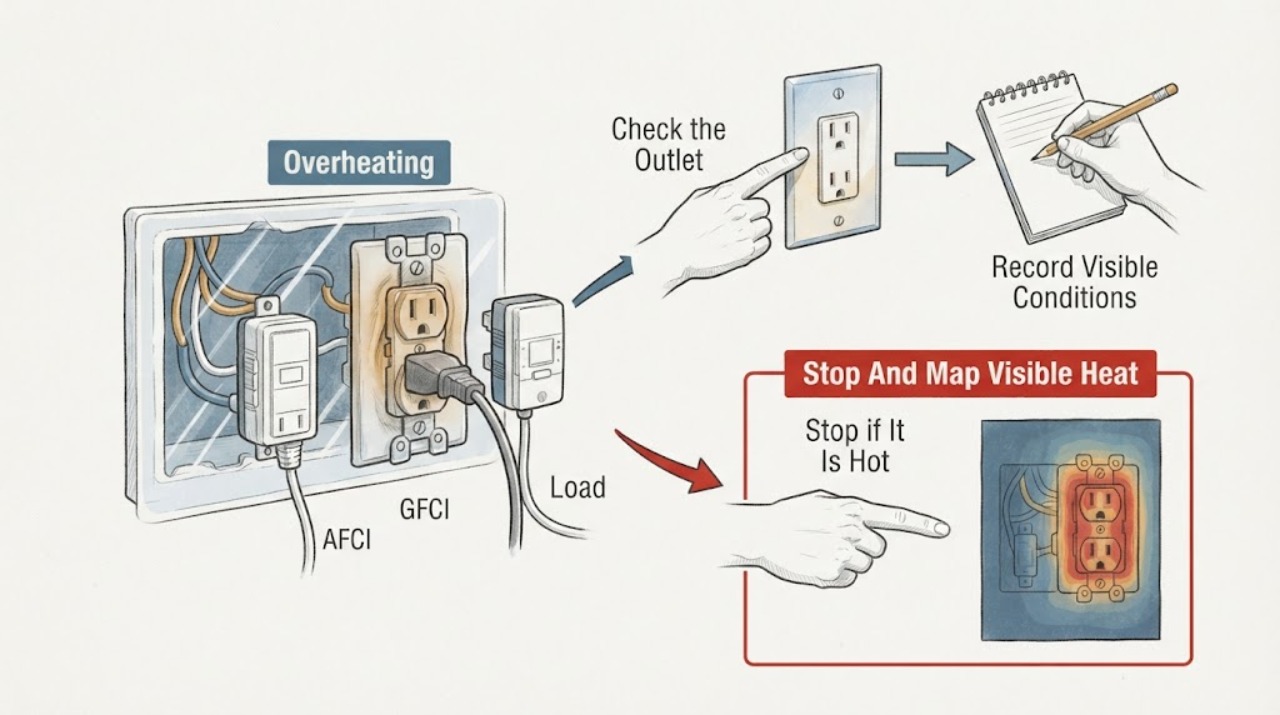
An overheating outlet is a safety warning, not a normal appliance symptom. Stop using the receptacle immediately and keep people away if it is hot, discolored, cracked, sparking, smoking, or producing a burning or rubbery smell. If a connected appliance can be switched off normally and the outlet is not actively arcing, turn the appliance off and unplug it by the plug; otherwise do not touch it. From a dry, safe position, note whether nearby outlets also lost power, whether a GFCI is tripped, and whether the branch breaker operated, but do not repeatedly reset protection. CPSC and Leviton identify hot or discolored outlets, sparks, shocks, loose plug fit, damaged cords, and recurring breaker trips as electrical warning signs. Do not remove the wallplate, probe the slots, bend plug blades, open the panel, test live voltage, replace wiring, or install a larger breaker. Leave the circuit unused and arrange prompt qualified electrical service; use local emergency guidance for smoke, active arcing, or fire.
Before you begin
Safety first
- This article covers stopping use, external observation, safe load disconnection only when no active hazard is present, and documenting symptoms. Receptacle, GFCI, AFCI, breaker, panel, wiring, grounding, and live-circuit testing require a qualified electrician.
Work through in order
Diagnostic checks
Use only checks that match the exact appliance or system and its official guide.
-
Check 1
Stop using the outlet and observe it, the wallplate, plug, cord, and nearby receptacles from a safe position without touching a hot or damaged surface.
Expected result: Record warmth or heat, discoloration, melting, cracks, smoke, sparks, burning odor, a loose plug fit, a shock or tingling sensation, or a dry intact exterior with heat no longer present.
Next step: Leave the outlet and any affected adjacent outlet unused, keep combustible items away, and arrange qualified electrical service; use local emergency guidance for smoke or active arcing.
Stop if: Do not touch the faceplate, press buttons, remove the plug from an actively arcing outlet, or re-energize the circuit to reproduce the heat.
Why this matters
Why: Heat, discoloration, melting, smoke, sparks, odor, shock, or looseness supports a wiring, receptacle, cord, plug, or load hazard. A cool exterior after shutdown does not prove the connection is safe; the original symptom still needs diagnosis.
-
Check 2
If there is no active arcing, smoke, water, or severe heat, switch off the connected appliance normally and unplug it by grasping the plug; do not pull the cord or touch a damaged plug.
Expected result: Record whether the plug or cord is hot, discolored, cracked, melted, loose, or damaged, and whether the outlet remains warm after the appliance is disconnected.
Next step: Set the appliance and cord aside, label them as unsafe, and provide them to the electrician; do not test the appliance in another outlet.
Stop if: Do not unplug a sparking, smoking, wet, fused, or severely hot connection, and do not bend plug blades or repair the cord.
Why this matters
Why: A damaged or hot plug or cord can be the heat source or a contributor and must not be reused. An outlet that remains warm with no load supports an outlet or wiring problem; an outlet that cools after disconnecting still needs assessment if it overheated.
-
Check 3
From the appliance labels and ordinary room observation, record what was connected, whether a power strip or extension cord was involved, whether another heat-producing appliance shared the circuit, and whether lights flickered or dimmed.
Expected result: Note one high-demand appliance, several loads sharing the branch, an extension cord or damaged power strip, a loose plug fit, repeated trips, flickering, or no known load when the outlet heated.
Next step: Keep all suspect equipment disconnected and do not substitute another high-load appliance; give the load history and timing to the electrician.
Stop if: Do not add a larger breaker, chain extension cords, use a power strip as a permanent fix, or keep operating a load that made the outlet hot.
Why this matters
Why: A high or unsuitable load, damaged cord, loose connection, or repeated circuit symptom can create heat and may require circuit or appliance correction. The load history helps an electrician but does not prove that the appliance or outlet alone is at fault.
-
Check 4
Without touching the hot outlet, look for an accessible GFCI with TEST and RESET buttons in the same room or nearby wet areas and observe whether its indicator or RESET position shows an interruption.
Expected result: Record no GFCI found, a tripped GFCI, a GFCI that will not reset, a fault indicator, or a GFCI that appears normal while the outlet remains hot or discolored.
Next step: Leave the affected circuit unused and arrange electrical service; do not reset a GFCI in a wet or damaged area or use the outlet merely because the indicator changes.
Stop if: Do not remove, rewire, bypass, hold, or repeatedly reset the GFCI, and do not touch the outlet to check whether it is still hot.
Why this matters
Why: A GFCI can interrupt downstream receptacles after detecting a ground fault, but a reset result cannot clear heat damage or a loose connection. Failure to reset or immediate retripping indicates unresolved power, wiring, device, or load trouble.
-
Check 5
From outside a dry, undamaged electrical panel, note whether the circuit breaker is visibly tripped or a fuse is visibly open; do not open the panel or reset protection while the outlet shows a hazard sign.
Expected result: Record a normal-looking breaker, one tripped breaker, a breaker that trips again, a hot or damaged panel, or no safe access to the panel.
Next step: Leave a tripped or uncertain circuit off and request qualified service; provide the time of the trip and what equipment was connected.
Stop if: Do not repeatedly reset, install a higher-rated breaker or fuse, touch conductors, or approach a smoking, wet, or hot panel.
Why this matters
Why: A trip can reflect overload, short, ground fault, appliance failure, or wiring damage. A normal breaker does not clear a hot outlet, and a repeat trip means the circuit should remain off while the fault is located.
-
Check 6
Before service arrives, record the outlet location, connected load, protection behavior, odor or sound, visible damage, and whether adjacent outlets were affected; photograph only from a safe distance without removing covers.
Expected result: Record a localized outlet symptom, multiple warm or dead receptacles, a GFCI or breaker event, a cord or plug symptom, moisture, or a pattern that appears when one load is used.
Next step: Keep the circuit and suspect equipment unused until qualified service clears them; use local emergency guidance if smoke, active arcing, or fire develops.
Stop if: Do not remove the wallplate, open the panel, probe the slots, test voltage, or re-energize the circuit for a better photograph or repeat symptom.
Why this matters
Why: This history helps the electrician choose between receptacle, upstream connection, branch-circuit, protective-device, load, and cord or plug checks without asking the homeowner to energize a hazardous circuit.
Use your observations
Decision map
Find the observation that best matches what you see, then follow the next safe action.
-
PATH 01Safety boundary
What you see
The outlet is sparking, smoking, actively arcing, burning, or producing a strong burning odor.
Do this next
Keep clear, avoid touching the outlet or nearby electrical controls, and follow local emergency guidance; arrange qualified electrical service after the area is safe.
Why this path and its safety boundary
Why it matters: This is an immediate electrical-fire or shock hazard, not a reset or outlet-replacement branch.
Safety stop: Do not unplug an actively arcing load, throw a nearby switch if doing so would bring you close to the hazard, or use water on an electrical fire.
-
PATH 02Safety boundary
What you see
The outlet or plug heats while a particular appliance or power strip is connected and cools after safe shutdown.
Do this next
Keep the appliance and cord disconnected and arrange electrician assessment of both the equipment and branch receptacle.
Why this path and its safety boundary
Why it matters: The load, cord, plug, loose fit, or receptacle may be contributing; cooling does not prove the circuit is safe.
Safety stop: Do not test the appliance in another outlet, use an extension cord workaround, or reconnect it to see whether heat returns.
-
PATH 03Safety boundary
What you see
The outlet remains warm or discolored after the connected load is safely disconnected, or an unused nearby outlet is warm.
Do this next
Leave the affected circuit unused and request prompt qualified electrical diagnosis; note nearby warm outlets and any prior trips.
Why this path and its safety boundary
Why it matters: A receptacle, feed-through connection, branch conductor, or upstream device may be overheating independently of the appliance.
Safety stop: Do not touch, open, tighten, or re-energize the receptacle to locate the heat source.
-
PATH 04Safety boundary
What you see
A nearby GFCI is tripped, will not reset, shows a fault, or trips again after the heat symptom.
Do this next
Leave the circuit unused and arrange qualified electrical diagnosis rather than replacing or rewiring the GFCI as a trial.
Why this path and its safety boundary
Why it matters: A ground fault, no upstream power, damaged protection, downstream load, or wiring issue may be present; a reset does not clear thermal damage.
Safety stop: Do not reset repeatedly, bypass the GFCI, or use the outlet because its indicator briefly changes.
-
PATH 05Safety boundary
What you see
The breaker trips again, a fuse opens again, or power disappears whenever the load is connected.
Do this next
Leave the circuit off, keep suspect equipment disconnected, and call a qualified electrician.
Why this path and its safety boundary
Why it matters: The protection is responding to an unresolved overload, short, ground fault, damaged appliance, or wiring problem.
Safety stop: Do not install a larger protective device, keep resetting, open the panel, or continue operating the circuit.
-
PATH 06Safety boundary
What you see
The receptacle, wallplate, plug, cord, or nearby switch is cracked, melted, loose, wet, discolored, or gives a shock or tingling sensation.
Do this next
Stop using the outlet and arrange prompt qualified electrical service; keep people and combustible materials away from the area.
Why this path and its safety boundary
Why it matters: The visible condition is a potential shock or fire hazard even if the outlet currently works.
Safety stop: Do not remove the cover, bend plug blades, tape over damage, touch wet parts, or test the outlet by reconnecting equipment.
-
PATH 07Safety boundary
What you see
The outlet was noticeably warm earlier but is now cool, dry, intact, and has no smoke, odor, sparks, looseness, or shock.
Do this next
Keep the previous load disconnected, document when and how the heat occurred, and arrange an electrician check before returning the outlet to normal use.
Why this path and its safety boundary
Why it matters: A transient load or connection problem may have occurred; the absence of current heat does not establish that the circuit is safe.
Safety stop: Do not reproduce the symptom with a high-load appliance or assume a cool faceplate clears a hidden connection.
Helpful context
Understand the symptom
Treat heat at an outlet as a fault until an electrician clears it
An outlet can heat because of a loose or damaged connection, a worn receptacle that grips a plug poorly, a damaged cord or plug, a high or unsuitable load, or a branch-circuit or protective-device problem. Heat can also be present at a nearby outlet that is not being used because current passes through connections feeding other receptacles. The visual symptom cannot identify which part is failing, so the safe decision is to stop using the circuit rather than keep testing it.
Use only external observations after power is left alone
Record where the heat, discoloration, odor, or noise appears and whether the connected appliance, plug, cord, wallplate, or nearby receptacles show damage. A GFCI may have interrupted a circuit near water, but a GFCI reset does not make a heat-damaged outlet safe. If there is a breaker or GFCI indication, do not keep cycling it; the protective device may be responding to a fault that needs diagnosis.
Do not repair the receptacle from the symptom alone
Replacing a receptacle, moving a wire, tightening a terminal, changing a breaker, or testing voltage requires circuit isolation and knowledge of the box, conductor, grounding, load, and protective-device arrangement. CPSC recommends qualified electrical help for a hot, sparking, shocking, loose, or nonworking receptacle. Keep the area clear and give the electrician the outlet location, load, timing, protection behavior, and visible evidence.
Safety boundary
Stop conditions
- Stop immediately for smoke, active arcing, sparks, burning odor, shock, water, melting, severe heat, or a hot or damaged panel; keep clear and follow local emergency guidance as appropriate.
- Do not remove the wallplate or receptacle, open the electrical panel, probe slots, test live voltage, tighten wiring, or replace a breaker or GFCI as a trial.
- Do not repeatedly reset a breaker or GFCI, install a higher-rated fuse or breaker, bypass protection, or re-energize a circuit that has overheated.
- Do not reconnect a hot, scorched, loose, wet, melted, or damaged plug, cord, appliance, power strip, or extension cord to another outlet.
- If an outlet has overheated even once, leave it unused until a qualified electrician evaluates the receptacle, circuit connections, protective devices, and connected load.
Only after diagnosis
Potential parts
- standard receptacle
Consider this only when an electrician confirms the receptacle is worn, heat-damaged, or failed and the branch circuit and protective arrangement are suitable.
Confirm device rating, grounding, box, conductor, location, load, and local requirements; do not select a replacement from heat appearance alone. - GFCI or AFCI protective device
Consider this only after professional diagnosis identifies failed or damaged protection or a required device arrangement, not merely because a device tripped.
Confirm circuit configuration, protection type, device rating, wiring, location, and applicable electrical requirements; never bypass protection. - branch-circuit breaker
Consider this only when qualified testing confirms a failed breaker after overload, short, ground-fault, appliance, and wiring causes are evaluated.
Match the panel, circuit, interrupt rating, conductor, and local requirements; a higher-rated breaker is not a safe fix for overheating. - appliance cord or plug
Consider this only when the electrician or qualified appliance technician confirms the cord or plug is damaged or contributing to heat and the appliance is otherwise suitable.
Confirm the exact appliance, cord construction, strain relief, grounding, and manufacturer requirements; do not repair damaged insulation or bend blades.
When checks do not resolve it
Need a professional?
Arrange prompt qualified electrical service for any outlet that is hot, warm and discolored, loose, cracked, wet, sparking, smoking, shocking, or associated with a burning smell, damaged cord, recurring breaker or GFCI operation, flickering, or heat from an unused nearby receptacle. Leave the circuit and suspect equipment unused. Active arcing, smoke, or fire requires local emergency safety guidance; do not attempt outlet or panel repair.
Safety scope: This article covers stopping use, external observation, safe load disconnection only when no active hazard is present, and documenting symptoms. Receptacle, GFCI, AFCI, breaker, panel, wiring, grounding, and live-circuit testing require a qualified electrician.
Common questions
FAQ
Is a warm outlet safe if it still works?
No. A warm or discolored outlet can indicate a loose connection, damaged receptacle, cord, plug, or overload and may be a fire hazard. Stop using it and arrange qualified electrical service, even if it cools down.
Should I unplug the appliance from an overheating outlet?
Only if there is no smoke, active arcing, water, or severe heat and you can switch the appliance off normally; grasp the plug, not the cord. Do not touch or unplug an actively hazardous connection, and do not reconnect the appliance elsewhere until it is assessed.
Can a GFCI cause an outlet to lose power after overheating?
Yes. A GFCI can interrupt a protected circuit after a ground fault, but resetting it does not clear heat damage or a loose connection. If it will not reset or trips again, leave the circuit unused and call an electrician.
What if the outlet heats only with one appliance connected?
Keep that appliance and its cord disconnected. The load, plug, cord, receptacle, or branch circuit may be contributing, and the symptom cannot identify which one. Do not test the appliance in another outlet; have the equipment and circuit assessed.
When should I treat an overheating outlet as an emergency?
Use local emergency guidance for smoke, active arcing, sparks that continue, flames, or a strong burning smell. Keep clear and do not use water on an electrical fire. For heat, discoloration, looseness, shock, or recurring trips without active fire, leave the circuit unused and arrange prompt qualified electrical service.
Read the exact guide
Official sources
- Leviton_Eletrical_Fires_V9Leviton · Leviton electrical-safety infographic; it provides general warning signs and does not diagnose a particular receptacle or establish local code requirements.
- GFCI Outlets & ReceptaclesLeviton · Leviton GFCI product and support guidance; installed device behavior and local electrical requirements vary.
- CPSC Guide to Home Wiring HazardsU.S. Consumer Product Safety Commission · CPSC consumer electrical-safety guidance; it does not replace local electrical code or an electrician's assessment of a particular circuit.
Community feedback
Share a repair observation
Share a plain-text repair observation. Accepted observations are published automatically; this page may take a moment to update.