
On this page
Start here
Quick answer
A burning smell at a wall switch is a warning sign, not a normal operating odor. If the switch is cool, dry, and operates normally enough to turn off without touching a hot or damaged surface, turn it off and leave that circuit or load unused; otherwise leave it alone. Do not remove the wall plate, keep toggling the switch, or repeatedly reset a breaker. Smoke, flame, rapidly increasing heat, or a strong odor requires leaving the area and contacting emergency services; otherwise arrange a qualified electrician to inspect the switch, box, connected fixture, and branch circuit.
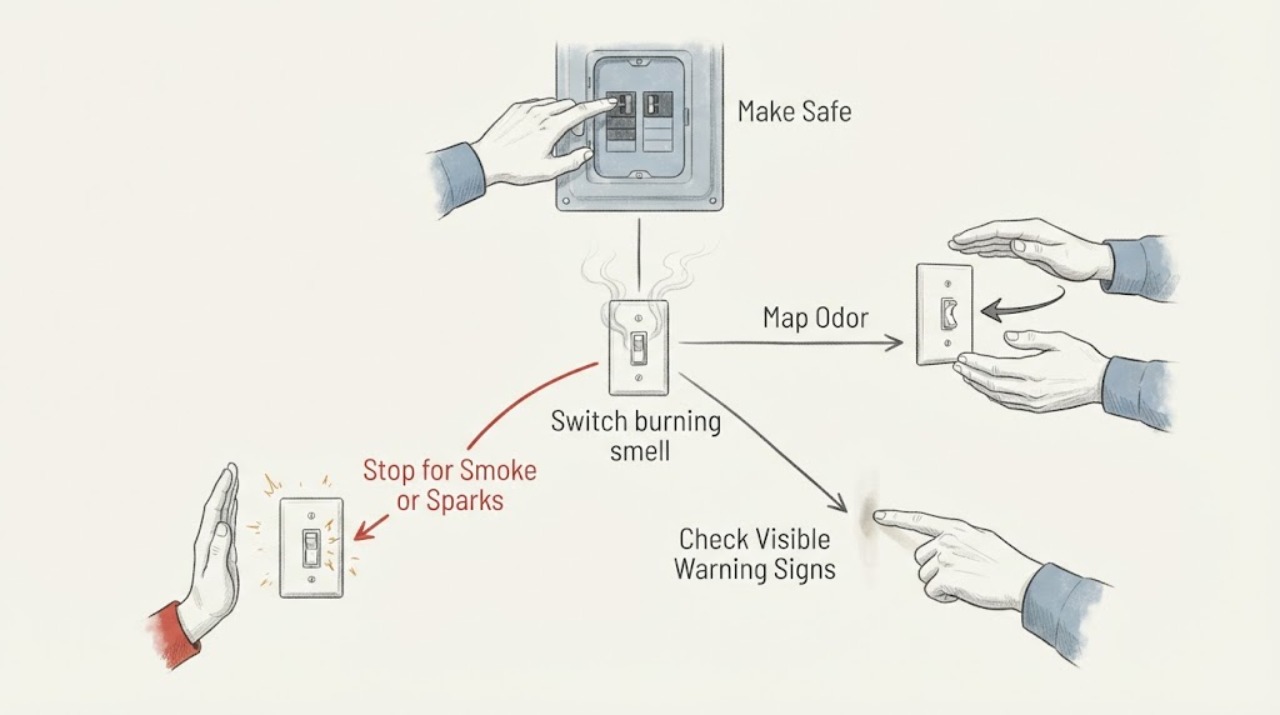
Work through in order
Diagnostic checks
Use only checks that match the exact appliance or system and its official guide.
-
Check 1
From a dry, stable position, stop using the switch. If the control and surrounding wall are cool, dry, intact, and safe to touch, turn the switch off once; if it is hot, wet, cracked, melted, smoking, or sparking, do not touch it.
Expected result: The switch can be turned off without contact with a hazardous surface, or the area has heat, smoke, flame, sparks, water, or rapidly worsening odor.
Next step: Leave the circuit or connected load unused and arrange qualified electrical service. For smoke, flame, rapidly increasing heat, or an emergency, leave the area and contact emergency services.
Stop if: Do not touch the switch or breaker if doing so would put you near heat, smoke, water, exposed conductors, or active arcing.
Why this matters
Why: A safe shutoff removes normal use while preserving the warning for inspection. Heat, smoke, flame, sparks, or water can make the condition an immediate fire or shock hazard.
-
Check 2
Without touching the switch, note where the odor is strongest: the wall plate, the switch opening, the light or fan it controls, or another nearby device. Note whether it begins only while toggling or stays present with the switch off.
Expected result: The odor is limited to switching, remains while off, is strongest at the fixture, or cannot be localized safely.
Next step: Write down the timing and location for the electrician; do not operate the switch again to reproduce the odor and do not open the fixture or wall.
Stop if: Stop observing if the smell becomes stronger, the wall becomes hot, or smoke, sparks, or visible damage appears.
Why this matters
Why: A switching-linked odor keeps the control and its connections in scope. A continuous or fixture-linked odor may indicate a heat source beyond the switch, and an uncertain location should not be guessed from smell alone.
-
Check 3
From a safe distance and in normal lighting, look for discoloration, a melted edge, a warped plate, a loose plate, soot, or a gap around the switch. Do not remove screws or the plate to look behind it.
Expected result: There is visible browning, melting, soot, warping, looseness, or no visible change.
Next step: Photograph the exterior if safe, keep the switch unused, and report the exact finding. Do not tape over damage or treat a new plate as a repair.
Stop if: Do not approach closer if the plate is hot, wet, smoking, or giving off an active electrical sound.
Why this matters
Why: Visible heat or damage supports prompt electrical inspection, but an intact exterior does not rule out a loose connection or overheating inside the box.
-
Check 4
Record any associated flicker, dimming, crackling, buzzing, intermittent operation, tripped breaker, blown fuse, or other lights and outlets that changed around the same time. Do not test by adding a load or repeatedly resetting protection.
Expected result: The symptom is isolated to the control, affects the connected light or fan, appears on several devices, or coincides with breaker or fuse activity.
Next step: Leave the affected circuit and loads unused as appropriate and give the electrician the timeline and list of affected devices. Do not bypass protection or keep resetting it.
Stop if: Stop immediately for smoke, flame, arcing, a hot wall, or any shock or tingling sensation.
Why this matters
Why: A broader pattern or protective-device activity expands the inspection beyond the face of the switch and can indicate an overloaded, damaged, or otherwise abnormal circuit. No breaker trip does not prove the circuit is safe.
-
Check 5
Without opening anything, identify whether the control is a plain switch, dimmer, timer, smart control, three-way control, or a switch serving a fan, heater, high-wattage lamp, or other substantial load. Note any recent installation, lamp change, remodeling, or moisture exposure.
Expected result: The control type or connected load is known, recently changed, unusually warm, or uncertain.
Next step: Provide the identification and recent-change history during service. Do not substitute a different switch, install a dimmer, or alter wiring based only on the odor.
Stop if: Do not continue if identifying the load requires removing a cover, reaching a fixture, handling a wet device, or using a ladder.
Why this matters
Why: Control type, load, and recent work help the electrician check fit, connections, and the connected equipment; they do not prove that the switch itself is the failed component.
-
Check 6
Prepare a concise service record with the room and control location, odor timing, photos taken from a safe distance, what the switch controls, recent changes, and any breaker or fuse event.
Expected result: The record distinguishes a one-time event from a repeated or continuous odor and includes safe exterior evidence, or important details are unavailable.
Next step: Give the record to a qualified electrician and keep the switch or load unused until assessed when the odor was credible or recurring.
Stop if: Do not delay urgent help while collecting notes if the odor is active, worsening, or accompanied by heat, smoke, sparks, or flame.
Why this matters
Why: A clear timeline and scope helps a professional start with the right circuit and avoids unsafe attempts to reproduce the symptom. Missing details should be reported as unknown rather than guessed.
Use your observations
Decision map
Find the observation that best matches what you see, then follow the next safe action.
-
PATH 01Next step
What you see
There is smoke, flame, active sparking, rapidly increasing heat, or a strong worsening odor.
Do this next
Leave the area, keep others away, and contact emergency services. Do not return to operate the switch or investigate the wall.
-
PATH 02Next step
What you see
The switch or plate is hot, discolored, melted, warped, wet, or giving off crackling or buzzing.
Do this next
Do not touch or remove it. Keep the circuit and load unused if that can be done without approaching the hazard, and arrange prompt qualified electrical service.
-
PATH 03Next step
What you see
The odor appears when the switch is operated, but there is no smoke or visible active fire.
Do this next
Stop operating it, record the control and connected load, and have the switch, box, fixture, and connections inspected before reuse.
-
PATH 04Next step
What you see
The odor continues with the switch off or is strongest at the fixture, wall, or another device.
Do this next
Keep the area and affected load unused and request an electrician to trace the source; do not assume replacing the switch will solve it.
-
PATH 05Next step
What you see
There is flicker, dimming, buzzing, intermittent operation, a tripped breaker, a blown fuse, or more than one affected device.
Do this next
Do not add loads or repeatedly reset protection. Give the pattern to the electrician so the wider circuit can be assessed.
-
PATH 06Next step
What you see
The smell was brief or cannot be localized and there are no visible active warning signs.
Do this next
Do not reproduce it by toggling the switch. Record what happened and arrange an assessment if it recurs, persists, or cannot be confidently explained.
Helpful context
Understand the symptom
What a burning smell at a switch can mean
An odor that appears when a switch is used can come from a failing switch or dimmer, a loose or overheated connection, the connected light or fan, or a problem elsewhere on the same circuit. The odor location is useful evidence, but it does not identify the failed part. A smell that continues while the switch is off, or that is strongest at the wall or fixture, makes concealed wiring or another heat source more concerning. Color and odor alone cannot establish a safe diagnosis.
Keep the first checks non-invasive
Stay on the floor and observe from a safe distance. Do not remove the plate, pull the switch from its box, probe an outlet, open a fixture, or touch a hot, wet, melted, or discolored surface. Do not keep using a switch merely because the smell fades. If there is smoke, flame, a rapidly worsening odor, or a hot wall, leave the area and use emergency services.
What to give the electrician
Record the room, the exact control, whether the odor occurs on switching or continuously, any buzzing or flicker, recent replacement or remodeling, what the control operates, and any breaker behavior. A photo from a safe distance can preserve discoloration or melting without requiring disassembly. A qualified electrician should determine whether the switch, box, fixture, protective device, or circuit wiring needs repair or replacement.
Safety boundary
Stop conditions
- Stop all hands-on inspection for smoke, flame, active arcing, rapidly increasing heat, water near electrical equipment, exposed conductors, shock, or a worsening odor.
- Do not remove switch plates or covers, pull devices from boxes, probe live wiring, bypass protective devices, repeatedly reset a breaker, or use a ladder or wet equipment for this check.
- A switch, dimmer, timer, smart control, branch-circuit connection, fixture, or protective-device repair belongs to a qualified electrician when the cause is not plainly external and safe to address.
Only after diagnosis
Potential parts
- light switch or dimmer
Consider only if inspection confirms the control is damaged and identifies the circuit, load, control type, and required rating.
A qualified electrician should confirm the exact control type, wiring arrangement, load, box, and local requirements before replacement. - wall plate and electrical box components
Consider only if inspection finds heat damage, a damaged box, or a plate that cannot safely secure the device after the underlying fault is addressed.
Match the existing box, device dimensions, material, grounding arrangement, and applicable installation requirements; appearance alone is not enough. - circuit protective device
Consider only after diagnosis shows a protective device is defective or the circuit requires a correctly specified protective-device change.
Panel and circuit compatibility must be confirmed by a qualified electrician; never substitute a device or rating from the odor symptom alone.
When checks do not resolve it
Need a professional?
Use emergency services for smoke, flame, active sparking, or rapidly increasing heat. Use a qualified electrician for a recurring or persistent odor, hot or discolored control, buzzing, flicker, breaker activity, visible melting, or an unexplained source.
Common questions
FAQ
Is a burning smell from a light switch normal?
No. Treat it as a warning sign, stop using the switch, and arrange qualified electrical inspection; heat, discoloration, buzzing, flicker, smoke, or breaker activity increase the urgency.
Can I keep using the switch if the smell stops?
No. A temporary odor can disappear when an overheated connection cools. Do not reproduce it by toggling the switch; record the event and have the cause assessed before reuse if the odor was credible or recurring.
Can I replace the switch myself?
Do not use a switch replacement as a first diagnostic step. A burning odor can involve the box, fixture, load, or branch circuit, and a qualified electrician should inspect the condition and confirm the correct control before replacement.
What if the breaker never tripped?
A breaker that has not tripped does not prove a switch or connection is safe. Leave the suspicious control or load unused and arrange an inspection, especially if there is heat, discoloration, noise, flicker, or a persistent odor.
When is this an electrical emergency?
Smoke, flame, active sparking, rapidly increasing heat, or a strong worsening odor is an emergency: leave the area, keep others away, and contact emergency services. Do not return to operate or open the switch.
Read the exact guide
Official sources
- Home Safety - Electrical Safety Foundation InternationalElectrical Safety Foundation International · Electrical warning signs including burning smell, discolored or warm switches, flicker, buzzing, and qualified inspection guidance.
- Electrical Safety DosElectrical Safety Foundation International · Electrical safety guidance for burning smell, warm or discolored switches and outlets, buzzing, flickering, damaged cords, and qualified service.
- Electrical Safety: ChecklistNational Fire Protection Association · Home electrical warning signs and referral to a qualified electrician for burning or rubbery smell, warm or discolored outlets, flicker, sparks, and breaker issues.
- Appliance and Electrical Fire SafetyU.S. Fire Administration · Home appliance and electrical fire prevention, including avoiding overloaded outlets and power strips and replacing damaged cords or loose-fitting outlets.
Community feedback
Share a repair observation
Share a plain-text repair observation. Accepted observations are published automatically; this page may take a moment to update.