
On this page
Start here
Quick answer
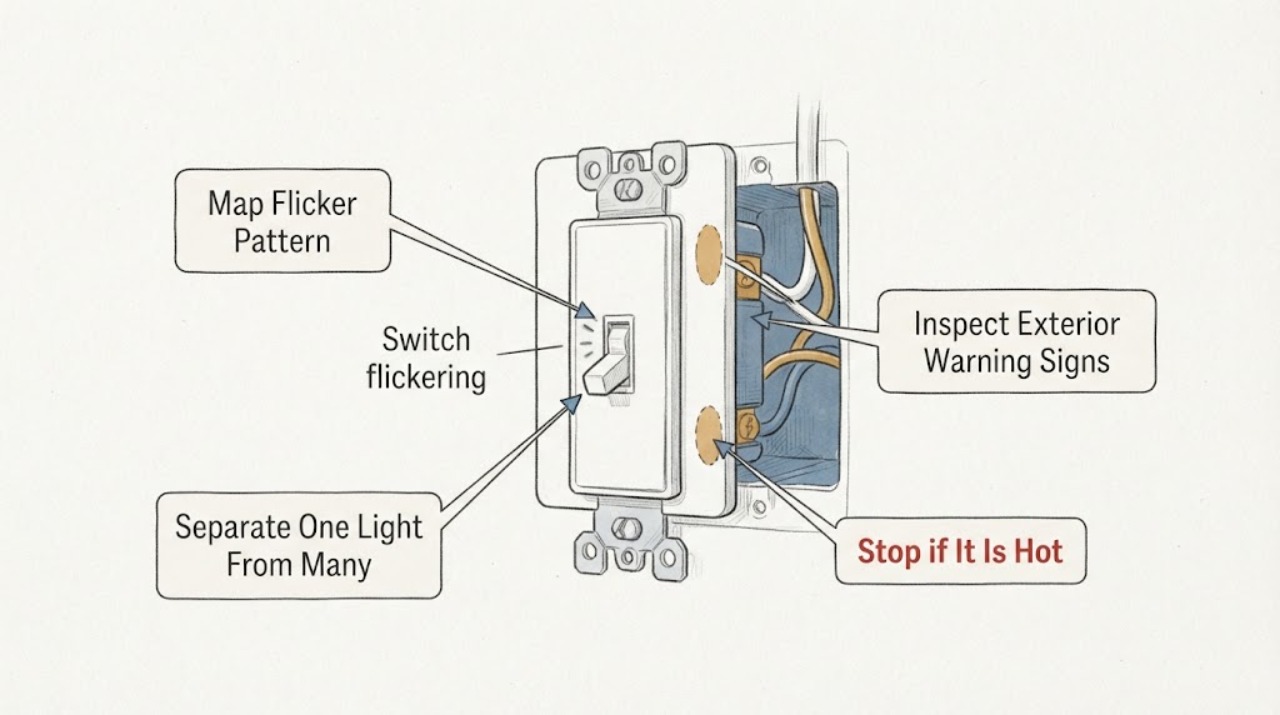
Flickering controlled by a wall switch is not automatically a bad bulb. It may be a failing switch or dimmer, an incompatible LED and control combination, a loose lamp or fixture connection, or a broader circuit or wiring problem. Stop operating the control if the switch plate is hot or discolored, you hear buzzing or crackling, smell burning, feel a shock, see sparks, or a breaker trips. If the area is cool, dry, intact, and the lamp is safely accessible, note whether the flicker is limited to one light and whether the bulb or control was recently changed; do not open the switch or fixture. Have a qualified electrician inspect persistent, unexplained, or circuit-wide flicker.
Work through in order
Diagnostic checks
Use only checks that match the exact appliance or system and its official guide.
-
Check 1
Observe the light from a safe position and record whether flicker occurs only while the switch is being moved, during warm-up, continuously, intermittently, or when the light is turned off. Do not toggle repeatedly to force the symptom.
Expected result: Flicker is tied to switch movement, limited to start-up, continues during normal operation, or cannot be reproduced safely.
Next step: Write down the pattern and leave the control unused if flicker persists or is accompanied by any warning sign. Arrange qualified electrical service rather than repeatedly testing it.
Stop if: Stop observing for smoke, sparks, heat, burning odor, crackling, or any shock or tingling sensation.
Why this matters
Why: A switching-linked pattern keeps the control and its connection in scope. Start-up-only behavior may involve the lamp or control, while persistent or unexplained flicker needs broader inspection; inability to reproduce it does not prove the circuit is safe.
-
Check 2
Without adding loads or opening devices, look at nearby lights and note whether only the switched light flickers or several lights change together. Note whether a light gets brighter or dimmer when a known appliance starts, but do not operate equipment solely to provoke a change.
Expected result: Only one light is affected, several lights on the same area change, or brightness changes when another load operates.
Next step: Keep the affected control or circuit unused as appropriate and give the electrician the list of affected lights and the timing. Do not test by plugging in another appliance or overloading an outlet.
Stop if: Stop if any other device is hot, discolored, buzzing, smoking, or giving a shock or tingle.
Why this matters
Why: An isolated symptom keeps the lamp, fixture, switch, and local connection in scope. Several affected lights or load-linked brightness changes support a circuit or wiring concern rather than a single bulb diagnosis.
-
Check 3
From a safe distance and in normal lighting, look at the switch plate and surrounding wall for heat discoloration, soot, melting, warping, a gap, or visible damage. Do not touch a hot surface or remove the plate to look behind it.
Expected result: The plate is cool and intact, or it is warm, discolored, melted, warped, loose, sooty, or otherwise damaged.
Next step: If any damage or warmth is present, stop using the control and arrange prompt qualified service. If the exterior is normal, continue only with non-invasive observations and do not assume the switch is cleared.
Stop if: Do not approach closer for active heat, smoke, sparks, water, or electrical noise.
Why this matters
Why: A damaged or warm control is a direct warning sign and raises the urgency of electrical inspection. A normal exterior does not rule out an overheated or loose connection inside the box.
-
Check 4
Without opening the fixture or switch, record whether the control is a plain switch, dimmer, timer, smart control, or multi-location control, and whether the light uses an LED, CFL, or other lamp. Note any recent bulb, control, or fixture change.
Expected result: A dimmer or specialty control is present, the lamp was recently changed, the control and lamp have worked together before, or the combination is unknown.
Next step: Provide the control and lamp details during service. Do not install a different dimmer, bypass a control, or open the fixture as a trial repair.
Stop if: Stop if identification requires a ladder, reaching into the fixture, removing a cover, or touching a hot or wet lamp.
Why this matters
Why: Control and lamp compatibility can affect flicker, especially after a change, but the same symptom can also be electrical. The control type and change history give the electrician a useful starting point without proving the cause.
-
Check 5
If the lamp is cool, dry, stable, and safely reachable without a ladder, observe whether it is loose, visibly damaged, or marked for a different type or wattage than the fixture recommends. Do not open the fixture or continue using a damaged lamp or cord.
Expected result: The lamp is correctly identified and intact, appears loose or damaged, or the recommended lamp information is missing or does not match.
Next step: Leave a damaged or mismatched lamp off and report the marking and condition. If the lamp is intact and correctly specified but flicker persists, have the control and wiring inspected rather than trying repeated lamp swaps.
Stop if: Do not touch or remove a lamp near water, heat, broken glass, exposed conductors, or a damaged fixture.
Why this matters
Why: A loose or damaged lamp or an incorrect lamp specification can explain a local light symptom, but it does not explain heat, buzzing, discoloration, or circuit-wide flicker. Missing information leaves the cause uncertain.
-
Check 6
Record whether the circuit breaker trips, a fuse blows, or another switched device loses power around the flicker. Do not repeatedly reset protection, bypass it, or add a load to see whether it trips.
Expected result: There is no protection event, a single event occurred, protection trips again, or more than one circuit symptom appears.
Next step: Keep the affected control or circuit unused when practical and arrange qualified electrical service. Give the electrician the exact sequence rather than resetting protection to continue using the light.
Stop if: Stop immediately for smoke, flame, active arcing, heat, burning odor, or a shock or tingling sensation.
Why this matters
Why: Breaker or fuse activity and multiple symptoms expand the concern beyond a bulb or switch face and can indicate an overload or wiring fault. No trip does not prove that a flickering connection is safe.
Use your observations
Decision map
Find the observation that best matches what you see, then follow the next safe action.
-
PATH 01Next step
What you see
There is smoke, flame, active sparking, rapidly increasing heat, or a strong worsening odor.
Do this next
Leave the area, keep others away, and contact emergency services. Do not return to operate or open the switch or fixture.
-
PATH 02Next step
What you see
The switch plate is warm or discolored, the control is loose or melted, or there is buzzing, crackling, or soot.
Do this next
Do not touch or remove the control. Keep it unused and arrange prompt qualified electrical service.
-
PATH 03Next step
What you see
Several lights change together, brightness varies when another appliance operates, or a breaker or fuse is involved.
Do this next
Treat it as a circuit or wiring concern, avoid adding loads or repeatedly resetting protection, and request an electrician to assess the wider circuit.
-
PATH 04Next step
What you see
Only one light flickers and a bulb, dimmer, fixture, or control was recently changed, with no heat, odor, noise, or visible damage.
Do this next
Record the exact lamp and control types and stop using the light if flicker continues. Have compatibility and connections checked before choosing a replacement part.
-
PATH 05Next step
What you see
Only one light flickers, there was no recent change, and the exterior looks normal.
Do this next
Do not assume it is harmless. Record when it happens and arrange an electrician if it persists, recurs, or cannot be explained by a safely verified lamp issue.
-
PATH 06Next step
What you see
Anyone feels a shock or tingle, or the switch, lamp, or fixture is wet or near water.
Do this next
Stop contact and use, keep people away, and request qualified electrical help; do not handle the device or attempt a test in a wet area.
Helpful context
Understand the symptom
What switch-related flicker can indicate
A flicker that follows one switch can involve the control, its connection, the lamp or fixture, or the circuit feeding it. A dimmer or smart control may also be incompatible with the light source. If several lights change together, or lights get brighter or dimmer when another appliance starts, treat the symptom as broader than a single bulb. Flicker alone cannot identify a failed component, and a normal-looking switch can still have a concealed connection problem.
Keep the first checks observational
Do not remove the switch plate, pull a device from its box, open a fixture, probe wiring, bypass a breaker, or keep toggling the control to reproduce the flicker. Stay on the floor and avoid touching a hot, wet, melted, or damaged surface. Smoke, flame, active sparking, or rapidly increasing heat is an emergency; leave the area and contact emergency services.
What to record before service
Record the room, exact control, controlled light or fan, whether flicker occurs at start-up or during steady operation, whether other lights or outlets change, the control and lamp type, recent changes, and breaker behavior. A photo or short observation from a safe distance can help, but it should not require opening anything. A qualified electrician can then decide whether the control, fixture, protective device, or branch-circuit wiring needs inspection.
Safety boundary
Stop conditions
- Stop all hands-on inspection for smoke, flame, active arcing, rapidly increasing heat, burning odor, water near electrical equipment, exposed conductors, shock, or tingling.
- Do not remove plates or covers, pull devices from boxes, probe live wiring, bypass protection, repeatedly reset a breaker, use a ladder, or open a fixture to diagnose flicker.
- Switch, dimmer, timer, smart control, fixture, protective-device, and branch-circuit repairs belong to a qualified electrician when the cause is not plainly external and safely observable.
Only after diagnosis
Potential parts
- light switch or dimmer
Consider only if inspection confirms the control is faulty or incompatible and identifies the wiring arrangement, load, and control type.
A qualified electrician should confirm the exact control, lamp compatibility, wiring arrangement, load, and local requirements before replacement. - lamp or lighting fixture component
Consider only if a safe inspection identifies a damaged lamp or fixture component and the switch and circuit are not the underlying cause.
Match the fixture's marked lamp type and wattage guidance and confirm the physical and electrical fit; do not infer compatibility from appearance. - arc-fault or other circuit protective device
Consider only after diagnosis shows a protective device is defective or a correctly specified protective-device change is required.
Panel and circuit compatibility must be confirmed by a qualified electrician; never substitute a device or rating because a light flickers.
When checks do not resolve it
Need a professional?
Use emergency services for smoke, flame, active sparking, or rapidly increasing heat. Use a qualified electrician for persistent or unexplained flicker, a hot or discolored control, buzzing, burning odor, shock, circuit-wide changes, or breaker or fuse activity.
Common questions
FAQ
Does a flickering light mean the switch is bad?
Not necessarily. The switch or dimmer, lamp, fixture, compatibility, or a wider circuit can be involved. Flicker with heat, discoloration, buzzing, burning odor, shock, or breaker activity should be treated as an electrical warning and inspected.
Can I keep using the switch if the flicker is brief?
Do not keep operating it to reproduce the symptom. Record when it occurs and stop using the control if flicker persists, recurs, or has any heat, odor, noise, visible damage, or circuit symptom.
Could an LED lamp and dimmer cause flicker?
Yes, an incompatible control and lamp combination can contribute, especially after a change, but compatibility does not rule out a wiring fault. Record the exact lamp and control and have the combination checked before changing wiring or controls.
What if only one light flickers and the plate is cool?
A local lamp or fixture issue becomes more plausible, but a cool plate does not clear the switch or its hidden connection. If the flicker continues or returns, arrange inspection rather than repeatedly swapping parts or opening the fixture.
When is flickering an electrical emergency?
Smoke, flame, active sparking, or rapidly increasing heat is an emergency: leave the area, keep others away, and contact emergency services. A hot or discolored switch, burning odor, shock, buzzing, or repeated breaker activity needs prompt qualified electrical service.
Read the exact guide
Official sources
- Electrical Safety DosElectrical Safety Foundation International · Warning signs of overload or wiring problems, including flickering, discoloration, buzzing, warm switches, and burning smell.
- 07 SwitchesElectrical Safety Foundation International · Switch and lighting warning signs including flicker, hot or discolored plates, odor, buzzing, breaker activity, and professional installation guidance.
- Home Safety - Electrical Safety Foundation InternationalElectrical Safety Foundation International · Home electrical warning signs including flickering or dimming lights, burning smell, discolored switches, warm outlets, and qualified inspection.
- Appliance and Electrical Fire SafetyU.S. Fire Administration · Electrical fire prevention guidance including matching lamp wattage, avoiding overloaded outlets and power strips, and replacing damaged cords.
- Don’t Overload Your HomeElectrical Safety Foundation International · Overloaded-circuit warning signs including flickering, breaker or fuse activity, warm or discolored plates, buzzing, burning odor, and shock.
Community feedback
Share a repair observation
Share a plain-text repair observation. Accepted observations are published automatically; this page may take a moment to update.