
On this page
Start here
Quick answer
If turning a wall switch on repeatedly trips a breaker or fuse, leave the switch off and do not keep resetting the protection. Unplug or turn off the connected light or appliance only from a safe location, and inspect the switch plate and fixture externally for heat, discoloration, buzzing, sparks, odor, moisture or damage. A trip tied to one switch can indicate a fault in the switch, fixture, wiring or connected load; it is not a reason to install a larger breaker or open the box. If the switch is hot, cracked, sparking, shocking, wet or associated with flickering, smoke or a burning smell, keep the circuit out of use and call a licensed electrician promptly.
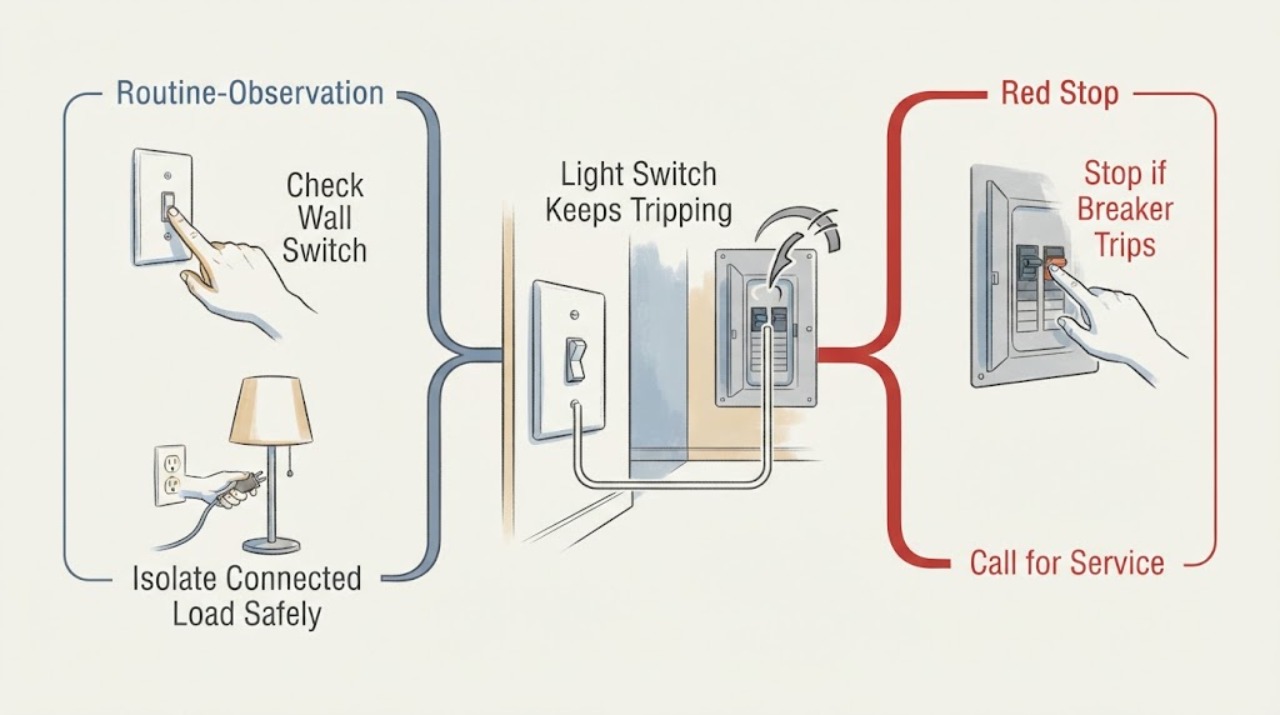
Work through in order
Diagnostic checks
Use only checks that match the exact appliance or system and its official guide.
-
Check 1
Record whether the breaker or fuse opens only when this switch is turned on, when it is turned off, when a connected light or appliance starts, or even while the switch is untouched.
Expected result: A trip synchronized with one switch operation differs from a circuit that trips under an unrelated load. Note which lights, outlets or fixtures lose power and whether the switch feels loose, stiff or abnormal.
Next step: Leave the switch off, unplug accessible connected loads if safe and give the electrician the exact timing and affected locations; do not repeat the operation to confirm it.
Stop if: Stop immediately for smoke, sparks, a burning smell, heat, a shock, water near the switch or a cracked plate.
Why this matters
Why: The timing identifies the switch-controlled branch as the investigation point without proving which internal component has failed.
-
Check 2
From a safe, dry position, turn off or unplug the lamp, fan, appliance or other accessible load controlled by the switch, without opening the fixture or handling damaged wiring.
Expected result: If the load has a damaged cord, moisture, scorching or an abnormal odor, it is a possible contributor. If the switch still trips with the connected load removed or the fixture is hard-wired, the fault remains in the switch, fixture or fixed wiring.
Next step: Keep a suspect load out of use and have it repaired or replaced through a qualified route. If the fixed switch still causes a trip, leave the branch off and arrange an electrician inspection.
Stop if: Do not reconnect a wet, damaged, scorched or shocked appliance, and do not access a hard-wired fixture or ceiling box as a user check.
Why this matters
Why: Separating a plug-in load can distinguish an appliance problem from a fixed switch-controlled circuit while keeping the electrical box closed.
-
Check 3
With the circuit left off after the trip, visually inspect only the switch plate, accessible fixture exterior and surrounding wall for warmth, discoloration, cracks, loose mounting, buzzing, flickering or visible arcing.
Expected result: A warm or discolored plate, crackling, sparks, a burning odor, a loose switch or flickering lights is a warning sign. A normal-looking plate does not rule out a hidden connection or fixture fault.
Next step: Leave the switch and circuit unused and call a licensed electrician. Tell the electrician whether the symptom appeared before or after the trip and whether other lights changed.
Stop if: Do not touch a hot or wet plate, remove the cover, tighten screws, operate the switch again or stand near active sparking.
Why this matters
Why: The visible symptoms can indicate overheating, arcing, damaged wiring or a failing device and require professional diagnosis rather than a cosmetic replacement.
-
Check 4
Without opening the panel or box, note recent changes such as a new light, dimmer, fan, heater, renovation, moisture event or added load on the same branch; check whether a GFCI or AFCI device is involved.
Expected result: A problem that began after a fixture change, renovation or moisture event has a different history from a long-standing switch that recently became noisy or hot. A protective device that will not remain reset should not be bypassed.
Next step: Keep the affected circuit out of use and provide the history to a qualified electrician, who can identify the correct protection and inspect the fixed wiring.
Stop if: Do not reset repeatedly, bypass a protective device, add a larger fuse or breaker, or use the circuit after water intrusion.
Why this matters
Why: Installation changes and moisture can expose wiring or fixture faults, while GFCI and AFCI operation is a safety response rather than a nuisance to defeat.
-
Check 5
After the external observations, do not perform another switch-on test; leave the switch off and arrange a licensed electrician to test the de-energized circuit and connected equipment using professional procedures.
Expected result: The electrician may find a faulty switch, fixture, lamp, loose connection, damaged conductor, overload or protective-device issue. A successful single reset would not prove the circuit safe.
Next step: Provide the switch location, trip timing, affected loads, visible symptoms, recent work and whether the circuit is now left off; follow the electrician’s clearance before restoring use.
Stop if: Keep the circuit off for smoke, odor, sparks, heat, shock, water intrusion, repeated trips or any exposed conductor until a qualified professional repairs it.
Why this matters
Why: CPSC treats a trip linked to a particular switch or receptacle as a professional electrical problem, not a consumer adjustment.
Use your observations
Decision map
Find the observation that best matches what you see, then follow the next safe action.
-
PATH 01Next step
What you see
The breaker or fuse trips every time one particular switch is operated.
Do this next
Leave the switch off and obtain a qualified electrician inspection; do not install a larger protective device.
Why this path and its safety boundary
Why it matters: The switch-controlled fixture, wiring, switch or protective device has an unresolved fault.
-
PATH 02Next step
What you see
The switch or plate is hot, discolored, cracked, loose, buzzing, sparking or smells burned.
Do this next
Stop using it, keep the circuit off if safe and call a licensed electrician; use emergency services for an active fire or immediate danger.
Why this path and its safety boundary
Why it matters: This is a potential overheating or arcing hazard.
-
PATH 03Next step
What you see
Only a plug-in lamp or appliance connected through the switch causes the trip and its cord or plug is damaged or wet.
Do this next
Keep that load unplugged and have it repaired or replaced through a qualified route; do not try it on another outlet.
Why this path and its safety boundary
Why it matters: The connected load may be the trigger rather than the wall switch itself.
-
PATH 04Next step
What you see
The circuit trips with the switch untouched, affects several lights or outlets, or will not remain reset.
Do this next
Leave the affected circuit unused and have a licensed electrician map and inspect it.
Why this path and its safety boundary
Why it matters: The fault may be elsewhere on the branch, in fixed wiring or in the protective device.
-
PATH 05Next step
What you see
The problem began after water intrusion, renovation, a new fixture or other electrical change.
Do this next
Do not operate the switch or remove covers; provide the history to a qualified electrician for inspection and repair.
Why this path and its safety boundary
Why it matters: The recent change or moisture may have exposed damaged or incorrect wiring.
Helpful context
Understand the symptom
A switch-triggered trip is a circuit fault signal
The wall switch may be the point that exposes a fault in the switch, light fixture, appliance, cable or protective device. The useful distinction is whether the breaker trips exactly when the switch is operated, or whether the switch itself shows heat, arcing or mechanical damage. Neither pattern is suitable for repeated user reset tests.
Keep the switch and panel closed
Leave the switch off and do not remove the faceplate, pull the switch from the box, probe terminals, change fuse or breaker size, or bypass GFCI or AFCI protection. If there is smoke, active sparking or a fire, move away and contact emergency help; do not touch the switch or panel.
A normal-looking plate does not clear hidden wiring
A cool, intact switch can still control a faulty fixture or have a wiring problem behind the box. If the trip is repeatable with that switch, record the pattern and have the circuit assessed instead of swapping parts by trial and error.
Only after diagnosis
Potential parts
- wall switch or dimmer device
A failed switch can cause a trip, but the same symptom can come from the fixture, wiring, load or protective device.
No rating or fit is asserted. Have a qualified electrician identify and install the correct device. - light fixture, lamp or connected appliance component
A connected load may be faulty, especially if it alone triggers the trip, but sound timing does not identify a replaceable part.
Keep hard-wired fixtures and damaged plug-in loads out of use until professionally assessed. - circuit protection device
Protection may be operating correctly or may require replacement, but changing it without finding the cause can create a fire or shock hazard.
Never select a larger rating or bypass protection; identification and replacement belong to a qualified electrician.
When checks do not resolve it
Need a professional?
Call a licensed electrician for any breaker or fuse trip tied to a particular switch, and call promptly for a hot, discolored, cracked, loose, buzzing, sparking or odorous switch, flickering lights, a shock, moisture, damaged wiring, repeated trips or a recent electrical change. Use emergency services for an active electrical fire or immediate danger.
Common questions
FAQ
Why does the breaker trip when I turn on one switch?
The switch may expose a fault in its wiring, the controlled fixture, a connected load or the branch protection. CPSC treats a trip linked to a particular switch as a qualified-electrician problem, not a reason to reset repeatedly.
Can I replace the switch to stop the trips?
Do not replace it as a first test. A faulty switch is only one possibility, and the fault may be in the fixture, wiring or protective device. Leave it off and have the circuit assessed professionally.
What if the switch is warm or buzzing but the breaker has not tripped?
Stop using it. Warmth, buzzing, discoloration, odor, flickering or sparks can indicate an electrical hazard even without a trip; leave the circuit off if safe and call a licensed electrician.
Should I install a larger breaker so the switch stays on?
No. CPSC warns against putting in a higher-rated fuse or breaker. The cause must be identified and corrected by a qualified electrician.
Read the exact guide
Official sources
- CPSC, National Electrical Safety Foundation Urge Consumers to Plug Into Electrical SafetyU.S. Consumer Product Safety Commission · CPSC advice to unplug repeatedly tripping appliances, inspect cords and stop using warm outlets.
- Electrical Safety: ChecklistNational Fire Protection Association · NFPA warning signs for recurring trips, warm or discolored outlets, burning odors, flickering lights and sparks.
- CPSC Guide to Home Wiring HazardsU.S. Consumer Product Safety Commission · CPSC guidance on switch-triggered trips, visible arcing, overheating, branch protection and qualified electrician boundaries.
Community feedback
Share a repair observation
Share a plain-text repair observation. Accepted observations are published automatically; this page may take a moment to update.