
On this page
Start here
Quick answer
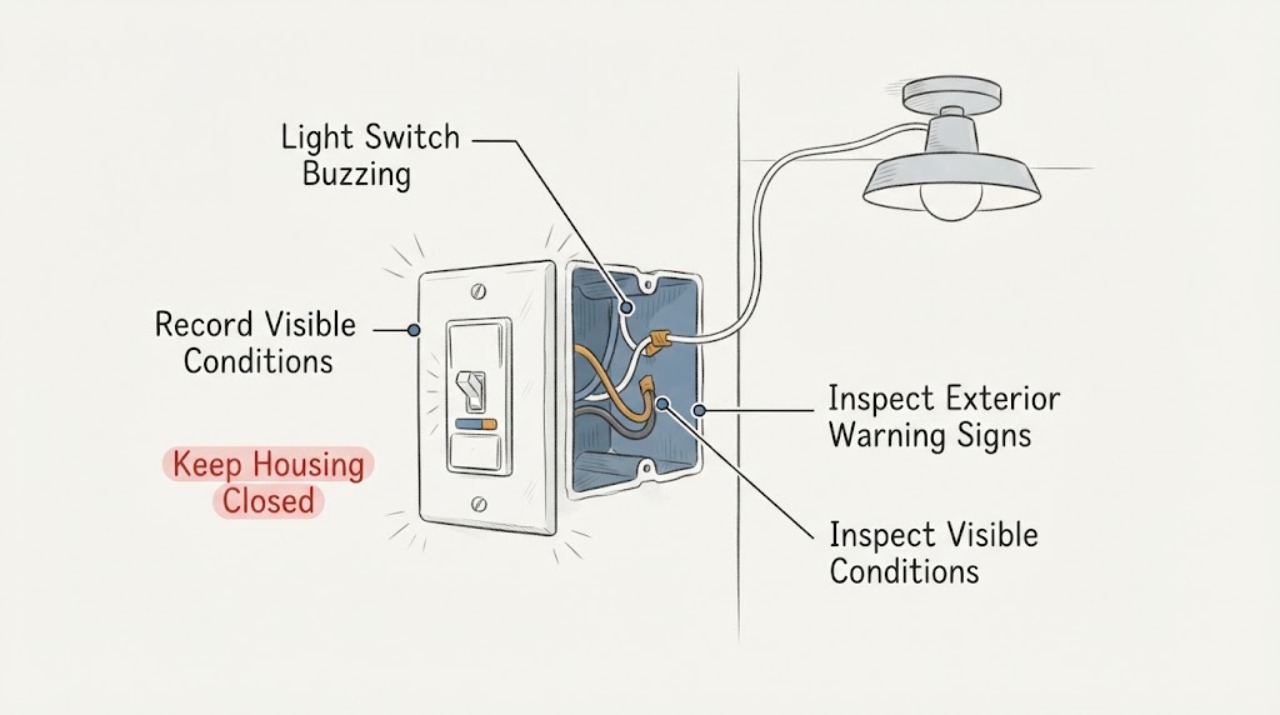
Treat a persistent buzz from a wall switch as an electrical warning, not a noise to ignore. Stop operating the switch and inspect only from outside for a hot or discolored plate, flickering light, burning-plastic odor, crackling, sparks, smoke, or a loose control. CPSC lists buzzing, odors, sparks, hot switch plates, and frequent breaker trips as electrical hazard warning signs, while Leviton says a switch that feels warm, buzzes, or sparks should be replaced. Do not remove the wall plate, tighten terminals, test voltage, replace the switch, or open a dimmer or smart-control box yourself. If the switch is hot, smells burned, sparks, smokes, shocks you, or trips the breaker, leave it off and obtain qualified electrician help; for active smoke or fire, leave the area and contact emergency services.
Before you begin
Safety first
- User checks are limited to stopping use, a safe exterior visual/listening observation, recording the control/load context, and noting breaker symptoms without opening electrical equipment. Do not remove plates, open boxes or panels, tighten or move wires, test voltage, replace switches or fuses, change breaker ratings, bypass controls, or repeatedly energize a buzzing circuit.
Work through in order
Diagnostic checks
Use only checks that match the exact appliance or system and its official guide.
-
Check 1
Stop deliberately operating the buzzing switch. From a safe position, listen once without placing a hand on the plate or reaching toward the fixture. If the control is not hot, smoking, or sparking, turn the connected light off using the normal control; if it is hot, smoking, sparking, or visibly damaged, do not touch it.
Expected result: The buzz is persistent, occurs only in one switch position, occurs with the light off or on, changes with a dimmer setting, or is accompanied by flicker, crackling, heat, odor, sparks, or smoke.
Next step: Leave the switch off and continue only with an exterior visual check. Do not turn it on repeatedly to reproduce the sound or attempt to quiet it with pressure, lubricant, or a new bulb.
Stop if: For smoke, flame, sparks, a burning odor, electric shock, a hot plate, water intrusion, or exposed wiring, leave the area if necessary and obtain urgent professional or emergency help without touching the device.
Why this matters
Why: A persistent or position-dependent buzz can involve the switch/control or the connected load, but the symptom alone cannot identify a safe repair. Heat, odor, visible arcing, smoke, or flicker raises the urgency from investigation to immediate electrical escalation.
-
Check 2
Without removing the wall plate or opening the box, look at the accessible face of the switch, plate, and nearby wall. Note discoloration, melted plastic, soot, a plate that is warm or hot, a loose or leaning control, visible gaps, moisture, or a smell of overheated plastic. Do not touch a suspect surface to measure its temperature.
Expected result: The plate and control look cool and intact; or there is heat, discoloration, melting, odor, moisture, looseness, or visible damage.
Next step: If any warning sign is present, stop using the circuit and arrange a qualified electrician inspection. If none is present, keep the switch off and document the sound and controlled light for the electrician.
Stop if: Do not remove screws, pull the switch from the box, tighten terminals, insert tools, or touch a hot, wet, melted, or damaged control.
Why this matters
Why: A cool, intact exterior does not prove the connection is safe, but heat or discoloration indicates possible overheating in the switch, load, or wiring. A loose control or moisture can also compromise safe operation and requires an electrician rather than a faceplate adjustment.
-
Check 3
From outside the installation, record the control type and load context: standard toggle, dimmer, timer, motion/occupancy control, or smart switch; LED, fluorescent, or other lamp; single- or multi-location control; and whether the buzzing began after a lamp, control, fixture, or wiring change. Do not remove the control to read a label.
Expected result: The buzz began after a control or lamp change; the control is a dimmer or electronic/smart device; the lamp flickers or dims; or no recent change is known.
Next step: Leave the circuit unused and provide the control/load details to a qualified electrician. Do not swap bulbs repeatedly, bypass the control, or connect a different load to test it.
Stop if: Stop if the lamp, fixture, control, or wiring shows heat, smoke, odor, arcing, water exposure, or physical damage; do not energize it for another test.
Why this matters
Why: A changed load or electronic control can create a compatibility or control fault, while flicker with buzzing can indicate an electrical connection or overload concern. These observations guide an electrician but do not justify guessing at a replacement or compatibility.
-
Check 4
From outside the electrical panel, record whether the same circuit's breaker has tripped or needs frequent resetting. Do not remove the panel cover, replace a fuse, change a breaker rating, or reset a breaker to keep using a buzzing switch. If the panel or breaker is hot, wet, damaged, or arcing, do not touch it.
Expected result: The breaker is normal and has not tripped; it has tripped once; it trips repeatedly; or the panel shows heat, odor, sparks, or damage.
Next step: For any repeat trip or panel warning, leave the affected circuit off if it can be isolated without danger and call a qualified electrician. Even with a normal breaker, a persistent buzz still requires inspection before reuse.
Stop if: Do not reset repeatedly, install a larger fuse or breaker, open the panel, or touch a wet, hot, sparking, or damaged electrical component.
Why this matters
Why: A repeat trip can signal a short, overload, misconnection, or fault in the switch or load. Heat, odor, and arcing at the panel are electrical hazards independent of the wall switch and require immediate professional attention.
-
Check 5
Decide whether the switch remains completely quiet and shows no warning signs after it has been left unused, without opening or modifying the installation. Record the final sound, plate appearance, light behavior, circuit-breaker history, control type, load type, and recent changes for the electrician.
Expected result: The buzz is gone and no warning sign has appeared; or the buzz returns, the switch is warm or discolored, the light flickers, a breaker trips, or any odor, spark, smoke, shock, moisture, or damage is present.
Next step: If any recurrence or warning sign exists, leave the switch off and arrange a qualified electrician inspection. For smoke or flame, leave the area and contact emergency services; do not use water on an electrical fire.
Stop if: Do not replace the switch, open the box, test voltage, bypass a dimmer or safety device, alter wiring, or continue operating a buzzing, hot, discolored, sparking, or smoking circuit.
Why this matters
Why: A temporarily quiet switch is not proof that an intermittent connection or control fault is safe. Any recurrence or hazard sign means the circuit should remain out of service until inspected; continued use can worsen an overheating or arcing condition.
Use your observations
Decision map
Find the observation that best matches what you see, then follow the next safe action.
-
PATH 01Next step
What you see
The switch plate or control is hot, discolored, melted, loose, or smells of overheated plastic.
Do this next
Stop using the switch and arrange a qualified electrician inspection as soon as possible. Do not touch or remove the control to investigate.
-
PATH 02Next step
What you see
The switch sparks, smokes, shocks a person, shows arcing, or is associated with an active burning odor or flame.
Do this next
Leave the area if needed and obtain urgent professional or emergency help. Do not operate the switch, touch the wiring, or use water; use the circuit's disconnect only if it can be done without approaching the hazard and local emergency guidance permits it.
-
PATH 03Next step
What you see
The controlled light flickers or dims, or the circuit breaker trips again when the switch or load is used.
Do this next
Leave the switch and connected load unused and call a qualified electrician. Do not reset repeatedly, increase fuse/breaker size, or open the panel.
-
PATH 04Next step
What you see
The buzz began after installing a dimmer, smart switch, timer, motion control, LED lamp, or new fixture/load.
Do this next
Leave the circuit off and provide the control and load details to an electrician. Compatibility and wiring must be checked against the exact devices; do not substitute parts as a test.
-
PATH 05Next step
What you see
The switch continues to buzz but looks cool and intact with no obvious flicker or breaker trip.
Do this next
Keep it unused and arrange a qualified electrician inspection. A quiet exterior does not rule out an internal switch, load, or connection fault.
Helpful context
Understand the symptom
A buzzing switch needs a safety decision first
The sound may come from the switch, a dimmer or smart control, the connected lamp, or a connection in the branch circuit. You cannot identify the source safely by removing the cover or touching the wiring. A control that is warm, discolored, loose, sparking, or associated with flicker or an odor is a stop condition. Even when the switch still works, continued operation can leave a heat or connection fault energized.
Use observations, not internal electrical tests
From outside the box, note when the buzzing begins, whether it changes with the switch position, and whether the connected light flickers or dims. Record whether the control is a standard toggle, dimmer, timer, occupancy sensor, or smart switch, and what lamp or fixture it controls. Do not repeatedly turn it on to reproduce the sound, open the box, or substitute a switch based on appearance alone.
Stop and escalate at the first hazard sign
Turn the fixture off if that can be done without touching a hot, sparking, smoking, or damaged control. If the plate is hot, there is a burning odor, visible arcing, smoke, shock, repeated breaker action, or water near the switch, stop using it and arrange an electrician inspection. The electrician can identify whether the switch, load, wiring, or circuit protection is involved and select a compatible replacement if needed.
Only after diagnosis
Potential parts
- wall switch or dimmer control
Consider a replacement only after an electrician confirms that the control itself is the diagnosed source of the buzzing and identifies the correct control type for the connected load and circuit.
Confirm the exact control, load, circuit arrangement, ratings, and local code requirements with the electrician before ordering; appearance alone does not establish compatibility.
When checks do not resolve it
Need a professional?
Arrange a qualified electrician inspection for any persistent switch buzz, and urgently stop use for a hot or discolored plate, burning odor, flicker, crackling, sparks, smoke, shock, water exposure, loose control, damaged wiring, or a repeatedly tripping breaker. For active smoke or fire, leave the area and contact emergency services.
Safety scope: User checks are limited to stopping use, a safe exterior visual/listening observation, recording the control/load context, and noting breaker symptoms without opening electrical equipment. Do not remove plates, open boxes or panels, tighten or move wires, test voltage, replace switches or fuses, change breaker ratings, bypass controls, or repeatedly energize a buzzing circuit.
Have this ready
- Provide the switch location, whether the buzz occurs with the light on or off, plate temperature/appearance observed without touching a suspect surface, flicker or sound details, control type, lamp or fixture type, recent changes, and breaker history. Do not remove the switch or cover to obtain details.
Common questions
FAQ
Is a buzzing light switch dangerous?
It can be an electrical warning sign, especially with heat, discoloration, flicker, odor, sparks, smoke, or breaker trips. Stop using the switch and have a qualified electrician inspect it rather than ignoring or opening it.
Should I tighten the screws on a buzzing switch?
No. Do not remove the plate or expose wiring. A buzzing switch can involve the control, load, or branch wiring; a qualified electrician should isolate and diagnose it safely.
What if the switch buzzes only with an LED lamp or dimmer?
Record the control and lamp types and leave the circuit unused. A recent control or load change can point to a compatibility or wiring issue, but it is not safe to substitute parts repeatedly or guess at ratings.
What should I do if the breaker trips when I use the switch?
Do not keep resetting it or install a larger fuse or breaker. Leave the switch off and obtain qualified electrician help because a repeat trip can indicate a short, overload, or other electrical fault.
Can I keep using a switch if the buzzing stops?
A temporary quiet period does not prove the fault is repaired. Do not repeatedly energize it to test; arrange inspection if the buzz returns or if any heat, odor, flicker, spark, smoke, shock, or discoloration appears.
Read the exact guide
Official sources
- The Circuit Breaker or GFCI Outlet Trips When I Try to Turn the Light OnLeviton Manufacturing Co., Inc. · Manufacturer support guidance for a Leviton electronic switch; wiring and code must be assessed by a qualified person.
- When Should I Replace a Switch?Leviton Manufacturing Co., Inc. · Manufacturer support guidance for switches and dimmers; exact installed product and local code control.
- Electrical Safety Month PosterU.S. Consumer Product Safety Commission · General household electrical safety warning signs, including switches and outlet covers.
- CPSC Guide to Home Wiring HazardsU.S. Consumer Product Safety Commission · General home wiring hazard guide; local electrical rules and a qualified electrician control.
Community feedback
Share a repair observation
Share a plain-text repair observation. Accepted observations are published automatically; this page may take a moment to update.