
On this page
Start here
Quick answer
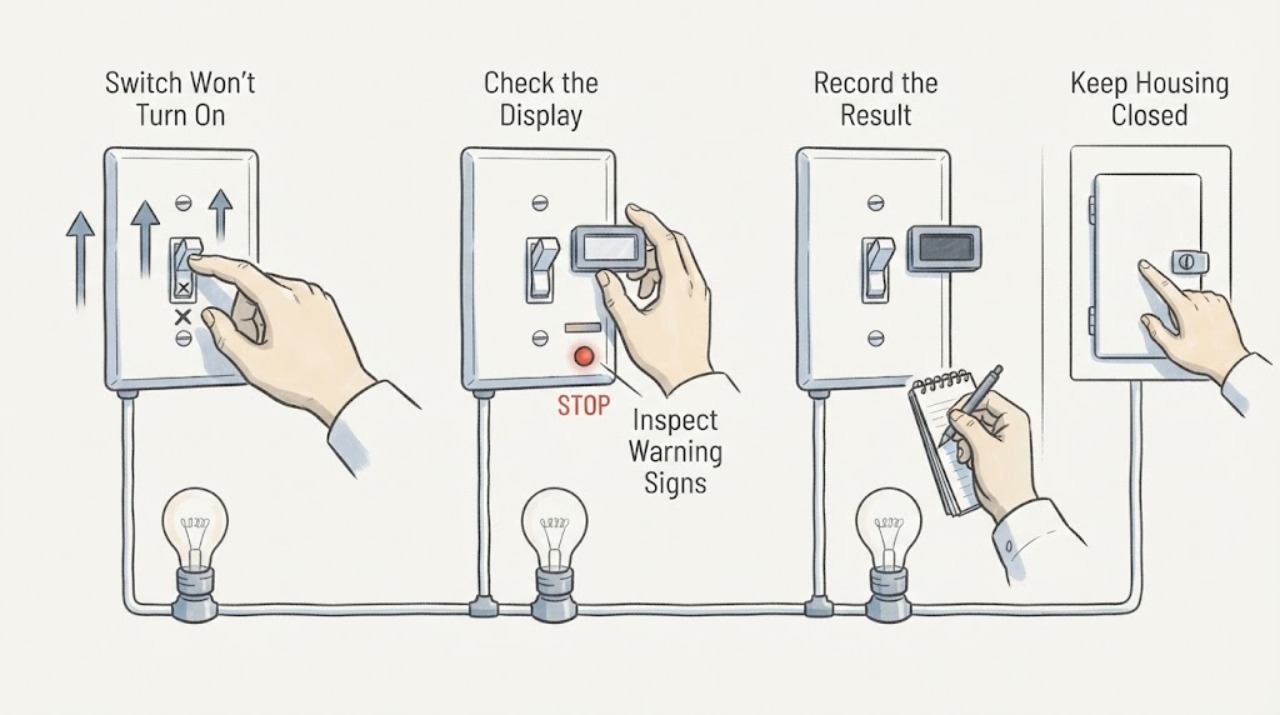
If a switch will not turn on, first identify whether it is a wall switch, pushbutton, or appliance control, then check only the external behavior: whether the control moves normally, whether the controlled light or appliance is the only thing without power, and whether a nearby breaker or protective device has tripped. Stop immediately for heat, discoloration, burning odor, crackling, sparks, shock, water, exposed wiring, or a breaker that trips again. Do not remove the faceplate, open the electrical box, test live wiring, bypass the switch, or keep resetting a tripped circuit. If safe external checks do not restore operation, arrange qualified electrical service.
Work through in order
Diagnostic checks
Use only checks that match the exact appliance or system and its official guide.
-
Check 1
Without removing anything, identify whether the control is a wall switch, pushbutton, dimmer, or appliance power control, and identify exactly what it should operate. Do not keep pressing an appliance control that is hot, wet, cracked, or giving off an odor.
Expected result: The control is a wall device, a plug-in appliance control, or a hard-wired appliance control; and one named light or appliance is affected or the affected load is unclear.
Next step: Continue with the matching external checks. For an appliance control, unplug the appliance if it can be done safely and use the manufacturer's service path; do not open the appliance.
Stop if: Stop if the control or appliance is wet, hot, cracked, smoking, or otherwise damaged.
Why this matters
Why: A wall switch and an appliance control have different service boundaries, while an unknown load makes it unsafe to infer a failed switch. A single dead load can be a lamp or appliance problem rather than a circuit problem.
-
Check 2
From a dry position, look and listen around the switch plate and the controlled load for heat, browning or discoloration, a burning smell, buzzing, sizzling, crackling, visible arcing, sparks, shock, smoke, or damaged insulation. Do not touch a suspicious plate to test its temperature.
Expected result: One or more warning signs is present, or the switch and surrounding area appear cool, dry, intact, and quiet.
Next step: If any warning sign is present, stop using the switch and arrange qualified electrical help; for smoke or fire, leave and contact emergency services from a safe location. If none is present, continue without disassembly.
Stop if: Stop immediately for heat, discoloration, odor, noise, arcing, sparks, shock, smoke, water, or exposed wiring.
Why this matters
Why: The warning signs are potential wiring or fire hazards and are not evidence that the switch merely needs a harder push. A normal exterior permits only low-risk checks; it does not clear hidden wiring.
-
Check 3
Operate the control once with normal, gentle pressure and note whether it has its usual travel and click. Do not force a control that is stuck, unusually loose, grinding, or partly detached, and do not remove the faceplate to inspect it.
Expected result: The control moves normally but the load stays off; the control is loose, stuck, cracked, or detached; or the control operates but the load responds intermittently.
Next step: For a damaged or intermittent control, leave it unused and arrange qualified service. If it moves normally, compare the load and circuit behavior in the next checks.
Stop if: Stop operating the control if it feels hot, loose, stuck, damaged, or produces noise, odor, or sparks.
Why this matters
Why: Normal movement does not prove that power reaches the load. A loose, stuck, damaged, or intermittent control points to a mechanical or electrical fault that needs professional inspection rather than repeated operation.
-
Check 4
Check other lights or outlets that are visibly nearby and normally share the area, using only their ordinary controls. Do not use a damaged outlet or appliance as a test load.
Expected result: Only the controlled load is off; several nearby loads are also off; or another device is also hot, discolored, noisy, or sparking.
Next step: Record which loads work. If multiple loads are off, move to the protective-device check only if the panel area is dry and safe; if a nearby device shows a hazard, stop and call a qualified electrician.
Stop if: Stop for any heat, odor, crackling, arcing, sparks, shock, water, or exposed wiring at the other devices.
Why this matters
Why: One dead load makes a lamp, appliance, fixture, or individual switch more plausible. Several dead loads make a circuit interruption more plausible. Another hazard changes the task to an immediate stop rather than a comparison exercise.
-
Check 5
If there are no hazard signs and the panel or protective-device area is dry and accessible, look for a breaker in an intermediate or off position or a tripped ground-fault device. Do not remove the panel cover, touch bare conductors, or repeatedly reset a device.
Expected result: A breaker or protective device is visibly tripped; no device appears tripped; or the device trips again when reset once according to its normal labeling.
Next step: If the area is safe and the device is clearly resettable, follow its normal instructions for one reset only. If it trips again, will not reset, or the cause is unclear, stop and arrange qualified electrical service.
Stop if: Stop for a repeat trip, a hot or damaged panel, moisture, exposed parts, or any need to remove the panel cover.
Why this matters
Why: A tripped device can explain why the switch and other loads are off, but a repeat trip indicates an unresolved fault. No visible trip does not prove that the switch or wiring is safe or energized.
-
Check 6
When the switch controls a plug-in lamp or appliance and the receptacle appears normal, unplug the load and test it only with its ordinary safe control or a known-good compatible power source. For a light, replace only an accessible lamp with the exact type and rating specified by its fixture or manual; do not open the fixture.
Expected result: The load works elsewhere or with a suitable replacement lamp; the load remains dead; or the receptacle, cord, plug, or fixture shows damage.
Next step: Stop using any damaged load and arrange the appropriate qualified service. If the load is known good but the switch still does not operate it, use the switch/circuit service branch.
Stop if: Do not test a wet, hot, cracked, smoking, sparking, or visibly damaged load or fixture.
Why this matters
Why: A load that works elsewhere points away from the load itself and back toward the switch or circuit. A load that remains dead can have its own fault. Damage at the cord, plug, receptacle, or fixture is a safety issue, not a replacement-part guess.
-
Check 7
After a safe external correction such as a clearly tripped protective device or an accessible lamp replacement, operate the switch once while nearby and observe the load. Do not repeatedly cycle the switch to force a result.
Expected result: The load returns and remains normal; it stays off; operation is intermittent; or the switch or load develops heat, odor, noise, sparks, or a shock.
Next step: Use the load only if it remains normal and the exact manual permits it, while monitoring for recurrence. Otherwise leave the switch unused and arrange qualified service with the recorded observations.
Stop if: Stop immediately for recurrence, intermittent operation, heat, odor, noise, sparks, shock, smoke, or another protective-device trip.
Why this matters
Why: A normal result after an obvious external correction suggests that condition may have caused the symptom but does not prove the wiring or switch is healthy. A failed, intermittent, or hazardous result requires diagnosis beyond user-level checks.
Use your observations
Decision map
Find the observation that best matches what you see, then follow the next safe action.
-
PATH 01Next step
What you see
The switch or nearby wiring is hot, discolored, noisy, sparking, arcing, wet, smoking, or associated with a burning smell or shock.
Do this next
Stop using it, keep clear, and arrange qualified electrical help. For smoke or fire, leave and contact emergency services from a safe location.
-
PATH 02Next step
What you see
The switch is loose, stuck, cracked, detached, unusually hard to operate, or intermittent.
Do this next
Leave the control unused and have a qualified electrician inspect the switch and its connections; do not remove the plate or try to tighten terminals.
-
PATH 03Next step
What you see
Several nearby lights or outlets are off, or a breaker or protective device is visibly tripped.
Do this next
If the panel area is dry and safe, follow the device's normal labeling for one reset only. If it trips again, will not reset, or the cause is unclear, stop and obtain qualified service.
-
PATH 04Next step
What you see
Only the controlled light or appliance is off and the switch moves normally without warning signs.
Do this next
Use the safe load check to distinguish an accessible lamp or plug-in appliance issue from a switch or fixture issue. If the load is known good and remains off, arrange qualified electrical service.
-
PATH 05Next step
What you see
The nonworking control is part of a hard-wired or plug-in appliance rather than a wall switch.
Do this next
Unplug the appliance when safe and follow the manufacturer's support instructions; do not open the appliance or test its internal wiring.
-
PATH 06Next step
What you see
The external checks show no hazard but the switch still will not turn on the load, or the circuit state cannot be established confidently.
Do this next
Stop troubleshooting and arrange a qualified electrician to inspect the de-energized circuit, switch, load, and protective devices.
Helpful context
Understand the symptom
What this symptom does and does not identify
A switch that will not turn on can mean the control itself is damaged, the connected light or appliance has failed, the branch circuit is off, or a protective device has interrupted power. The same symptom appears on wall switches, pushbuttons, and appliance controls, so begin by recording what the switch controls and what else on the circuit still works. These instructions stay at the external-observation level; they do not identify an internal repair part.
Keep the inspection external
Do not remove a cover, loosen terminals, probe an energized conductor, bridge the switch, or work inside a box or appliance. Do not use the switch if it is hot, wet, loose, cracked, discolored, noisy, sparking, or associated with a burning smell. Official safety guidance treats these signs as a reason to stop and have a qualified electrician assess the circuit.
What to record for service
Record the switch type, the controlled light or appliance, whether the control feels normal or loose, which nearby loads still work, whether a breaker or protective device moved, and any heat, odor, noise, spark, shock, water, or recent installation detail. A qualified professional can then inspect the de-energized circuit and determine whether the switch, load, wiring, or protection needs attention.
Safety boundary
Stop conditions
- Do not remove faceplates or panel covers, loosen terminals, probe live wiring, bypass the switch, or work inside an appliance or fixture.
- Do not keep resetting a breaker or protective device, repeatedly cycle a failed switch, or use a hot, wet, damaged, noisy, or sparking control or load.
- For smoke or fire, leave the area and contact emergency services from a safe location rather than continuing diagnosis.
When checks do not resolve it
Need a professional?
Use qualified electrical service when the switch remains off after safe external checks, the control is damaged or intermittent, multiple loads are affected, a protective device trips again, or diagnosis would require access to wiring, a fixture, an appliance, or an electrical panel.
Have this ready
- Provide the switch type, controlled load, control feel, nearby loads that still work, protective-device behavior, the timing of the failure, and any heat, odor, noise, spark, shock, water, or recent installation observations. Do not open anything to gather more information.
Common questions
FAQ
Why will a switch not turn on even though nearby lights work?
Nearby lights working makes a whole-area outage less likely, but it does not identify whether the controlled lamp, appliance, fixture, switch, or branch wiring has failed. Check only the external load behavior and arrange qualified service if a known-good load remains off.
Should I keep resetting the breaker when the switch will not work?
No. A single normal reset may be appropriate only when the panel area is dry, safe, and the device is clearly resettable. If it trips again or will not reset, stop and obtain qualified electrical help.
Can I remove the switch plate to see whether a wire is loose?
Do not remove the plate or inspect live wiring as a user-level check. A switch may still have energized conductors even when the load is off; have a qualified electrician isolate and inspect the circuit.
When is a switch that will not turn on an emergency?
Heat, discoloration, burning odor, buzzing, crackling, sparks, arcing, shock, smoke, water, or exposed wiring makes it unsafe to continue. Stop using it; for smoke or fire, leave and contact emergency services from a safe location.
Read the exact guide
Official sources
- How to avoid a costly lockdown DIY disasterElectrical Safety First · General household electrical safety; used for the boundary between simple external checks and wiring work
- CPSC Guide to Home Wiring HazardsU.S. Consumer Product Safety Commission · General household wiring guidance for nonworking, hot, sparking, shocking, or repeatedly tripping switches and receptacles
- Home Wiring Safety TipsElectrical Safety Foundation International (ESFI) · General residential switch and wiring safety boundaries; not a model-specific repair procedure
Community feedback
Share a repair observation
Share a plain-text repair observation. Accepted observations are published automatically; this page may take a moment to update.