
On this page
Start here
Quick answer
Do not troubleshoot a suspected miswired double wall switch while it is energized. Turn off the correct branch circuit if you can identify it safely, keep the switch untouched, and do not rely on the wall switch position as proof that the box is dead. A double switch may control two loads, be part of a 3-way or multi-location circuit, or have a device-specific neutral and traveler arrangement, so wire colors and a generic diagram are not enough. If the switch is warm, buzzing, sparking, loose, gives a shock, trips a breaker, or the circuit cannot be positively identified, stop using it and have a qualified electrician inspect the switch, box, loads, grounding, and breaker before restoring power.
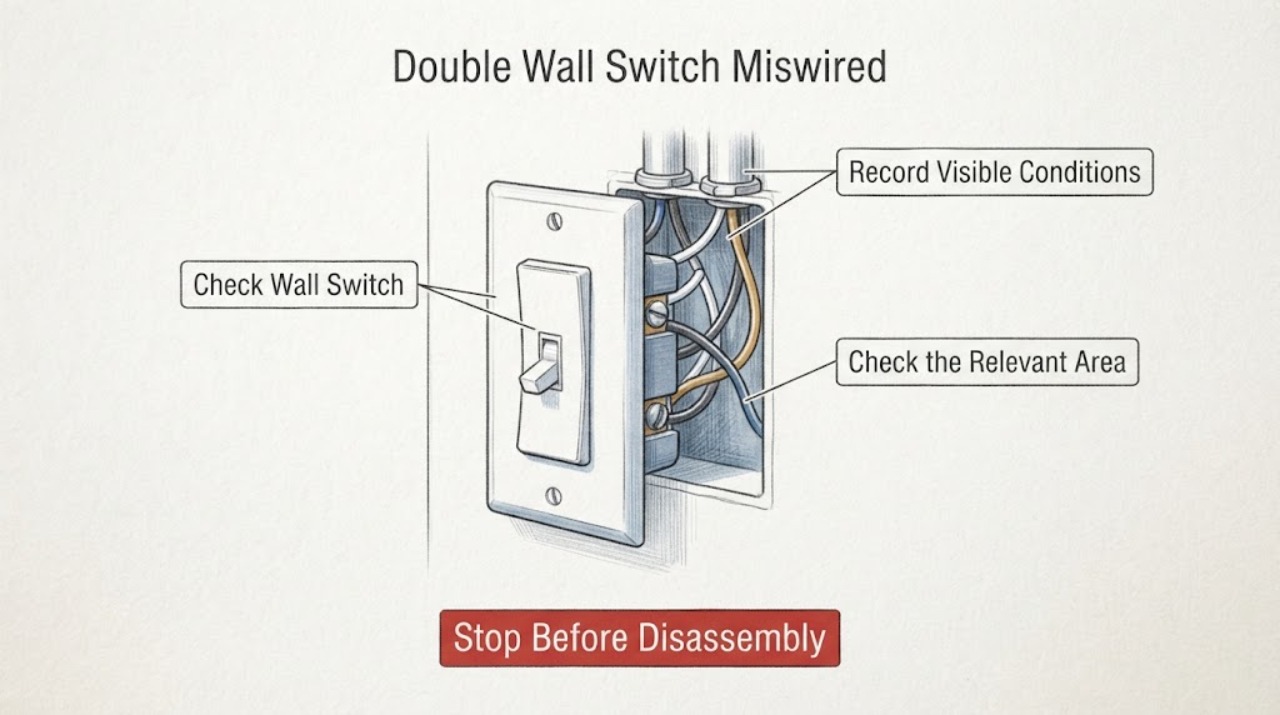
Work through in order
Diagnostic checks
Use only checks that match the exact appliance or system and its official guide.
-
Check 1
Before touching the wall plate or switch, ask whether there is any warmth, buzzing, crackling, flickering, sparking, burning odor, visible damage, shock, or a breaker trip associated with the switch.
Expected result: Any of these signs is present, or the switch controls a load that behaves unpredictably.
Next step: Stop using the switch, keep people away, and have a qualified electrician assess it. If there is active smoke or fire, leave and call emergency services.
Why this matters
Why: The switch or its wiring may have an unsafe connection or arcing condition; normal operation of one light does not make the installation safe.
-
Check 2
If there is no active fire, isolate power at the branch breaker only from a safe position and only when the correct circuit is clearly identified. Do not remove the wall plate, touch screws, or assume the switch being off means the box is de-energized.
Expected result: The correct breaker is known and can be switched off safely, or the circuit is unlabeled, shared, or uncertain.
Next step: Switch off the clearly identified circuit and leave it off. If it cannot be identified confidently, stop and arrange an electrician rather than opening the box to find out.
Why this matters
Why: A wrong breaker leaves conductors energized, and a double or multi-location circuit may not behave as expected from one switch position.
-
Check 3
From outside the box, record which two lights, fans, or other loads the two controls are intended to operate, whether each control works alone or affects the other, and whether a second switch location exists.
Expected result: One control operates the wrong load, both loads operate together, a 3-way partner behaves oddly, or the intended load is dead; alternatively, the controls operate the expected loads without heat or noise.
Next step: Keep the circuit off if the behavior is abnormal. Give the electrician the observed switch-to-load map and the full switch model; do not correct wires based on the symptom.
Why this matters
Why: The behavior can help an electrician identify a line/load, traveler, shared-feed, or device-compatibility question, but it does not prove a particular conductor is connected incorrectly.
-
Check 4
Collect the switch brand and full model from packaging or visible labeling, note whether it is a basic switch, dimmer, smart switch, illuminated switch, or GFCI/switch combination, and note the number of switch locations.
Expected result: The exact device and configuration can be identified, or the device is unlabeled/unknown and the box arrangement is not documented.
Next step: Use the exact manufacturer instructions only as information for the electrician. If the device or wiring is uncertain, do not attempt a replacement or connection yourself.
Why this matters
Why: Official diagrams are device- and topology-specific. An unknown switch or unknown box cannot be safely matched to a generic double-switch wiring picture.
-
Check 5
Arrange an electrician to inspect the de-energized box, conductors, grounding, connected loads, breaker, and any upstream or downstream devices before power is restored.
Expected result: The electrician finds a loose connection, damaged switch, wrong line/load or traveler arrangement, missing grounding/neutral, incompatible device, or no wiring fault at the switch.
Next step: Follow the electrician’s written correction and testing plan. Do not substitute a different switch, increase breaker size, or restore power until the circuit is confirmed safe.
Why this matters
Why: Any of these findings changes the repair and safety decision; the switch symptom alone cannot identify a replacement part or authorize re-energizing.
Use your observations
Decision map
Find the observation that best matches what you see, then follow the next safe action.
-
PATH 01Next step
What you see
The switch plate is hot, there is buzzing, crackling, an odor, visible arcing, smoke, a shock, or repeated breaker tripping.
Do this next
Stop use, turn off the identified circuit if safe, and obtain qualified electrical service; call emergency services for active smoke or fire.
Why this path and its safety boundary
Why it matters: These are warning signs of an unsafe wiring or device condition and possible arcing or fire risk.
-
PATH 02Next step
What you see
Both controls work but operate the wrong loads, affect each other, or a second location behaves incorrectly.
Do this next
Leave power off and provide the electrician the switch model, number of locations, and observed load behavior.
Why this path and its safety boundary
Why it matters: The installation may not match the device’s intended line/load/traveler or multi-location configuration, but the observation does not identify the wire to move.
-
PATH 03Next step
What you see
The circuit, switch type, or existing box configuration cannot be identified confidently.
Do this next
Do not open or rewire the box; have a qualified electrician identify the circuit and device-specific wiring.
Why this path and its safety boundary
Why it matters: A generic color-based or two-switch diagram may be incompatible with the actual device, neutral availability, grounding, or multi-way topology.
-
PATH 04Next step
What you see
The exact device manual and box configuration are available, and a qualified electrician confirms the wiring and protective devices are correct.
Do this next
Follow the electrician’s testing and restoration plan, and retain the exact model instructions for future service.
Why this path and its safety boundary
Why it matters: Only that professional assessment establishes that the installation is ready for controlled restoration; the visual symptom alone cannot do so.
Helpful context
Understand the symptom
“Double wall switch miswired” can mean several different situations: two independent single-pole controls in one box, a 3-way or multi-location arrangement, a device that needs a neutral, or a switch connected to the wrong load. The outward symptom does not identify which wiring topology is present, and a working light does not prove the box is wired safely.
The checks here are deliberately limited to power isolation, observation, documentation, and the handoff to an electrician. They do not provide a universal wire-by-wire recipe and do not tell a reader to separate conductors, probe an energized box, or re-energize the circuit for testing.
When checks do not resolve it
Need a professional?
Call a qualified electrician before touching the switch if it is warm, noisy, damaged, sparking, shocking, flickering, incorrectly controlling loads, or associated with a tripped breaker. Call emergency services for active smoke or fire. Do not restore power merely because the switch appears to work.
Common questions
FAQ
Can I fix a double switch by matching the wire colors?
No. Colors and box layouts can vary, and a double switch may be single-pole, 3-way, multi-location, smart, illuminated, or otherwise device-specific. Keep power off and use the exact instructions through a qualified electrician.
What if the light still works after I suspect miswiring?
Working output does not prove the wiring is safe. A switch can still operate while having a loose connection, wrong topology, heat, arcing, or a missing protective connection. Stop if there is any warmth, sound, odor, flicker, shock, or breaker trip.
What should I do if the breaker trips again?
Do not install a larger breaker or keep resetting it. Leave the circuit off and have a qualified electrician identify and correct the cause.
Read the exact guide
Official sources
- Getting Started Guide — Wired Switch CompanionLeviton Manufacturing Co., Inc. · Leviton DD0SR-1 wired switch companion and compatible multi-location devices only; used to show that wiring diagrams are device/topology-specific and that mismatched or uncertain wiring requires an electrician, not as a generic double-wall-switch recipe.
- National Electric CodeU.S. Consumer Product Safety Commission · CPSC explanation that the NEC safeguards people and property from electrical shock and fire hazards; used only to support professional/code-compliant scope, not a local code determination.
- CPSC Guide to Home Wiring HazardsU.S. Consumer Product Safety Commission · CPSC guidance on shock at switch plates, miswired devices, and breaker-tripping switch/receptacle conditions; used only for safe handoff, not as a universal installation procedure.
- Home Electrical Safety ChecklistU.S. Consumer Product Safety Commission · CPSC home electrical safety checklist for outlets and switches; used for the warning that loose switch connections or worn switches can arc/overheat and that warm switches require electrician inspection.
Community feedback
Share a repair observation
Share a plain-text repair observation. Accepted observations are published automatically; this page may take a moment to update.