
On this page
Start here
Quick answer
If one control in a two-switch box works and the other does not, treat the nonworking side as an electrical fault that needs a safe external check and, usually, a licensed electrician—not as permission to remove the cover. From a dry, safe position, note whether the faceplate is hot, discolored, loose, buzzing, sparking or associated with an odor, shock, flicker or a tripped breaker. Stop using the switch immediately for any warning sign; if there is smoke or active arcing, leave the area and use emergency help. Do not open the box, probe it, move wires or repeatedly reset a breaker. CPSC says a switch that does not work should not be ignored and should be checked by a qualified electrician.
Before you begin
Safety first
- Do not remove the faceplate, open the box, probe live conductors, move wires, replace the device, bypass protection, or repeatedly reset a tripping breaker. Use only a licensed/qualified electrician for internal diagnosis and repair; use emergency help for smoke, active arcing or fire risk.
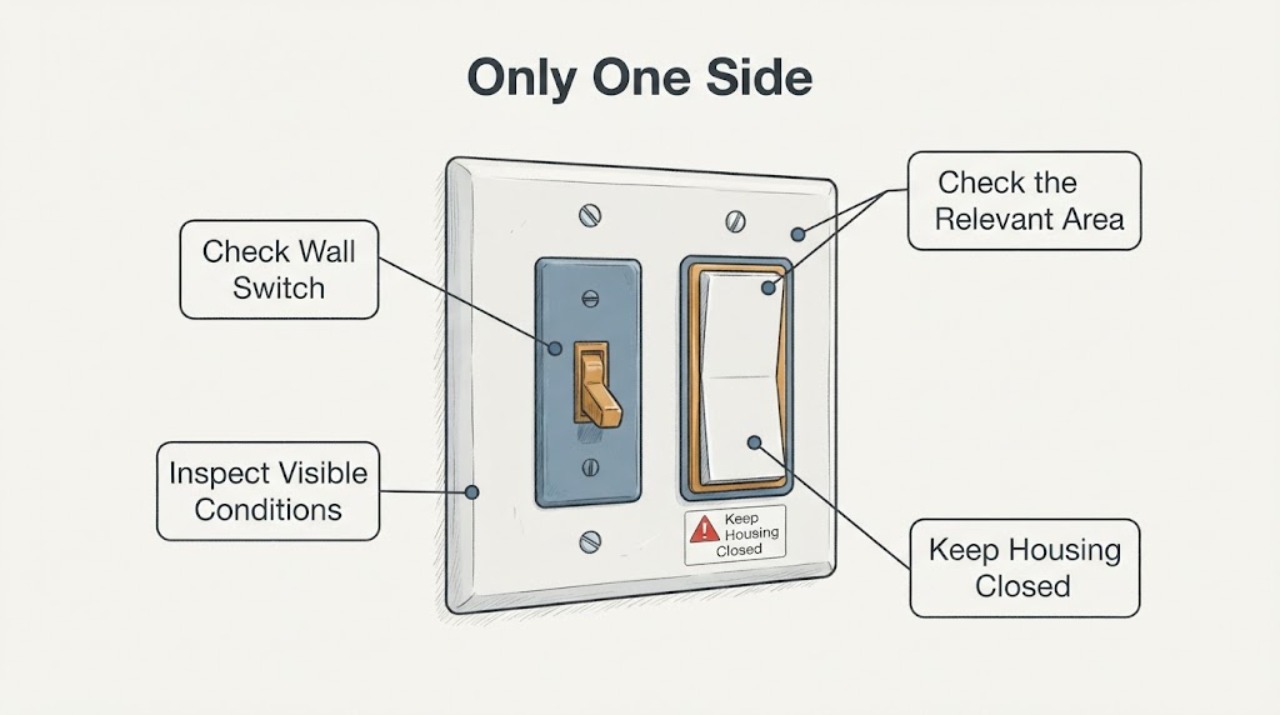
Work through in order
Diagnostic checks
Use only checks that match the exact appliance or system and its official guide.
-
Check 1
Stop operating the affected side and visually inspect only the outside of the switch plate and surrounding wall from a dry, safe position. Do not remove the plate or touch a hot, damaged or wet surface.
Expected result: The plate is cool and intact, or it is hot, discolored, cracked, loose, wet, smoky or visibly damaged.
Next step: For any heat, damage, moisture, smoke or visible arcing, keep clear and stop using the box. If no warning sign is present, continue only with external documentation and arrange electrical inspection.
Why this matters
Why: A nonworking control is already a fault condition; heat, discoloration, moisture or damage increases the possibility of an unsafe wiring/device condition and cannot be narrowed safely from appearance alone.
-
Check 2
With the switch untouched, note whether the symptom is isolated to one control or accompanied by a dark room, flickering lights, other dead switches/outlets or a breaker that is visibly tripped. Do not repeatedly reset a breaker to see whether the switch returns.
Expected result: Only one switch side is dead, or other devices are also without power or the breaker has tripped.
Next step: Record which controls and nearby devices are affected. Leave a repeatedly tripping or visibly damaged circuit off and call a licensed electrician; do not substitute a larger fuse or breaker.
Why this matters
Why: CPSC treats a switch that fails to operate as a condition requiring qualified help and separately directs qualified-electrician help when a particular switch trips the circuit. A wider outage means the switch may not be the only affected point, but it does not identify the fault.
-
Check 3
Observe the working side only for normal operation without cycling the faulty side. Record whether the working control also causes dimming, flicker, buzzing, crackling, odor, heat or a shock/tingle.
Expected result: The working side is normal, or one or both sides show noise, flicker, odor, heat, shock or visible arcing.
Next step: Stop using the entire box when any warning sign appears and arrange licensed inspection. Do not infer that replacing only the dead switch will correct the cause.
Why this matters
Why: ESFI lists unusual sounds, arcs/sparks, hot or discolored plates, shocks and flicker as electrical hazard signs. A normal working half does not prove the shared box or wiring is safe.
-
Check 4
From outside the box, record the switch brand/model marking if visible, the room and load controlled, the age or recent work if known, and any breaker label. Do not open the box, probe conductors, move wires or attempt a switch replacement.
Expected result: The label/history is available, or the box is unmarked and its wiring history is unknown.
Next step: Give the electrician the exact symptom, what still works, the affected breaker, warning signs and any recent renovation or fixture change. If information is missing, do not guess a wiring layout.
Why this matters
Why: These details help an electrician scope the visit but cannot establish compatibility, conductor identity or a repair method for an unbranded double-switch box.
-
Check 5
If there is smoke, active arcing, a burning odor, a shock, a hot plate, water near the box or an immediate fire concern, move people away and use emergency services from a safe location. Only turn off the circuit from a dry, safe position if doing so does not require approaching damage; do not re-enter to inspect.
Expected result: An immediate electrical emergency is present, or the symptom is limited to one dead side with no warning signs.
Next step: For an emergency, leave the area and contact emergency help. Otherwise keep the affected control unused and schedule a licensed electrician; do not perform live or internal checks.
Why this matters
Why: Smoke, arcing, burning odor, heat, shock and water can indicate an urgent hazard; a quiet dead side still needs qualified diagnosis because a nonworking switch should not be ignored.
Use your observations
Decision map
Find the observation that best matches what you see, then follow the next safe action.
-
PATH 01Next step
What you see
The switch plate is hot, discolored, loose, wet, smoky, buzzing, sparking or associated with a burning odor or shock.
Do this next
Stop using the box, keep people clear and obtain licensed-electrician or emergency help as appropriate; do not touch or open it.
Why this path and its safety boundary
Why it matters: These are recognized electrical warning signs, not a routine switch-position issue.
-
PATH 02Next step
What you see
Only one side is dead, the plate is cool and intact, and no nearby lights/outlets flicker or lose power.
Do this next
Leave the faulty side unused, document what works and arrange an electrician; do not remove the cover or replace the switch based on guesswork.
Why this path and its safety boundary
Why it matters: The immediate warning signs are not observed, but CPSC still says a switch that does not work should be checked by a qualified electrician.
-
PATH 03Next step
What you see
The breaker trips, other devices are dead, or the fault returns when the switch is operated.
Do this next
Do not repeatedly reset or up-rate the breaker/fuse. Leave the affected circuit off when safe and call a qualified electrician.
Why this path and its safety boundary
Why it matters: The symptom affects more than the visible switch side or is associated with a protective-device trip; the cause cannot be assigned externally.
-
PATH 04Next step
What you see
There is smoke, active arcing, a strong burning-plastic odor, water at the box, a shock or immediate fire risk.
Do this next
Leave from a safe route, keep others away and call emergency services or the utility as appropriate; do not operate the box or re-enter to inspect.
Why this path and its safety boundary
Why it matters: This is an urgent electrical hazard and should not be investigated by a homeowner.
Helpful context
Understand the symptom
A half-working double switch is not a safe wiring diagnosis
The symptom identifies a two-control switch box in which only one side operates. It does not establish whether the cause is the switch mechanism, a connection, a branch-circuit condition, a load or another wiring fault. CPSC says switches that do not work should not be ignored and may warn of a more serious problem. Because the box can contain energized conductors even when one control is dead, keep the investigation outside the cover.
Look for stop-use warning signs
A hot or discolored plate, crackling or buzzing, a burning-plastic odor, visible arcing, a shock or tingle, flickering, smoke or a breaker that trips when the switch is used changes this from a simple operating complaint to an electrical safety issue. ESFI lists these as wiring hazard signs, and CPSC directs users to discontinue use of a hot switch and obtain qualified help.
Keep the repair boundary with a licensed electrician
A user can document what works and what warning signs are visible from a safe position. Removing the faceplate, checking terminals, probing for live voltage, replacing the switch or changing a connection requires electrical competence and local-code compliance. Electrical Safety First says electrical work should be left to competent professionals and advises not to DIY when unsure.
When checks do not resolve it
Need a professional?
Call a licensed electrician for any nonworking side of a double switch box. Stop using it immediately for heat, discoloration, buzzing, crackling, odor, flicker, shock, visible arcing, moisture or a breaker trip. For smoke, active arcing or fire risk, leave and contact emergency services from a safe location. Do not open the box or perform internal electrical tests.
Safety scope: Do not remove the faceplate, open the box, probe live conductors, move wires, replace the device, bypass protection, or repeatedly reset a tripping breaker. Use only a licensed/qualified electrician for internal diagnosis and repair; use emergency help for smoke, active arcing or fire risk.
Have this ready
- Provide the room, what each switch controls, which side still works, affected breaker label/state, visible warning signs, any recent renovation or fixture change, and an external photo only if it can be taken without approaching heat, smoke, arcing or water.
Common questions
FAQ
Can I replace only the dead half of the double switch?
Do not assume that is the fix. The symptom does not identify the device, connection, load or branch-circuit cause, and electrical-safety guidance says not to DIY uncertain wiring work. Have a qualified electrician inspect it.
Should I keep resetting the breaker?
No. If the breaker trips when the switch is used or trips repeatedly, stop using the circuit and obtain qualified help. Never install a larger fuse or breaker to make the symptom disappear.
Is a cool switch with no sparks safe to ignore?
No. CPSC says switches or receptacles that do not work should not be ignored and may warn of a more serious problem. Leave the faulty side unused and schedule a licensed inspection even when no heat or noise is present.
Read the exact guide
Official sources
- Home Wiring Safety TipsElectrical Safety Foundation International · Opened official ESFI home-wiring guidance. It lists outages/trips, dim or flickering lights, arcs/sparks, sizzling/buzzing, hot or discolored plates and shocks as warning signs requiring licensed-electrician inspection. It is not a component diagnosis for this switch box.
- CPSC Guide to Home Wiring HazardsU.S. Consumer Product Safety Commission · Opened the official CPSC home-wiring safety guide PDF. It supports safe external recognition of a nonworking switch and warning signs, discontinuing a hot switch, and qualified-electrician service. It does not establish a diagnosis for this unbranded double-switch box or authorize user wiring work.
- Electrical Safety Advice for DIY-ersElectrical Safety First · Opened official electrical-safety guidance. It says electrical work should be left to competent professionals, advises shutting off power for DIY near wiring, and says not to DIY when unsure. It is used only for the safety boundary, with local code and electrician practice controlling the work.
Community feedback
Share a repair observation
Share a plain-text repair observation. Accepted observations are published automatically; this page may take a moment to update.