
On this page
Start here
Quick answer
Treat an abnormal bathroom double switch as an electrical safety issue. Stop using it if either half is warm, buzzing, sparking, loose, wet, smells burned, gives a shock, or trips power. From a dry position, switch off the circuit breaker if it can be identified safely, keep the bathroom switch and nearby water away from use, and do not remove the cover, probe the wires, or perform a live-voltage test. A bathroom circuit may include GFCI protection, but a reset or breaker status does not prove that a damaged switch or wiring is safe; a licensed or qualified electrician should inspect persistent or abnormal operation.
Work through in order
Diagnostic checks
Use only checks that match the exact appliance or system and its official guide.
-
Check 1
Stop using both halves of the bathroom switch if either control is warm, loose, buzzing, crackling, sparking, wet, discolored, smells burned, gives a shock, or makes a breaker trip. Keep hands and the floor dry and do not touch the switch plate to investigate the symptom.
Expected result: There is heat, moisture, an odor, noise, visible damage, a shock, or repeated loss of power.
Next step: From a dry location, turn off the suspected circuit breaker if it can be identified without touching damaged equipment. Keep the circuit off and contact a qualified electrician.
Stop if: Do not approach the switch or breaker with wet hands, standing water, smoke, arcing, or exposed conductors.
Why this matters
Why: This is an abnormal electrical condition with shock or fire potential, not a harmless switch-label or bulb problem.
-
Check 2
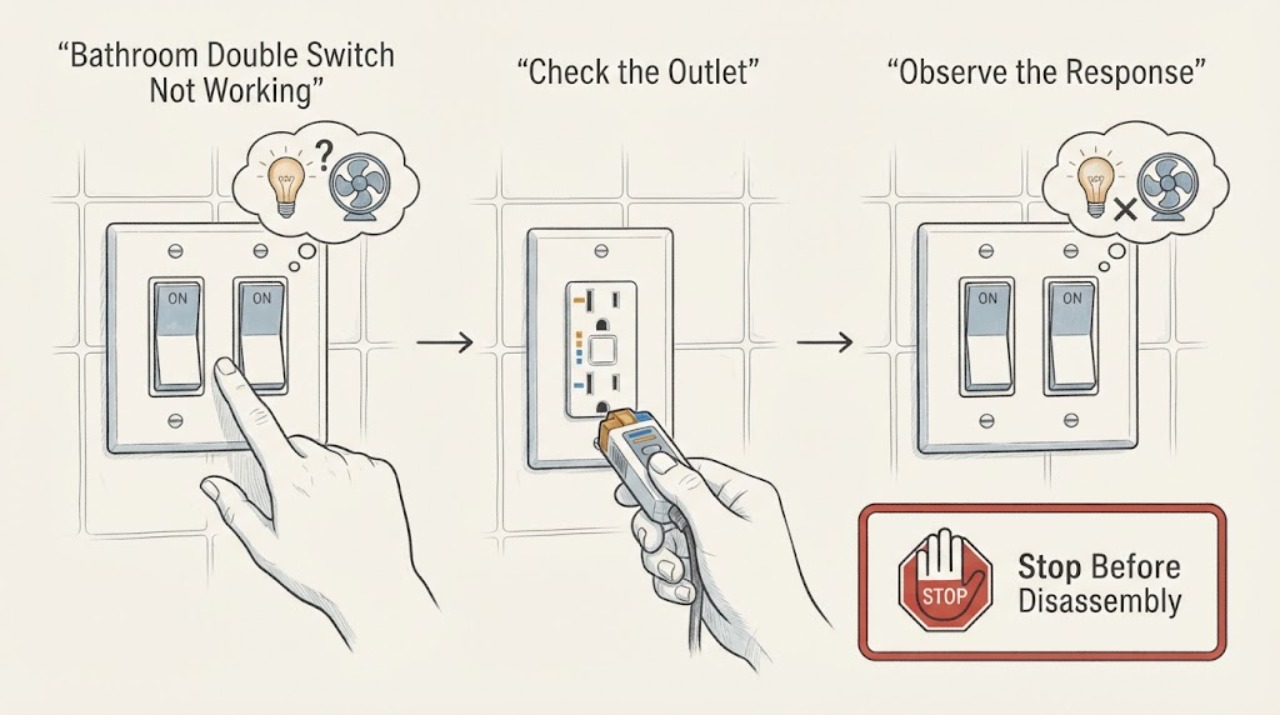
After the circuit is switched off, observe the outside of the two-gang plate and the controlled fixtures without removing anything. Record whether one or both buttons fail, whether the switch rocks or moves in the wall, and whether the light, exhaust fan or other load is also dead.
Expected result: Only one half is dead, both halves are dead, the plate or switch moves, or the controlled load is dead while the switch feels normal.
Next step: Photograph the exterior condition and keep the circuit isolated if operation is abnormal. Do not remove the plate or use a tester, screwdriver or meter in the box.
Why this matters
Why: The pattern can help an electrician trace the correct branch, but it does not prove a particular wire, neutral, breaker, switch or fixture fault.
-
Check 3
From outside the switch box, note whether a nearby bathroom receptacle or protective device has a TEST/RESET label and whether the breaker or safety switch is visibly tripped. Do not reset a device if the area is wet, the switch is damaged, a burning smell or sparks are present, or the cause of the trip is unknown.
Expected result: A GFCI or breaker is tripped, it will not remain reset, or no protective device is identifiable.
Next step: Leave the affected circuit off and have an electrician identify the circuit and test the installation. Do not keep resetting it or substitute a higher-rated breaker.
Why this matters
Why: A trip may indicate a ground fault, overloaded/failed load, or wiring problem; absence of a trip does not clear a faulty switch. CPSC describes GFCI protection as shock mitigation, not a substitute for repair.
-
Check 4
Give the electrician the room, the two loads controlled by each half, the exact abnormal behavior, any breaker/GFCI event, and photographs of the dry exterior. Ask for the circuit and switch-box inspection before replacing the double switch or restoring power.
Expected result: The switch remains intermittent, one load is dead, the circuit trips, the box is loose/damaged, or the cause cannot be identified from the exterior.
Next step: Keep the circuit isolated as directed and use licensed or qualified electrical service. Do not perform live measurements, open the box, or reconnect wires yourself.
Why this matters
Why: The public safety sources do not support naming a wiring fault or prescribing a connection change without inspection and local-code context.
Use your observations
Decision map
Find the observation that best matches what you see, then follow the next safe action.
-
PATH 01Next step
What you see
The switch is warm, wet, buzzing, sparking, burned, loose, or has shocked someone.
Do this next
Stop touching it, isolate the circuit from a dry safe position if possible, and call a qualified electrician; do not reset and retry repeatedly.
Why this path and its safety boundary
Why it matters: The bathroom switch or its wiring may present a shock or fire hazard.
-
PATH 02Next step
What you see
Both switch halves stopped working and a breaker or GFCI is tripped.
Do this next
Do not keep resetting it. Leave the circuit off and have an electrician determine whether the load, switch, fixture or wiring is safe.
Why this path and its safety boundary
Why it matters: A protective device has detected or responded to a possible circuit/load fault, but the trip does not identify its source.
-
PATH 03Next step
What you see
Only one half fails while the other still controls its load and there is no heat, moisture, odor, noise or shock.
Do this next
Avoid the failed half and schedule qualified inspection; do not open the box simply because the other half still works.
Why this path and its safety boundary
Why it matters: The symptom is narrower, but an external observation cannot distinguish a failed switch half from a load or branch-wiring issue.
-
PATH 04Next step
What you see
The bathroom or switch box is wet, conductors are exposed, power cannot be isolated confidently, or smoke/arcing is present.
Do this next
Do not touch the switch, water or exposed wiring. Leave the area if necessary, call emergency services for fire or immediate danger, and have a licensed electrician isolate and repair it.
Why this path and its safety boundary
Why it matters: The situation exceeds safe consumer observation and may involve energized wiring in a wet location.
Helpful context
Understand the symptom
A two-gang switch can control two separate loads while sharing a box or branch circuit, so one half working does not prove the other half is safe. The task provides no wiring type, country, switch rating, or history of a breaker/GFCI event. Use only external observations after power is isolated; do not infer a loose terminal, neutral, feed, or switch failure from the symptom alone.
Bathrooms add shock risk because water and grounded surfaces are nearby. A GFCI can interrupt some ground faults, but it does not authorize opening the switch box or testing live conductors. If the switch is hot, wet, sparking, noisy or has shocked anyone, leave it out of service and use qualified electrical service.
When checks do not resolve it
Need a professional?
Call a qualified electrician before further use if the double switch is warm, wet, loose, noisy, discolored, sparking, gives a shock, repeatedly trips a breaker/GFCI, or remains unreliable after a safe external check. Do not replace the switch, alter wiring, or perform live measurements without the required qualification and local-code knowledge.
Common questions
FAQ
Can I remove the wall plate to see why one switch is not working?
No. Do not remove the plate or expose wiring as a troubleshooting step. Switch boxes can remain energized unless the correct circuit is isolated, and bathroom moisture increases shock risk. Use a qualified electrician.
Does resetting the bathroom GFCI prove the double switch is safe?
No. A GFCI can interrupt some ground faults, but a reset does not identify a damaged switch, fixture or wire. Do not reset it when there is moisture, heat, odor, sparking or a repeated trip; arrange inspection.
Why does one half work while the other half does not?
The two controls may serve different loads or have a fault affecting only one path, but the symptom alone cannot identify the switch, fixture, neutral, feed or wiring. Record the pattern with power isolated and have it inspected.
Read the exact guide
Official sources
- GFCI Fact SheetU.S. Consumer Product Safety Commission · Official GFCI guidance used to explain shock protection near water and why a GFCI does not identify or repair a faulty switch/wire. It does not authorize live testing or switch-box work.
- How to Use GFCIsElectrical Safety Foundation International · Electrical-safety foundation guidance used to explain that GFCIs can trip on wet equipment and that failed test/reset functions require qualified replacement; it is not a live switch-testing or wiring guide.
- Electrical safety in the homeNSW Government · Government safety guidance used for the external-only and no-DIY boundary: do not touch exposed wiring at switches, and use a licensed electrician for switch replacement or wiring. Local licensing and code rules vary by jurisdiction.
- CPSC and NESF Urge Consumers to "Plug Into Electrical Safety"U.S. Consumer Product Safety Commission · Official consumer safety guidance used for removing shocked or repeatedly tripping electrical equipment from use and obtaining qualified inspection of warm or hot switches. It does not diagnose the assigned double switch or replace local electrical-code requirements.
- Home Electrical Safety ChecklistU.S. Consumer Product Safety Commission · Official bathroom checklist used for the wet-location boundary: unplug small appliances, treat irregular operation or damaged wiring as a shock/fire hazard, and use GFCI protection. It does not provide a switch-wiring procedure.
Community feedback
Share a repair observation
Share a plain-text repair observation. Accepted observations are published automatically; this page may take a moment to update.