
On this page
Start here
Quick answer
First determine whether the problem is only surface-finish wear or whether the wood itself has been exposed or damaged. From a safe standing position, photograph the sheen and scratch pattern, look for bare or gray-looking wood, dark staining, cupping, raised edges, soft spots, gaps, or moisture near the floor, and identify whether the floor is factory-finished, site-finished, solid, or engineered from the flooring records. A maintenance coat may suit a sound floor whose finish is dull, while worn-through finish, deep scratches, dents, or wood damage may require professional sanding and refinishing; moisture damage must be addressed before any finish work. Do not sand, scrape, mix chemicals, or apply a new coating as a test. Have a qualified wood-flooring professional assess the finish and substrate when the wood is exposed, the floor is moving or cupped, moisture is suspected, or the floor type is unknown.
Before you begin
Safety first
- Do not sand, scrape, refinish, mix chemical finishes, or probe suspected moisture damage as a homeowner diagnostic step.
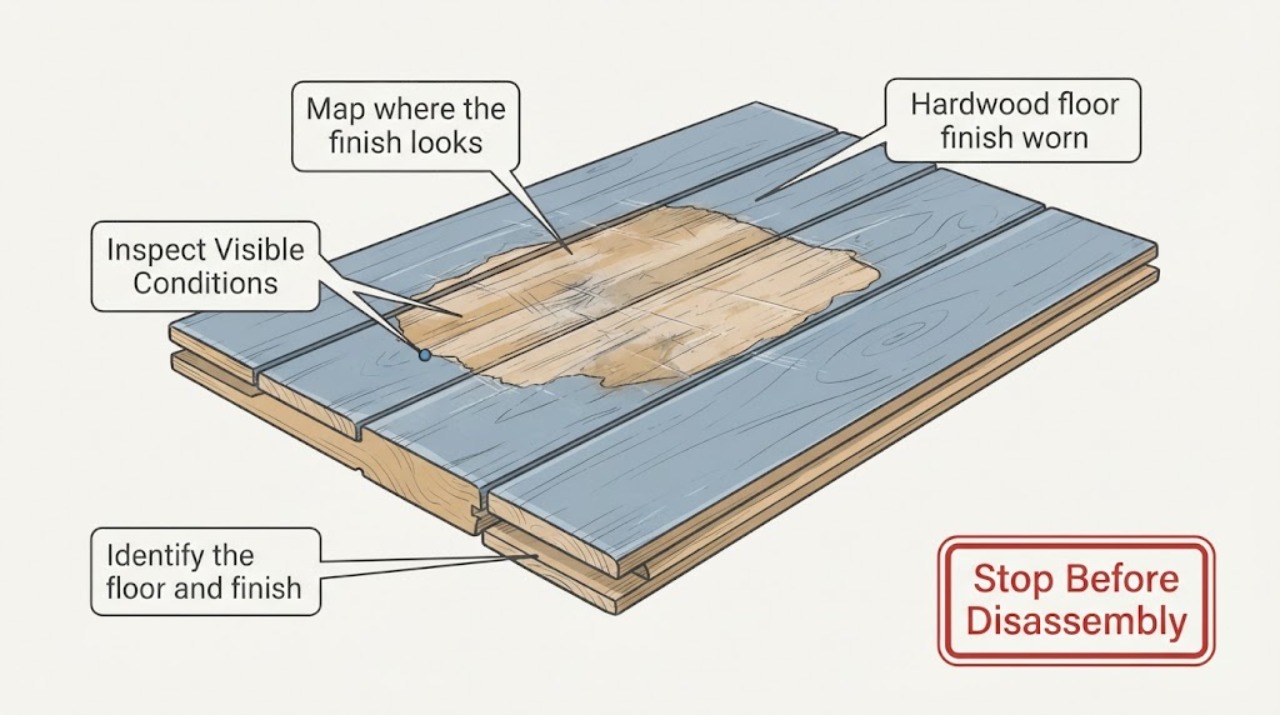
Work through in order
Diagnostic checks
Use only checks that match the exact appliance or system and its official guide.
-
1. Map where the finish looks worn
Photograph the whole room and close views from a normal standing position. Note whether dullness or scratches are limited to walk paths, doorways, chair areas, or scattered across the room, and whether the underlying color and texture still look intact.
Expected result: The finish is uniformly dull but the wood looks intact; wear follows traffic paths; scratches expose a different color or texture; or dark marks and discoloration are present.
Next step: Keep the photographs and continue with the floor-type and moisture checks before selecting cleaner, scratch repair, or refinishing work.
Stop if: Stop any cosmetic experiment if the wood appears exposed, stained, soft, swollen, or structurally changed.
Why this matters
Why: Uniform dullness can be a finish-maintenance question, while traffic-shaped wear may indicate the protective layer is thinning. A color or texture change, dark mark, or exposed-looking area may involve the wood, a stain layer, or moisture rather than sheen alone.
-
2. Look for wood movement or moisture clues
Visually inspect the worn area and nearby boards for cupping, crowning, raised edges, open gaps, buckling, soft spots, dark staining, mold-like growth, or a nearby leak source. Check adjacent rooms, exterior doors, plumbing fixtures, and recent spill or cleaning history without lifting boards or probing the floor.
Expected result: The boards remain flat and firm with no discoloration; movement or gaps are visible; the wood is dark, soft, swollen, or stained; or moisture is present or its source is unknown.
Next step: Photograph the pattern, stop introducing moisture to the area, and arrange a flooring or water-damage professional assessment when any movement, softness, staining, or leak concern is present.
Stop if: Stop and escalate immediately for active leaks, widespread dampness, soft flooring, buckling, suspected mold, or a floor that could be unsafe to walk on.
Why this matters
Why: Finish wear is not the same as wood or moisture damage. Movement, soft or swollen wood, and staining can require moisture-source correction and flooring assessment before any finish is applied.
-
3. Identify the floor and finish system
Check installation records, product paperwork, a visible room transition, or a matching spare board to determine whether the floor is solid or engineered and factory-finished or site-finished. Record the finish sheen and any manufacturer or installer information; do not remove a board or scrape a hidden area to identify it.
Expected result: The construction and finish are documented; only the general wood-floor type is known; or the floor system cannot be identified.
Next step: Give the records, photos, and any spare material to the flooring professional. Treat an unidentified or factory-finished surface as a professional matching and compatibility question.
Stop if: Stop material selection when the floor construction, finish, or previous coating is unknown.
Why this matters
Why: Finish systems and available wear layers differ. A professional needs the actual floor construction and finish history to judge whether maintenance coating, spot repair, or complete refinishing is appropriate; a generic product cannot establish compatibility.
-
4. Decide whether this is a localized finish issue or a floor project
Compare the affected area with adjacent rooms and note the extent, depth, and cause of wear: small surface scuffs, broad dullness, finish worn through to wood, deep scratches or dents, or movement across many boards. Record whether furniture, footwear, pets, cleaning products, sunlight, or a prior coating could explain the pattern without claiming a cause from appearance alone.
Expected result: The issue is limited to light surface wear; the finish is worn away or damage is deep; the floor has broad movement or moisture signs; or the cause and extent are unclear.
Next step: Request a written assessment that states whether the recommended scope is cleaning/maintenance, localized repair, maintenance coating, complete refinishing, board replacement, or moisture correction, and why.
Stop if: Do not sand or refinish as a trial when damage is deep, wood is exposed, moisture is suspected, or the floor type is unknown.
Why this matters
Why: The National Wood Flooring Association distinguishes a maintenance-coat decision from complete sanding and refinishing when finish is worn away or the wood is damaged. Broad movement or moisture signs move the decision beyond finish appearance and require a professional diagnosis first.
Use your observations
Decision map
Find the observation that best matches what you see, then follow the next safe action.
-
PATH 01Safety boundary
What you see
The floor is flat and firm, the finish is only dull, and the wood is not exposed or stained.
Do this next
Ask a flooring professional whether a compatible maintenance-coat evaluation is appropriate for the identified finish system.
Why this path and its safety boundary
Why it matters: A maintenance coat is different from taking the floor back to raw wood and depends on the existing finish being sound and compatible.
Safety stop: Do not apply a new coating without confirming the existing finish and surface preparation requirements.
-
PATH 02Safety boundary
What you see
Bare-looking wood, deep scratches, dents, or finish loss is present but no moisture or movement is visible.
Do this next
Arrange a professional refinishing assessment and ask whether the wear layer and floor construction can support the proposed scope.
Why this path and its safety boundary
Why it matters: NWFA guidance associates worn-through finish and deeper damage with a more substantial professional refinishing decision, but the number and method of treatments depend on the floor condition.
Safety stop: Do not sand manually or test a chemical finish on a visible area.
-
PATH 03Safety boundary
What you see
The boards cup, crown, buckle, gap, soften, stain, or show an active or unexplained moisture source.
Do this next
Address the moisture source and obtain flooring and, where appropriate, water-damage assessment before finish work.
Why this path and its safety boundary
Why it matters: A finish cannot correct moving or moisture-damaged wood, and coating over wet or unstable material can conceal the problem.
Safety stop: Stop walking on unsafe sections and stop cosmetic work until professionals assess the floor.
-
PATH 04Safety boundary
What you see
The floor construction or prior finish cannot be identified.
Do this next
Provide photos, records, and any spare material to a qualified wood-flooring professional for compatibility and scope evaluation.
Why this path and its safety boundary
Why it matters: Solid, engineered, factory-finished, and site-finished floors can have different repair limits and coating requirements.
Safety stop: Do not choose a cleaner, scratch kit, or finish solely from a generic hardwood label.
Helpful context
Understand the symptom
Finish wear is not the same as wood damage
A floor can look dull because its protective surface has normal wear, but exposed wood, deep scratches, dents, dark staining, cupping, or soft spots change the decision. The visual checks here help separate a finish question from a moisture or board-condition question; they do not establish the source of damage beneath the floor.
Why the floor type matters
Factory-finished and site-finished floors can use different finish systems, and engineered floors have a wear layer whose condition affects what work is possible. The floor's records, spare material, and a professional inspection are safer compatibility evidence than a generic product description.
When to call a professional
Use a qualified wood-flooring professional for worn-through finish, deep scratches or dents, broad movement, suspected moisture, an unknown floor system, or a project that would require sanding or chemical finish application. OSHA identifies airborne wood dust and finishing chemicals as workplace hazards, so this article keeps the homeowner steps observational.
Only after diagnosis
Potential parts
- floor-scratch-repair-kit
Only consider a localized kit after the floor finish and construction are identified and the damage is confirmed as a shallow, isolated surface mark rather than exposed wood or moisture damage.
Match the kit to the floor's finish and color system; a generic kit is not evidence of compatibility or a substitute for refinishing assessment. - wood-floor-cleaner
Only consider a cleaner when the existing finish is intact and the product's instructions match the identified floor and finish system.
Do not use a cleaner to treat bare, soft, swollen, stained, or moisture-damaged wood; follow the flooring and finish manufacturer's care guidance.
When checks do not resolve it
Need a professional?
The finish is worn through, deep scratches or dents are visible, or many boards need attention., Boards cup, crown, buckle, gap, soften, stain, or show a possible leak or moisture source., The floor is engineered, factory-finished, previously coated, or otherwise not identifiable from records., The proposed work would require sanding, refinishing, chemical finish mixing, or moving heavy furniture.
Safety scope: Do not sand, scrape, refinish, mix chemical finishes, or probe suspected moisture damage as a homeowner diagnostic step.
Have this ready
- Whole-room and close-up photos taken from normal standing height
- Floor construction, finish, installer, and prior coating information if known
- Locations of bare-looking wood, deep damage, movement, staining, or moisture clues
- Cleaning, furniture, pet, sunlight, leak, and prior repair history
Common questions
FAQ
Is a dull hardwood floor ready for refinishing?
Not necessarily. A sound floor with intact wood may be a maintenance-coat question, while finish worn through to bare wood or deeper damage may require complete professional refinishing. Identify the floor and finish system first.
How can I tell finish wear from wood or moisture damage?
Finish wear is more likely to appear as dullness or shallow traffic scratches with flat, firm boards. Exposed-looking wood, dark staining, softness, cupping, crowning, buckling, gaps, or a leak concern points beyond surface wear and needs professional assessment.
Can I sand a worn spot myself?
Do not sand or scrape as a test. Sanding can create airborne wood dust, change the wear layer, and leave an uneven or incompatible repair. A flooring professional can determine whether the floor supports localized work, a maintenance coat, or complete refinishing.
What should I tell a flooring professional?
Provide whole-room and close-up photos, the floor's solid or engineered and factory- or site-finished status if known, prior coating or cleaning history, and any signs of moisture, movement, exposed wood, deep damage, or staining. Ask for the recommended scope in writing.
Read the exact guide
Official sources
- Wood Floor FinishesNational Wood Flooring Association · Industry association reference used to explain why finish type and construction must be identified before a repair or coating decision.
- Refinishing Your FloorsNational Wood Flooring Association · Industry association guidance for hardwood-floor finish wear; actual scope depends on the identified floor construction and condition.
- Wood Dust - OverviewOccupational Safety and Health Administration · Government workplace-safety guidance used to keep homeowner troubleshooting observational rather than providing sanding instructions.
Community feedback
Share a repair observation
Share a plain-text repair observation. Accepted observations are published automatically; this page may take a moment to update.