
On this page
Start here
Quick answer
Raised hardwood boards usually mean the floor has responded to moisture or has lost room to move, but the hump does not identify the source or whether the subfloor is affected. Keep people and heavy loads off the raised area, photograph the pattern, look for active water and safe ground-level evidence, and arrange a qualified flooring or water-damage assessment. Do not press the boards flat, nail or screw them down, pull boards, pry trim, sand, apply aggressive heat, or begin demolition before the moisture source and the floor assembly are assessed.
Before you begin
Safety first
- Ask the professional to identify and correct the moisture source, assess boards, finish, adhesive or fasteners, subfloor, perimeter, and adjacent cavities, then document whether controlled drying, repair, or replacement is appropriate.
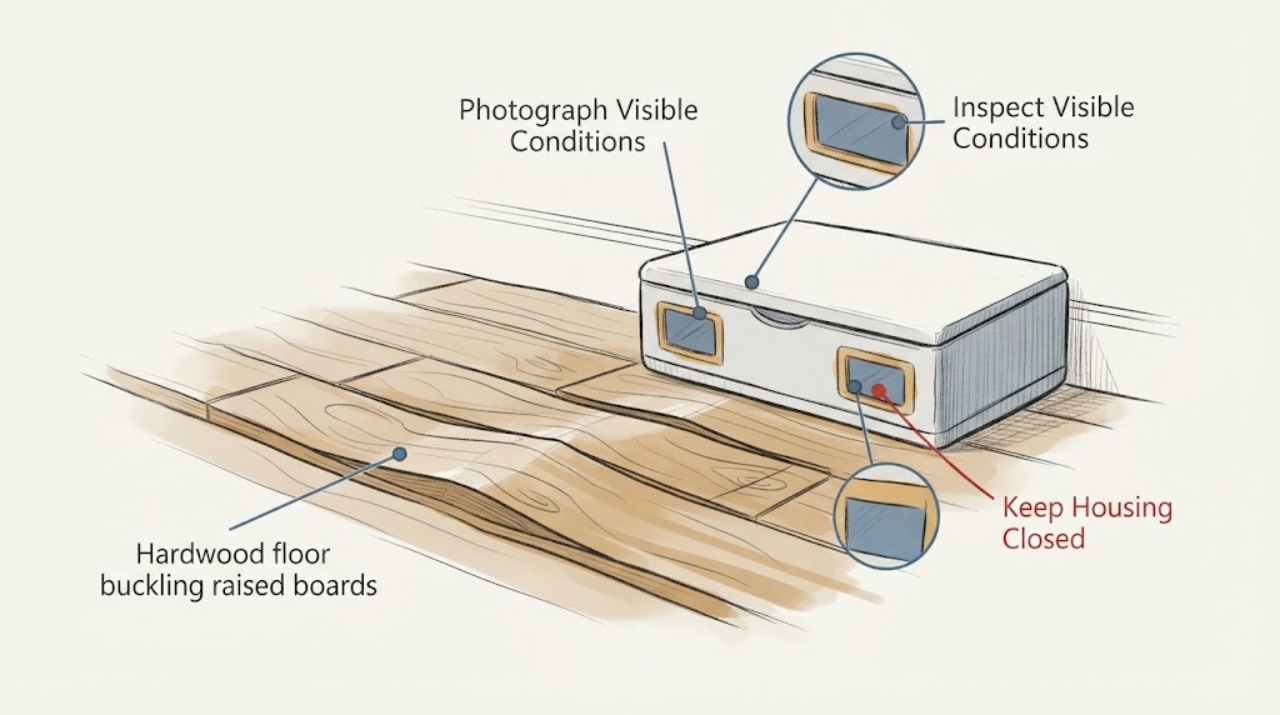
Work through in order
Diagnostic checks
Use only checks that match the exact appliance or system and its official guide.
-
Check 1
From a stable standing position, photograph and map every raised board without walking repeatedly over the hump, placing furniture on it, or trying to press it flat.
Expected result: Record whether the deformation is one board, a tight group, a ridge, a tented joint, edge lifting at a wall or transition, or a wider field of buckling; note cracked finish, open joints, and trip risk.
Next step: Keep traffic and loads off the area, preserve the photos, and continue with source observations from safe, accessible locations.
Stop if: Stop if the floor is unstable, a raised edge is sharp, the area is a trip hazard, or inspection would require lifting flooring, trim, or a floor covering.
Why this matters
Why: A localized ridge may help trace a nearby spill or leak, while a broad or repeating pattern may involve moisture migration, humidity, subfloor conditions, or installation movement. Shape alone cannot show whether the boards or supporting layers are salvageable.
-
Check 2
Look for moisture sources around the raised area from the room side: recent spills, plumbing or appliance leaks, exterior doors or windows, HVAC condensation, damp walls, and floor transitions; do not remove baseboards or open the floor.
Expected result: Record whether water is active, recently stopped, absent but suspected below the floor, or unknown; note staining, musty odor, damp materials, and whether the pattern follows a wall, fixture, or opening.
Next step: If water is active and can be stopped without tools or unsafe access, stop it safely, keep people away, and call a water-damage or flooring professional. Otherwise document the likely source and arrange assessment.
Stop if: Do not remove trim, lift boards, cut openings, enter a wet crawl space, or touch water that may be sewage or otherwise contaminated.
Why this matters
Why: An active or contaminated source needs prompt professional response. A dry surface does not prove the subfloor is dry, and an unknown source means a cosmetic repair could fail or conceal continuing damage.
-
Check 3
If available, scan the raised area and a nearby unaffected area with a non-invasive moisture meter according to its instructions; record the meter type or mode, locations, time, and readings without drilling or inserting pins.
Expected result: Note whether the raised area is consistently higher, similar to the comparison area, or erratic across the pattern.
Next step: Send the map and photos to a flooring or water-damage professional and let them interpret the readings with the floor construction and local conditions.
Stop if: Stop if the meter requires penetrating the finish, if the surface is wet or slippery, or if obtaining readings requires moving heavy furniture or entering an unsafe space.
Why this matters
Why: A repeatable difference supports moisture mapping and helps prioritize a professional inspection. A similar or unstable reading does not rule out moisture below the finish, and a single number is not a universal repair threshold.
-
Check 4
Inspect only existing, safe-to-reach edges or openings for visible dampness, staining, swollen material, odor, or mold-like growth; do not create an opening or disturb the raised boards.
Expected result: Record whether a visible edge is dry and sound, damp or discolored, swollen, or unavailable because the assembly is enclosed.
Next step: Request a professional flooring and moisture assessment that can determine controlled drying, repair, or replacement without unnecessary demolition.
Stop if: Stop before prying trim, lifting boards, cutting the subfloor, scraping growth, or entering a basement, crawl space, or wall cavity with unsafe moisture or air quality.
Why this matters
Why: Damage below the boards expands the repair scope beyond a surface finish. An enclosed assembly remains uncertain, so no visible problem at an edge is not proof that the floor is dry underneath.
-
Check 5
Decide whether the source is identified and stopped, the raised area is stable to observe, and there is no contaminated water, persistent odor, visible mold-like growth, or suspected structural weakening.
Expected result: Yes means the area can remain undisturbed while a flooring professional reviews the documented pattern. No means one or more of those conditions is present or uncertain.
Next step: For yes, keep traffic off the boards and avoid covering or refinishing them. For no, restrict access, preserve the evidence, and contact the appropriate qualified professional.
Stop if: Do not demolish, remove moldy material, force-dry with aggressive heat, or restart a repair based only on appearance or one meter reading.
Why this matters
Why: A yes result supports a planned flooring assessment. A no result calls for prompt water-damage, flooring, mold/moisture, or structural evaluation before any drying method or repair is selected.
Use your observations
Decision map
Find the observation that best matches what you see, then follow the next safe action.
-
PATH 01Safety boundary
What you see
Water is active, the source is sewage or otherwise contaminated, the buckling is expanding, or the floor is unsafe to walk on.
Do this next
Restrict access and call a qualified water-damage or flooring professional promptly. Provide the source, timing, photographs, and any odor, contamination, or safety concern.
Why this path and its safety boundary
Safety stop: Do not use fans, heaters, wet vacuums, chemicals, or demolition as a substitute for source assessment when water quality or concealed damage is unknown.
-
PATH 02Safety boundary
What you see
The source appears clean and stopped, the raised area is limited, and no odor, mold-like growth, or structural concern is observed.
Do this next
Preserve the floor as found, record moisture trends and the event timeline, and schedule a qualified flooring assessment to decide whether stabilization, drying, repair, or replacement is appropriate.
Why this path and its safety boundary
Safety stop: Do not press, nail, screw, sand, seal, or cover the raised boards to make them appear flat.
-
PATH 03Safety boundary
What you see
Moisture readings are elevated or patterned below the raised area, the source cannot be located, or the surrounding floor also shows swelling or staining.
Do this next
Request a professional moisture investigation of the hardwood, subfloor, perimeter, nearby walls, fixtures, and any accessible space below; share the comparison map and photos.
Why this path and its safety boundary
Safety stop: Do not create inspection holes, remove boards, pry trim, or enter a crawl space or basement to chase the source.
-
PATH 04Safety boundary
What you see
There is a musty odor, visible mold-like growth, long-standing wet material, or concern that the floor or supporting structure has weakened.
Do this next
Stop disturbing the area and call a qualified water-damage or mold/moisture professional; request flooring or structural expertise when the floor system may have lost integrity.
Why this path and its safety boundary
Safety stop: Do not scrape, vacuum, remove moldy materials, or perform demolition in an attempt to expose the source.
Helpful context
Understand the symptom
Why boards rise or buckle
Wood expands and contracts as its moisture condition changes. A spill, plumbing leak, exterior water entry, humidity, or moisture migrating from below can make neighboring boards press against one another and rise. Installation clearances, subfloor dampness, and the difference between solid and engineered construction also affect the pattern. A raised board is therefore a symptom of a moisture or movement problem, not proof that one board can simply be pushed back into place.
Record the shape without disturbing it
Take photos from standing height and map where the raised area starts and ends. Note whether it runs along a wall, doorway, transition, appliance, or plumbing fixture; whether the finish is cracked; and whether there is odor, staining, or a soft-feeling surrounding area. If you have a non-invasive moisture meter, compare affected and nearby unaffected boards as a trend, recording the instrument mode and locations. Readings depend on the meter, wood species, construction, and conditions, so they are evidence for a professional rather than a clearance test.
Drying and board replacement require a scope decision
A professional should identify and stop the source before choosing drying, repair, or replacement. Some minor movement may lessen as conditions stabilize, but industry guidance says a buckled wood floor may require replacement where the buckling occurred. The correct scope can include the finish, boards, adhesive or fasteners, subfloor, perimeter, and adjacent wall or floor cavity. Cosmetic flattening before that assessment can hide evidence and cause more damage.
Safety boundary
Stop conditions
- Keep traffic and heavy loads off the raised boards. Stop if the floor is unstable, sharp, or a trip hazard.
- Do not press, nail, screw, sand, seal, cover, pull boards, pry trim, drill, cut openings, or demolish the floor during observation.
- Do not use aggressive heat, bleach, mold chemicals, fans, or wet-vacuum methods when the source or water quality is unknown; contaminated water requires professional controls.
- Call a qualified flooring or water-damage professional for active or unknown moisture, widespread or recurring buckling, below-floor damage, mold-like growth, odor, unsafe flooring, or structural concern.
Only after diagnosis
Potential parts
- moisture-meter
Useful only for documenting a relative moisture pattern between raised and unaffected flooring before professional assessment; it cannot locate the source or certify the floor for repair.
Confirm supported wood species, meter mode, surface limitations, and manufacturer guidance; do not treat one reading as a universal threshold. - floor-repair-kit
Consider this category only after the moisture source is stopped and a flooring professional confirms a localized surface repair rather than buckled-board or subfloor replacement.
Match species, board construction, finish, color, and repair method to the existing floor; never use a kit to hide active moisture or structural damage.
When checks do not resolve it
Need a professional?
Call a qualified flooring or water-damage professional promptly for active or contaminated water, an unknown source, expanding or widespread buckling, elevated below-floor moisture, persistent odor or mold-like growth, unsafe flooring, or any need to remove boards, trim, or subfloor. Ask for structural expertise if the floor or supporting materials may have lost integrity.
Safety scope: Ask the professional to identify and correct the moisture source, assess boards, finish, adhesive or fasteners, subfloor, perimeter, and adjacent cavities, then document whether controlled drying, repair, or replacement is appropriate.
Have this ready
- Dated photos and a map of every raised board, including walls, transitions, fixtures, and nearby damage
- The suspected water or humidity source, whether it is active or stopped, and whether the water may be contaminated
- Moisture-meter locations, instrument mode, comparison readings, and time of each reading
- The first-noticed date, recurrence, odor, staining, subfloor observations, trip risks, and any health or structural concerns
Common questions
FAQ
Can raised hardwood boards flatten on their own?
Some minor movement may lessen as conditions stabilize, but a buckled portion may not return to its original geometry. A professional should identify and stop the source before deciding whether the boards, finish, or subfloor can be retained.
Should I put weight on the raised boards?
No. Keep people, furniture, and heavy loads off the area. Weight can damage the finish, fasteners, adhesive, subfloor, or neighboring boards and does not correct the moisture source.
Does a moisture-meter reading prove what caused the buckling?
No. Meter readings depend on the instrument, wood species, construction, surface, and conditions. Use affected-versus-unaffected readings to document a pattern and let a flooring professional interpret it.
Can I nail or screw the raised board back down?
Do not fasten or press it down. The board may still be swollen, the subfloor may be wet, and concealed utilities or damage may be present. Source correction and professional assessment come before any repair method.
When should I call a flooring or water-damage professional?
Call promptly for active or unknown moisture, expanding or widespread buckling, elevated below-floor readings, musty odor, mold-like growth, contaminated water, an unsafe floor, or any need to remove boards, trim, or subfloor.
Read the exact guide
Official sources
- Moisture Control, Part of Indoor Air Quality Design Tools for SchoolsU.S. Environmental Protection Agency · Use for recognizing that uncontrolled moisture and condensation can damage floors and wood materials and may migrate into concealed construction.
- Mold Course Chapter 4: General Remediation IssuesU.S. Environmental Protection Agency · Use for safe observation and escalation after a water event, especially when wood, subfloor, odor, mold-like growth, or contaminated water may be involved.
- NWFA Installation GuidelinesNational Wood Flooring Association · Use for professional moisture mapping, comparison of affected and unaffected wood, source correction, and the replacement implications of buckling.
- Rethinking Commercial Engineered Hardwood FlooringArmstrong Flooring · Use for the general mechanism that wood expands and contracts with moisture, humidity, and temperature changes and may gap, cup, or buckle; product behavior varies.
Community feedback
Share a repair observation
Share a plain-text repair observation. Accepted observations are published automatically; this page may take a moment to update.