
On this page
Start here
Quick answer
Buckled hardwood is usually a moisture and movement problem, not a surface blemish to force flat. Stop adding water, avoid walking on raised boards, and document when the change began and where it is spreading. Look for an active leak, condensation, wet subfloor, foundation or slab moisture, or a room-humidity change without prying up boards or starting demolition. A flooring professional should assess both the flooring and the substrate after the moisture source is controlled; the right repair can range from drying and stabilization to localized repair or replacement, depending on the installation and damage.
Work through in order
Diagnostic checks
Use only checks that match the exact appliance or system and its official guide.
-
Check 1
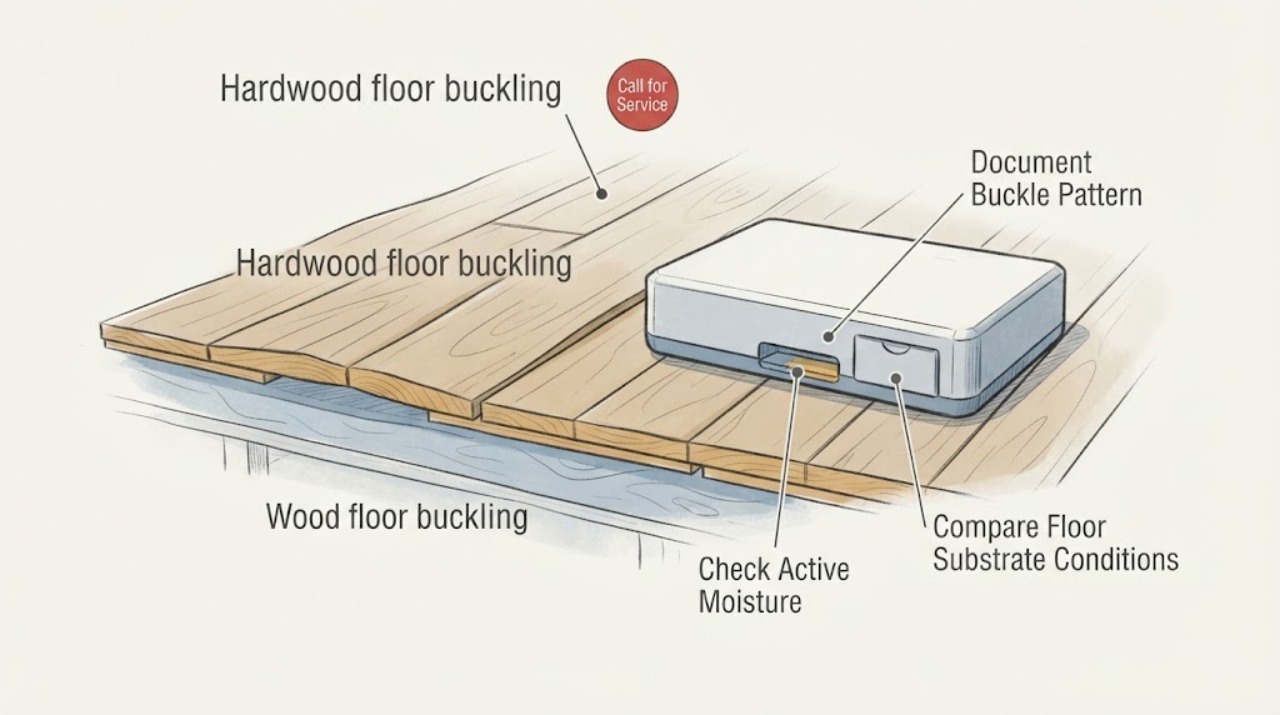
Photograph the buckled area from several angles and mark its edges with removable tape or a simple sketch. Record whether the boards form a raised ridge, tent, broad wave, or isolated hump, and when you first noticed it.
Expected result: The deformation is beside a door, appliance, window, plumbing route, exterior wall, or floor transition; it is spread across a room; or it appeared soon after a spill, leak, cleaning, weather event, or humidity change.
Next step: Keep the photos and timeline for the flooring professional and continue with visual source checks only. Do not force the boards down, nail them, sand them, glue them, or place heavy objects on the ridge.
Stop if: Stop walking over the area if boards feel unstable, edges are sharp, or the raised surface creates a trip hazard.
Why this matters
Why: A localized pattern and recent water event point toward a nearby moisture path. A broad pattern may involve the subfloor, slab, installation conditions, or room climate. The appearance alone cannot distinguish solid from engineered flooring or determine whether boards can be saved.
-
Check 2
Visually inspect accessible areas around sinks, appliances, bathrooms, exterior doors, windows, radiators, plumbing, foundation walls, and floor penetrations. Look for droplets, wetness, staining, swollen trim, condensation, or a damp smell; do not remove flooring or open a wall to search.
Expected result: You find active water or fresh dampness, a dry historical stain, condensation without a leak, or no visible source.
Next step: Photograph and report the location and timing of any moisture. If the source is not safely obvious, arrange a qualified water-damage or flooring assessment rather than sealing the surface or masking the symptom.
Stop if: Stop immediately around standing water, wet electrical equipment, sewage or unknown contaminated water, or any area that would require dismantling building components.
Why this matters
Why: Active water must be controlled before the floor is evaluated. A dry stain can still mark a concealed or recurring path. Condensation points to a climate or surface-temperature issue. No visible source does not rule out moisture below the floor or inside a wall.
-
Check 3
From a safe standing position, compare the affected floor with an unaffected nearby area. Note differences in board movement, hollow or soft-feeling spots, squeaks, loose transitions, baseboard swelling, odors, and whether the floor is over a basement, crawlspace, slab, or another occupied level. If available, record moisture-meter readings without drilling or damaging the finish, and follow the meter instructions for the material.
Expected result: Only the finish looks changed; boards are visibly displaced; the floor feels soft or moves; the edge or trim is swollen; or a moisture reading is higher in the affected area than the comparison area.
Next step: Give the comparison notes and readings to a flooring professional. The flooring system should be evaluated as a whole before any refinishing or replacement decision; do not use a repair kit to conceal movement or moisture.
Stop if: Stop if the substrate feels unsafe, the flooring is lifting enough to expose fasteners, or inspection would require lifting boards, cutting, drilling, or entering a crawlspace.
Why this matters
Why: A displaced or moving floor can involve the flooring system or its substrate, while swollen trim or a higher comparison reading supports a moisture path. A normal surface reading does not prove the subfloor is dry, especially when the installation or meter is unknown.
-
Check 4
Answer yes or no: Is there active or contaminated water, a large or rapidly spreading buckle, a soft or unstable floor, suspected subfloor or structural damage, mold-like odor or visible growth, or a need to remove flooring to find the source?
Expected result: If yes to any item, keep people away from the area and arrange a qualified flooring or water-damage assessment. If no, preserve the documentation and monitor only from a safe position while the moisture source is investigated.
Next step: Tell the professional the floor type if known, installation age if known, buckle pattern, affected area, water history, readings, and any changes after weather or HVAC operation.
Stop if: Stop all hands-on investigation if the area becomes unstable, water is present, occupants develop symptoms, or the next step would be demolition, structural repair, mold remediation, or chemical treatment.
Why this matters
Why: A yes means cosmetic treatment is premature and professional evaluation is needed to separate source control, drying, substrate work, and finish repair. A no does not prove the floor is stable or dry; it only means no listed escalation sign was observed from the safe inspection point.
Helpful context
Understand the symptom
What buckling tells you
Wood flooring changes dimension as it takes on or releases moisture. A leak, wet subfloor, slab or foundation moisture, condensation, or a room-climate change can create forces that show up as cupping, crowning, gaps, or a raised buckle. The National Wood Flooring Association notes that water damage ranges from minor cupping to severe buckling and that repair options depend on the individual case. The source must be identified and eliminated before the floor is assessed.
Avoid a cosmetic-only fix
Do not cover a wet or buckled floor with new flooring, sealants, rugs, or heavy furniture. Do not steam-clean a wood floor or attempt to flatten boards with fasteners, adhesive, heat, or force. A repair product may be appropriate only after the flooring type, moisture source, substrate, and damage extent have been assessed by someone qualified for that system.
Only after diagnosis
Potential parts
- moisture-meter
May help document differences between accessible areas, but readings depend on the meter, wood or substrate, and instructions; it does not replace a flooring assessment.
- floor-repair-kit
Only potentially useful for a confirmed, stable, cosmetic defect after moisture and movement are resolved; it is not a solution for buckling or wet flooring.
When checks do not resolve it
Need a professional?
Arrange a qualified flooring assessment when hardwood boards buckle, especially after water exposure, when the buckle spreads, the floor feels soft or unstable, the source is hidden, or the affected area may include the subfloor or slab.
Have this ready
- Photos and a sketch of the affected boundary and buckle pattern
- When the change began and any related leak, spill, rain, snowmelt, cleaning, or humidity event
- The known or suspected flooring type and installation age, if available
- Moisture readings and the comparison location, if taken without damaging the floor
- Whether there is odor, visible growth, swollen trim, movement, soft spots, or an HVAC or basement relationship
Common questions
FAQ
Can I push or nail buckled hardwood boards back down?
Do not force, nail, glue, sand, or weigh down raised boards before the moisture source and substrate are assessed. The deformation may involve the flooring system below the visible surface, and a cosmetic fix can hide ongoing damage.
Does buckled flooring always mean there was a plumbing leak?
No. Plumbing is one possibility; water can also come from a window or door, foundation or slab, condensation, a spill, or a room-climate change. Look for accessible evidence and treat an unexplained buckle as a reason for professional assessment.
Is a moisture meter enough to decide whether the floor can be refinished?
No. A meter can document a reading and help compare locations, but readings depend on the instrument, material, and instructions. The flooring, underlayment, subfloor, and surrounding conditions need to be evaluated together before refinishing or replacement.
When is hardwood floor buckling urgent?
Treat it as urgent when water is active or contaminated, the area is spreading, boards are soft or unstable, electrical equipment is wet, the source is hidden, or the affected area may involve the subfloor or structural system. Keep people away and call a qualified professional.
Read the exact guide
Official sources
- Flood Cleanup to Protect Indoor Air and Your HealthU.S. Environmental Protection Agency · Supports checking flooring and hidden materials for dryness, using a moisture meter as an aid, and calling qualified professionals when water damage or HVAC contamination is involved.
- NWFA Installation GuidelinesNational Wood Flooring Association · Supports the moisture-first sequence, assessment of flooring and subfloor together, and the need for case-specific repair evaluation for cupping or buckling.
- Addressing Indoor Environmental Concerns During RemodelingU.S. Environmental Protection Agency · Supports distinguishing moisture sources such as plumbing, foundations, condensation, and humidity from cosmetic damage and recognizing that un-dried cavities can lead to material damage.
Community feedback
Share a repair observation
Share a plain-text repair observation. Accepted observations are published automatically; this page may take a moment to update.