
On this page
Start here
Quick answer
Treat buckled hardwood after a moisture event as a water-source and flooring-system problem, not a board-pressing or quick-patch job. Keep people and heavy loads off the raised area, document the pattern and the suspected source from a safe position, and arrange a qualified flooring or water-damage assessment. A moisture meter can help map the affected and unaffected areas, but do not pull boards, pry baseboards, drill, sand, apply heat, or cover the floor before the moisture source and the condition below the floor are assessed.
Before you begin
Safety first
- Ask the professional to identify and correct the moisture source, assess the hardwood and subfloor, determine whether controlled drying is suitable, and document any boards or supporting materials that require repair or replacement.
Work through in order
Diagnostic checks
Use only checks that match the exact appliance or system and its official guide.
-
Check 1
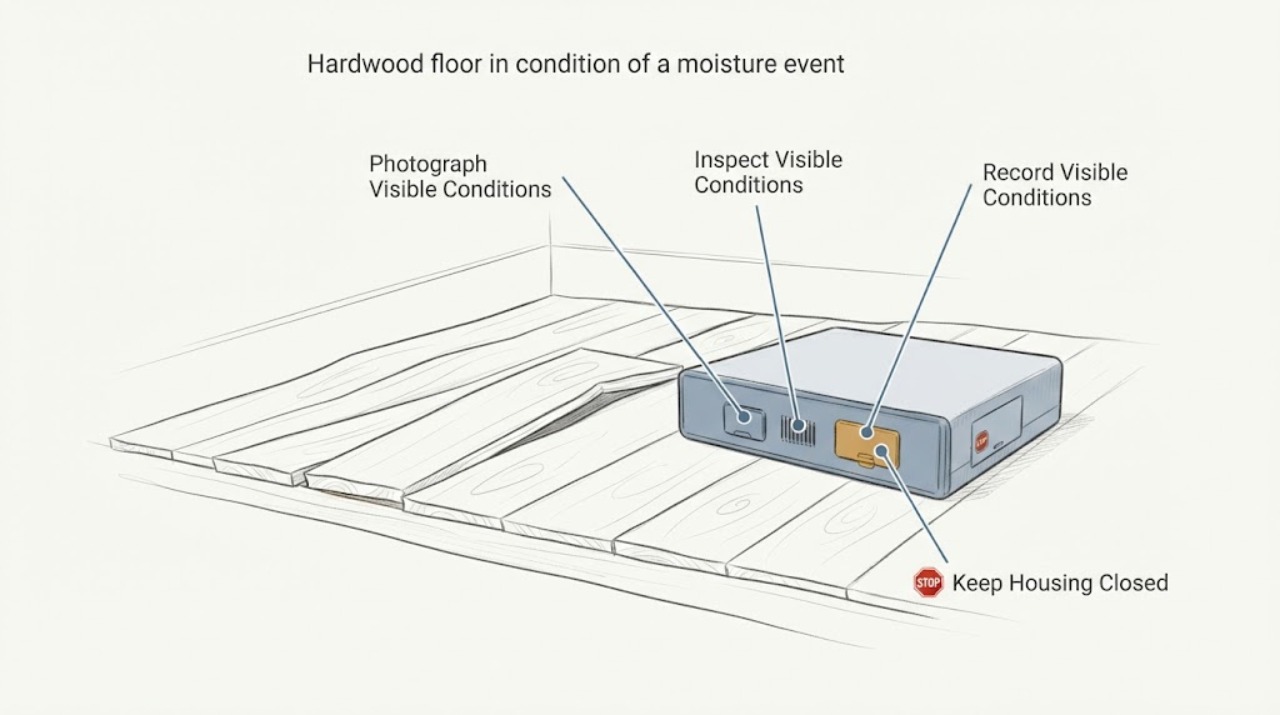
From a stable standing position, photograph and map the raised or distorted boards without walking repeatedly over them, placing furniture on them, or trying to press them flat.
Expected result: Record whether the change is a single hump, a group of boards, edge lifting near a wall or doorway, widespread distortion, open joints, cracked finish, or visible staining.
Next step: Keep traffic and loads off the raised area, save the photos with the date, and continue with source observations from accessible locations.
Stop if: Stop if the floor is unstable, sharp edges are exposed, the path is a trip hazard, or inspection would require lifting boards, trim, or floor coverings.
Why this matters
Why: A localized area can help a professional trace a spill or leak, while a broad or recurring pattern can point to moisture movement, humidity, or subfloor conditions. The shape alone cannot identify the source or whether boards can be salvaged.
-
Check 2
Trace the moisture event visually from the room side: look for a recent spill, leaking fixture or appliance, wet wall or baseboard, exterior door or window entry, nearby HVAC condensation, or dampness at a floor transition without opening construction or removing trim.
Expected result: Record whether the source is active, recently stopped, unknown, on top of the floor, at the perimeter, or suspected below the floor; note any musty odor or staining.
Next step: If water is active, stop the source only when that can be done without tools or unsafe access, keep people away, and call a water-damage or flooring professional. Otherwise document the likely source and arrange an assessment.
Stop if: Do not remove baseboards, open walls, lift boards, enter a wet crawl space, or touch water that may be sewage or otherwise contaminated.
Why this matters
Why: An active or contaminated source needs prompt professional response, while a dry surface does not prove the subfloor or cavity is dry. An unknown source means the floor should not be repaired cosmetically yet.
-
Check 3
Use a moisture meter on the affected floor and a nearby visually unaffected area, following the meter maker's surface and species guidance; record the meter mode, locations, time, and readings without drilling or sampling the floor.
Expected result: Note whether the affected area reads consistently higher, is similar to the comparison area, or gives unstable or implausible readings across the pattern.
Next step: Send the map and readings with the photos to a flooring or water-damage professional; use trends to guide service, not to authorize sanding, sealing, or board removal.
Stop if: Stop if the meter requires penetrating pins, the finish is fragile, the surface is wet enough to create a slip hazard, or readings would require moving heavy furniture.
Why this matters
Why: A higher or patterned reading supports moisture mapping and helps the professional prioritize inspection, but it is not a pass/fail moisture standard and does not prove the source or the extent below the finish.
-
Check 4
Inspect only existing, safe-to-reach openings such as an uncovered transition edge or an already open utility view for visible moisture, staining, swollen material, odor, or mold-like growth; do not create an opening.
Expected result: Record whether the visible subfloor or edge is dry and sound, damp or discolored, visibly swollen, or not observable because the assembly is enclosed.
Next step: Request a professional flooring/water-damage assessment that can determine drying, repair, or replacement needs without spreading contamination or causing unnecessary demolition.
Stop if: Stop before prying trim, lifting flooring, cutting the subfloor, or entering a crawl space, basement, or cavity with unsafe moisture or air-quality conditions.
Why this matters
Why: Moisture or damage below the hardwood raises the scope beyond a surface touch-up. An enclosed assembly remains uncertain, so the absence of a visible problem is not clearance to refinish.
-
Check 5
Decide whether the moisture source is known to be clean and fully stopped and whether no structural or health warning sign is present; do not use this check to approve DIY demolition or mold cleanup.
Expected result: Yes means the source is identified and stopped, the affected area is stable to observe, and there is no sewage, persistent odor, structural concern, or expanding damage. No means any one of those conditions is uncertain or present.
Next step: For yes, keep conditions stable and avoid covering or refinishing the floor until assessed. For no, restrict access, preserve the evidence, and call the appropriate qualified professional.
Stop if: Do not demolish, remove moldy material, use aggressive heat, or restart a repair based only on the floor's appearance or one meter reading.
Why this matters
Why: A yes result supports scheduling a qualified flooring assessment with the documented moisture map. A no result calls for prompt professional water-damage, flooring, or structural evaluation before drying methods or repairs are chosen.
Use your observations
Decision map
Find the observation that best matches what you see, then follow the next safe action.
-
PATH 01Safety boundary
What you see
Water is active, the source is sewage or otherwise contaminated, or the buckling is expanding.
Do this next
Restrict traffic and keep clear of the affected area. Call a qualified water-damage/flooring professional promptly and disclose the water source, timing, photographs, and any odor or health concern.
Why this path and its safety boundary
Safety stop: Do not use fans, heaters, wet vacuums, bleach, or demolition as a substitute for source assessment when the water quality is unknown.
-
PATH 02Safety boundary
What you see
The source appears clean and stopped, the area is limited, and there is no odor, visible mold-like growth, or structural concern.
Do this next
Preserve the floor as observed, record meter trends and the event timeline, and arrange a qualified flooring assessment to determine whether drying, repair, or replacement is appropriate.
Why this path and its safety boundary
Safety stop: Do not press, nail, screw, sand, seal, or cover the raised boards to make the surface look flat.
-
PATH 03Safety boundary
What you see
Readings are elevated below the floor, moisture is widespread, or the source cannot be located from accessible areas.
Do this next
Request a professional moisture investigation that includes the hardwood, subfloor, perimeter, adjacent walls, and any accessible space below; provide the comparison map and photographs.
Why this path and its safety boundary
Safety stop: Do not create inspection holes, remove boards, or enter an attic, crawl space, basement, or wall cavity without appropriate professional assessment and safety controls.
-
PATH 04Safety boundary
What you see
There is musty odor, visible mold-like growth, long-standing wet material, or suspected structural weakening.
Do this next
Stop disturbing the area and call a qualified water-damage/mold professional; ask for a flooring specialist or structural professional when the floor or subfloor may have lost integrity.
Why this path and its safety boundary
Safety stop: Do not remove moldy materials, scrape growth, or perform demolition in an attempt to expose the source.
Helpful context
Understand the symptom
Why hardwood buckles after water or humidity changes
Wood responds to moisture by expanding and contracting. A spill, plumbing leak, exterior water entry, high humidity, or moisture migrating from below can create enough uneven swelling for boards to cup, crown, separate, or buckle. Engineered wood can resist some moisture exposure, but it is not automatically waterproof. The visible hump is therefore evidence of a moisture event; it does not identify whether the source is above the floor, below it, or still active.
What to record without disturbing the floor
Photograph the affected area from several angles and record where the deformation starts and stops, how it relates to walls and transitions, and when the change was first noticed. Note recent spills, appliance or plumbing leaks, weather, cleaning, humidity, and any odor or staining. Compare a moisture-meter reading on the affected area with a nearby unaffected area only as a trend; readings depend on the meter, wood species, construction, and conditions.
Drying and replacement are professional decisions
Some minor movement may lessen as conditions stabilize, but a floor that has buckled may not return to its original geometry. The National Wood Flooring Association guidance calls for identifying and eliminating the moisture source before replacement and says buckled portions require replacement where buckling occurred. Do not hide a raised area with a rug or force it flat; the repair plan depends on whether the boards, finish, subfloor, adhesive, or surrounding construction were affected.
Safety boundary
Stop conditions
- Keep traffic and heavy loads off raised boards. Stop if the floor is unstable, sharp edges are exposed, or the deformation creates a trip hazard.
- Do not pull boards, pry trim, drill, cut openings, sand, nail, screw, press flat, seal, cover, or demolish the floor during observation.
- Do not use aggressive heat, bleach, mold chemicals, fans, or wet-vacuum methods when the source or water quality is unknown; contaminated water requires professional controls.
- Call a qualified flooring or water-damage professional for active or unknown moisture, widespread or recurring buckling, below-floor damage, mold-like growth, odor, or structural concern.
Only after diagnosis
Potential parts
- moisture-meter
Useful only for documenting relative patterns between affected and unaffected flooring before professional assessment; a meter cannot identify the water source or certify that the assembly is ready for repair.
Confirm the meter's supported wood species, measurement mode, surface limitations, and manufacturer guidance; do not treat a single reading as a universal threshold. - floor-repair-kit
Consider a repair kit only after the moisture source is stopped and a flooring professional confirms that the remaining damage is a localized surface repair rather than buckled-board or subfloor replacement.
Match wood species, board construction, finish, color, and repair method to the existing floor; do not use a kit to conceal active moisture or structural damage.
When checks do not resolve it
Need a professional?
Call a qualified flooring or water-damage professional promptly for active or contaminated water, an unknown source, expanding or widespread buckling, elevated below-floor moisture, persistent odor or mold-like growth, unsafe flooring, or any need to remove boards, trim, or subfloor. Ask for structural expertise if the floor or supporting materials may have lost integrity.
Safety scope: Ask the professional to identify and correct the moisture source, assess the hardwood and subfloor, determine whether controlled drying is suitable, and document any boards or supporting materials that require repair or replacement.
Have this ready
- Dated photos and a map of the buckled area, including walls, transitions, and nearby fixtures
- The suspected water or humidity source, whether it is active or stopped, and whether the water may be contaminated
- Moisture-meter locations, instrument mode, comparison readings, and the time of each reading
- The first-noticed date, recurrence, odor, staining, subfloor observations, and any safety or health concerns
Common questions
FAQ
Will a buckled hardwood floor flatten as it dries?
Some minor movement may lessen as conditions stabilize, but a buckled floor may not return to its original geometry. A professional should identify and stop the moisture source before deciding whether boards can be retained or need replacement.
Can I put weight on the raised boards to flatten them?
No. Keep people, furniture, and heavy loads off the raised area. Weight can damage the finish, fasteners, subfloor, or neighboring boards and does not correct the moisture source.
Does a moisture-meter reading prove the floor is damaged?
No. Meter readings depend on the instrument, wood species, construction, surface, and conditions. Compare affected and unaffected areas for a documented pattern and let a flooring professional interpret the result.
Should I sand or refinish a buckled floor?
Not before the source and subfloor condition are assessed. Sanding can hide evidence, damage a finish that may need replacement, and leave the floor vulnerable if moisture remains or the boards have lost their original geometry.
When is hardwood buckling a water-damage emergency?
Call promptly when water is active, the source is contaminated or unknown, the buckling is expanding, the floor feels unsafe, odor or mold-like growth is present, or the subfloor or surrounding structure may be weakened.
Read the exact guide
Official sources
- Mold Course Chapter 4: General Remediation IssuesU.S. Environmental Protection Agency · Use for safe observation and escalation after a water event, especially when wood, subfloor, odor, mold-like growth, or contaminated water may be involved.
- Rethinking Commercial Engineered Hardwood FlooringArmstrong Flooring · Use for the general mechanism that wood expands and contracts with spills, humidity, and temperature changes, including the possibility of buckling; product-specific performance varies.
- NWFA Installation GuidelinesNational Wood Flooring Association · Use for professional assessment of wood-floor moisture content, mapping, drying decisions, and the replacement implications of buckled flooring.
- Moisture Control, Part of Indoor Air Quality Design Tools for SchoolsU.S. Environmental Protection Agency · Use for recognizing that uncontrolled moisture and condensation can damage floors and other wood materials and may migrate into concealed construction.
Community feedback
Share a repair observation
Share a plain-text repair observation. Accepted observations are published automatically; this page may take a moment to update.