
On this page
Start here
Quick answer
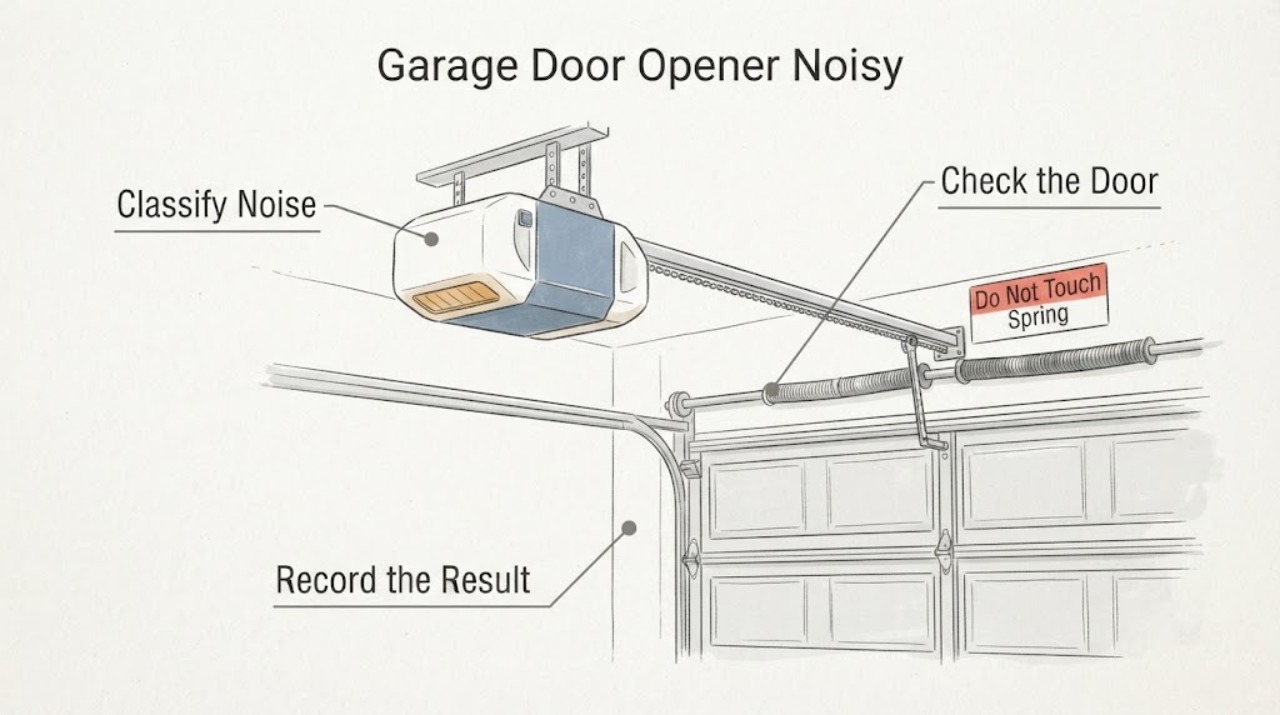
A noisy garage door opener is not always an opener-motor problem: the door, rollers, hinges, track, mounting, and chain, belt, or screw drive can all transmit sound. From a safe position, record whether the sound is a squeak, rattle, grinding, slapping, or vibration and whether it happens only while the door moves. Look for visible loose or damaged hardware without touching springs, cables, or energized parts. If the noise is new, worsening, accompanied by a crooked or heavy door, grinding, a loose cable, or failed safety behavior, stop repeated operation and call a qualified garage-door technician. Do not adjust springs or cables, remove covers, or loosen tension hardware as a noise test.
Before you begin
Safety first
- This article covers safe observation and service handoff only. A trained technician must handle springs, cables, drums, bottom brackets, track correction, electrical work, opener-cover access, drive-tension adjustment, and repairs beyond the exact owner manual.
Work through in order
Diagnostic checks
Use only checks that match the exact appliance or system and its official guide.
-
Check 1
From a stable position outside the door's travel path, observe one normal open or close cycle and note when the noise starts, where it seems loudest, and whether it occurs during movement, at the beginning or end of travel, or while the opener runs without visible door movement.
Expected result: Record a squeak, scrape, rattle, slap, click, hum, whine, grinding sound, or broad vibration; note whether it comes from the door panels, rollers and track, rail and trolley, motor housing, ceiling or wall mount, or an uncertain location.
Next step: Save a short recording from the safe position and use the location and timing to choose the next observation. Stop repeated cycling if the noise is sudden, loud, grinding, or accompanied by jerking or a crooked door.
Stop if: Stop immediately for smoke, burning odor, sparks, a door that drops or moves unexpectedly, a cable off its drum, a visibly broken spring, loose glass, or any person or pet in the travel path.
Why this matters
Why: A noise that follows the door path points toward door hardware, balance, alignment, or friction; a noise localized to the opener or rail points toward the drive, trolley, mounting, or opener itself. The sound type alone does not identify a failed part.
-
Check 2
With the door closed and the opener not being operated, inspect only visible door panels, hinges, rollers, tracks, brackets, and seals from the floor; do not climb, move the door, remove a roller, or reach near the spring or cable assemblies.
Expected result: Look for a roller outside the track, a bent or damaged track, cracked or loose hinge, panel rubbing, displaced seal, visible corrosion, broken glass, missing fastener, or no visible defect.
Next step: Photograph the defect and keep the opener unused if the door is crooked, binds, has a damaged track, or has a roller or cable out of place. Request a qualified garage-door inspection before trying to straighten or replace anything.
Stop if: Do not touch or adjust torsion or extension springs, cables, drums, bottom brackets, red-marked fasteners, or a door that is unsupported, off track, or under abnormal tension.
Why this matters
Why: A visible door-path defect can explain scraping, squeaking, rattling, or vibration and needs door-system service; no visible defect does not clear concealed bearings, balance, or alignment.
-
Check 3
Decide whether a manual-release and balance check can be performed exactly as described in the opener's owner manual, with the door fully closed, no visible spring, cable, track, panel, or glass damage, and a clear area; if any condition is uncertain, do not release the door.
Expected result: The door and hardware appear intact and the manual permits the check, or the door is crooked, heavy, stuck, damaged, not fully closed, or the release would put anyone near a hazard.
Next step: If the manual-approved check is safe, observe only whether the door moves smoothly and remains in position at the manual's test point; otherwise keep the door closed and arrange qualified service with the reason the check was skipped.
Stop if: Stop if the door starts to rise or fall by itself, feels unusually heavy, binds, jerks, will not stay in position, or the inspection exposes a spring, cable, drum, or bottom-bracket problem.
Why this matters
Why: A safe manual check can show whether door resistance or imbalance is loading the opener; an unsafe or abnormal door is itself a service condition. An unbalanced door can stress the opener and is not corrected by changing opener force or spring tension as a homeowner experiment.
-
Check 4
Only when the door has passed the safe boundary above and the exact owner manual permits it, compare the opener's sound with the door safely disconnected and secured; keep clear of the moving rail and never remove the opener cover.
Expected result: The opener becomes quiet when the door is disconnected, remains noisy by itself, or the comparison cannot be performed safely or the sound is still uncertain.
Next step: Record the comparison and ask the technician to inspect the corresponding path. If the door cannot be safely disconnected or secured, skip this check and provide the original cycle recording instead.
Stop if: Do not run the opener with a damaged, unsupported, or partially open door; do not reach into the rail, touch a moving chain or belt, loosen tension hardware, or work on energized equipment.
Why this matters
Why: Noise only under door load favors door resistance, balance, alignment, or the connection between door and opener; noise with the door disconnected favors the rail, chain, belt, screw, trolley, mounting, or opener drive. This is a routing result, not proof of a particular replacement part.
-
Check 5
From the floor and without a ladder or cover removal, observe the opener mount, rail connection, trolley, and any visible chain or belt while the system is idle and, only if safe, during one normal cycle.
Expected result: Note visible mount movement, rail vibration, a chain or belt with unusual slack or rubbing, a bent trolley, a loose-looking connection, damaged drive material, or no visible abnormality.
Next step: Photograph the model label and visible condition, then have a qualified technician compare the drive and mounting with the exact manual and installation requirements. Do not tighten or adjust anything above normal reach.
Stop if: Stop if the rail or opener shifts, fasteners appear detached, the drive is frayed or broken, the trolley jams, or observation would require a ladder, reaching over the door, or contact with moving parts.
Why this matters
Why: Movement or visible drive damage can transmit noise and needs model-specific service; a chain, belt, or screw adjustment is not interchangeable, and visual slack is not enough to set tension safely.
-
Check 6
Check the exact opener and garage-door manuals before considering cleaning or lubrication, and decide whether the proposed task stays within the manual's ordinary user-maintenance boundary.
Expected result: The manual identifies the drive type and a permitted user-maintenance product or location, or the drive type, lubricant, adjustment, or access requirement is uncertain.
Next step: If the manual does not clearly authorize the task, do not experiment; give the technician the model, drive type, noise recording, and earlier observations. If it does authorize a low-risk task, follow only that manual and stop if the noise changes or worsens.
Stop if: Do not lubricate springs, cables, bearings, or a belt based on a generic tip; do not open the powerhead, change force or travel settings to hide noise, or work near energized parts.
Why this matters
Why: A model-specific maintenance instruction may address routine friction, but applying the wrong lubricant or adjusting an unknown chain, belt, screw, spring, or fastener can add damage or risk. Genie specifically says not to lubricate a belt-drive operator in its general guidance.
Use your observations
Decision map
Find the observation that best matches what you see, then follow the next safe action.
-
PATH 01Safety boundary
What you see
The noise follows the door path and there is a visible roller, hinge, track, panel, seal, or alignment defect.
Do this next
Keep operation limited or stopped, provide photos and the cycle recording, and request garage-door hardware and balance inspection.
Why this path and its safety boundary
Why it matters: The door system is the first service path; the opener may be transmitting load rather than causing the original noise.
Safety stop: Do not straighten tracks, remove rollers, adjust brackets, or touch spring and cable hardware.
-
PATH 02Next step
What you see
The opener is quiet when safely unloaded but noisy with the door connected, or the door is heavy, jerky, binding, or unbalanced.
Do this next
Stop repeated cycles and request a qualified door-system assessment before changing opener force or ordering an opener part.
Why this path and its safety boundary
Why it matters: Door resistance, balance, alignment, or the door-to-opener connection may be loading the operator.
-
PATH 03Next step
What you see
The opener remains noisy when safely separated from the door, or the visible rail, trolley, chain, belt, or mount vibrates abnormally.
Do this next
Provide the model label, drive type, sound recording, and whether the noise changes with load to a qualified opener technician.
Why this path and its safety boundary
Why it matters: The rail, drive, trolley, mounting, or opener internals need model-specific diagnosis; noise alone does not identify a gear, belt, chain, or motor failure.
-
PATH 04Next step
What you see
A spring, cable, track, panel, glass, electrical, or safety-system problem is visible, or the source cannot be separated safely.
Do this next
Stop operating the opener, keep people and pets clear, and arrange urgent qualified garage-door service. Use emergency help for smoke, sparks, fire, or an uncontrolled door.
Why this path and its safety boundary
Why it matters: The risk boundary is more important than further noise classification and requires trained service.
Helpful context
Understand the symptom
Separate door noise from opener noise
The sound may come from the door moving through its tracks or from the opener drive and mounting. A squeak, scrape, or rattle that follows the door often points to door hardware or alignment; a hum, whine, vibration, or grinding that remains at the opener can point to the drive, trolley, mounting, or an internal fault. This distinction is a routing clue, not a diagnosis or a reason to order a part.
Keep the inspection at ordinary user access
Use a normal wall control or remote only from outside the door path and observe from a stable floor. Do not open the powerhead, perform live electrical tests, climb to the opener, or reach toward springs, cables, drums, bottom brackets, or a moving rail. Genie identifies springs and associated components as being under extreme tension and directs owners to a dealer when those components need attention.
Maintenance depends on the drive and the exact manual
A chain, belt, and screw-drive opener do not receive the same maintenance. Genie advises following the specific garage-door and opener manuals, and its maintenance guidance distinguishes lubricating a chain from not lubricating a belt drive. Cleaning or lubrication may reduce ordinary friction noise, but it will not correct a bent track, unbalanced door, damaged bearing, failing gear, loose mounting, or worn drive. Treat any product-specific adjustment as a technician or exact-manual decision.
Safety boundary
Stop conditions
- Do not adjust, loosen, replace, or lubricate torsion or extension springs, cables, drums, bottom brackets, or other tension hardware.
- Do not open the powerhead, perform live electrical testing, remove covers, change force or travel settings to mask noise, or reach into a moving rail, chain, belt, or screw.
- Stop for a crooked, falling, unsupported, stuck, unusually heavy, or unexpectedly moving door; a broken spring or cable; an off-track roller; damaged track or glass; smoke; burning odor; sparks; or failed safety behavior.
- Keep children, pets, and bystanders out of the travel path and request qualified service when the safe observation boundary is exceeded.
Only after diagnosis
Potential parts
- garage door opener chain or belt assembly
Consider only after a technician confirms the drive type, model, wear, and tension condition as the source of the noise.
Match the exact opener model, rail length, drive type, carriage, and manufacturer instructions; visible noise does not establish compatibility or replacement need. - garage door opener vibration isolation hardware
Consider only when the opener is correctly mounted and the technician confirms vibration transmission rather than a door, drive, or structural defect.
Confirm the opener model, mounting arrangement, load, and manufacturer-approved installation details before ordering; do not use an isolator to conceal loose or unsafe mounting.
When checks do not resolve it
Need a professional?
Call a qualified garage-door technician for new or worsening noise, grinding, loud vibration, a noisy opener that persists when safely unloaded, a door that is heavy, crooked, jerky, or binding, any visible drive or mounting defect, or any spring, cable, track, or safety concern. Request urgent help for an uncontrolled or falling door, exposed tension hardware, smoke, sparks, burning odor, or water near electrical equipment.
Safety scope: This article covers safe observation and service handoff only. A trained technician must handle springs, cables, drums, bottom brackets, track correction, electrical work, opener-cover access, drive-tension adjustment, and repairs beyond the exact owner manual.
Common questions
FAQ
Why is my garage door opener suddenly noisy?
The sound may be from the door hardware, track, rollers, hinges, mounting, rail, trolley, chain, belt, screw, or opener internals. Record when and where it occurs, then use safe observations to route the inspection; a sound alone does not identify a part.
Can I lubricate a noisy garage door opener?
Only follow the exact garage-door and opener manuals. Drive types differ, and Genie’s general guidance says not to lubricate a belt-drive operator. Do not use generic lubrication as a substitute for diagnosing a bent track, imbalance, loose mount, worn drive, or tension-component problem.
Should I adjust the garage door opener force to reduce noise?
No. Force or travel adjustments can affect safe operation and can hide a door or mechanical problem. Have a qualified technician inspect balance, alignment, drive condition, and safety behavior before any model-specific adjustment.
Is it safe to disconnect the door to find the noise?
Only when the door is fully closed, the hardware shows no damage, the area is clear, and the exact owner manual permits the check. Skip it if the door is crooked, heavy, stuck, damaged, or near a spring or cable hazard, and call a technician.
When should I stop using the opener?
Stop for grinding or sudden loud noise, a crooked or falling door, unusual heaviness, jerking, a broken spring or cable, an off-track roller, damaged track or glass, smoke, burning odor, sparks, or failed safety behavior. Keep people and pets clear and arrange qualified service.
Read the exact guide
Official sources
- Maintaining Your Garage DoorThe Genie Company · General Genie maintenance guidance used for safe visual checks, noise and balance clues, drive/mount observations, manual-specific maintenance, and the boundary around springs, cables, rollers, and other tension-loaded parts.
- Genie Garage Door Opener TroubleshootingThe Genie Company · Official Genie troubleshooting guidance used for the distinction among chain, belt, and screw drives, noisy-operation checks, and the need to check door repair, lubrication, and balance. It does not diagnose every opener model or authorize work beyond its instructions.
- Automatic Residential Garage Door OperatorsU.S. Consumer Product Safety Commission · Safety context for preserving the opener's intended safety functions; it does not prescribe a noise diagnosis or homeowner repair method.
Community feedback
Share a repair observation
Share a plain-text repair observation. Accepted observations are published automatically; this page may take a moment to update.