
On this page
Start here
Quick answer
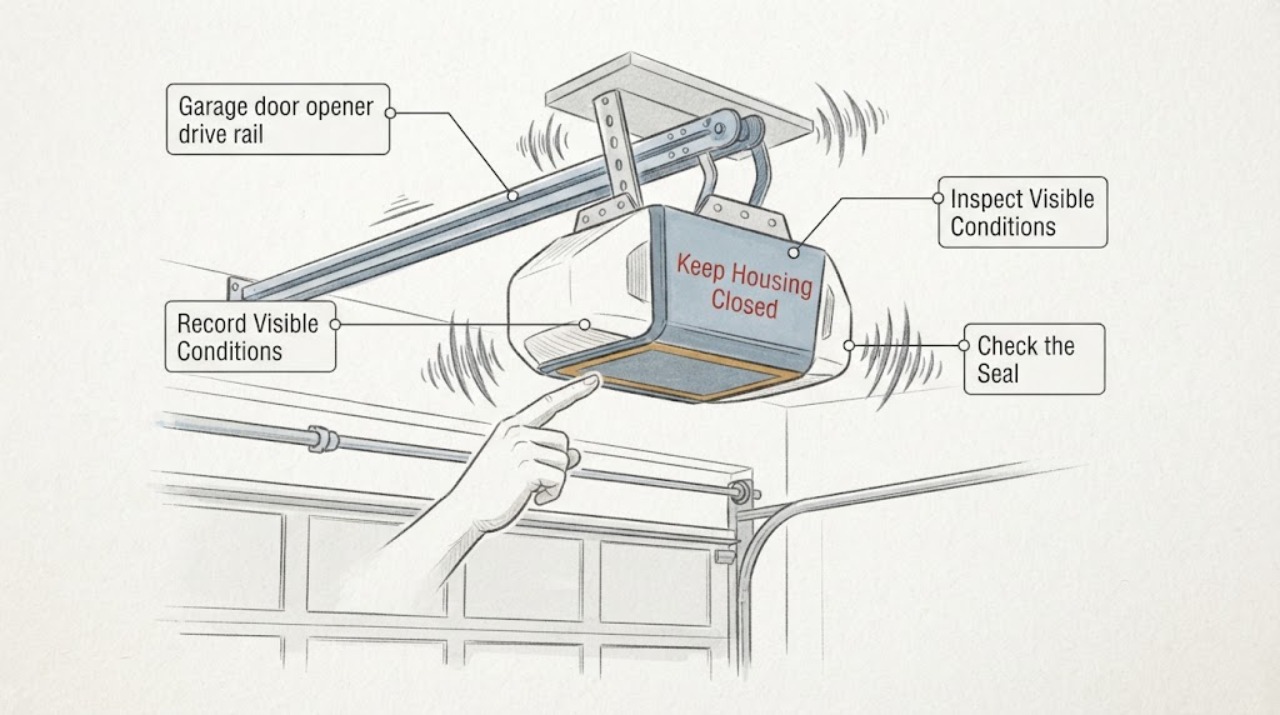
A drive rail that suddenly becomes loud should not be treated as normal. Do not keep cycling the door if the sound is grinding or scraping, the door is unbalanced, binds, jumps its path, stalls, or moves unevenly. From a safe position, use the sound and travel history you already have, visually inspect the accessible rail and door path without touching hardware, and record the opener model and drive type. Noise may come from the rail drive, carriage, belt, chain, screw, mounting vibration, or a door problem that is loading the opener; a qualified garage-door technician should diagnose anything beyond safe observation.
Work through in order
Diagnostic checks
Use only checks that match the exact appliance or system and its official guide.
-
Check 1
From a safe standing position with people and vehicles clear of the doorway, classify the sound from an existing observation or recording as a hum, rattle, squeal, scraping, clicking, popping, or grinding, and note whether it began suddenly or developed gradually. Do not start another cycle just to reproduce it.
Expected result: A grinding or scraping sound, a sudden severe change, or a sound accompanied by a stop or stall is present; a steady low-level operating sound without a change is less specific but still worth documenting when the rail is the suspected source.
Next step: Stop using the opener for grinding, scraping, severe new noise, or any stall, and arrange a qualified garage-door inspection. Keep the recording and note whether the noise seemed to come from the rail, powerhead, or door area.
Stop if: Stop all operation immediately if the sound is grinding or scraping, the opener stalls, the door jumps, the door is visibly off its path, or anyone could enter the moving-door area.
Why this matters
Why: A harsh or newly worsening sound can indicate drive, carriage, motor, mounting, or door-loading trouble. Sound character is a service clue, not a safe diagnosis or permission to continue operating.
-
Check 2
With the door closed and the opener at rest, look along the accessible drive rail from the floor without touching it. Note visible bowing, sag, separation, rubbing marks, an apparently displaced carriage, foreign objects, or a mounting area that appears to vibrate or shift; do not reach up, climb, tighten hardware, or remove a cover.
Expected result: A rail or carriage looks displaced, rub marks or debris are visible, or the mounting area appears loose; no visible defect only means that the hidden drive and attachments remain unverified.
Next step: Photograph the observation and keep the opener off. Have a qualified technician inspect rail alignment, carriage/drive condition, mounting, and the correct model-specific service procedure.
Stop if: Stop if inspection would require a ladder, reaching over the door, contact with the rail or its fasteners, cover removal, or entering the path of a door that is not fully secure.
Why this matters
Why: A visible rail or carriage abnormality can make the drive noisy or misaligned and may place unusual load on the opener. Hidden wear or looseness can exist even when the rail looks straight.
-
Check 3
From the floor and without moving the door by hand, observe the door's last known travel pattern: smooth or jerky movement, level or tilted panels, a pause, reversal, stall, jump, or a point where the sound changes. Check the doorway visually for a clear path, but do not pull the release, lift the door, or touch springs, cables, rollers, or tracks.
Expected result: The door was uneven, binding, stuck, stalled, tilted, or noisy at one travel position; smooth travel history with rail-only noise is still not proof that the opener is safe to run.
Next step: Keep the system out of service and request a door-and-opener inspection. Tell the technician the position where the sound or travel problem appeared and whether the door looked level.
Stop if: Stop and keep clear if the door is off track, partially open without stable support, visibly sagging, binding, or moving unexpectedly. Never work under or between door sections.
Why this matters
Why: A door problem can load the opener and make a drive rail sound loud. An unbalanced or binding door can fall, move unexpectedly, or damage the opener if cycling continues.
-
Check 4
Identify the opener's brand, model, and drive style from an exterior label, the owner's manual, or a safe photograph. Record whether the rail uses a chain, belt, or screw and whether the noise is limited to the drive rail or is also heard at the powerhead or door.
Expected result: The model and drive type are known and the sound location is reasonably described; the model, drive type, or sound location is unknown.
Next step: Send the model, drive type, sound description, and safe photos to the technician or authorized support channel. Do not order or install a drive component solely from a noise description.
Stop if: Stop if identifying the model would require opening the powerhead, touching wiring, climbing, or moving the door.
Why this matters
Why: Rail lubrication, carriage, gear, belt/chain tension, mounting, and service limits vary by design. A generic part or lubricant recommendation may be wrong without the model and an inspection.
-
Check 5
Review recent changes without operating the system: installation or mounting work, weather exposure, a door impact, a power event, a prior lubrication or part change, or a change from a quiet sound to a loud one. Compare the timing with the first noise and note any visible damage from the floor.
Expected result: The noise followed an impact, mounting change, service, power event, or visible damage; there is no known change but the noise is persistent or worsening.
Next step: Keep the opener out of service when the noise is severe or the door is abnormal, and provide the timeline and photos during a professional inspection. Avoid repeated cycles to compare sounds.
Stop if: Stop if the history includes a door impact, jump, stall, visible hardware displacement, grinding, scraping, or any sign that the door is not balanced or secure.
Why this matters
Why: The timeline helps a technician distinguish a new alignment or mounting concern from age-related or internal drive wear, but it does not establish the failed component.
Use your observations
Decision map
Find the observation that best matches what you see, then follow the next safe action.
-
PATH 01Next step
What you see
Grinding or scraping is present, the door is unbalanced, binding, stalled, off its path, or moving unexpectedly.
Do this next
Stop using the opener, keep people and vehicles clear, and arrange urgent qualified garage-door service. Do not touch springs, cables, tracks, rail fasteners, or the opener.
-
PATH 02Next step
What you see
A visible rail, carriage, mounting, or drive-path abnormality is found.
Do this next
Leave the system at rest and send safe photos and the model information to a qualified technician. Do not tighten, realign, lubricate, remove, or replace the drive hardware yourself.
-
PATH 03Next step
What you see
The door appears level in its last observed travel, but the rail noise is persistent, new, or worsening.
Do this next
Keep a service appointment; internal drive, carriage, belt/chain/screw, gear, or mounting issues still need model-specific professional diagnosis.
-
PATH 04Next step
What you see
A proposed check requires climbing, touching tensioned hardware, opening the powerhead, bypassing a sensor, changing force/travel settings, or repeatedly running the door.
Do this next
Stop at the safe observation boundary and provide the technician with the model, drive type, sound description, travel history, and photos.
Helpful context
Understand the symptom
Why a drive rail can sound loud
The rail carries the trolley or carriage that transfers the opener's motion to the door. Depending on the design, the drive may be a chain, belt, or screw. A change in sound can reflect a drive or carriage issue, mounting vibration, or a door that is binding or out of balance. Sound alone cannot identify a part, and a door under spring or cable tension can move unexpectedly.
Keep the inspection observational
Stay on the floor or another safe, readily accessible position. Do not touch springs, cables, track fasteners, the rail drive, or the opener housing. Do not climb, remove covers, disconnect the drive to experiment, bypass a safety sensor, adjust force or travel, or repeatedly run a noisy door. A photo or short recording made during an already observed event is more useful than another risky test.
What a technician needs to know
Record the opener brand and model from an exterior label or the owner's manual, whether the drive is chain, belt, or screw, when the noise began, whether it occurs during opening or closing, and whether the door stalls, reverses, tilts, or moves in jerks. Include safe photos of the visible rail, mounting area, door position, and any visible damage.
Only after diagnosis
Potential parts
- garage door opener gear
Consider this part only after a qualified inspection identifies worn or damaged internal gearing as the source of the rail noise.
Gear shape and service procedure vary by opener model. Confirm the complete model and manufacturer fit information; do not open the powerhead based on noise alone. - garage door rail lubricant
Consider a manufacturer-approved lubricant only when the model manual or technician identifies lubrication as appropriate and no stop-use symptom is present.
Drive types and lubricant locations differ. Verify the model instructions and keep lubricant away from sensors, electrical parts, and surfaces where it could attract debris. - garage door vibration isolator
Consider an isolator only after a professional confirms that mounting vibration, rather than a binding door or failing drive, is the cause.
Mounting geometry and load requirements vary by opener and structure. A technician should confirm suitability and installation.
When checks do not resolve it
Need a professional?
Call a qualified garage-door technician for any persistent or newly severe rail noise, and stop using the opener immediately for grinding, scraping, an unbalanced or binding door, a stall, a jump, an off-path door, or unexpected movement.
Have this ready
- Provide the opener brand and model, chain/belt/screw drive type, sound character and timing, last known door travel behavior, recent changes or impact, visible rail or mounting observations, and safe photos or an existing recording.
Common questions
FAQ
Is a loud garage door opener rail always failing?
No, but a new or worsening sound should be documented and assessed. Drive type, mounting vibration, carriage or drive wear, and a door that binds or is out of balance can sound similar. Grinding or scraping, stalling, jumping, or an unbalanced door means stop using it and call a qualified technician.
Should I lubricate the rail when it gets noisy?
Only if the exact owner's manual or a technician says the drive design calls for it and no stop-use symptom is present. Lubrication cannot correct a binding door, damaged drive, displaced rail, or unsafe hardware, and the wrong product can attract debris or affect components.
Can I disconnect the opener and move the door to find the noise?
Do not use a release or move the door as a diagnostic experiment unless a qualified technician directs it and the door is known to be closed and secure. Springs, cables, and an unbalanced door can create sudden movement. Safe visual observations and existing recordings are the appropriate first step here.
What should I tell the garage-door technician?
Share the opener model, chain/belt/screw drive type, the sound character and when it occurs, the last known door travel pattern, any visible rail or mounting change, recent impact or service, and safe photos or recordings.
Read the exact guide
Official sources
- Non-Reversing Automatic Garage Door Openers Are a HazardU.S. Consumer Product Safety Commission · General residential garage-door and opener safety; this article follows its professional-service boundary and does not reproduce manual hardware testing.
- Genie Garage Door Opener TroubleshootingThe Genie Company · Genie-specific guidance used for general drive-type and noise distinctions; exact checks remain model-specific and are limited here to safe observation.
- Quiet Garage Door OpenersLiftMaster · General context for why drive style affects sound; it does not diagnose a particular opener or authorize a part replacement.
Community feedback
Share a repair observation
Share a plain-text repair observation. Accepted observations are published automatically; this page may take a moment to update.