
On this page
Start here
Quick answer
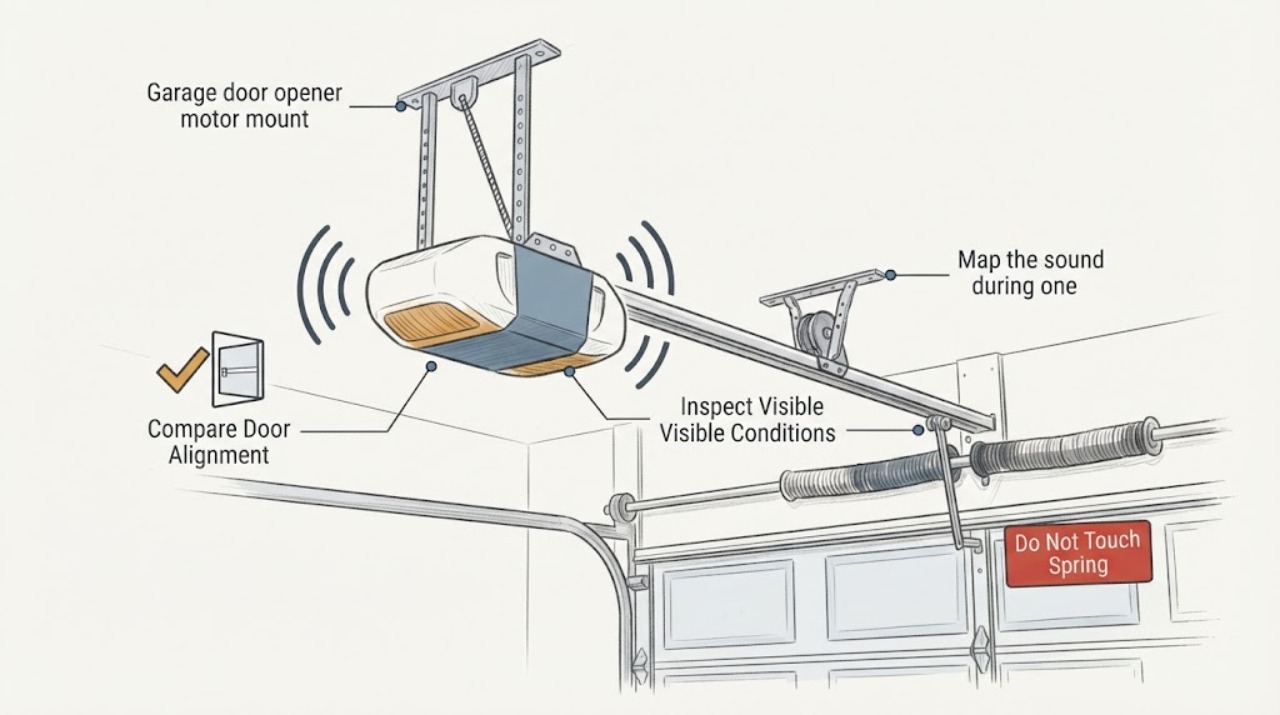
A loud garage-door opener may be transmitting vibration through its motor mount, but the same sound can come from the drive, rail, door hardware, or an unbalanced door. From a safe position on the garage floor, listen during one normal cycle, note where the sound starts, observe visible movement of the opener or support, and watch whether the door travels smoothly and stays aligned. Do not climb, touch the motor mount, tighten overhead hardware, disconnect the door, or handle springs, cables, or tracks. Stop using the opener for grinding, scraping, severe vibration, door imbalance, binding, derailment, heat, or any unsafe movement, and arrange qualified garage-door service.
Before you begin
Safety first
- User checks remain at floor level and non-invasive. Do not climb, remove the opener cover, touch or tighten the mount, disconnect the door, handle springs, cables, tracks, or rollers, bypass sensors, or repeatedly cycle a noisy system.
Work through in order
Diagnostic checks
Use only checks that match the exact appliance or system and its official guide.
-
Map the sound during one normal cycle
From a safe floor position outside the door’s travel path, use the normal wall control or remote for one cycle only if the door and surroundings look safe. Listen without approaching the opener, rail, springs, cables, or tracks.
Expected result: Record whether the sound begins at start-up, during travel, at the fully open or closed position, or while the motor stops, and whether it sounds like vibration, rattling, squealing, grinding, or scraping.
Next step: Write down the timing and sound description for the professional. Do not repeat the cycle to obtain a closer sound or attempt to locate it by touching overhead components.
Stop if: Stop immediately for grinding, scraping, popping, severe rattling, smoke, heat, odor, sudden movement, or a door that does not remain on its normal path.
Why this matters
Why: A start/stop vibration may be transmitted through the motor mount or support; a travel-only sound may involve drive or door movement; grinding or scraping is a stop-use warning rather than a lubrication or tightening invitation.
-
Observe visible vibration and mount movement
From the floor and outside the travel path, look at the opener housing and any visible support or ceiling connection while the door is stationary and, only if safe, during the single normal cycle. Do not touch, climb, reach, or tighten any fastener.
Expected result: Note whether the housing or visible support moves noticeably, a bracket appears loose or displaced, the rail shakes, or the exterior looks stable while the noise still occurs.
Next step: Photograph from a safe distance and tell the service professional exactly what moved and when. Leave the opener unused if the movement is severe or the support appears damaged.
Stop if: Stop for visible separation, sagging, falling material, severe vibration, exposed hardware, unstable support, or any need to access the mount or ceiling.
Why this matters
Why: Visible movement supports a vibration or support assessment, but a stable-looking mount does not rule out an internal drive or door-source problem. A loose-looking or displaced overhead assembly is unsafe to correct from a ladder or by hand.
-
Watch the door travel and alignment
Without touching the door or disconnecting the opener, observe one normal opening or closing movement from a safe side position. Keep clear of the panels, hinges, bottom edge, and track area.
Expected result: Record smooth versus jerky travel, pauses, reversals, a door that sags or tilts, changing side gaps, binding, a jump from the track, or a door that stops short.
Next step: Stop operating the door for any abnormal travel and call a qualified garage-door professional. Do not perform a balance test, release the trolley, or adjust springs, cables, rollers, or tracks.
Stop if: Stop immediately for binding, sudden drop, tilt, reversal at an unexpected point, a jump from the track, a door that will not stay aligned, or any person, pet, or vehicle in the path.
Why this matters
Why: Uneven travel, binding, tilt, or derailment points to a door or counterbalance safety issue that can overload the opener and make the mount vibrate; smooth travel does not prove the mount or drive is sound.
-
Compare sound with the door stationary
If the opener and door appear safe and the control allows it, note whether the noise is present only during door travel or also briefly when the motor starts or stops with the door stationary. Do not hold a control continuously or create an unsupported test condition.
Expected result: Record travel-linked noise, start/stop-only noise, a hum without movement, or no reproducible noise on the single observation.
Next step: Provide the timing and whether the door moved to the professional. Do not remove the cover, override controls, or energize the opener repeatedly.
Stop if: Stop for humming with no movement, burning odor, heat, smoke, repeated reset behavior, or any need to access the motor or wiring.
Why this matters
Why: Travel-linked noise keeps the door, rail, and drive path in focus; start/stop-only vibration may help the professional inspect the mount and support; a hum without movement can indicate a fault that should not be repeatedly energized.
-
Check surrounding safety clues from the floor
With the system off through its normal control, visually check the accessible floor and wall area for fallen hardware, oil or debris, damaged panels, a displaced track appearance, and clear travel space. Do not pick up unknown hardware, touch lubricants, or reach into the track or spring area.
Expected result: Record visible debris, impact marks, a panel or track that looks displaced, moisture, a blocked path, or no external clue.
Next step: Keep the area clear, photograph without approaching overhead components, and arrange professional inspection. Do not sweep debris into the mechanism or attempt a temporary fastener or lubricant fix.
Stop if: Stop for loose parts, damaged panels, displaced tracks, moisture, electrical concerns, blocked travel, or any need to touch springs, cables, rails, or the motor mount.
Why this matters
Why: Fallen hardware, damage, moisture, or a displaced-looking track raises the urgency and makes continued operation unsafe. No visible clue does not exclude an internal opener or mount fault.
Use your observations
Decision map
Find the observation that best matches what you see, then follow the next safe action.
-
PATH 01Next step
What you see
The door travels smoothly, the sound is a repeatable start/stop vibration, and visible opener movement is present without heat or damage.
Do this next
Arrange qualified service to assess the motor mount, support, and vibration transmission. Do not tighten overhead hardware yourself.
-
PATH 02Next step
What you see
The noise occurs during travel and the door binds, tilts, pauses, or shows changing alignment.
Do this next
Stop using the opener and request garage-door service for the door, drive path, and counterbalance system. Do not disconnect, lift, or adjust the door.
-
PATH 03Next step
What you see
There is grinding, scraping, severe rattling, a hum without movement, heat, smoke, or burning odor.
Do this next
Leave the opener unused, keep the garage clear, and arrange prompt professional service. Do not re-energize it to reproduce the noise.
-
PATH 04Next step
What you see
A bracket, mount, rail, track, panel, spring, or cable appears loose, displaced, damaged, or unstable.
Do this next
Keep people and vehicles away and request qualified garage-door service. Do not touch or tighten the overhead assembly.
-
PATH 05Next step
What you see
The opener or door is near water, electrical equipment, an obstruction, or an unsafe access area.
Do this next
Stop the observation and arrange appropriate professional assistance. Do not touch wet equipment or enter the door’s travel path.
Helpful context
Understand the symptom
Locate the noise before naming the part
Noise can travel through a ceiling or rail, so the loudest point in the room is not necessarily the failed component. LiftMaster describes vibration differences among opener drive designs, while a garage-door safety standard requires the door to be properly balanced and directs repairs to cables, springs, and related hardware to qualified service personnel. Safe observation narrows the handoff without exposing you to overhead or counterbalance hazards.
Keep the opener and door intact
Do not remove the opener cover, touch the motor mount, tighten brackets, lubricate an inaccessible part, or reach toward the rail, trolley, spring, cable, or track. Do not disconnect the opener to test balance. One normal control cycle is enough to document the symptom; repeated cycling can worsen a mechanical fault.
When the noise is a stop condition
Grinding, scraping, a door that binds or moves unevenly, severe shaking, a jump from the track, a door that will not stay aligned, heat, smoke, or visible damage means stop. Keep people and vehicles clear, leave the opener unused, and arrange qualified garage-door service. Do not try to catch, restrain, or manually force the door.
Only after diagnosis
Potential parts
- garage door opener gear
Consider only after a qualified professional confirms an internal drive-gear fault rather than a motor mount, door balance, rail, or track problem.
Match the opener model, drive system, and manufacturer requirements; internal opener service must be performed with power isolated by qualified personnel. - garage door rail lubricant
Consider only if the manufacturer or professional identifies an appropriate accessible lubrication point; lubricant will not correct a loose mount, grinding drive, track problem, or unbalanced door.
Use only the product and locations approved for the specific opener and door system; do not reach, climb, or apply lubricant to springs, cables, or inaccessible hardware. - garage door vibration isolator
Consider only after a professional confirms that vibration transmission at the mount is the cause and that the support can safely accept the part.
Confirm opener model, support construction, load, fastener requirements, and manufacturer guidance; overhead installation is not a user task.
When checks do not resolve it
Need a professional?
Arrange qualified garage-door service for persistent loud noise, visible mount or support movement, travel-linked vibration, a door that binds or tilts, or any uncertainty about the opener, rail, door, or counterbalance system.
Safety scope: User checks remain at floor level and non-invasive. Do not climb, remove the opener cover, touch or tighten the mount, disconnect the door, handle springs, cables, tracks, or rollers, bypass sensors, or repeatedly cycle a noisy system.
Have this ready
- Provide the sound description and timing, one-cycle observation, visible movement, door travel and alignment result, opener and door model if already documented, photos from the floor, and any heat, odor, damage, fallen hardware, moisture, or obstruction.
Common questions
FAQ
Can a loose motor mount make a garage-door opener loud?
It can transmit or amplify vibration, but drive, rail, door, track, and counterbalance problems can sound similar. Observe the timing and visible movement from the floor and have a professional identify the source.
Should I tighten the garage-door opener mount?
No. The mount is overhead and supports a moving system. Do not climb, reach, or tighten it yourself; stop for visible movement and arrange qualified garage-door service.
When should I stop using a noisy garage-door opener?
Stop for grinding, scraping, severe shaking, binding, a tilted or unbalanced door, derailment, heat, smoke, burning odor, moisture, or any unsafe movement. Keep clear and request professional service.
Read the exact guide
Official sources
- Revision of Garage Door Operator StandardU.S. Consumer Product Safety Commission · Safety-standard text used for escalation boundaries; not a consumer repair procedure.
- Quiet Garage Door OpenersLiftMaster · Manufacturer product-context information used to explain why drive type and mounting can affect sound; not a repair instruction for this opener.
- Automatic Residential Garage Door OperatorsU.S. Consumer Product Safety Commission · General safety context for garage-door operators; it does not identify the cause of a particular noise.
Community feedback
Share a repair observation
Share a plain-text repair observation. Accepted observations are published automatically; this page may take a moment to update.