
On this page
Start here
Quick answer
If a garage-door opener becomes loud only when it is lifting or lowering the door, stop repeated cycles and observe from the side, with the full door in view and no one in its path. Note whether the sound is grinding, popping, scraping, rattling, or a steady vibration, and whether the door jerks, binds, moves unevenly, or stops. A load-dependent noise can come from the door being unbalanced or binding, loose opener or rail fasteners, a worn chain/belt/drive component, or vibration transferred through the mounting. Do not touch springs, cables, drums, brackets, moving parts, or the opener cover; do not pull the emergency release, adjust force or travel, or add lubricant until the opener and door model are identified. Stop use and call a garage-door professional immediately for grinding, a jerking or crooked door, a door that will not stay in position, broken or loose hardware, or any sign of spring or cable damage.
Before you begin
Safety first
- Do not touch or adjust springs, cables, drums, brackets, rollers, hinges, tracks, gears, chain/belt tension, force, or travel limits; do not pull the emergency release, open the powerhead, bypass sensors, place yourself under the door, or use a ladder for inspection. Keep the door path clear and have high-tension and moving-door work handled by a qualified professional.
Work through in order
Diagnostic checks
Use only checks that match the exact appliance or system and its official guide.
-
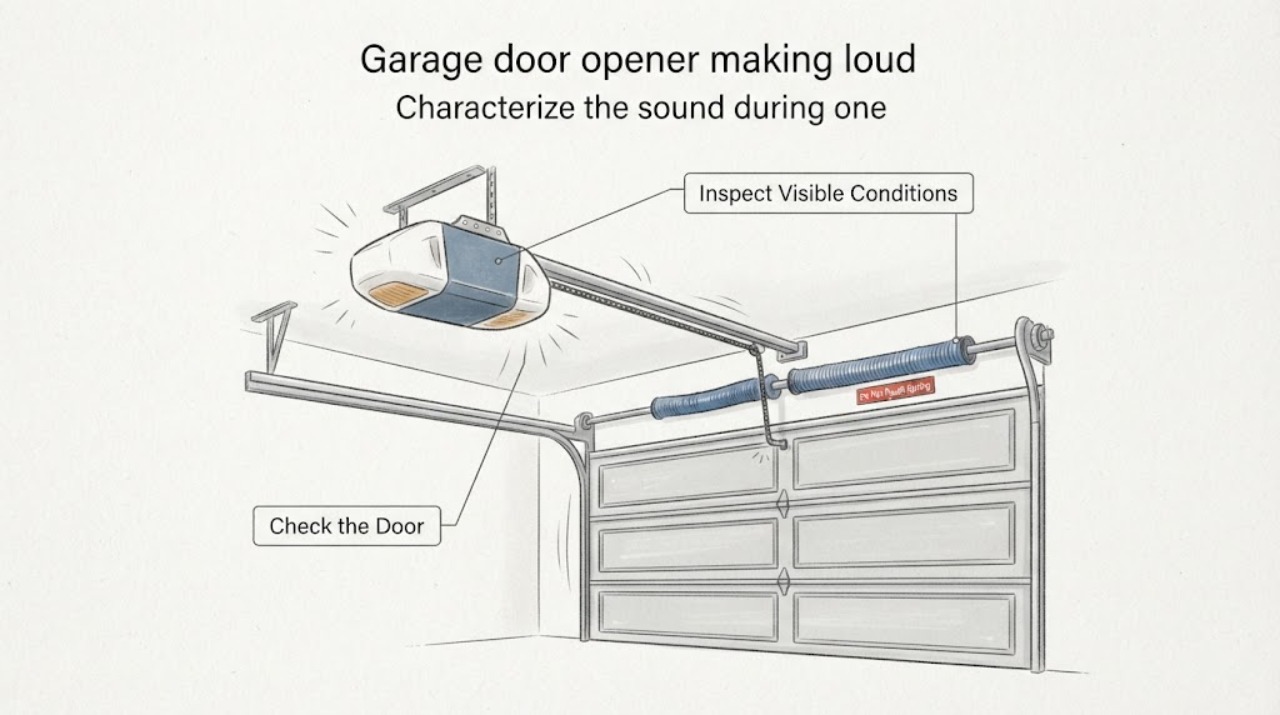
Characterize the sound during one safe observation
From outside the door path and with the full door visible, use the wall control for one brief open or close cycle only if the door is not already jerking, crooked, stuck, or making a severe grinding or popping sound. Stop the cycle immediately if any unsafe behavior appears; do not repeat it to make the sound louder.
Expected result: Record whether the noise is grinding, scraping, popping, rattling, humming, or vibration; whether it begins at startup, mid-travel, or near an end position; and whether it occurs only while the door carries load.
Next step: Stop using the opener for severe or worsening noise and give the sound description and timing to a garage-door professional. Keep the remote away from children and do not stand under the moving door.
Stop if: Stop immediately for grinding, popping, cable or spring movement, door jerking, crooked travel, a door that reverses unexpectedly, falling hardware, or any person or object entering the path.
Why this matters
Why: A noise synchronized with door movement points to the drive, rail, mounting, or door hardware under load. Grinding, popping, or a sudden change is a stop-use signal rather than evidence that a lubricant or adjustment will solve it.
-
Watch the door for binding or imbalance signs
From a safe side position, observe the door panels, rollers, tracks, and bottom edge during the brief observation without touching or disconnecting anything. Do not pull the emergency release, move the door by hand, inspect springs up close, or adjust force or travel settings.
Expected result: Record smooth or uneven travel, a door that shudders or pauses, panels that separate or rub, rollers that appear to jump, one side rising first, a door that will not remain where the control stops it, or no visible binding.
Next step: Stop operating for any bind, imbalance, damaged spring/cable, or uneven travel and arrange professional service. Do not compensate by changing opener force, limits, or speed.
Stop if: Stop for a door that drops, rises unexpectedly, binds, leaves the tracks, has a broken spring/cable, or cannot remain stable when stopped by normal control.
Why this matters
Why: Jerking, rubbing, crooked travel, or failure to stay positioned suggests door resistance, balance, track, roller, spring, or cable concerns that can overload the opener. A smooth-looking door does not rule out a drive or mounting fault.
-
Look for visible loose mounting or rail vibration
With the opener and door stationary, look from floor level at the powerhead, rail supports, ceiling or header mounting, chain/belt cover, and visible fasteners. Do not climb, remove a cover, reach toward the rail, tighten hardware, or place a hand on a vibrating assembly.
Expected result: Record a visibly loose bracket, rail or powerhead movement, a sagging support, missing fastener, rattling cover, chain/belt that appears displaced, or no visible movement while stationary.
Next step: Photograph the stationary assembly and request a technician assessment. Do not tighten, realign, open, or support the opener yourself.
Stop if: Stop for a hanging powerhead or rail, exposed wiring, a broken bracket, a loose chain/belt, falling hardware, or anything that would require a ladder or contact with the assembly.
Why this matters
Why: Movement or a loose support can transmit noise and change the drive alignment under load; a displaced chain, belt, carriage, or cover may indicate a model-specific repair. No visible issue from the floor does not clear concealed fasteners or internal components.
-
Separate drive noise from door-hardware noise by location
During only a safe, brief observation, listen from the side of the garage for whether the sound is loudest at the powerhead, along the rail, at the door tracks, or at a hinge/roller area. Do not follow the sound with your hands, place your body under the door, or inspect springs, cables, drums, or rollers at close range.
Expected result: Record the loudest location and whether the sound travels with the door, remains near the opener, or occurs when the door panels and tracks move through a particular section.
Next step: Send the location, timing, and a short recording if safely obtained to the service provider. Stop use rather than applying a generic lubricant to a component that has not been identified.
Stop if: Stop for metal-on-metal grinding, a snap or bang, visible cable or spring movement, a roller leaving its track, or any need to enter the door path while moving.
Why this matters
Why: A sound concentrated at the powerhead or rail suggests opener drive, carriage, rail, or mounting concerns; a sound at a panel, roller, hinge, or track suggests door hardware. These locations can overlap, so the observation is a routing clue, not a diagnosis.
-
Check safe operation and control behavior
From the control position, note whether the opener responds normally, stops or reverses, strains, runs without moving the door, or requires repeated commands. Do not test by standing beneath the door, bypassing sensors, holding controls to override a fault, or changing force and limit settings.
Expected result: Record normal movement with noise, a stop or reversal, a motor that runs while the door stalls, delayed movement, an indicator code, or a door that will not close or open fully.
Next step: Keep the opener out of service for a stalled, reversing, incomplete, or noisy door and provide any indicator code and exact behavior to a professional using the model manual as reference.
Stop if: Stop for a safety sensor fault, uncontrolled movement, a door that will not stop or reverse correctly, a motor that strains while the door does not move, or any need to bypass a safety feature.
Why this matters
Why: A motor running without expected door movement can indicate carriage, chain/belt, gear, or coupler trouble; stops, reversals, and incomplete travel can indicate binding, safety, limit, or control issues. A safety reversal or sensor behavior must not be defeated to continue testing.
-
Prepare a model-specific service handoff
Collect the opener and door brand/model if visible, drive type, rail style, sound recording from a safe position, when the noise occurs, travel behavior, visible mounting observations, indicator codes, and recent work or storm impact. Do not open the powerhead or remove door hardware to improve the information.
Expected result: Record whether the likely route is door balance/binding, rail or mounting vibration, gear/carriage/drive noise, control or safety behavior, or unresolved without professional inspection.
Next step: Request garage-door opener service and tell the provider whether the door is being kept closed, whether any water or vehicle impact occurred, and whether the noise is worsening. Keep the remote inaccessible to children.
Stop if: Stop gathering information when it requires disconnecting the door, touching springs/cables, opening the powerhead, removing guards, using a ladder, or entering the travel path.
Why this matters
Why: The opener model and drive type determine compatible gears, lubricants, rails, and vibration-control parts. A sound that occurs only under door load requires the door and opener to be evaluated together; a generic replacement part cannot prove the cause.
Use your observations
Decision map
Find the observation that best matches what you see, then follow the next safe action.
-
PATH 01Next step
What you see
The opener makes grinding, popping, or severe worsening noise, or the door jerks, drops, binds, or travels crooked.
Do this next
Stop operating the opener, keep everyone clear, and call a garage-door professional. Do not pull the release, touch springs or cables, or attempt an adjustment.
-
PATH 02Next step
What you see
The door movement looks smooth, but the sound is concentrated at the powerhead or rail only while lifting.
Do this next
Keep use to a minimum and request opener service for possible drive, carriage, gear, rail, or mounting inspection. Provide the model and sound location; do not open or tighten the assembly.
-
PATH 03Next step
What you see
The sound is loudest at a track, roller, hinge, or panel area and the door shows rubbing or uneven travel.
Do this next
Stop use and request door-hardware service. A door-side resistance problem can overload an otherwise functioning opener, and spring/cable work requires a trained technician.
-
PATH 04Next step
What you see
The motor runs but the door stalls, the carriage or drive appears not to transmit motion, or an indicator code is present.
Do this next
Leave the opener out of service and give the exact model, code, and behavior to a professional. Do not bypass sensors, force the door closed, or open the powerhead.
-
PATH 05Next step
What you see
The door reverses, will not close or open fully, or a safety sensor/control behavior is abnormal.
Do this next
Stop repeated testing and request service using the owner's manual for the exact model. Never defeat a safety feature or change force/limit settings as a noise remedy.
-
PATH 06Next step
What you see
The opener and door operate smoothly and a professional confirms the noise source and completes the repair or maintenance.
Do this next
Follow the model-specific maintenance instructions and monitor the next normal cycles from a safe position. If load-dependent noise returns, stop use and reopen the service call.
Helpful context
Understand the symptom
Noise under load points to the door-opener system
A motor or drive that sounds normal with little resistance but becomes loud while moving the door is being asked to transmit force. The load may be abnormal because the door binds or is out of balance, or the opener may have loose mounting hardware, a worn drive or carriage, rail vibration, or a model-specific lubrication requirement. A sound alone cannot identify a failed gear or spring, and garage-door springs, cables, and brackets store dangerous energy. Treat the first observation as a stop-use decision, not a prompt to open the powerhead.
Observe from a safe position
Keep the door fully visible, keep people and vehicles clear, and use the wall control only for a brief observation if the door has been operating normally enough to do so. Do not repeat a cycle to reproduce a grinding noise. Never place hands near rollers, hinges, cables, springs, the chain or belt, or the moving door, and do not test balance by disconnecting the opener or moving the door manually; those checks belong to a trained technician.
Only after diagnosis
Potential parts
- garage door opener gear
Consider only when a technician or exact model documentation identifies worn or damaged opener gearing as the source of load-dependent grinding or failure to transmit motion.
Match the opener model, drive configuration, gear assembly, and manufacturer instructions; a gear cannot correct a binding or unbalanced door. - garage door rail lubricant
Consider only when the exact opener manual specifies lubrication for the identified rail or drive component and the assembly is otherwise in good repair.
Use only the lubricant type and locations approved for the model; do not apply lubricant to a belt, safety sensor, electrical part, spring, or unknown component. - garage door vibration isolator
Consider only when a professional confirms that sound transmission through an otherwise secure opener mounting is the cause, rather than a loose bracket, rail alignment, or door fault.
Confirm the mounting pattern, load rating, ceiling/header structure, and manufacturer approval; an isolator must not substitute for repairing loose or damaged support.
When checks do not resolve it
Need a professional?
Call a qualified garage-door technician for load-dependent loud noise that persists, grinding or popping, a jerking or crooked door, binding, incomplete travel, a motor that runs without moving the door, loose or damaged hardware, unusual spring or cable movement, failed safety behavior, or an opener that is unbalanced or cannot stay positioned. Stop use immediately for sudden severe noise, uncontrolled movement, or suspected spring/cable failure.
Safety scope: Do not touch or adjust springs, cables, drums, brackets, rollers, hinges, tracks, gears, chain/belt tension, force, or travel limits; do not pull the emergency release, open the powerhead, bypass sensors, place yourself under the door, or use a ladder for inspection. Keep the door path clear and have high-tension and moving-door work handled by a qualified professional.
Have this ready
- Provide the opener and door brand/model if visible, drive type, exact sound (grinding, scraping, rattling, humming, or popping), when it starts, sound location, door travel behavior, indicator codes, photos from safe positions, and any recent installation, impact, storm, or maintenance history.
Common questions
FAQ
Why is my garage door opener loud only when the door is moving?
The opener is under load only while it moves the door, so a door that binds or is unbalanced can overload the drive. Loose mounting, rail vibration, carriage or gear wear, and door hardware can sound similar. Observe from a safe position once, then stop repeated cycles if the sound is severe or worsening.
Should I lubricate a noisy garage door opener?
Not until the opener model and component are identified. Some models specify lubrication for particular drive parts, while lubricant will not fix a loose mount, worn gear, binding door, or spring problem. Do not lubricate springs, belts, sensors, or unknown moving parts as a first response.
Is grinding from a garage door opener dangerous?
It can indicate a drive or carriage fault, or a door that is binding or unbalanced. Stop operating the opener, keep clear of the door path, and call a qualified technician—especially if the door jerks, drops, travels crookedly, or shows spring or cable damage.
Can I test the garage door balance myself?
Do not disconnect the opener or move a noisy or unstable door manually as a home test. Springs, cables, drums, and brackets store dangerous energy. Tell the technician whether the door binds, jerks, or fails to stay positioned during normal control operation and let the professional perform balance checks.
What information helps diagnose a noisy opener?
Record the model and drive type, sound character, when it starts, whether it occurs only while lifting or lowering, where it is loudest, door travel behavior, indicator codes, and any recent work or impact. Photos or a short recording are useful only from a safe position with the door fully visible.
Read the exact guide
Official sources
- Non-Reversing Automatic Garage Door Openers Are a HazardU.S. Consumer Product Safety Commission · CPSC safety alert supports stopping use for unbalanced, binding, or unsafe garage doors and keeping people clear of the moving path; the article does not reproduce the alert's manual release or force-test procedure for a noisy under-load diagnosis.
- Genie Garage Door Opener TroubleshootingThe Genie Company · Official manufacturer troubleshooting guidance used for the general distinction among noisy operation, door binding, drive/carriage problems, and the need to keep the door and opener in good repair; model-specific manuals control and no internal repair steps are generalized here.
- Automatic Residential Garage Door OperatorsU.S. Consumer Product Safety Commission · CPSC's official FAQ is used only for the existence of a mandatory safety standard and reinforces that safety functions are not to be bypassed during troubleshooting; it is not a model-specific repair guide.
Community feedback
Share a repair observation
Share a plain-text repair observation. Accepted observations are published automatically; this page may take a moment to update.