
On this page
Start here
Quick answer
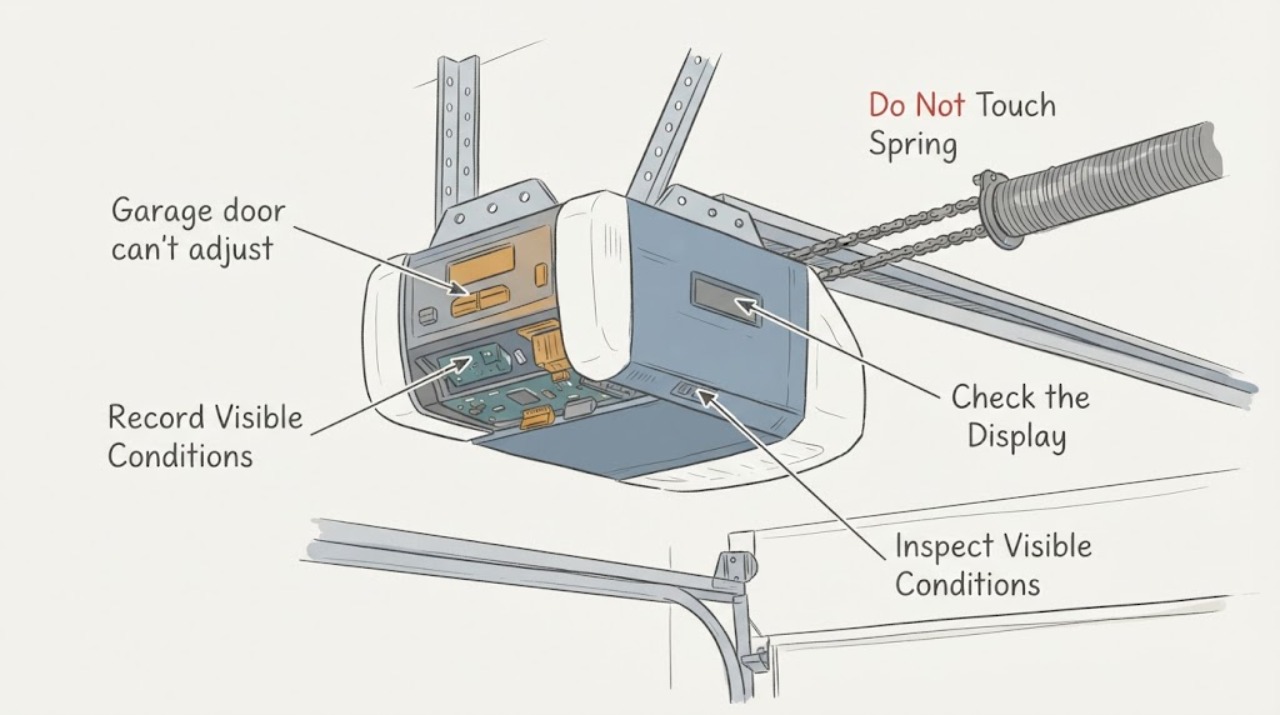
A 2004 Craftsman opener cannot be given a reliable travel-limit procedure from the year alone. Craftsman support says the model number determines the relevant support resources, and older opener families can use different limit controls. Find the model label and its exact manual before turning a limit screw or entering a programming mode. Keep people and vehicles clear, do not work on springs or other high-tension door hardware, and treat a failed safety-reversal test as a stop-use condition.
Work through in order
Diagnostic checks
Use only checks that match the exact appliance or system and its official guide.
-
Check 1
Keep the door closed when possible, clear people, pets and vehicles from the doorway, and read the model label on the motor unit without removing covers. Record the complete model number, date/serial information if present, and whether the door is sectional or one-piece.
Expected result: A complete model number is readable, or only “Craftsman” and the approximate 2004 age can be identified.
Next step: Use the exact model number with Craftsman support/manual lookup before making an adjustment. If the label is missing or unreadable, arrange professional identification rather than guessing a procedure.
Why this matters
Why: A complete model number is needed to select the correct manual and control layout; the year alone does not establish how limits are adjusted.
-
Check 2
From outside the moving hardware, observe one symptom only if the opener is already safe to operate: does the door stop short on opening, stop short on closing, press into the floor, or reverse? Do not repeatedly cycle it and do not change force settings to overcome resistance.
Expected result: The door has a consistent stop-position symptom, or it binds, jerks, falls, feels unusually heavy, or behaves unpredictably.
Next step: If the door binds, falls, is heavy or jerks, stop use and call a qualified garage-door technician. If it only stops at the wrong point and the door moves normally, follow only the exact model manual once identified.
Why this matters
Why: A stop-position symptom may involve limits, but binding, imbalance, springs, cables or other door hardware cannot be diagnosed by changing limits and can make continued operation unsafe.
-
Check 3
Find the exact Craftsman manual or support route using the model number. Compare the manual’s adjustment method with the motor unit before touching any control; do not assume a screw direction, button sequence, number of turns or programming mode from another Craftsman model.
Expected result: The manual matches the complete model and explicitly describes travel-limit adjustment, or no matching manual can be verified.
Next step: If the manual matches, follow its limit procedure exactly and stop if its safety prerequisites are not met. If no matching manual is available, use Craftsman support or a qualified technician instead of cross-model instructions.
Why this matters
Why: A matching manual can define the model’s procedure and warnings; a different-year or different-model guide does not prove compatibility.
-
Check 4
After any model-approved limit adjustment, perform the manufacturer/manual safety checks with the door in full view and the area clear. Use the CPSC test only as directed: a test block on the floor in the door path, never a person or body part.
Expected result: The closing door reverses promptly on the test block, or it strikes/stops without properly reversing.
Next step: If it fails, disengage the opener and arrange adjustment, repair or replacement according to the exact manual and qualified service. Do not bypass sensors, defeat reversal or keep increasing force.
Why this matters
Why: A successful reversal supports the safety check; failure means the opener must not remain in normal service while the reversal problem is unresolved.
-
Check 5
Stop immediately if the attempted adjustment would require removing a spring, loosening a cable or bracket, opening high-voltage areas, standing under an unsupported door, or working around an unbalanced/binding door.
Expected result: The task is limited to the identified opener control and the door is stable, or it involves spring, cable, structural or electrical work.
Next step: For any spring, cable, bracket, structural or electrical issue, leave the door secured and use a qualified garage-door technician.
Why this matters
Why: Opener limit programming is separate from high-tension door repair; the latter can cause a falling door or serious injury.
Use your observations
Decision map
Find the observation that best matches what you see, then follow the next safe action.
-
PATH 01Next step
What you see
The complete Craftsman model number is found and the door moves normally, but it stops short or overtravels.
Do this next
Use the matching Craftsman manual, make only its prescribed adjustment, and repeat the safety-reversal test afterward.
Why this path and its safety boundary
Why it matters: A model-specific travel-limit adjustment may be relevant, but the year alone still does not select the control procedure.
-
PATH 02Next step
What you see
The model number is missing or the available manual is for a different opener family.
Do this next
Contact Craftsman support with the motor-unit information or have a qualified technician identify the opener before adjustment.
Why this path and its safety boundary
Why it matters: The adjustment method and control directions are unresolved; cross-model screw turns or button sequences are not reliable evidence.
-
PATH 03Next step
What you see
The door binds, is unusually heavy, falls, jerks, or shows a spring, cable or bracket problem.
Do this next
Stop operation and keep people clear; arrange qualified garage-door service. Do not touch springs, cables or high-tension hardware.
Why this path and its safety boundary
Why it matters: This is a door-hardware or balance hazard, not a limit-setting problem that should be corrected by adding force.
-
PATH 04Next step
What you see
The opener fails to reverse on the prescribed test block after the adjustment.
Do this next
Disengage the opener and contact qualified service; do not bypass the reversing system or continue cycling the door.
Why this path and its safety boundary
Why it matters: The entrapment-protection check has failed, so normal operation is unsafe until the system is adjusted, repaired or replaced.
Helpful context
Understand the symptom
Why the year is not enough
A 2004 Craftsman opener may have a model-specific adjustment method, but the task does not include the model number or a photograph of the motor unit controls. Craftsman’s support page says model numbers determine the support outlet and provides links for product help, manuals, warranty and parts. That is why this page does not guess whether the unit uses side limit screws, a button sequence, or another control layout.
Treat travel limits as a safety adjustment
Travel limits determine where the door stops, so an incorrect setting can leave the door short, press it against the floor, or interfere with entrapment protection. The CPSC advises testing the reverse function and disengaging an opener that does not reverse on contact with the prescribed test block until it is adjusted according to its owner manual, repaired or replaced. This article does not tell you to bypass the reversing system or compensate for a binding door by increasing force.
The safe handoff
If the model label is missing, the door binds, the limit control will not respond, the opener needs repeated force changes, or any spring, cable, bracket or other high-tension hardware is involved, stop and use a qualified garage-door technician. Do not remove springs, loosen cable hardware, defeat photoeyes or place yourself under a moving door while trying to recover the limits.
When checks do not resolve it
Need a professional?
Use qualified garage-door service when the model cannot be identified, the door binds or is unbalanced, springs/cables/brackets are involved, the opener requires force changes to complete travel, the safety reversal test fails, or the exact manual does not resolve the limit problem. Provide the complete model label, door type, stop-position symptom and test result.
Common questions
FAQ
Can I adjust a 2004 Craftsman opener by year alone?
No. The year does not identify the model’s limit-control layout. Craftsman directs owners to use the model number for support, manuals and parts, so identify the motor-unit model before using any screw or button procedure.
Should I increase force if the door will not close?
Do not use force as a substitute for a binding, unbalanced or obstructed door. Stop if the door is heavy, jerks, falls or shows spring/cable trouble, and use qualified service.
What must happen after a travel-limit adjustment?
The exact manual’s safety checks must be followed, including the reversal check. CPSC guidance says a closing opener must reverse on contact with the test block; if it does not, disengage it until adjusted, repaired or replaced.
Can I bypass the sensors while setting the limits?
No. Do not defeat photoeyes, the reversing system or any entrapment protection. If the setup cannot be completed with safety devices operating, stop and use qualified service.
Read the exact guide
Official sources
- Non-Reversing Garage Door Openers are a HazardU.S. Consumer Product Safety Commission · Opened CPSC consumer safety guidance. It supports testing the reverse function with a test block and disengaging an opener that fails; it does not identify the assigned Craftsman control layout or authorize spring/cable work.
- Customer Service, Manuals and Warranty Help | CRAFTSMAN®CRAFTSMAN / Stanley Black & Decker · Opened the official CRAFTSMAN support page. It states that model numbers determine the support outlet and provides product-help, manuals, parts and contact resources. It does not provide a travel-limit procedure for an unidentified 2004 opener.
Community feedback
Share a repair observation
Share a plain-text repair observation. Accepted observations are published automatically; this page may take a moment to update.