
On this page
Start here
Quick answer
On an Amarr garage door, the bottom seal sits in or against a retainer at the lower door section. A seal that is cracked, stiff, split, disintegrating, pulled out, or leaving a gap may be replaceable, but a bent or detached retainer, damaged bottom section, loose fasteners, crooked door, cable problem, or spring issue changes the repair and safety risk. Keep the door closed and inspect only from a stable standing position: photograph the seal and retainer, note whether the full width contacts the floor, and check for daylight, water, pests, sharp metal, loose hardware, or a door that is not level. Do not remove the retainer, bottom brackets, springs, cables, red-marked hardware, or opener components. Amarr recommends contacting a local dealer for bottom-seal replacement, and a trained garage-door technician should handle any retainer, section, balance, cable, or spring work.
Before you begin
Safety first
- This article supports stable standing-position observation, photography, model identification, and noting floor gaps without touching the door hardware. It does not authorize seal or retainer removal, spring or cable work, bottom-bracket or track adjustment, opener operation on a damaged door, or balance testing by the homeowner.
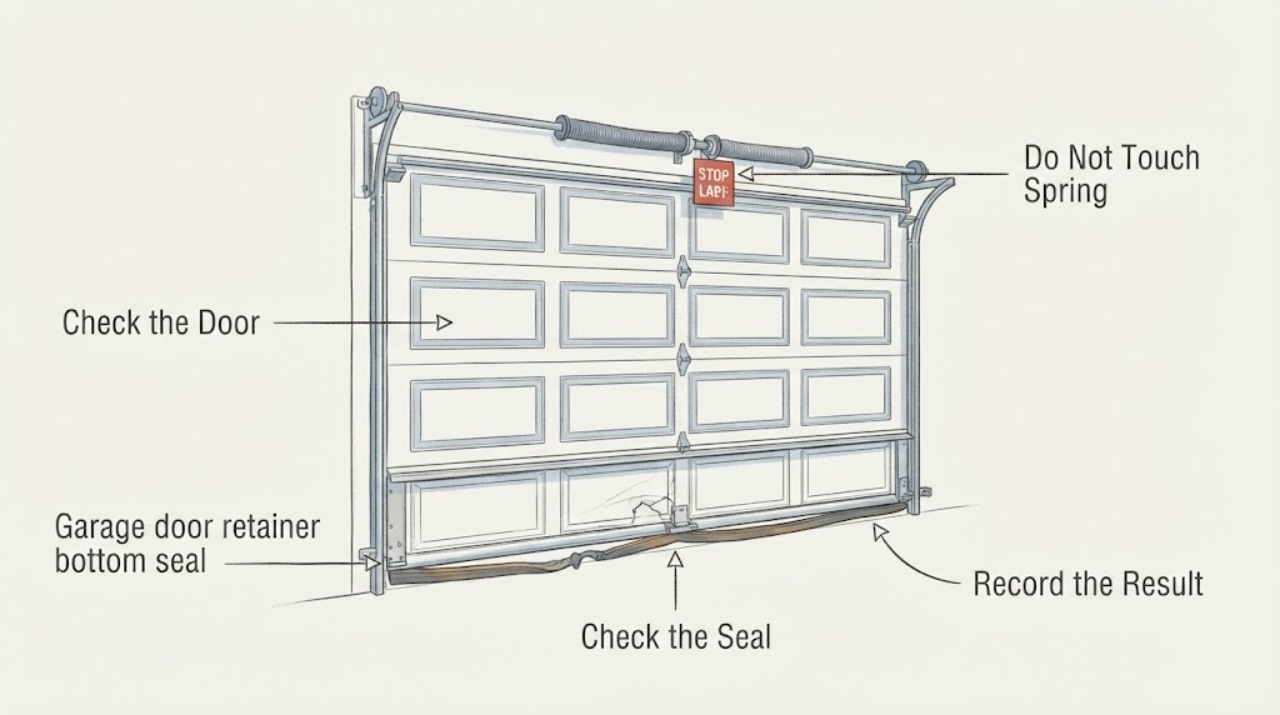
Work through in order
Diagnostic checks
Use only checks that match the exact appliance or system and its official guide.
-
Check 1
Stop using the opener and keep the garage door in its current closed position if the bottom seal or retainer is hanging loose, the door is crooked, a section is bent, or any cable or spring looks abnormal. From a stable standing position, look for a broken spring, cable off a drum, loose bottom bracket, falling material, or a door that cannot sit securely on the floor.
Expected result: Record a stable closed door with only seal wear, a loose or sharp retainer, a bent bottom section, a crooked or sagging door, a cable off the drum, a broken spring, or another unstable condition.
Next step: Use the safety branch that matches the strongest observation. Keep people and vehicles clear of an unstable door and arrange a trained garage-door technician before operating it again.
Stop if: Do not pull the door down by hand, run the opener, touch lift cables or springs, remove bottom brackets, or stand beneath a door that is moving or unsupported.
Why this matters
Why: A worn seal alone may be a dealer-replaceable weatherproofing item. A crooked door, detached retainer, bent section, cable problem, spring problem, or loose bottom bracket can involve load-bearing or high-tension hardware and is not a safe seal-only repair.
-
Check 2
With the door closed and motionless, photograph the bottom seal and retainer across the full width from both sides without touching them. Note whether the seal is stiff, cracked, split, flattened, pulled out, missing, or disintegrating, and whether the retainer is straight, bent, detached, corroded, missing fasteners, or visibly separated from the bottom section.
Expected result: Record seal-only wear, a localized seal gap, a retainer gap or bend, a retainer detached across part of the door, sharp or exposed metal, or damage that extends into the bottom door section.
Next step: Send the photos and model information to an Amarr dealer or trained technician and ask them to distinguish seal replacement from retainer, fastener, bottom-section, or alignment repair. Do not pry the retainer or pull the seal to test it.
Stop if: Do not scrape, drill, bend, cut, pry, or pull on the retainer, seal, bottom bracket, or door skin.
Why this matters
Why: Amarr says a retainer holds the seal and that most fallen bottom seals can be replaced, but seal profiles and attachment methods vary by door type and age. A retainer or section defect can prevent a replacement seal from seating and may change the repair scope.
-
Check 3
From inside the garage with the door closed, inspect the floor contact along the seal without placing fingers beneath the door. Note daylight, water or wind entry, pest openings, a gap at one end, a gap under the center, or a seal that folds away from the floor. Do not lift the door or place objects under the seal.
Expected result: Record continuous even contact, a localized gap, a full-width gap, water or debris tracks, or a bottom edge that is not level with the floor.
Next step: Photograph the gap and note when water or wind appears, then ask a dealer to assess the seal, retainer, door alignment, and floor relationship. Use temporary interior protection for belongings only without blocking or loading the door.
Stop if: Do not kneel under the door, force the lower section against the floor, add shims or adhesive as a structural fix, or operate the opener while an object is near the opening.
Why this matters
Why: A localized opening can follow a displaced or damaged seal or retainer. A full-width or uneven gap can also indicate a door alignment, floor, bottom-section, track, or balance issue; replacing weatherstrip alone may not correct the underlying geometry. Amarr cautions that bottom seals deter infiltration but are not guaranteed to be completely leak-proof.
-
Check 4
Locate the Amarr product label, installation paperwork, or prior service record from a safe standing position without removing panels. Record the door collection or model if shown, approximate age, number of sections, seal shape visible in the retainer, and whether the damage followed a storm, impact, forced closure, or recent service.
Expected result: Record reliable model information, an unknown model, a discontinued or older-looking retainer, impact or storm damage, recent installation work, or no clear event.
Next step: Give the model, photos, measurements taken without dismantling, and event history to an Amarr dealer. Ask for confirmation of seal profile, retainer condition, section damage, and any required balance or safety inspection before selecting parts.
Stop if: Do not remove the seal to measure its channel, drill new mounting holes, substitute a retainer by appearance, or make spring or opener adjustments to improve the seal gap.
Why this matters
Why: Amarr states that seal size and shape vary with door type and age, so a generic seal may not seat correctly. Impact or storm damage can affect the bottom section or alignment, while an older or unclear retainer needs a dealer to confirm available parts and a safe repair method.
-
Check 5
Arrange an Amarr dealer or trained garage-door technician when the retainer is damaged, the seal will not stay seated, the bottom section is bent, the door is not level, or any spring, cable, bracket, track, or balance concern appears. Provide the photo set and ask the technician to verify the repaired seal's continuous contact and the door's safe travel before normal use.
Expected result: The professional assessment should identify seal profile and condition, retainer attachment, bottom-section and bracket condition, door balance and alignment, spring and cable safety, and whether opener operation is safe.
Next step: Keep the door out of service until the technician confirms the repair and safe operation. Ask for the exact part description and any follow-up maintenance instructions rather than fitting an unverified universal seal.
Stop if: Do not approve spring, cable, bottom-bracket, track, or opener adjustments as a do-it-yourself add-on to a seal repair.
Why this matters
Why: A seal-only repair may restore weather protection when the retainer and door are sound. A damaged retainer or section, misalignment, or high-tension hardware issue requires a broader repair plan; Amarr recommends professional help for installation and spring or cable work.
Use your observations
Decision map
Find the observation that best matches what you see, then follow the next safe action.
-
PATH 01Safety boundary
What you see
The door is stable and level, the retainer appears straight and attached, and only the rubber or vinyl seal is cracked, stiff, flattened, missing, or pulled out.
Do this next
Send model information and full-width photos to an Amarr dealer and have them confirm the replacement seal and safe installation. Keep the door closed if the seal can catch or fall.
Why this path and its safety boundary
Why it matters: A seal-only replacement may be appropriate, but the exact profile and dimensions still depend on the Amarr door type and age.
Safety stop: Do not pull the remaining seal from the retainer, cut a channel, or run the opener to test a loose strip.
-
PATH 02Safety boundary
What you see
The retainer is bent, detached, corroded, missing fasteners, sharp, or no longer holds the seal along part of the bottom section.
Do this next
Stop operating the door and arrange a trained technician to identify the retainer and inspect its attachment, bottom section, and nearby brackets. Provide close photographs without touching the damage.
Why this path and its safety boundary
Why it matters: A seal replacement alone may not stay seated. The retainer attachment and bottom section require model-specific inspection, and fasteners may be near loaded door hardware.
Safety stop: Do not straighten, drill, screw, rivet, glue, or remove the retainer yourself.
-
PATH 03Safety boundary
What you see
The seal has a full-width or uneven floor gap, the lower section sits crooked, the door binds, or the gap changes as the door travels.
Do this next
Keep the opener off and arrange a garage-door inspection covering alignment, balance, tracks, bottom section, retainer, and seal. Protect belongings from water only from a safe position.
Why this path and its safety boundary
Why it matters: The weatherstrip may be showing a door alignment, track, floor, bottom-section, or balance problem rather than an isolated seal defect.
Safety stop: Do not adjust tracks, springs, cables, bottom brackets, opener limits, or force the door against the floor.
-
PATH 04Safety boundary
What you see
The seal or retainer was damaged after impact, forced closure, a storm, or a vehicle contact, and the bottom section is dented, split, displaced, or no longer straight.
Do this next
Keep the door out of operation and arrange an Amarr dealer or trained technician to assess the full damaged section and hardware. Photograph the condition for the service and warranty record.
Why this path and its safety boundary
Why it matters: The event may have altered the door section, retainer, hinges, rollers, tracks, balance, or opener load. Installing a seal without checking the door can hide a safety or alignment problem.
Safety stop: Do not bend the panel back, pull the retainer into alignment, run the opener, or attempt a storm or impact repair around springs and cables.
-
PATH 05Safety boundary
What you see
A spring is broken, a lift cable is frayed or off the drum, the door is crooked or heavy, a bottom bracket is loose, or the door cannot stay safely in position.
Do this next
Keep people, pets, and vehicles clear, do not operate the door, and arrange urgent service from a qualified garage-door technician. Leave the area if the door is falling or structural damage is worsening.
Why this path and its safety boundary
Why it matters: This is a high-tension or load-bearing garage-door hazard, not a bottom-seal repair. Amarr warns that spring tension can cause serious injury or death and directs spring and cable work to trained technicians.
Safety stop: Do not touch springs, cables, bottom brackets, red-marked fasteners, tracks, or opener hardware; do not attempt to balance, lift, or secure the door yourself.
Helpful context
Understand the symptom
Separate the seal from the retainer and door section
Amarr describes the retainer as the part that holds the weather seal, while the bottom section carries the rubber seal at the base of the door. A seal can wear out while the retainer remains usable, but a bent, torn-away, corroded, or loose retainer may need a different repair. A damaged bottom section, bottom bracket, lift cable, or spring is a safety and alignment issue rather than a simple seal replacement.
Inspect from a safe, closed-door position
Look at the full door width from inside and outside while the door is closed and stable. Record gaps, daylight, water entry, pest openings, a seal that has pulled out of one area, a retainer that is visibly detached, and any section or bottom edge that is bent. Do not run the opener to test a damaged seal, and do not touch springs, cables, bottom brackets, or fasteners.
The exact profile and attachment matter
Amarr notes that seals have different sizes and shapes depending on the door's type and age, and its installation documents show that not every door uses the same hardware. Identify the door model or product label and photograph the cross-section or retainer from a safe angle. Let an Amarr dealer or trained technician confirm whether the seal alone, retainer, fasteners, bottom section, or a larger door repair is appropriate.
Safety boundary
Stop conditions
- Do not remove, adjust, or repair springs, lift cables, bottom brackets, red-marked fasteners, tracks, or the hardware attached to them; Amarr warns that high spring tension can cause serious injury or death.
- Do not operate the opener when the retainer, bottom section, cable, spring, bracket, or door alignment is visibly unsafe, and do not stand beneath or place hands under a moving or unsupported door.
- Do not bend, drill, cut, glue, or pry a damaged retainer, remove a seal to identify its channel, or substitute a generic profile without exact Amarr door confirmation.
- Keep the door out of service for a crooked or heavy door, cable off the drum, broken spring, loose bottom bracket, sharp detached retainer, impact damage, falling material, or a door that cannot remain stable.
- Arrange an Amarr dealer or trained garage-door technician when the retainer or bottom section is damaged, the seal will not stay seated, the door has a full-width or uneven gap, or diagnosis requires balance, spring, cable, bracket, track, section, or opener work.
Only after diagnosis
Potential parts
- Amarr garage-door bottom weather seal
Consider this category only when the retainer and bottom section are sound and an Amarr dealer confirms the seal profile for the exact door type and age.
Amarr states that seal sizes and shapes vary by door type and age. Do not select a generic seal from appearance alone or use a seal change to conceal alignment or retainer damage. - Amarr bottom seal retainer
Consider this category only when inspection confirms the retainer is bent, detached, corroded, or incompatible with a sound bottom section and the exact replacement is available.
Retainer shape, attachment, section design, and seal interface vary. A trained technician must confirm the part and handle installation without disturbing bottom brackets or high-tension hardware. - Amarr garage-door bottom section or related hardware
Consider this category only if impact, storm, corrosion, or retainer damage has affected the door section and a dealer determines that section repair or replacement is needed.
Section dimensions, hinges, struts, brackets, finish, and reinforcement must match the exact Amarr door. Section work can alter balance and opener loading and is not a seal-only task.
When checks do not resolve it
Need a professional?
Contact an Amarr dealer or trained garage-door technician when the bottom seal is damaged and will not stay seated, the retainer is bent or detached, the bottom section is damaged, the seal gap is full-width or uneven, or the door is crooked, heavy, noisy, or unsafe. Do not operate a door with a broken spring, frayed or off-drum cable, loose bottom bracket, exposed sharp hardware, or impact damage; treat falling-door or structural danger as an emergency.
Safety scope: This article supports stable standing-position observation, photography, model identification, and noting floor gaps without touching the door hardware. It does not authorize seal or retainer removal, spring or cable work, bottom-bracket or track adjustment, opener operation on a damaged door, or balance testing by the homeowner.
Common questions
FAQ
Can an Amarr garage-door bottom seal be replaced if it is damaged?
Often, yes. Amarr says most fallen bottom seals can be replaced through a local dealer. First confirm that the retainer is straight and attached and that the bottom section and door alignment are sound; a bent or detached retainer or damaged section needs a broader repair assessment.
What does the garage-door retainer do?
The retainer holds the rubber or nylon bottom seal against the door. Amarr notes that retainers can have different shapes and that seal size and shape vary with the door type and age, so a generic replacement may not fit or operate safely.
How do I know whether the retainer or only the seal is damaged?
With the door closed, photograph the full width without touching it. A seal that is cracked, stiff, flattened, or pulled out with a straight attached retainer may be a seal-only issue. A bent, detached, sharp, corroded, or loose retainer, a bent bottom section, or an uneven door gap needs dealer or technician inspection.
Why does a new bottom seal still leave a gap?
The retainer profile may be wrong, the door bottom may be bent or misaligned, the floor may be uneven, or the door may have a balance or track problem. Amarr notes that seals are not completely leak-proof and that seal size and shape depend on the door; have a dealer assess the full door rather than forcing the seal against the floor.
Can I remove the Amarr retainer or repair the bottom seal myself?
Do not remove a retainer or work near bottom brackets, cables, or springs yourself. Amarr warns that high spring tension can cause serious injury or death and directs spring and related hardware work to a trained technician. A dealer should identify the exact seal and retainer and verify safe door operation after repair.
Read the exact guide
Official sources
- Residential Conventional Hardware Installation InstructionsAmarr · Amarr installation instructions for listed residential steel door families and conventional hardware; the actual door may differ and installation or repair should be performed by a qualified technician.
- Don't Overlook the Importance of Your Garage Door SealsAmarr · Amarr manufacturer homeowner education; door type, seal size, age, retainer shape, and installation method vary by product.
- Residential Garage Door and Commercial Door FAQsAmarr · Amarr homeowner FAQ; exact door model, seal profile, repair scope, and safety conditions must be confirmed by a trained dealer or technician.
Community feedback
Share a repair observation
Share a plain-text repair observation. Accepted observations are published automatically; this page may take a moment to update.