
On this page
Start here
Quick answer
A noisy garage door is usually a door-motion or opener-maintenance clue, not a diagnosis by itself. Listen from a safe position for squeaking, rattling, grinding, scraping, banging, or opener vibration; note whether the sound follows the door along the tracks or comes from the opener. With the door closed and the area clear, inspect only visible rollers, hinges, tracks, fasteners, and obstructions, then use only the lubricant and points allowed by the installed door and opener instructions. Stop using the opener and arrange professional service for a bang or pop, broken or frayed spring or cable, jerky or off-track movement, an unbalanced or binding door, failed safety reversal, or noise that persists after basic maintenance.
Before you begin
Safety first
- This article supports safe listening, floor-level visual inspection, and manufacturer-approved low-risk maintenance only. Do not adjust springs, cables, tracks, brackets, loaded mounts, opener settings, wiring, or safety systems.
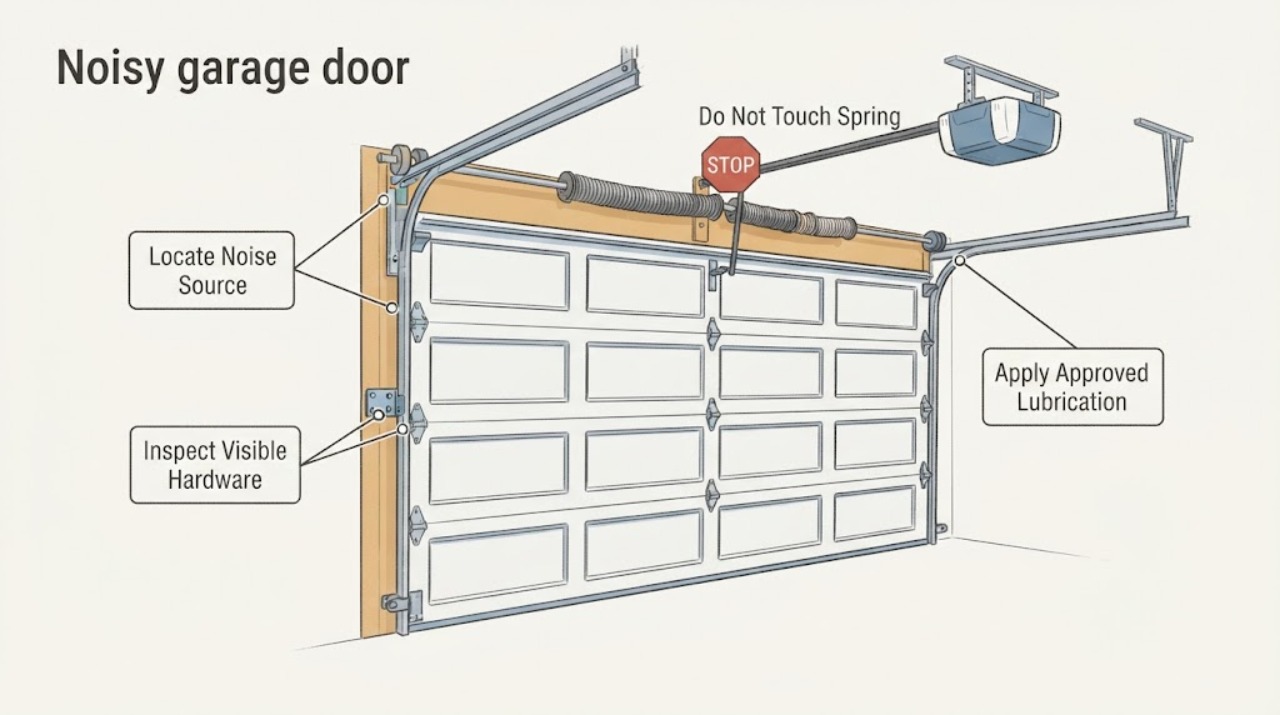
Work through in order
Diagnostic checks
Use only checks that match the exact appliance or system and its official guide.
-
Check 1
From a stable position outside the door's travel path, observe one normal open-and-close cycle only if the door is currently moving smoothly and the area is clear; listen at the sides of the opening and near the opener without touching moving parts.
Expected result: Record whether the sound is a squeak or creak, rattle, grinding or scraping, bang or pop, or a hum or vibration; note whether it follows the door panels and rollers or stays concentrated at the opener, rail, or ceiling mount.
Next step: Stop repeated cycling, write down the sound and exact part of the cycle when it occurs, and use the observation to choose a visible inspection or professional service path.
Stop if: Stop immediately for a bang or pop, cable or spring movement, door sway, jerking, scraping metal, an off-track roller, unexpected reversal, smoke, or any person or pet entering the travel path.
Why this matters
Why: A sound that follows the door points toward rollers, hinges, track contact, or door hardware, while sound concentrated at the opener points toward its drive, rail, mount, or controls. Grinding, scraping, a sudden bang, jerky travel, or worsening noise is not a routine lubrication diagnosis.
-
Check 2
With the door fully closed and the opener idle, inspect from floor level the visible rollers, hinges, track surfaces, brackets, fasteners, weather seal, and the opener mount; remove only loose debris that is not attached to a moving or loaded part.
Expected result: Note cracked, chipped, or worn rollers; bent, rusty, or obstructed tracks; loose or missing visible fasteners; a loose rail or opener mount; damaged hinges or seals; and anything rubbing the door or track.
Next step: Photograph each finding and request component-specific garage-door service when damage, looseness, rubbing, or a loaded part is involved; keep the door closed if movement is not smooth.
Stop if: Do not loosen track brackets, spring hardware, cable drums, bottom roller brackets, opener covers, or fasteners that support a loaded assembly; do not climb to inspect a ceiling mount.
Why this matters
Why: A visible worn roller, obstruction, loose hardware, bent track, or vibrating mount gives a service technician a focused starting point, but appearance alone does not prove which part is failing or authorize track, spring, cable, or bracket adjustment.
-
Check 3
Only if the door is closed, the hardware is intact, the sound is a mild squeak or creak, and the installed instructions identify the point as user-serviceable, apply the specified garage-door lubricant to the permitted hinge or roller-stem locations and wipe drips.
Expected result: After the lubricant has settled, note whether the same sound is reduced, unchanged, or replaced by grinding, scraping, rattling, or uneven travel; do not spray the track or use an unapproved product to force a comparison.
Next step: Follow the installed manufacturer's maintenance schedule only when the result remains smooth and quiet; otherwise stop use and give the technician the product instructions and before-and-after observations.
Stop if: Do not lubricate an unknown point, belt drive, spring, cable, bottom bracket, or track as a guess; do not use a ladder or reach around moving parts.
Why this matters
Why: A quieter, smooth cycle supports a limited maintenance result but does not prove that worn parts, alignment, balance, or the opener are sound. No change or a new harsh sound points to inspection or service rather than more lubricant.
-
Check 4
From the floor and outside the travel path, observe the opener, rail, chain or belt, and door connection during one safe cycle, without opening the motor housing or touching the drive while energized.
Expected result: Record whether the opener mount or rail vibrates, the chain or belt visibly slaps or drags, the screw-drive carriage skips, the door hesitates, or the noise occurs only when the opener is pulling the door.
Next step: Stop automatic cycling when the door hesitates, binds, skips, or the drive makes grinding or shrieking sounds; provide the opener type, sound timing, and photographs to qualified service.
Stop if: Do not open the opener housing, adjust drive tension, alter limits or force settings, touch wiring, or reach over the door while it moves.
Why this matters
Why: Opener-only noise or visible drive slack can require opener-specific service, while noise and resistance that follow the door point back to door hardware, alignment, or balance. A smooth-looking opener does not rule out concealed wear.
-
Check 5
Before further troubleshooting, confirm from a safe position that the door stays on its intended path, does not bind or drift, and that the opener's safety reversal and photo-eye behavior follow the installed manufacturer's test instructions; do not improvise a balance or spring adjustment.
Expected result: The door may travel smoothly and remain controlled, bind or stick, become unbalanced, fail to reverse, or show a sensor or mounting problem during the specified test.
Next step: Keep people and pets clear; stop automatic use and call qualified garage-door service for a failed safety test, balance problem, binding, or any spring, cable, track, or bracket concern.
Stop if: Do not lift a heavy or binding door, pull a release beneath an unstable door, adjust spring tension, replace cables, or work on the safety system beyond the manufacturer's ordinary test.
Why this matters
Why: A binding or unbalanced door can be hazardous even if its noise is modest, and a failed reversal or sensor test means the automatic operator should not be used normally until repaired. A passing test improves the safety picture but does not identify the source of noise.
Use your observations
Decision map
Find the observation that best matches what you see, then follow the next safe action.
-
PATH 01Safety boundary
What you see
The sound is a mild squeak or creak, the door travels smoothly on its path, no loaded hardware is damaged, and an approved reachable lubrication point is identified.
Do this next
Apply only the installed system's approved lubricant to the permitted point, wipe excess, and stop if the noise or movement worsens.
Why this path and its safety boundary
Why it matters: A limited maintenance issue is plausible, but the result must be judged by smooth travel and safe operation rather than sound volume alone.
Safety stop: Do not spray the track, spring, cable, bottom bracket, or an unknown assembly as a trial.
-
PATH 02Safety boundary
What you see
A roller, hinge, track, bracket, fastener, seal, rail, or opener mount is visibly worn, damaged, loose, bent, obstructed, or vibrating.
Do this next
Keep the door closed if travel is not smooth, photograph the part, and arrange garage-door service without loosening loaded hardware.
Why this path and its safety boundary
Why it matters: The visible clue narrows the service conversation but does not establish which loaded part can be adjusted or replaced safely.
Safety stop: Do not bend tracks, adjust brackets, remove rollers, open the opener, or reach above safe floor-level access.
-
PATH 03Safety boundary
What you see
The sound is grinding or scraping, the door jerks, catches, goes off track, drags, or the problem persists after an approved maintenance check.
Do this next
Stop automatic operation, keep the opening clear, and request prompt professional diagnosis before another cycle.
Why this path and its safety boundary
Why it matters: The symptom is no longer a simple noise nuisance; alignment, worn components, opener drive, or another concealed fault may be involved.
Safety stop: Do not force the door, pull it back onto the track, change limits or force settings, or continue cycling to reproduce the sound.
-
PATH 04Safety boundary
What you see
There is a sudden bang or pop, a visibly broken or frayed spring or cable, a door that is unbalanced or binding, or movement that could cause the door to fall.
Do this next
Keep people and vehicles away, leave the door in its safest stable position without forcing it, and arrange urgent qualified garage-door service.
Why this path and its safety boundary
Why it matters: Springs, cables, and the door's counterbalance carry hazardous loads. A homeowner noise check cannot make this safe.
Safety stop: Do not touch, unwind, cut, replace, tension, or disconnect spring or cable assemblies and do not manually move an unstable door.
-
PATH 05Safety boundary
What you see
The opener does not reverse as required, the photo-eye system is damaged or misaligned, the door closes unexpectedly, or a safety test cannot be completed safely.
Do this next
Stop automatic use, keep the door path clear, and arrange qualified service for the opener and door system.
Why this path and its safety boundary
Why it matters: The operator cannot be treated as safe for normal automatic use until the safety system and door are repaired or verified according to the manufacturer's instructions.
Safety stop: Do not bypass sensors, adjust force or limits as a noise experiment, or place people or objects in the path except as the manufacturer's specified test requires.
Helpful context
Understand the symptom
Locate the sound before choosing a fix
A squeak or creak that follows the door can come from dry or worn rollers, hinges, or other moving hardware. Rattling can come from loose hardware or an opener drive, while grinding, scraping, sudden banging, jerky travel, or a door that binds is a stronger reason to stop and arrange service. Listen from the side of the opening, not beneath a moving door, and do not repeatedly cycle a door that is worsening or moving unevenly.
Lubrication is limited by the installed system
Manufacturers do not use one universal lubrication procedure. Clopay describes lubricating suitable moving parts while avoiding the track, and Genie distinguishes roller, hinge, spring, cable, chain, belt, and screw-drive maintenance. Use the installed door and opener instructions, apply only to user-serviceable points with the door closed when required, and wipe excess. Do not treat a spring, cable, bottom bracket, or unfamiliar opener assembly as a routine spray target.
A quieter cycle is not proof that the door is safe
Noise may decrease after approved maintenance while a worn roller, misaligned track, loose mounting, balance problem, or opener fault remains. A garage door should move smoothly and stay controlled; the CPSC warns that an unbalanced or binding door should be serviced by a professional and that a failed safety reversal requires repair before normal use. Treat safety and movement changes as more important than volume alone.
Safety boundary
Stop conditions
- Stop cycling the door for a bang, pop, grinding, scraping, jerking, off-track movement, binding, or worsening noise.
- Do not adjust, unwind, cut, replace, or lubricate spring and cable assemblies, bottom roller brackets, or other loaded hardware.
- Do not open the opener housing, touch wiring, alter force or travel settings, bypass photo-eyes, or reach around moving parts.
- Do not use a ladder or roof access for a noise check, and do not manually move a heavy, binding, or unstable door.
- Keep people, pets, and vehicles clear and stop automatic use if the safety reversal or sensor test fails or cannot be completed safely.
Only after diagnosis
Potential parts
- garage door roller
Consider this category only if inspection confirms a worn, cracked, chipped, or noisy roller is the cause; noise alone is not enough to select a replacement.
Confirm the exact door design, roller dimensions, stem, bearing or seal type, and manufacturer fit information before ordering; bottom roller brackets are loaded hardware. - garage door hinge
Consider this category only if inspection identifies a damaged or worn hinge or pivot as the source of the noise.
Confirm the door section, hinge position, gauge, mounting pattern, and installed manufacturer's fit information before ordering. - garage door opener drive component
Consider this category only when the door hardware is sound but the opener produces persistent drive-specific grinding, slapping, skipping, or shrieking.
Confirm the opener type, model, drive system, and manufacturer's compatibility information; do not open or modify the energized operator as a selection test.
When checks do not resolve it
Need a professional?
Arrange routine garage-door service when a noisy door remains noisy after the installed manufacturer's approved maintenance, or when visible rollers, hinges, tracks, fasteners, mounts, or seals are worn or damaged. Seek prompt or urgent service for grinding, scraping, jerky or off-track travel, a sudden bang or pop, broken or frayed springs or cables, an unbalanced or binding door, opener drive problems, failed safety reversal, damaged photo-eyes, or any unsafe access. Springs, cables, loaded brackets, structural mounts, and opener repairs are professional work.
Safety scope: This article supports safe listening, floor-level visual inspection, and manufacturer-approved low-risk maintenance only. Do not adjust springs, cables, tracks, brackets, loaded mounts, opener settings, wiring, or safety systems.
Common questions
FAQ
Why is my garage door noisy but still opening?
A door can still move while rollers, hinges, tracks, fasteners, balance, or the opener are developing a problem. Identify whether the sound follows the door or stays at the opener, inspect only visible floor-level hardware with the door closed, and arrange service for grinding, scraping, jerky travel, sudden bangs, or persistent noise.
Can I lubricate a noisy garage door myself?
Only for an intact, smoothly moving door and only at points the installed door and opener instructions identify as user-serviceable. Do not spray the track or guess at springs, cables, bottom brackets, belts, or unfamiliar assemblies; stop if the sound or movement worsens.
Should I keep using a garage door that makes a grinding or scraping sound?
No. Stop repeated cycling and keep the opening clear. Grinding, scraping, jerky or off-track movement can involve alignment, worn components, or the opener and should be assessed before another cycle.
What does a loud bang from a garage door mean?
A sudden bang or pop can accompany a spring, cable, or other loaded-hardware failure. Keep people and vehicles away, do not touch or adjust the assembly, and arrange urgent qualified garage-door service.
When should I stop troubleshooting a noisy garage door?
Stop for a bang or pop, broken or frayed spring or cable, binding, imbalance, off-track travel, unexpected movement, failed safety reversal or photo-eye behavior, smoke, wiring concerns, or any inspection that requires a ladder, opener access, or loaded-hardware adjustment.
Read the exact guide
Official sources
- How to Fix a Noisy Garage Door: Comprehensive Guide for HomeownersClopay · Manufacturer guidance used for general noise-routing concepts; the installed door and opener instructions control when the brand or system differs.
- Maintaining Your Garage DoorThe Genie Company · Manufacturer maintenance guidance used for system-specific distinctions and safety boundaries; the installed opener and door manual controls the actual procedure.
- Publication - 523 Non-Reversing Automatic Garage Door Openers Are a HazardU.S. Consumer Product Safety Commission · Consumer safety guidance for automatic residential garage doors; the installed manufacturer's instructions and qualified service control any repair procedure.
Community feedback
Share a repair observation
Share a plain-text repair observation. Accepted observations are published automatically; this page may take a moment to update.