
On this page
Start here
Quick answer
Treat a rotting garage door frame as a possible door-system safety issue until you know which wood is affected. A little rot in non-structural trim, with a dry and solid jamb and a door that remains aligned, can be assessed as a moisture-control and carpentry job. Soft, swollen, separating or fastener-pulling wood at a jamb, header, track or other door attachment point is different: the jamb transfers door loads into the building, so keep the door out of service and arrange a trained garage-door technician; a contractor or structural professional may also be needed. Do not pry at the rot, remove tracks or springs, lift a door that binds, or patch over a wet source. First make only a floor-level visual check, trace visible water entry, and record whether the door moves smoothly without forcing it.
Before you begin
Safety first
- Do not remove springs, cables, bottom brackets or tracks; do not pry, lift or force a door with a questionable frame; do not drill or add fasteners into rotten wood as a test; and do not close wet rot behind new trim.
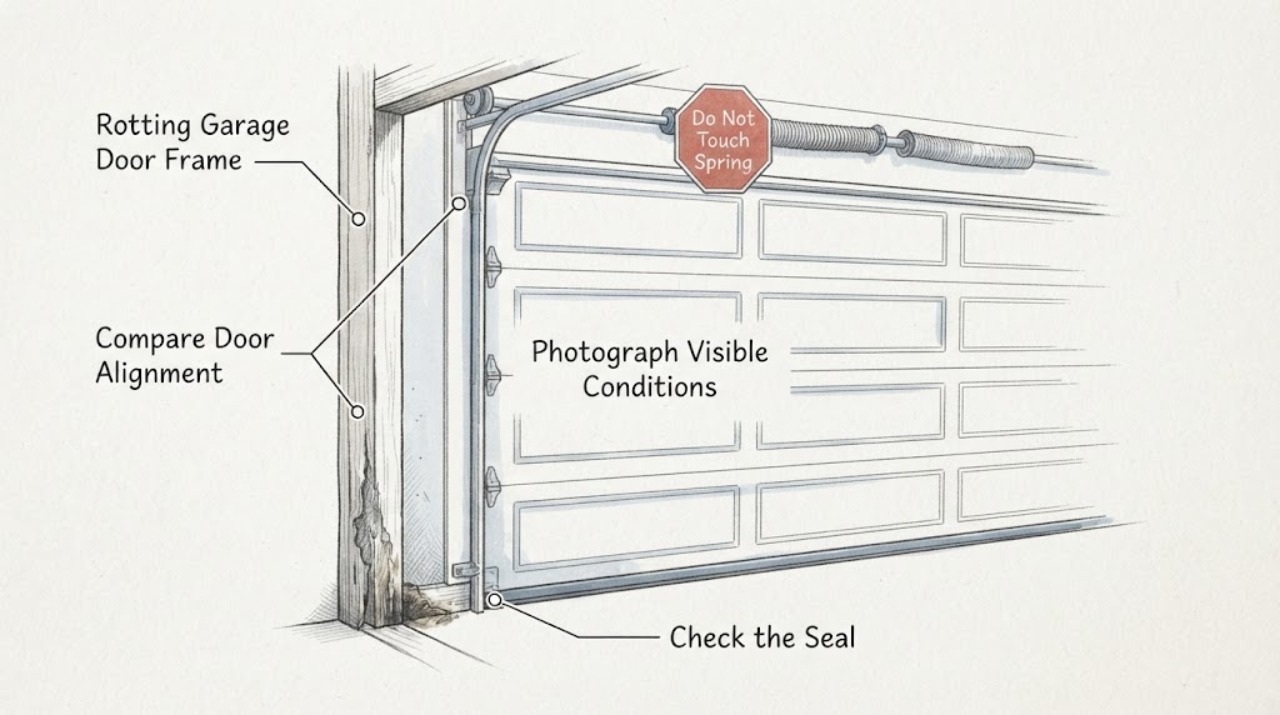
Work through in order
Diagnostic checks
Use only checks that match the exact appliance or system and its official guide.
-
Check 1
Keep the garage door closed and the opener out of routine use while you inspect from the floor. Photograph the affected area without prying, probing deeply, removing trim, loosening hardware, or touching springs, cables, bottom brackets or tracks.
Expected result: The damage is limited to paint or trim away from attachment points, or the wood is soft, swollen, split, separating, or visibly pulling hardware away from the jamb or header.
Next step: For a damaged attachment or framing member, leave the door closed and request a trained garage-door inspection. For trim-only damage, continue the visible moisture check before arranging carpentry work. Do not operate the door to see whether it holds.
Why this matters
Why: Cosmetic trim damage is a narrower carpentry and moisture question. Soft or separating wood at a hardware or framing connection may compromise the door's support; the photograph cannot establish how much sound material remains.
-
Check 2
From outside and inside the garage, follow visible water around the opening: check for standing water at the slab, a downspout or gutter outlet near the wall, wet or failed visible flashing, and water marks that continue upward or sideways. Do not open the wall or seal over damp wood to perform this check.
Expected result: A repeatable water path or damp cavity is visible, or the area is dry with no visible source.
Next step: Correct the visible drainage or weather-entry issue through the appropriate building professional before closing the area. If the source is concealed or the wood remains damp, request a building-envelope or contractor assessment rather than covering it.
Why this matters
Why: A repeatable source can keep new or repaired wood wet; EPA links persistent moisture in building cavities with rot and structural damage. No visible source does not rule out concealed leakage, condensation or a failed flashing detail.
-
Check 3
Without forcing or manually lifting the door, observe its closed alignment from a safe distance: look for a jamb that has moved, a track that no longer sits parallel, daylight at an unusual side gap, rollers or hinges that appear to be pulling the wood, or fasteners that are no longer seated.
Expected result: The opening and hardware look aligned and solid, or the track/jamb relationship is displaced, gapped, leaning or visibly pulling out.
Next step: If anything is displaced or pulling out, stop operation and arrange a trained garage-door technician; ask whether the surrounding framing also needs a qualified contractor or structural review. Do not add screws, shim the track, or remove it as a test.
Why this matters
Why: A sound-looking trim board does not prove that the jamb behind it is sound. Displacement at the track or jamb connects the rot concern to the door's load path and should be treated as a system safety issue.
-
Check 4
Only if there is no visible damage at the attachments and the door has not shifted, note its normal behavior from the controls without repeatedly cycling it: it should travel smoothly and evenly, with no binding, sudden drop, scraping or need to force it. Do not pull the emergency release or lift the door to test a questionable frame.
Expected result: The door operates smoothly, or it binds, jerks, scrapes, shifts, drops or stops against the damaged side.
Next step: If operation is not smooth, stop using the opener and arrange trained service. If it is smooth but the wood is soft or the moisture source is unresolved, keep use limited and schedule inspection before repairing or repainting the frame.
Why this matters
Why: DASMA says a door that does not go up and down smoothly may be unsafe and that awkward manual operation can indicate an out-of-balance system. A smooth cycle does not certify a rotten jamb; it only removes one visible warning sign.
-
Check 5
Prepare a service handoff with the door width and type, photos of the rot and hardware, the affected height and side, moisture observations, whether the door has shifted, and any scraping or binding. Identify whether the damaged wood is trim, a jamb, a header or unknown.
Expected result: The damage is at a track, roller, hinge, header or fastener point; the frame type is unknown; or the door symptom cannot be separated from the rot.
Next step: Request an on-site assessment by a trained garage-door technician, and involve a qualified contractor or structural professional when building framing or a load-bearing connection may be affected. Do not order parts or begin structural shoring from this article.
Why this matters
Why: The available guidance does not support selecting a replacement board, fastener or door part from a symptom and photograph alone. Jamb connection methods vary with the building frame and materials, and the door and track work as a system.
Use your observations
Decision map
Find the observation that best matches what you see, then follow the next safe action.
-
PATH 01Next step
What you see
The rot is confined to removable-looking trim, away from track, hinge, roller and header attachment points; the jamb is visibly solid and the door remains aligned.
Do this next
Trace and correct the visible moisture source, then have the trim and underlying wood assessed before refinishing. Keep the door out of use if new softness or movement appears.
Why this path and its safety boundary
Why it matters: This is more consistent with a surface weatherproofing/carpentry scope, although concealed damage has not been ruled out.
-
PATH 02Next step
What you see
Wood is soft, split, swollen or pulling away where a track, roller, hinge, header or other door hardware is attached.
Do this next
Keep the door closed and stop opener use. Call a trained garage-door technician and ask for a building-framing assessment if the support behind the jamb or header is involved; do not reinforce or remove hardware yourself.
Why this path and its safety boundary
Why it matters: The affected area may be part of the door's load path; DASMA says jamb attachments transfer door loads into the building and treats the interface as critical.
-
PATH 03Next step
What you see
The door binds, scrapes, shifts, drops, or no longer travels smoothly after the frame damage appeared.
Do this next
Stop cycling the door and arrange trained door-system service. Do not release the trolley, lift the door, adjust springs, loosen bottom brackets, or work on the track to test a theory.
Why this path and its safety boundary
Why it matters: DASMA identifies a door that does not move smoothly as a potentially unsafe condition; the symptom does not identify whether the cause is rot, track alignment, balance or another door-system issue.
-
PATH 04Next step
What you see
The source of moisture or the boundary between trim and structural framing cannot be seen without opening the wall or removing door hardware.
Do this next
Leave the area protected from further water where safe, avoid sealing over wet material, and book an on-site door and building inspection. Provide the photographs and moisture history rather than dismantling the opening.
Why this path and its safety boundary
Why it matters: The evidence is insufficient for a safe repair plan or for deciding that the rot is cosmetic.
Helpful context
Understand the symptom
Frame, trim and jamb are not the same risk
People use frame to mean the visible casing, the vertical jambs, or the structural framing behind them. The visible finish may be replaceable trim, but a jamb or header can be where the track, rollers, hinges and door loads are attached. DASMA describes the jamb attachment as a critical transition into the building, while Clopay describes the framing as an anchor for the door hardware. That is why the location and softness of the wood matter more than the size of the stain.
Find the water path before anyone closes the wood back up
Rot requires a moisture problem to be addressed as well as damaged material. Look from outside for ponding at the slab, a downspout or gutter discharging near the opening, failed visible flashing, or water tracking down the jamb. Garaga's frame guidance calls out moisture wicking at the floor and the need for a properly aligned opening; EPA says water that enters building cavities and does not dry quickly can lead to rot and structural damage. These sources support tracing and correcting the visible moisture path, not a universal repair dimension for an existing opening.
Do not turn a soft attachment point into a DIY door repair
Springs, bottom brackets and tracks can carry stored energy or door loads. DASMA says springs and spring-connected brackets should be handled only by trained technicians, and it says awkward manual operation can indicate an unsafe condition. If rot is next to a track fastener, header, hinge support or other load path, keep the door closed, do not disengage and lift it to test the frame, and arrange professional inspection. A contractor or structural professional may need to assess the building framing before the door system is repaired.
When checks do not resolve it
Need a professional?
Call a trained garage-door technician before further operation if the jamb, header, track or hardware connection is soft, displaced or pulling out, or if the door binds, scrapes, drops or shifts. Add a qualified contractor or structural professional when the surrounding building framing, concealed moisture or load-bearing connection may be involved. A trim-only repair still needs the water source addressed first.
Safety scope: Do not remove springs, cables, bottom brackets or tracks; do not pry, lift or force a door with a questionable frame; do not drill or add fasteners into rotten wood as a test; and do not close wet rot behind new trim.
Have this ready
- Provide photos from floor level, door type and approximate width, the side and height of the damage, moisture observations, whether hardware is pulling out, and any change in alignment or operation.
Common questions
FAQ
Can I replace only the rotten visible trim?
Only after an inspection confirms that the trim is separate from the jamb and hardware support and that the underlying wood is dry and sound. A new face board can hide a soft attachment point or ongoing water entry.
Is rot beside the garage-door track serious?
It can be. The track and jamb are part of the door's support and load path, so soft wood or fastener pullout there should be treated as a service condition until a technician verifies the attachment and surrounding framing.
Can I open the door to see whether the frame holds?
Do not use operation as a load test. DASMA says a door that does not move smoothly may be unsafe, and springs, cables, brackets and tracks have specific hazards. Keep a questionable door closed and arrange trained service.
Read the exact guide
Official sources
- Addressing Indoor Environmental Concerns During Remodeling: Moisture ControlU.S. Environmental Protection Agency · Opened official EPA building-moisture guidance. It supports tracing water entry, drainage and drying rather than covering a wet cavity; it does not specify a garage-door repair or structural remedy.
- How to Connect Door Jambs to the FrameDoor & Access Systems Manufacturers Association (DASMA) · Opened official DASMA technical article. It supports treating a damaged jamb or attachment as a structural door-system concern, while explicitly showing that attachment methods vary by building frame and material; it is not a repair specification for this unknown opening.
- Garage Doors and Rolling DoorsDoor & Access Systems Manufacturers Association (DASMA) · Opened official DASMA technical overview. Its garage-door section directly supports the track/jamb relationship used to prioritize rot near those attachment points; it does not identify a part or repair method.
- Interior Garage Door Framing: Understanding the Basics for a Structurally Sound SetupClopay · Opened official Clopay framing guide. It identifies the frame as the anchor for hinges, rollers and tracks and notes wood's susceptibility to rot in damp or humid conditions; it is general framing guidance, not an exact model repair manual.
- The Beginner's Guide to Preparing Your Garage Door FrameGaraga · Opened official Garaga manufacturer guidance. It supports the relevance of jamb alignment and keeping the jamb away from a concrete floor to limit moisture wicking during frame preparation; it is not a universal retrofit dimension for an existing frame.
- Garage Door Systems: Safety TipsDoor & Access Systems Manufacturers Association (DASMA) · Opened official DASMA safety guidance for garage-door systems. It supports the service boundary and the warning that a door that does not move smoothly may be unsafe; it does not diagnose the cause of rot.
Community feedback
Share a repair observation
Share a plain-text repair observation. Accepted observations are published automatically; this page may take a moment to update.