
On this page
Start here
Quick answer
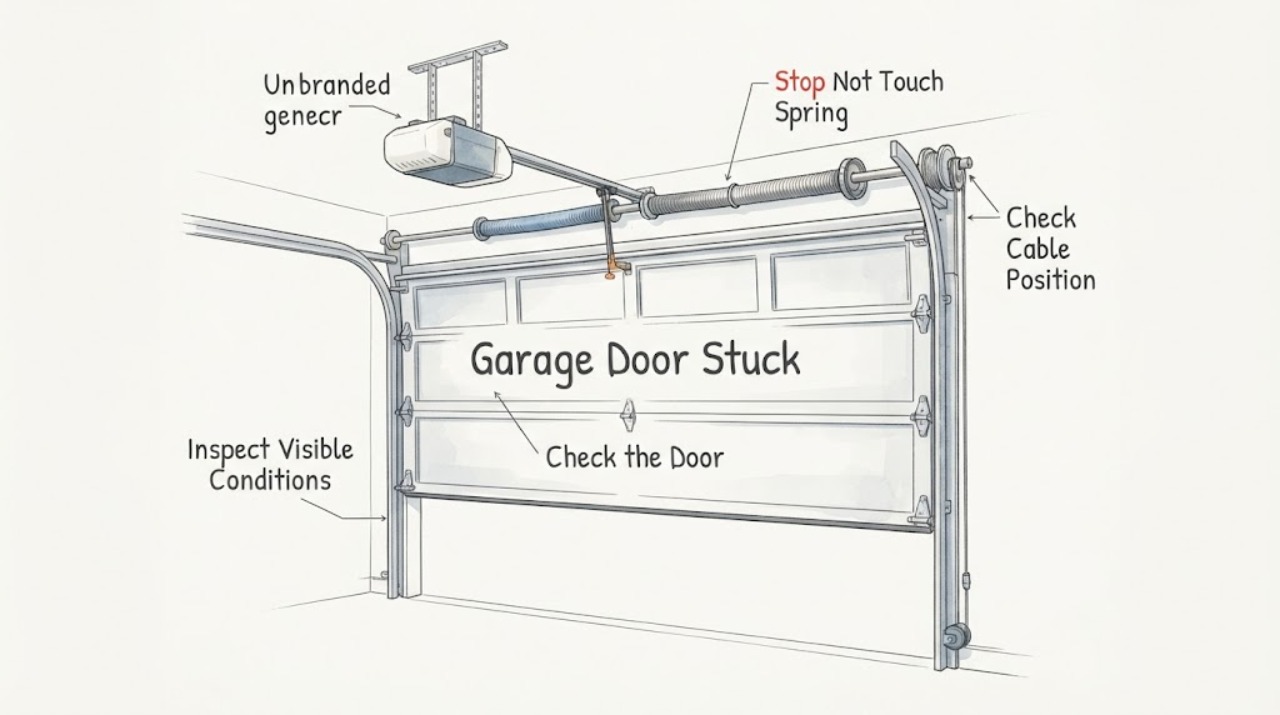
A stuck garage door may be blocked in the travel path, binding in a track, stopped by the opener's safety system, or made dangerously heavy by a broken spring, loose cable, or other counterbalance failure. From outside the travel path, note whether the door is fully closed, partly open, or crooked; look for visible obstructions, track damage, hanging cables, or a separated spring; and observe the opener and safety-sensor indicators without touching tensioned hardware. Do not pull the emergency release on a partly open or visibly damaged door, climb, force the door, adjust springs, loosen red or bottom-bracket fasteners, or handle cables. If the door binds, is unbalanced, has damaged tracks or cables, or will not move after a simple path check, stop and arrange garage-door service.
Work through in order
Diagnostic checks
Use only checks that match the exact appliance or system and its official guide.
-
Map the door position and visible travel path
From outside the door's travel path, note whether the door is fully closed, partly open, tilted, or off the tracks. Look along the floor, threshold, tracks, and opening for a vehicle, stored item, ice, fallen hardware, a bent section, or another visible obstruction. Do not step under the door or reach into the path.
Expected result: The path is visibly blocked; the door is crooked or a roller is out of the track; the door is closed but the opener does nothing; or no obstruction is visible.
Next step: Remove only an item that is loose, outside the door mechanism, and safely reachable with the door stationary. Otherwise photograph the condition from a distance and use the matching branch below.
Stop if: Stop immediately for a partly open door, sagging or tilted sections, a displaced roller, bent track, hanging cable, broken spring, loose bottom bracket, or any need to enter the travel path.
Why this matters
Why: A clear obstruction can explain a single stop, while a crooked panel, displaced roller, or bent track indicates a door hardware problem. A clear path with no movement does not clear the springs, cables, or opener. CPSC says track hardware keeps the door on track and that binding or sticking needs professional service.
-
Observe the opener response and safety-sensor indicators
From a clear standing position, use one normal wall-control or remote command only if no person, vehicle, pet, or object is in the opening and the door and hardware look intact. Note whether the opener is silent, clicks, hums, starts then reverses, or moves only briefly. If the photo-eye indicators are visible without entering the path, note whether they appear powered and aligned; do not adjust them or bypass the safety system.
Expected result: The opener is silent; it runs while the door stays still; it reverses immediately; the sensor indicators are dark or abnormal; or the door moves unevenly or makes a new noise.
Next step: Stop commands after this observation. Record the opener brand and model if visible, the indicator pattern, and whether the door moved at all; consult the exact manual or request service rather than changing force, travel, or sensor settings generically.
Stop if: Stop for any movement toward a person or object, a door that reverses unpredictably, a loud bang, smoke, burning odor, exposed wiring, or a need to enter the opening or defeat a sensor.
Why this matters
Why: A silent opener or abnormal sensor indicator can point toward control power or the safety system, while a running opener with no door movement can also reflect a disconnected drive or a door-side failure. Immediate reversal may be a safety response or a mechanical bind. LiftMaster lists sensor alignment, track alignment, a blocked path, and broken springs among reasons an opener may not work.
-
Inspect springs, cables, and bottom brackets from a safe distance
With the door stationary, look from the side or outside for a visible gap in a spring, a separated extension spring, a slack or hanging lift cable, a cable off its drum or pulley, a loose bottom corner, or a bracket or fastener that appears displaced. Use a zoomed photograph if needed; do not touch, pull, restrain, wind, unwind, loosen, or replace any of these components.
Expected result: A spring is visibly separated; a cable hangs or is off its normal path; one side of the door is lower; a bottom corner or bracket is displaced; or the counterbalance parts look intact from the available angle.
Next step: Keep the door in its current position, keep people away, and arrange garage-door service. Provide the photographs and describe whether the door is closed, partly open, or crooked; do not attempt a balance test or manual lift when these clues are present.
Stop if: Stop immediately for any spring, cable, bottom bracket, red fastener, damaged track, sudden weight change, or visible tension. Never climb or work above shoulder height on this system.
Why this matters
Why: A broken or disconnected counterbalance can make the door dangerously heavy or unstable and can cause the opener to run without safely lifting it. An intact-looking spring from a distance does not prove the system is safe. CPSC and Clopay direct professional service for sticking, unbalanced, damaged, or spring-related conditions.
-
Check track, rollers, and panel alignment without contact
From outside the travel path, compare the left and right vertical tracks and the visible horizontal track sections. Look for a track that is bent, spread, loose, obstructed, or no longer parallel, and for a roller or hinge that is visibly displaced. Do not lubricate, straighten, loosen, remove, or push a roller back into a track.
Expected result: The tracks look parallel and clear; one track is bent or loose; a roller is out; a panel is cracked or separated; or the door is binding at one repeatable point.
Next step: Stop operation and send the provider a wide photo plus a close photo of the suspected point. If the track is clearly damaged or the door is off track, do not attempt to free or realign it.
Stop if: Stop for a loose or bent track, off-track roller, separated panel, damaged hinge, sharp metal, a partly open door, or any need to place hands or tools near moving parts.
Why this matters
Why: A bent or displaced track, roller, hinge, or panel can stop the door and can make opener force unsafe. A clean visual path with a repeatable bind still needs professional diagnosis because the obstruction may be inside the hardware or counterbalance system. LiftMaster identifies track alignment and a blocked door path as common opener trouble causes, while Clopay warns that damaged door or supporting track can be hazardous to operate.
-
Prepare a safe handoff for the door technician
Record the door position, whether the opener was silent or running, the first point where motion stopped, sensor indicator behavior, visible track or panel damage, spring and cable observations, recent impact or weather event, and the opener and door labels if readable from a safe position. Do not disconnect the opener or move the door to obtain a better photograph.
Expected result: The record shows a blocked path, opener or sensor symptom, counterbalance warning, track or panel damage, or an unresolved stuck door with no visible cause.
Next step: Request garage-door service and keep the opening isolated until the door is inspected. Tell the provider that no spring, cable, bottom bracket, track, sensor, or force adjustment was touched.
Stop if: Do not pull the emergency release on a partly open or damaged door, climb, move the door by force, adjust opener force or travel, or loosen any spring-related hardware.
Why this matters
Why: This separates an opener-control assessment from a door, track, or counterbalance visit and helps the technician bring the right model information. It does not authorize a homeowner balance test or a spring adjustment; the stored-energy boundary remains in place.
Use your observations
Decision map
Find the observation that best matches what you see, then follow the next safe action.
-
PATH 01Safety boundary
What you see
A loose object outside the mechanism is visibly blocking the path, and the door and hardware remain stationary and intact.
Do this next
Remove only that loose object from a safe position, keep people clear, and follow the exact opener manual for one cautious retest. If the door still sticks or makes abnormal noise, stop and request service.
Why this path and its safety boundary
Safety stop: Do not enter under a partly open door, use a vehicle to move it, or keep cycling the opener after a second failure.
-
PATH 02Safety boundary
What you see
The opener is silent, reverses, shows abnormal sensor indicators, or runs without moving an apparently intact door.
Do this next
Stop commands, record the indicators and opener model, and request opener service or follow only the exact manual's user-level checks. Do not alter force, travel, wiring, or safety-sensor bypass settings.
Why this path and its safety boundary
Safety stop: Stop for unpredictable motion, exposed wiring, smoke, burning odor, or any need to defeat the entrapment-protection system.
-
PATH 03Safety boundary
What you see
A spring is separated, a cable is slack or displaced, one side is lower, the door is severely heavy or unbalanced, or a bottom bracket or red fastener is abnormal.
Do this next
Keep everyone away from the door, leave it in its current position, and arrange prompt service from a qualified garage-door technician.
Why this path and its safety boundary
Safety stop: Do not pull the emergency release, lift or lower the door, wind or unwind a spring, loosen fasteners, restrain a cable, or replace counterbalance parts.
-
PATH 04Safety boundary
What you see
A track is bent or loose, a roller is out, a panel or hinge is damaged, or the door is crooked or binding at one point.
Do this next
Stop operation and request garage-door service with photos from outside the travel path. Keep vehicles and people clear of the opening.
Why this path and its safety boundary
Safety stop: Do not straighten tracks, reseat rollers, loosen brackets, lubricate a damaged joint, or force the door through the bind.
-
PATH 05Safety boundary
What you see
No safe visual cause is clear, but the door remains stuck or the opener continues to fail after one normal command.
Do this next
Leave the system untouched and arrange a professional inspection. Provide the door position, command response, photographs, labels, and any recent impact or weather information.
Why this path and its safety boundary
Safety stop: Do not keep testing, disconnect a partly open door, or attempt a generic balance, force, travel, or spring procedure.
Helpful context
Understand the symptom
A garage door is a large moving system, not just a panel and motor. The opener, rollers, tracks, hinges, cables, springs, bottom brackets, and floor clearance all affect whether it can move safely. A motor that hums does not prove the opener is the failed part, and a door that will not move can become more dangerous if a spring or cable has lost its counterbalance.
Begin with the door stationary and keep everyone out of the opening. CPSC says a door that binds or sticks should be serviced by a professional and warns that a severely unbalanced door can fall unexpectedly. Clopay likewise warns that springs, cables, and bottom brackets are under extreme tension. The safe homeowner contribution is a distance inspection and a precise report, not a counterbalance repair.
Identify the safe stop point before testing
Do not stand under a partly open door or place hands near rollers, hinges, section joints, tracks, springs, cables, or the bottom corners. If the opening is needed for an emergency, use another safe route when possible. Do not repeatedly command a stuck door, use a vehicle or rope to pull it, or hold it open with an improvised support.
If the door is intact, fully closed, and the exact owner manual specifically describes a safe user-level control check, follow that manual. A generic release, balance test, force adjustment, or sensor adjustment is not interchangeable across door and opener designs.
Only after diagnosis
Potential parts
- garage-door spring assembly
Consider this category only after a qualified technician confirms a broken or incorrectly specified counterbalance spring; a stuck symptom alone does not identify the spring type or required specification.
Spring selection depends on the exact door, weight, dimensions, and counterbalance design. Do not order or install a spring from a color, appearance, or generic search result. - garage-door lift cable and bottom bracket
Consider this category only when service inspection confirms a slack, broken, displaced, or damaged cable or bracket and the door system is secured for repair.
Bottom brackets and cables can carry stored spring force. Confirm the exact door system and use a qualified door technician; do not handle the component during this guide. - garage-door roller or track hardware
Consider this category only when a qualified inspection confirms a damaged roller, hinge, track, or mounting component after the door is safely supported and the counterbalance risk is assessed.
Match the exact door and track design. A visually similar roller or track part may not be suitable, and hardware replacement is not a safe way to force a stuck door. - garage-door safety sensor
Consider this category only when the opener's exact manual and a service diagnosis confirm a failed sensor rather than simple obstruction, wiring, alignment, or a door-side bind.
Confirm the exact opener model and approved entrapment-protection components. Never bypass or substitute a sensor based only on an indicator light.
When checks do not resolve it
Need a professional?
Request garage-door service for a door that binds or sticks, is partly open or crooked, has a visible spring, cable, bottom-bracket, track, roller, or panel problem, or leaves the opener running without safe door movement. Treat a damaged, unbalanced, or unstable door as a prompt service need and keep people and vehicles clear.
Common questions
FAQ
Is it safe to pull the emergency release when a garage door is stuck?
Not as a generic first step. A partly open, crooked, damaged, or spring-failed door can drop or shift when disconnected from the opener. Keep the door stationary and follow the exact manual only when it explicitly covers the current safe door position; otherwise call a garage-door professional.
What does a humming opener mean when the garage door will not move?
It means the opener is responding, not that the door-side system is safe or intact. A blocked path, disconnected drive, track bind, broken spring, or cable problem can all leave the motor running without moving the door. Stop after one observation and inspect only from a safe distance.
How can I tell whether a garage door spring is broken?
From a safe distance, you may see a gap in a torsion spring, a separated extension spring, a sudden heavy or crooked door, or a slack cable. These are warning clues, not an invitation to test the balance. Do not touch springs, cables, bottom brackets, or related fasteners; arrange professional service.
Can I straighten a bent garage-door track myself?
Do not straighten or loosen a track on a stuck door. The track, rollers, panels, and counterbalance work together, and forcing one part can release movement or leave the door off track. Photograph the damage and request service.
Should I adjust the opener force or travel limits for a stuck door?
No. Force or travel changes can mask a mechanical bind and can affect entrapment protection. First identify whether the door, track, spring system, or safety sensor is abnormal; leave adjustments to the exact manual or a qualified technician.
When should I call a garage-door professional?
Call when the door binds or sticks, is partly open or crooked, has a broken spring or slack cable, is off track, has damaged panels or tracks, reverses unpredictably, or will not move after a simple safe path observation. Keep people and vehicles clear until it is inspected.
Read the exact guide
Official sources
- SAFETY INFORMATIONClopay Corporation · Supports the explicit stop boundary around springs, cables, bottom brackets, red fasteners, tracks, damaged doors, and high-tension hardware.
- Garage Door Opener Repair & MaintenanceLiftMaster · Supports separating opener response from door-side faults and recording sensor, track, path, and spring clues without changing settings.
- Publication - 523 Non-Reversing Automatic Garage Door Openers Are a HazardU.S. Consumer Product Safety Commission · Supports professional service for sticking or unbalanced doors, keeping people away from moving doors, and observing opener safety behavior.
Community feedback
Share a repair observation
Share a plain-text repair observation. Accepted observations are published automatically; this page may take a moment to update.