
On this page
Start here
Quick answer
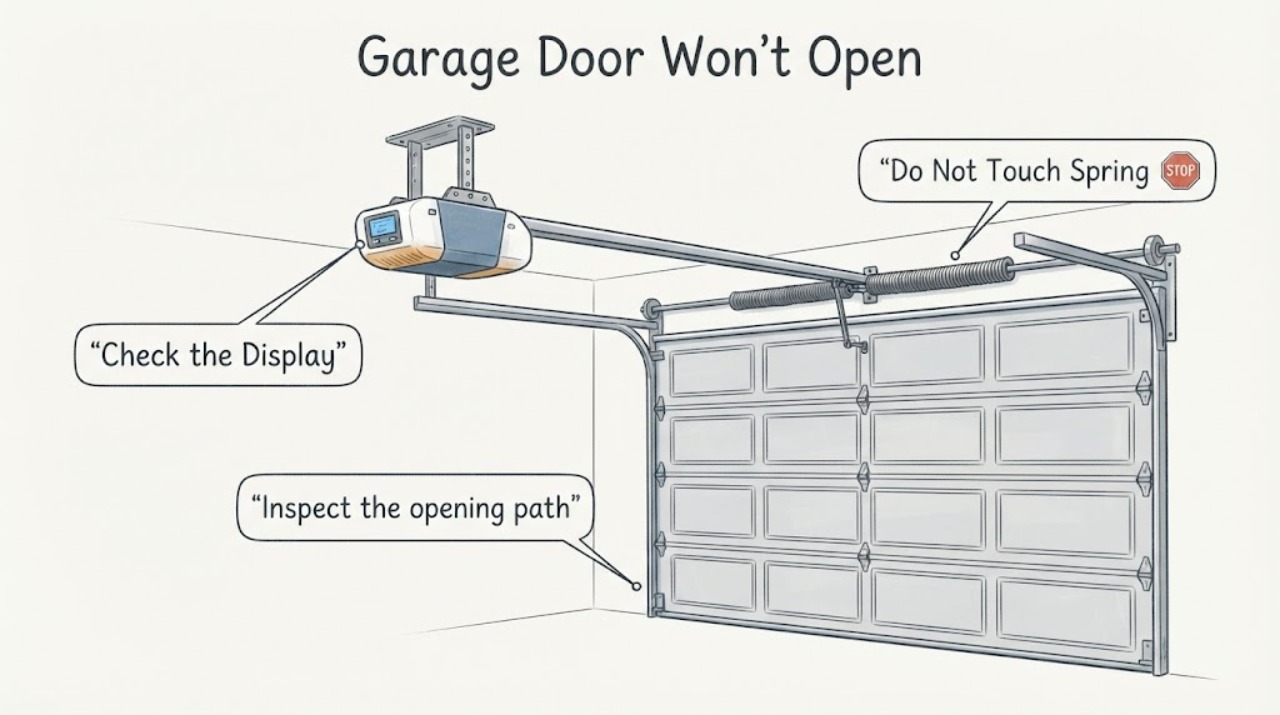
Start with safe observations: check whether the opener has power and responds to the wall control or remote, look for a blocked photo-eye path or door track from the ground, and watch for a broken spring, loose cable, or door that is visibly off track. A door that is heavy, crooked, jammed, or supported by damaged springs or cables should stay closed and be handled by a trained garage-door professional. Springs, lift cables, bottom brackets, and related counterbalance hardware carry high tension; do not pull the release to lift a suspect door, adjust spring hardware, or loosen cable fasteners.
Work through in order
Diagnostic checks
Use only checks that match the exact appliance or system and its official guide.
-
Check the control response without forcing the door
From a clear position, press the wall control once and observe the opener light, sound, and trolley response; then try the remote once if it is available. Visually confirm that the opener power cord is seated and the wall control or remote shows no obvious damage, without opening the opener housing.
Expected result: There is no light or sound, the opener clicks or hums, the trolley moves but the door does not, the wall control works while the remote does not, or neither control produces movement.
Next step: Record the response and stop repeated cycling; continue to the ground-level path and hardware observations only if the door and surrounding area remain stable.
Stop if: Stop for smoke, a burning smell, sparking, a loose hanging opener, unexpected door movement, or a door that is visibly unstable.
Why this matters
Why: No response can point toward power, control, or opener trouble; a moving trolley with a stationary door can indicate a disengaged connection or door hardware problem; a remote-only failure makes its battery or control path more likely. None of these observations clears a damaged spring or cable for manual handling.
-
Inspect the opening path and safety sensors from the floor
With the door stationary, inspect the floor under the door, the visible track edges, and both photo-eye lenses from a standing position. Remove only a loose object that is clearly outside the door and safe to pick up; do not reach under the door, move track hardware, or use a ladder.
Expected result: An object blocks the path, a track is visibly bent or obstructed, a sensor is dirty or knocked out of position, wiring is loose or frayed, or the path appears clear.
Next step: Keep people and vehicles clear, document the visible obstruction or sensor condition, and request service if the issue is not an obvious safe-to-remove object.
Stop if: Do not reach beneath the door, straighten a track, pull a cable, bypass a sensor, or place hands near rollers, hinges, springs, or bottom brackets.
Why this matters
Why: A clear, aligned path removes one common obstruction clue but does not prove the door is balanced or the spring system is sound. A bent track, damaged wiring, or sensor problem needs correction or professional assessment rather than extra force from the opener.
-
Look for counterbalance damage without touching it
From the floor and outside the door's travel path, visually inspect the springs, cable drums, lift cables, pulleys, and bottom brackets. Look only for a visible gap or break in a spring, a frayed or hanging cable, a loose or bent bracket, rust, or a cable that has come off its drum; do not touch or move any part.
Expected result: A spring is visibly broken or gapped, a cable is frayed or off the drum, a bracket is bent or loose, the door is crooked, or no damage is visible.
Next step: Stop operating the opener and arrange garage-door service when any damage, crookedness, or uncertain hardware is visible; provide clear photos taken from a safe distance.
Stop if: Never wind, unwind, cut, disconnect, pull, loosen, remove, or replace a spring, cable, pulley, bottom bracket, or red-marked fastener as a homeowner check.
Why this matters
Why: Any damaged counterbalance component can prevent opening and can release stored energy or allow the heavy door to move unexpectedly. No visible damage does not prove the spring tension, cable anchorage, or balance is safe to test.
-
Observe one brief movement only if the hardware looks intact
If no spring, cable, bracket, off-track, or falling-door warning sign is visible and the area is clear, use the wall control once while standing away from the door and watch whether it remains still, begins to open, binds, jerks, or reverses. Do not repeat the cycle to force a partial opening.
Expected result: The opener is silent, the motor runs but the door stays still, the door moves a short distance and stops, it binds or jerks, or it begins to open smoothly.
Next step: Stop after the single observation, record the position and sound, and arrange service if the door does not complete a normal opening without strain or returns to the same fault.
Stop if: Stop immediately for a loud bang, cable movement, door twist, rapid drop, grinding, a door off its track, or any unexpected movement toward a person or vehicle.
Why this matters
Why: A running motor with no door movement can indicate a disconnected drive or door connection; binding or stopping can indicate track, balance, or hardware trouble; smooth movement narrows the issue but does not authorize spring adjustment or continued cycling if the original failure returns.
-
Record conditions that may change the service diagnosis
From a safe position, record whether the failure began after a power interruption, impact, storm, freezing condition, recent maintenance, or a loud snap, and whether the door is closed, partly open, or blocking a needed exit. Do not attempt to lift or secure a partly open door yourself.
Expected result: The problem follows a power event, impact, storm or freeze, a loud snap was heard, the door is partly open or crooked, or no event is known.
Next step: Give the timeline and door position to the technician, keep the opening isolated, and use another safe entrance if available.
Stop if: Do not prop, clamp, tie, pull, or manually lower a door with uncertain springs, cables, tracks, or balance.
Why this matters
Why: The event history helps distinguish an opener/control issue from sudden door-hardware failure. A loud snap, partly open door, or impact raises the chance of a spring, cable, track, or panel problem and increases the need for prompt service.
Use your observations
Decision map
Find the observation that best matches what you see, then follow the next safe action.
-
PATH 01Safety boundary
What you see
The opener has no response, the wall control and remote differ, or the opener shows a control or power clue while the door hardware appears stable.
Do this next
Keep the door stationary, document the control and power response, and follow the model's owner instructions or request opener service; do not open the motor housing or bypass safety devices.
Why this path and its safety boundary
Safety stop: Stop for smoke, sparking, a burning smell, damaged wiring, or a loose opener mount.
-
PATH 02Safety boundary
What you see
A visible obstruction, bent track, binding point, sensor issue, or damaged wiring is present.
Do this next
Remove only an obvious loose object that is safely outside the door, then request garage-door service for track, sensor, wiring, or binding conditions that remain.
Why this path and its safety boundary
Safety stop: Do not straighten track, bypass sensors, reach under the door, or use the opener to overcome resistance.
-
PATH 03Safety boundary
What you see
A spring is broken or gapped, a cable is frayed or off the drum, a bottom bracket is bent or loose, the door is crooked, or a loud snap preceded the failure.
Do this next
Stop using the opener and keep people, vehicles, and pets away; arrange prompt service from a trained garage-door technician.
Why this path and its safety boundary
Safety stop: Do not pull the release, lift the door, adjust spring tension, loosen fasteners, or touch the cable and counterbalance hardware.
-
PATH 04Safety boundary
What you see
No obvious ground-level cause is visible, but the door still will not open or stops, binds, or reverses after one safe observation.
Do this next
Leave the door closed and request diagnosis of the opener, drive connection, track, balance, and counterbalance system rather than repeatedly cycling it.
Why this path and its safety boundary
Safety stop: Do not compensate for an unknown door fault by increasing force settings or manually forcing the door.
Helpful context
Understand the symptom
Separate an opener problem from a door-hardware problem
A silent opener, a humming motor, a moving trolley with a stationary door, and a door that starts then stops point to different checks. Begin with the control response and visible path. If the door is heavy, crooked, jammed, or a spring or cable is damaged, do not keep cycling the opener: the motor cannot safely compensate for a failed counterbalance system.
Treat springs, cables, and bottom brackets as a hard stop
Overhead Door warns that springs and cables are under high tension and should not be repaired by the homeowner. A visual check from the floor is enough to decide whether to stop; it is not a reason to touch, release, loosen, wind, cut, or replace a counterbalance component. Keep the doorway clear while service is arranged.
Only after diagnosis
Potential parts
- garage-door lift cable or counterbalance spring
Consider this category only if a trained technician confirms a damaged counterbalance component and identifies the door system and required repair.
Confirm door size, lift configuration, spring or cable type, and professional installation requirements; no fit or safe user replacement is assumed from a door that will not open. - garage-door opener remote battery
Consider this category only when the wall control operates the door normally but the remote does not respond and the remote shows no physical damage.
Confirm the existing remote's battery type and follow its instructions; this does not address a door or spring failure.
When checks do not resolve it
Need a professional?
Request garage-door service if one safe control and path check does not restore normal opening, the door binds or stops, the opener runs without moving the door, or the cause is unclear. Seek prompt service for a broken spring, frayed or off-drum cable, bent or loose bottom bracket, crooked or partly open door, loud snap, falling movement, or a door blocking a needed exit.
Common questions
FAQ
Why will my garage door opener run but the door will not open?
The drive may be disconnected, or the door may have a track, balance, spring, cable, or binding problem. Watch once from a safe position and stop if the motor runs without moving the door or if hardware looks damaged.
Can I pull the emergency release when my garage door will not open?
Do not use the release to lift a door when a spring, cable, track, balance, or bracket problem is possible. A garage door can weigh hundreds of pounds, and a release can leave that weight unsupported; have a trained technician assess it.
Is a broken garage-door spring the reason the door will not open?
It is one possible cause, especially after a loud snap or when a spring is visibly broken or gapped, but the symptom can also come from power, controls, sensors, tracks, or the drive. Never adjust or replace the spring yourself.
Should I increase the opener force so the garage door opens?
No. More force can mask a binding, unbalanced, or damaged door and create a safety hazard. Find the visible obstruction or control clue, then stop and request service when the cause is not obvious.
Read the exact guide
Official sources
- Garage Door Safety InformationOverhead Door · Supports the high-tension warning for springs and cables, safe visual inspection, and professional service for damaged components or an unbalanced door.
- Garage Door Opener Repair & MaintenanceLiftMaster · Supports checking common opener causes such as remote batteries, safety sensors, track alignment, obstructions, and broken springs, and contacting a dealer when troubleshooting does not solve the issue.
- Maintaining Your Garage DoorOverhead Door · Supports inspecting springs, cables, drums, brackets, tracks, sensors, controls, and the boundary against adjusting high-tension components without training.
Community feedback
Share a repair observation
Share a plain-text repair observation. Accepted observations are published automatically; this page may take a moment to update.