
On this page
Start here
Quick answer
Start by separating an opener or control problem from a door or spring problem. Check the remote battery and wall control, confirm the opener has power, and watch what the door does when you make one normal request. From a safe distance, look for an obstruction, a crooked door, a loose or frayed cable, or a visible gap in a spring. If the door is heavy, will not budge, the spring appears broken, a cable is loose, or the door is partly open and unstable, stop using it and call a trained garage-door professional; do not adjust or replace spring hardware yourself.
Before you begin
Safety first
- Do not adjust or replace springs, cables, bottom brackets, tracks, force settings, or travel limits without qualified training and the model-specific procedure.
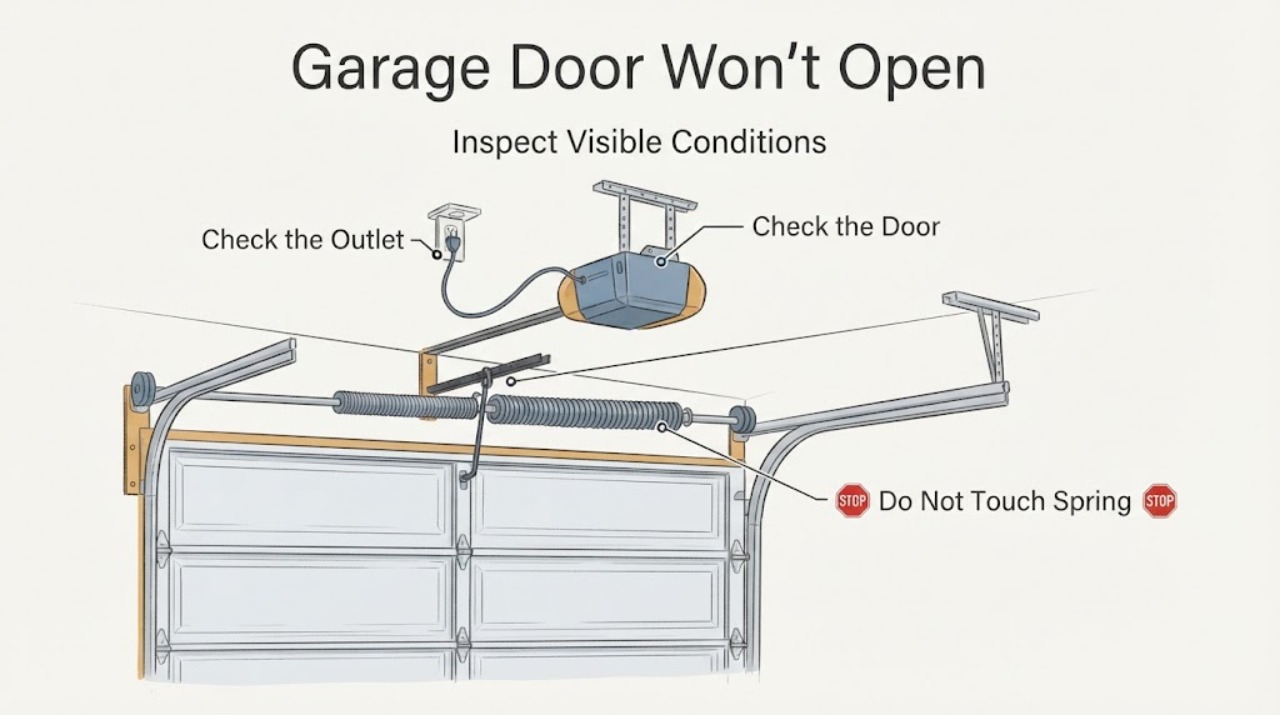
Work through in order
Diagnostic checks
Use only checks that match the exact appliance or system and its official guide.
-
Check 1
Make one normal opening request while standing clear of the door: try the wall control and then the remote, and observe the opener light, motor sound, and any movement. Check the remote battery only if the remote is the sole control that fails.
Expected result: If the wall control works but the remote does not, the likely branch is the remote battery, range, or programming. If neither control activates the opener and its light is off, check its power supply; if the motor runs but the door does not move, continue with the door and spring checks.
Next step: Record whether the failure is remote-only, control-wide, motor-only, or a heavy/stuck door. Do not repeatedly cycle the opener when the door does not move normally.
Why this matters
Why: Different responses distinguish an access-control problem from an opener or mechanically loaded door. A motor sound does not prove that the door is safe or mechanically able to lift.
-
Check 2
Check the opener's visible power connection and the garage circuit or outlet without removing covers. If the opener has no light or response, confirm the outlet or circuit is available and perform only the reset procedure specified by the opener manual.
Expected result: If power returns and the door opens normally, the interruption was electrical or control-related. If the circuit trips again, the opener remains dead, or there is a damaged cord or outlet, leave it off and arrange qualified electrical or opener service.
Next step: If the opener is powered but still cannot open the door, inspect the clear opening path and the door's safe, stationary condition from outside the moving path.
Why this matters
Why: A dead opener can make a sound door appear stuck, while repeated circuit trips indicate a fault rather than a reason to keep resetting. A working opener does not rule out a broken spring.
-
Check 3
From a safe distance, inspect the door opening and both visible tracks for a box, vehicle, ice, bent panel, displaced roller, or obvious track gap. Keep hands and tools out of the track and do not force the door past resistance.
Expected result: A clear obstruction or a door that starts unevenly, grinds, binds, or stops against a damaged track indicates a door or alignment problem. A damaged panel, roller, or track can prevent opening even when the opener responds.
Next step: Remove only a loose object that is completely outside the door and track, then make one normal test. For bent hardware, a jam, or resistance that remains, stop and call a garage-door professional.
Why this matters
Why: The track guides the door and cables support its weight with the spring system. A visible mechanical fault is a service decision, not an invitation to bend the track or pull the door straight.
-
Check 4
Without touching the spring assembly, look from the side and below for a visible gap in a torsion spring above the door, a stretched or damaged extension spring, a loose or frayed lift cable, a crooked door, or a loud snap that preceded the failure.
Expected result: A gap, damaged spring, loose cable, sudden bang, unusually heavy door, or door that will not budge strongly suggests a failed or unbalanced counterbalance system. A door that is light and moves evenly but the opener will not lift it points back toward the opener connection or control.
Next step: Stop operating the door and keep everyone clear if any spring or cable warning sign is present. Do not wind, remove, tighten, replace, or bypass spring or cable hardware; arrange trained service.
Why this matters
Why: Springs store and release the energy that balances the door; cables transfer that lifting force. When either system is damaged, the door can fall, slam, or overload the opener.
-
Check 5
If the door is fully closed, stable, and shows no spring, cable, panel, or track damage, compare the opener symptom with the model manual: check whether its lock or control setting is active and note any diagnostic lights. Do not disengage the opener or move a partly open door as a test.
Expected result: A control or remote-only fault with a door that is otherwise stable points to the opener system. A door that is heavy, falls, rises crookedly, or remains stuck after the control checks points to the door balance or hardware instead.
Next step: Give the technician the model number, installation or purchase information, symptom pattern, and any light or diagnostic behavior. Keep the opener and door out of service until a professional says they are safe.
Why this matters
Why: The same “won't open” report can originate in the command path or the counterbalance system. The safe boundary is reached when diagnosis would require releasing the door, changing force or travel, or touching tensioned parts.
Use your observations
Decision map
Find the observation that best matches what you see, then follow the next safe action.
-
PATH 01Next step
What you see
The wall control works but the remote does not.
Do this next
Check the remote battery, range, and model-specific programming. If the wall control also fails, follow the power branch instead.
-
PATH 02Next step
What you see
The opener is silent and has no light or response.
Do this next
Check the visible power supply and circuit once according to the manual. A repeated trip, damaged wiring, or dead opener after power is available needs qualified service.
-
PATH 03Next step
What you see
The opener runs but the door does not lift, is very heavy, or will not budge.
Do this next
Stop cycling the opener. Inspect only from a safe distance for a spring gap, loose cable, crooked door, or track damage, then arrange professional garage-door service.
-
PATH 04Next step
What you see
The door starts unevenly, grinds, binds, or encounters a visible obstruction or damaged track.
Do this next
Keep hands clear and do not force, bend, or realign the track. Remove only a loose object that is safely outside the mechanism; otherwise call a technician.
-
PATH 05Next step
What you see
The door is partly open, hanging, crooked, or unstable.
Do this next
Do not go underneath it, pull the emergency release, or attempt to lift or secure it yourself. Keep the area clear and call an emergency garage-door professional.
-
PATH 06Next step
What you see
You see a broken spring, loose or frayed cable, damaged panel, or exposed tension hardware.
Do this next
Stop all operation. Do not touch or adjust the spring, cable, brackets, or opener force; arrange trained service.
Helpful context
Understand the symptom
What the symptom tells you
A silent opener and a motor that runs without lifting the door are different failures. The door itself may also be unsafe to move when its counterbalance spring or lift cable has failed. Use the checks below to identify the branch without reaching into tracks, pulling on cables, or changing opener force or travel settings.
Spring and pinch-point warning
Garage doors are heavy moving assemblies, and torsion and extension springs store substantial energy. Keep people and vehicles clear, never stand under a stopped partly open door, and do not loosen brackets, winding hardware, cables, or spring fasteners. If the door is crooked, hanging, damaged, or unstable, leave it closed if it is already safely closed and arrange service.
Safety boundary
Stop conditions
- Stop immediately for a broken or visibly separated spring, loose or frayed cable, crooked or falling door, damaged track or panel, exposed tension hardware, or a loud snap followed by failure.
- Never stand under a stopped partly open door, pull its emergency release while it is unstable, or try to catch, force, or prop the door with improvised supports.
- Do not adjust or replace springs, cables, bottom brackets, opener force, or travel limits as an ordinary-user fix.
Only after diagnosis
Potential parts
- garage door spring system
Only consider this class when a professional confirms a visible spring gap, lost balance, unusual heaviness, or a spring-related failure; the symptom alone does not identify the correct spring.
Spring type and size depend on the door's weight, dimensions, and track configuration. Have a trained technician identify and install the correct system. - garage door lift cable
Only consider this class if a technician confirms fraying, a cable off the drum, or cable damage associated with the opening failure.
Cable work is tied to the spring and bottom-bracket system; confirm the exact door configuration and professional fitment. - garage door opener remote or control component
Only consider this class when the wall control and door mechanics work normally but the remote remains the only failed command path after its battery and programming are checked.
Confirm the opener model and approved control compatibility before ordering; do not infer fit from button appearance.
When checks do not resolve it
Need a professional?
Call a trained garage-door professional when the door is heavy or immovable, a spring or cable looks damaged, the door is crooked or partly open, the track or panel is bent, the opener repeatedly trips power, or safe remote and wall-control checks do not restore operation.
Safety scope: Do not adjust or replace springs, cables, bottom brackets, tracks, force settings, or travel limits without qualified training and the model-specific procedure.
Common questions
FAQ
Can a broken spring cause a garage door not to open?
Yes. A failed spring can leave the door unusually heavy, crooked, or immovable, and the opener may strain without lifting it. Treat a visible gap, loud snap, loose cable, or heavy door as a professional-service condition.
Why does my garage door opener run but the door does not move?
The opener may be disconnected or faulty, but a broken spring, loose cable, damaged track, or jammed door can also prevent lifting. Stop repeated cycles and inspect only from a safe distance before arranging service.
Is it safe to open a garage door manually when the spring may be broken?
Do not manually lift or release a partly open, heavy, crooked, or damaged door. A failed counterbalance can let the door fall or overload the person holding it; keep clear and call a trained professional.
Read the exact guide
Official sources
- Garage Door Safety ChecklistClopay · Residential garage doors and automatic openers
- Get SupportChamberlain · Chamberlain-family residential garage door openers and remote controls
- Request Garage Door Service and RepairClopay · Residential garage door systems and openers
- Garage Door Spring Systems: A Buying Guide for HomeownersClopay · Residential torsion and extension spring systems
Community feedback
Share a repair observation
Share a plain-text repair observation. Accepted observations are published automatically; this page may take a moment to update.