
On this page
Start here
Quick answer
First determine whether water is failing to enter the downspout, stopping inside its visible sections, or exiting normally but pooling at the discharge point. From the ground, clear only loose debris at reachable openings, then use a garden hose at a reachable outlet to check flow. If water still backs up, the downspout is high, a section is crushed or disconnected, or the system disappears underground, stop and have a gutter or drainage professional inspect it rather than forcing water or opening buried piping.
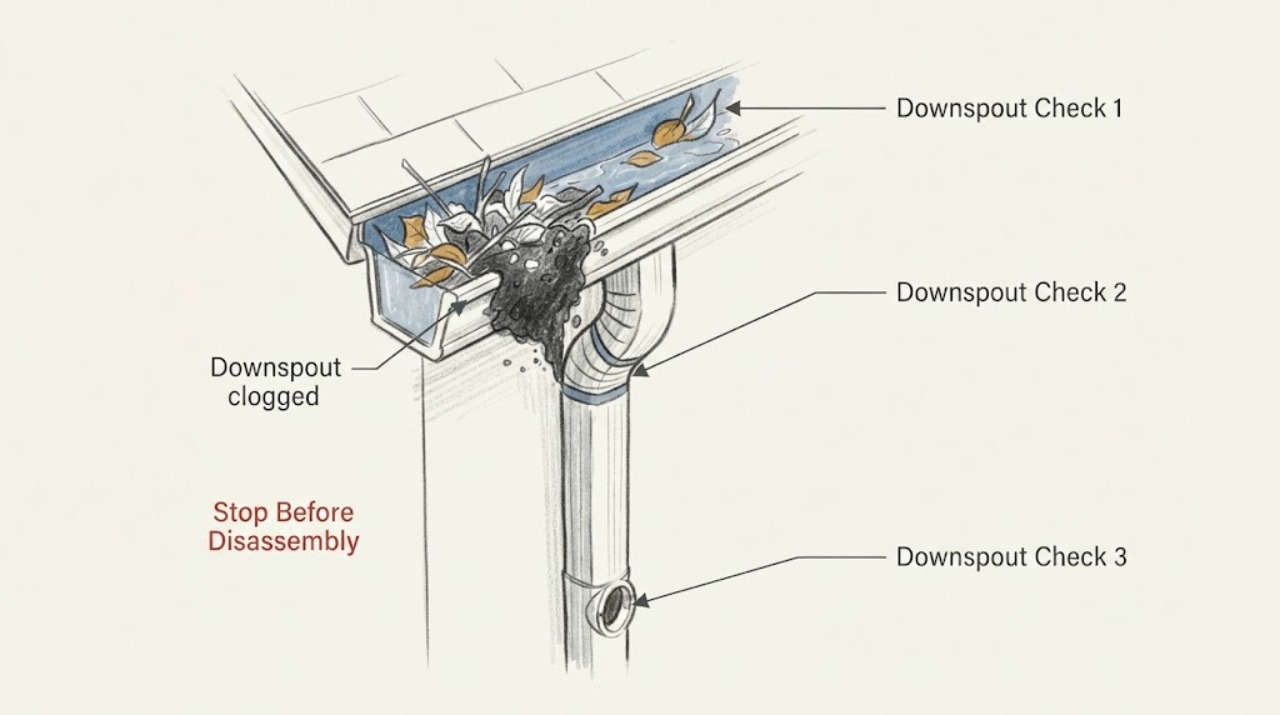
Work through in order
Diagnostic checks
Use only checks that match the exact appliance or system and its official guide.
-
Check 1
From ground level during light rain, or by adding a small amount of water to the gutter from a safe reachable point, watch the gutter outlet, the visible downspout joints, and the bottom discharge.
Expected result: If the gutter fills or overflows while the downspout stays dry, the restriction is likely at the gutter outlet or top elbow. If water appears at a seam but not at the bottom, a middle section may be blocked or separated. If water exits freely but pools beside the outlet, the visible downspout may be clear and the restriction is farther downstream.
Next step: Continue with the reachable-opening check below; if the system is concealed or the water threatens the foundation, stop the test and arrange professional drainage help.
Why this matters
Why: This separates an inlet blockage from a blockage in the visible downspout and from a discharge or grading problem, so the next check can stay at the relevant reachable point.
-
Check 2
After the rain stops, put on gloves and remove loose leaves or sediment from the reachable gutter outlet, bottom elbow, and surface extension. If a surface-fitted extension separates without force, inspect both openings; do not climb or pull on a high or stuck section.
Expected result: A compact wad at the gutter outlet or elbow confirms an accessible debris clog. A separated joint, crushed section, or standing debris with no reachable opening points to a damaged or less accessible section instead.
Next step: If the openings are clear, use the low-risk flow check at a reachable lower outlet. If the section is high, stuck, cracked, or unstable, stop and call a gutter professional.
Why this matters
Why: Loose debris can be removed at the opening, but a damaged or unreachable section should not be forced or dismantled by an ordinary user because it may release stored water or destabilize the gutter system.
-
Check 3
Only when the lower outlet is reachable from stable ground, place a garden hose at that opening and use a gentle flow while watching the upper opening and visible joints; do not force pressure into a backed-up pipe.
Expected result: If water passes through and exits normally, the visible run is likely open. If water backs up immediately, returns from an upper opening, or leaks from a joint, a remaining clog or damaged connection is still present.
Next step: Stop the hose as soon as it backs up. Have a professional inspect any remaining visible blockage, hidden connection, or crushed section.
Why this matters
Why: Free flow supports returning the extension and checking its discharge path. Immediate backup means the hose is not a solution; forcing more water can move the blockage toward a concealed connection or increase overflow.
-
Check 4
During the next rain, observe the outlet and nearby ground from a safe standing position after the loose debris has been removed.
Expected result: A steady outlet stream with water moving away from the building indicates the visible system and discharge path are working. Spillover, a weak stream, a new wet spot near the foundation, or erosion at the outlet indicates a remaining restriction, leak, or drainage-path problem.
Next step: Keep the outlet and extension free of leaves and schedule a professional inspection for recurring backup, foundation-side pooling, underground connections, or any repair that requires height or excavation.
Why this matters
Why: The downspout can be considered cleared only when water leaves the outlet and the discharge area handles it without sending water toward the structure. A recurring wet spot is not proof that the vertical pipe is clogged.
Use your observations
Decision map
Find the observation that best matches what you see, then follow the next safe action.
-
PATH 01Next step
What you see
Water overflows at the gutter while the downspout remains dry
Do this next
Treat the gutter outlet or top elbow as the first suspect and clear only loose debris at a reachable opening.
-
PATH 02Next step
What you see
Water flows through the visible downspout but pools at the bottom
Do this next
Inspect the surface extension, splash area, and nearby grading; the vertical downspout may not be clogged.
Helpful context
Understand the symptom
Use the symptom to locate the likely blockage
A downspout problem is not always a plug in the vertical pipe. Leaves can block the gutter outlet or an elbow, a joint can separate, and a clear downspout can still discharge into a blocked extension or a poorly draining area. Compare the point where water stops with the point where it should leave the system before choosing a tool. Work only from stable ground and reachable openings; do not climb to a roof or ladder for this check.
After the blockage is cleared
Run water again and watch the outlet and the ground around it. The discharge should not spill against the foundation, into a neighbor's property, or over an eroding slope. A recurring clog usually means leaves are entering at the gutter, an elbow or joint is damaged, or the downspout connects to a concealed drain that needs professional inspection.
Safety boundary
Stop conditions
- Stop if the downspout, gutter, or outlet is above safe reach, loose, cracked, crushed, or difficult to separate.
- Stop the hose test immediately if water backs up, spills near the foundation, or cannot be seen leaving the system.
- Do not climb a ladder or roof, dig for an underground pipe, or force a tool into an unknown connection; call a gutter or drainage professional for those conditions.
Only after diagnosis
Potential parts
- Downspout cleaning tool
Only for a reachable, open-ended visible section after loose debris has been identified.
Choose a tool that fits the accessible section; do not force it into a hidden, crushed, or underground connection. - Garden hose spray nozzle
For a gentle flow check at a reachable lower outlet or visible inlet.
Use only enough flow to observe passage; stop if water backs up. - Removable gutter drain screen
After the system is clear, if leaves repeatedly enter the gutter outlet.
Select a removable screen that matches the gutter outlet and remains serviceable for cleaning.
When checks do not resolve it
Need a professional?
Call a gutter or drainage professional when the blockage is above safe reach, returns after a reachable cleanout, causes water near the foundation, involves a loose or crushed section, or continues into an underground connection. Provide the observed overflow point, whether the reachable hose test passed or backed up, the location of any leak, and where the outlet discharges.
Have this ready
- Describe where water first backs up, what was visible at the gutter outlet and lower elbow, whether a gentle reachable hose test passed, and whether the discharge area is eroding or wet near the foundation.
Common questions
FAQ
How can I tell whether the downspout itself is clogged?
Watch both the gutter outlet and the bottom discharge. Overflow at the gutter with no bottom flow points to an inlet or upper blockage; immediate backup during a gentle reachable hose test points to a remaining blockage or damaged visible section.
Should I keep pushing water into a blocked downspout?
No. Stop as soon as water backs up or leaks from a joint. More pressure can increase overflow or push debris toward a concealed connection; have a professional inspect it instead.
When is a clogged downspout a professional job?
Call when the blockage is above safe reach, returns after accessible debris is removed, affects an underground connection, or leaves water against the foundation or causes erosion.
Read the exact guide
Official sources
- How to care for a rain garden or other stormwater facility on your propertyCity of Portland Bureau of Environmental Services · Official city guidance for clearing inlet debris, checking downspout elbows and joints, keeping overflow routes clear, and seeking drainage assistance.
- Gutters and Downspouts: Wetness or Erosion ProblemsNorthern Virginia Soil and Water Conservation District via Fairfax County · Official county-hosted conservation guidance for recognizing overflow marks, inspecting outlets, and directing discharge away from foundations.
- Drainage SystemSeattle Public Utilities · Official municipal guidance for visual inspection, downspout cleaning, discharge location, erosion signs, and professional video inspection of underground drainage.
Community feedback
Share a repair observation
Share a plain-text repair observation. Accepted observations are published automatically; this page may take a moment to update.