
On this page
Start here
Quick answer
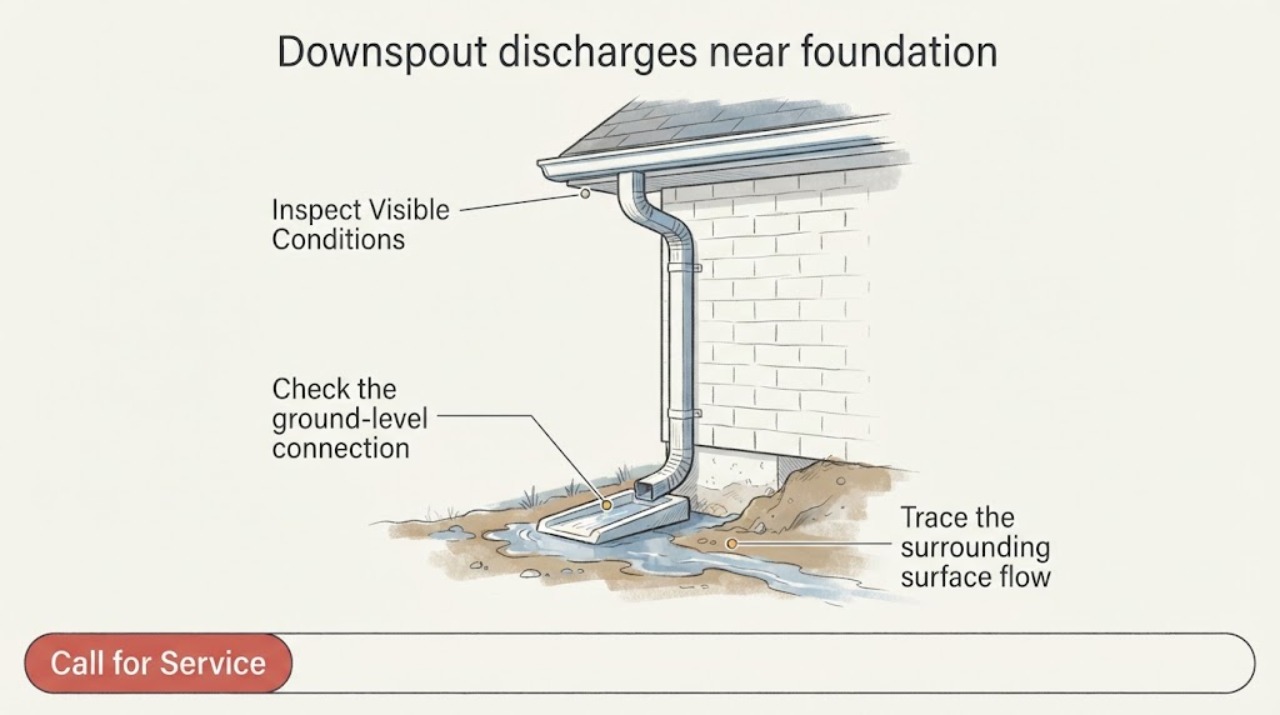
A downspout that releases water next to the foundation should be evaluated during or just after rain, but the homeowner check is ground-level observation only. Photograph where the stream lands, whether water pools or erodes soil, whether an extension or splash block is disconnected or blocked, and whether the surrounding ground or paved surfaces direct water toward the house. A simple, stable extension or splash block may be a reasonable temporary direction only when it sends water to a safe, permitted area; it does not solve a buried drain, settled grade, foundation leak, or water that has nowhere safe to go. Do not climb to inspect gutters, excavate beside the foundation, enter an unsafe crawlspace, or pressure-test a buried line. Ask a drainage or gutter professional for the right outlet and any foundation assessment when pooling persists, interior dampness appears, or the discharge cannot be redirected safely.
Work through in order
Diagnostic checks
Use only checks that match the exact appliance or system and its official guide.
-
1. Observe the discharge from the ground
During or shortly after rain, stand on stable, dry ground and photograph the downspout outlet, the point where water lands, and the foundation area without touching the stream or standing near an eroding edge. Note whether water reaches the wall, pools, runs toward the house, or flows into a safe permeable area.
Expected result: A concentrated stream at the wall differs from a detached extension, a splash block that overtops, broad sheet flow, or water that travels toward the foundation from another surface.
Next step: Mark the landing point and flow direction on a photo or sketch and repeat the observation after a representative rain if it can be done safely.
Stop if: Stop if the ground is unstable, lightning is present, water is entering the building, or the observation would require stepping into runoff or a ditch.
Why this matters
Why: The visible flow path tells the professional whether the immediate issue is outlet direction, capacity, erosion, grading, or a wider drainage pattern; it does not establish the condition of concealed foundation systems.
-
2. Check the ground-level connection and splash area
From the ground, look for a separated downspout extension, crushed or clogged outlet, displaced splash block, soil washed away beneath the outlet, or water trapped around the connection. Do not climb, remove upper gutter sections, or reach into a concealed drain.
Expected result: A visibly disconnected or crushed outlet is different from a connected outlet that discharges correctly but still leaves pooling, or from a buried outlet with no visible endpoint.
Next step: Photograph the connection and ask a gutter professional which extension, splash control, or outlet arrangement is appropriate for the site and local rules.
Stop if: Do not dig around the foundation, force a buried connection, or use a hose to pressure-test an unknown underground drain.
Why this matters
Why: A ground-level connection problem may support a simple replacement or service visit; persistent pooling with an intact outlet points toward grade, soil, surface drainage, or a concealed system that needs design rather than a longer piece alone.
-
3. Trace the surrounding surface flow
Walk only on stable ground around the accessible perimeter and look for settled soil, erosion channels, ponding, a driveway or patio edge that sends water toward the house, or nearby swales and drains that are overtopped. Compare the downspout path with other visible runoff paths; do not excavate or attempt to regrade the soil.
Expected result: Water may be confined to the downspout outlet, combine with roof or paved-surface runoff, or collect at a low area even after the outlet points away.
Next step: Document the low areas and neighboring surfaces in a service request and ask the professional to recommend a safe discharge route without sending water onto another property or an unsafe walkway.
Stop if: Stop at steep, muddy, icy, or unstable ground and do not use a ladder or roof access to continue the inspection.
Why this matters
Why: A broader surface-flow problem can overwhelm an extension or splash block. The remedy may require site drainage design, a swale or channel, or correction of a settled surface rather than a downspout part alone.
-
4. Check for accessible signs that water is reaching the building
From safe, normally occupied areas, look for new dampness, staining, musty odor, efflorescence, or water at the foundation-side wall, basement, or crawlspace entrance. Do not enter a dark, confined, flooded, or unsafe crawlspace, and do not remove interior finishes to search behind them.
Expected result: A dry interior with only outdoor pooling differs from recurring wall dampness, standing water, a new crack, or water that appears even when the downspout is not flowing.
Next step: Photograph accessible signs, record whether they follow rain, and request a drainage or foundation assessment before making a permanent discharge change.
Stop if: Escalate promptly for active interior water, structural movement, electrical hazards, sewage, or suspected mold; do not excavate or clean a contaminated area yourself.
Why this matters
Why: Interior signs can indicate a foundation, plumbing, grading, or waterproofing problem that an extension cannot correct. The timing relative to rain helps the professional choose the next investigation.
Use your observations
Decision map
Find the observation that best matches what you see, then follow the next safe action.
-
PATH 01Safety boundary
What you see
The outlet or extension is visibly disconnected, crushed, blocked, or washing out a small area at ground level, with no interior moisture sign.
Do this next
Request a gutter service visit or use a stable, compatible extension or splash control only if it can safely direct water to a permitted, non-damaging discharge area.
Why this path and its safety boundary
Safety stop: Do not use a temporary redirection that sends water toward a neighbor, walkway, septic system, or another unsafe location.
-
PATH 02Safety boundary
What you see
The outlet appears intact, but water still pools near the foundation or flows toward the house from a grade, patio, driveway, or other surface.
Do this next
Arrange a site-drainage assessment for grading, swales, channels, or a designed discharge route.
Why this path and its safety boundary
Safety stop: Do not excavate, regrade near the foundation, or connect to an underground drain without locating utilities and confirming the design.
-
PATH 03Safety boundary
What you see
The downspout appears to enter a buried drain and there is no safe visible outlet or the system backs up.
Do this next
Have a qualified drainage professional locate and evaluate the outlet and line before any hose test, digging, or replacement.
Why this path and its safety boundary
Safety stop: Do not pressure-test or open the buried system as a homeowner.
-
PATH 04Safety boundary
What you see
Interior dampness, staining, foundation cracking, active water, or a musty area follows rain or downspout flow.
Do this next
Request drainage and foundation or building-envelope assessment, and address urgent water or electrical hazards first.
Why this path and its safety boundary
Safety stop: Do not treat an interior moisture problem as solved by adding a longer downspout alone.
Helpful context
Understand the symptom
Why the outlet is only one part of the drainage path
Rainwater reaches the ground through the gutter, downspout, extension or splash area, surrounding grade, and sometimes a buried drain or designed infiltration feature. EPA guidance says water from downspouts should be directed away from the house and that the correct destination depends on the site; its downspout-redirection guidance also warns that a redirection may be unsuitable if it creates property damage or an unsafe condition. The useful first question is therefore where the water goes, not how long an extension is.
Measurements and permanent work are site-specific
Published drainage guidance can include example distances or grade targets, but soil, foundation type, lot shape, paved surfaces, local rules, utilities, and neighboring properties change what is appropriate. Do not apply a universal distance or slope from a chart to an existing home without checking the site. A professional may need to design a swale, channel, buried outlet, or foundation-water solution, especially when there is no safe place for surface discharge.
When to stop and call a professional
Call a gutter or drainage professional when the downspout remains near the foundation after a simple ground-level correction, water pools despite an intact outlet, the route is buried, or interior moisture is present. Tell the professional where the stream lands, what happens during rain, which surfaces contribute runoff, whether the soil is eroding or settling, and whether the building has dampness or staining. Keep roof, ladder, excavation, utility locating, and foundation work in the professional scope.
Only after diagnosis
Potential parts
- downspout-extension
Only consider an extension if the outlet is visibly close to the foundation and a safe, permitted destination is available for the site.
Confirm downspout dimensions, connection style, ground conditions, local rules, and the final discharge path before ordering. - splash-block
Only consider a splash block when a stable ground-level outlet can disperse water without sending it back toward the foundation or onto a walkway.
Confirm the block fits the outlet and the site can receive the flow; it is not a substitute for a drainage or foundation assessment. - drainage-channel
Only consider a channel after a professional confirms that surface runoff, rather than a concealed foundation or utility issue, is the problem and identifies a safe outlet.
Confirm channel capacity, site grade, utility clearance, local requirements, and discharge ownership before installation.
When checks do not resolve it
Need a professional?
Call a gutter or drainage professional for persistent foundation-side pooling, an unsafe or unavailable discharge route, a buried or backing-up outlet, broad surface-flow problems, or any interior moisture or foundation concern.
Common questions
FAQ
How far should a downspout discharge from the foundation?
There is no single safe distance for every existing home. The outlet should direct water away without creating pooling, erosion, unsafe walking conditions, or runoff onto another property, and local rules and site conditions may control the design. Ask a professional when the destination is unclear.
Can I add a downspout extension myself?
A stable ground-level extension may be reasonable when it fits the outlet and sends water to a safe, permitted destination. Do not use one as a substitute for diagnosing persistent pooling, a buried drain, settled grade, interior moisture, or foundation damage.
Why does water pool near the foundation even when the downspout is connected?
The outlet may be blocked or too close, but runoff can also arrive from a driveway, patio, walkway, settled soil, or another drainage path. Photograph the full surface flow during rain and request a site-drainage assessment if the outlet itself is not the whole problem.
Should I dig beside the foundation to install a drain?
Not as a first homeowner check. Excavation can affect utilities, waterproofing, structural soil, and the foundation. Have a drainage professional locate utilities and design any buried drain or foundation work.
What does indoor dampness mean when the downspout discharges near the house?
It may indicate that runoff, grading, a foundation drainage problem, or another water source is reaching the building. Record when it follows rain and where it appears, then arrange drainage or foundation assessment rather than relying on a longer extension alone.
Read the exact guide
Official sources
- Addressing Indoor Environmental Concerns During RemodelingU.S. Environmental Protection Agency · General U.S. residential moisture-control guidance; existing-site conditions and local requirements vary.
- Soak Up the Rain: Disconnect / Redirect DownspoutsU.S. Environmental Protection Agency · General informational EPA page that states it is no longer being updated; local regulations and site safety control any redirection.
- Land is Graded: Final Grade Slopes Away from FoundationU.S. Department of Energy, Building Science Education · Building-science guidance for foundation drainage; site design, existing homes, utilities, soil, and local code may require a professional design.
Community feedback
Share a repair observation
Share a plain-text repair observation. Accepted observations are published automatically; this page may take a moment to update.