
On this page
Start here
Quick answer
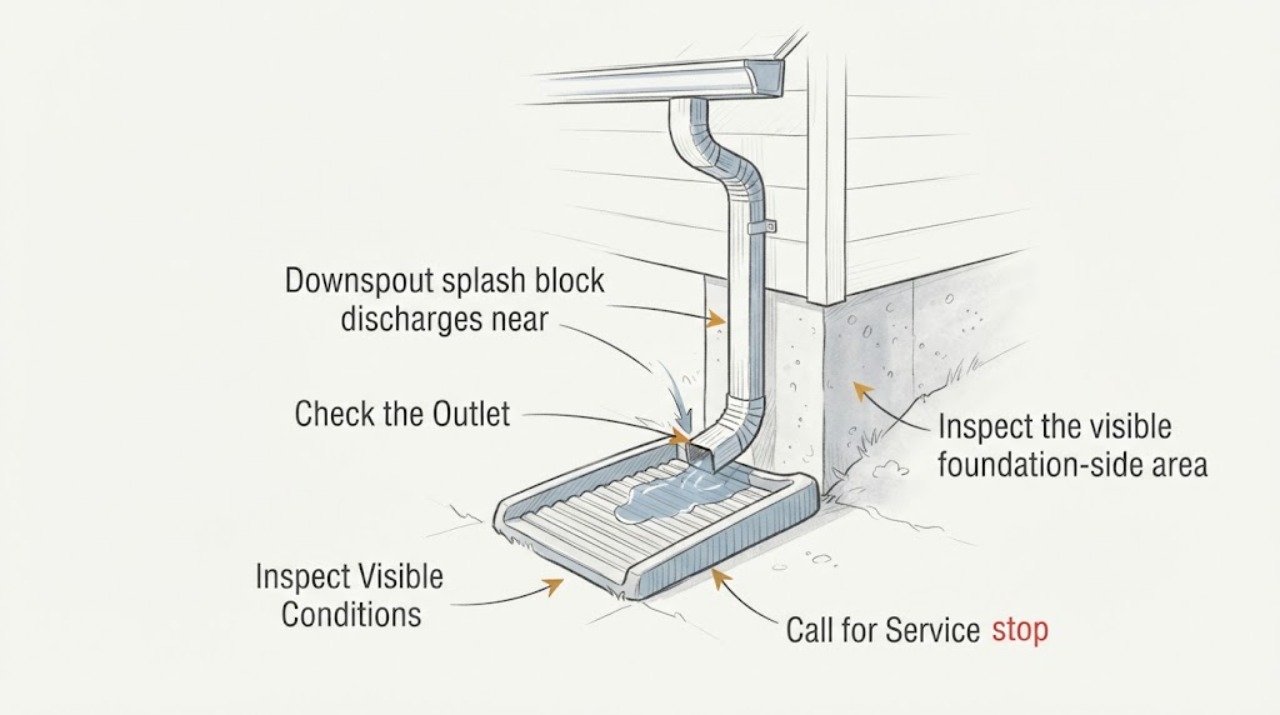
A splash block that releases roof runoff close to the foundation can saturate soil, cause erosion or ponding, and contribute to seepage. From ground level, confirm where the downspout ends, which way the water travels, whether the grade carries it away, and whether the foundation or basement shows related moisture. Keep observations to dry, stable conditions; do not excavate, climb, lift heavy drainage parts, or route water into an unknown underground connection. A simple, stable extension or splash block may be appropriate only when its discharge path is safe and allowed locally; otherwise have a gutter or drainage professional assess the site.
Work through in order
Diagnostic checks
Use only checks that match the exact appliance or system and its official guide.
-
Check 1
From a safe ground-level position, trace the visible route from the downspout outlet through the splash block or extension toward the yard. Note whether the outlet is aimed at the foundation, a flat area, a walkway, a neighboring property, or an open landscaped area.
Expected result: The splash block points away from the wall, points toward the wall, is displaced, or the discharge path disappears into an unknown connection.
Next step: Photograph the outlet and draw the visible flow path. Keep the current use unchanged until the destination is understood; request professional assessment if the path is buried, blocked, or directed toward a structure.
Stop if: Stop if the route requires digging, entering a drain opening, moving a heavy or unstable component, or approaching a steep, wet, icy, or traffic-exposed area.
Why this matters
Why: The outlet direction is the first indication of whether roof runoff is being carried away from the foundation. An unknown buried connection or a path toward a structure cannot be safely corrected by guessing.
-
Check 2
After ordinary rainfall has ended and the ground is safe, observe the soil and hard surfaces near the splash block without digging: look for ponding, a recurring wet strip, washed soil, a channel cut toward the wall, standing water at the foundation, or water crossing a walking surface.
Expected result: Water disperses in the intended landscaped area, pools beside the wall, erodes a narrow channel, freezes on a path, or reaches another structure or boundary.
Next step: Record the location and extent from the surface and keep people away from slippery or undermined areas. Ask a drainage professional to select a safe discharge route if water does not disperse away from the building.
Stop if: Stop walking the area if soil is soft or undermined, water is flowing rapidly, the path is slippery, or the observation would require excavation or crossing an unsafe surface.
Why this matters
Why: The receiving area and grade determine whether the splash block is working. Pooling, erosion, or a route toward another structure indicates that the discharge needs a site-specific drainage solution rather than a cosmetic repositioning.
-
Check 3
Inspect the visible foundation-side area from outside and, only if already safe and accessible, note basement or crawlspace signs such as dampness, seepage, efflorescence, musty odor, or a stain aligned with the downspout. Do not enter standing water or disturb the wall or soil.
Expected result: There are no related signs, a localized damp mark follows rainfall, moisture is active or spreading, or the interior area is inaccessible or unsafe.
Next step: Keep the discharge area and affected interior documented and arrange gutter, drainage, or water-intrusion assessment as appropriate. Do not coat, drill, seal, or excavate the foundation to test a theory.
Stop if: Stop if there is standing water, sewage, electrical exposure, structural movement, a collapsing soil edge, or any need to enter a confined or contaminated area.
Why this matters
Why: A matching moisture pattern increases the need to address runoff and inspect the building, but no visible sign does not prove that the foundation is unaffected. Active or spreading water is more urgent than a cosmetic splash-block issue.
-
Check 4
From the ground, inspect the splash block and the lowest visible downspout section for leaves, sediment, cracks, separation, uplift, or a blocked opening. Do not climb to inspect upper gutters and do not force a connection or move a component that resists normal hand contact.
Expected result: The block is intact and aligned, visibly cracked or displaced, blocked by loose surface debris, or connected to a section that is unstable or inaccessible.
Next step: Only remove loose debris that is reachable from a stable standing position without tools or force. Leave cracked, buried, elevated, or unstable parts in place and provide photos to a gutter professional.
Stop if: Stop if debris is compacted, the part is sharp, the outlet is elevated, the downspout moves, or correction would require a ladder, cutting, drilling, excavation, or force.
Why this matters
Why: A small visible obstruction or displacement may explain why water leaves the intended path, while a cracked, unstable, or inaccessible system may need replacement or professional correction. The lower outlet alone cannot confirm the condition of the upper gutter or buried drainage.
-
Check 5
Map the proposed receiving area from the ground: note property lines, public walkways, neighboring structures, septic or utility markers, storm drains, slopes, and any local drainage restrictions. Do not dig or assume an existing pipe is suitable for a new connection.
Expected result: There is a clear landscaped receiving area, the route crosses a boundary or walkway, the discharge would approach a utility or septic feature, or local requirements are unknown.
Next step: Keep the current site information and check local guidance before changing the route. Use a qualified drainage professional when the destination, utility location, or property responsibility is uncertain.
Stop if: Stop planning an alteration if the receiving area is not clearly controlled by the property, conflicts with a walkway or neighbor, or could affect utilities, septic systems, slopes, or foundations.
Why this matters
Why: A discharge that is safe for one lot can create erosion, nuisance flow, or infrastructure problems on another. Local rules and site conditions determine whether a surface extension, channel, collection system, or another design is appropriate.
Use your observations
Decision map
Find the observation that best matches what you see, then follow the next safe action.
-
PATH 01Next step
What you see
Runoff visibly travels toward the foundation, pools at the wall, or causes repeated erosion.
Do this next
Keep the area documented and arrange a gutter or drainage assessment; do not excavate or attach an improvised buried route.
-
PATH 02Next step
What you see
The splash block is intact and the grade disperses water safely away from the building.
Do this next
Monitor the same surface route after future ordinary rainfall and keep the outlet free of reachable loose debris. Escalate if ponding, erosion, or foundation moisture appears.
-
PATH 03Next step
What you see
The visible outlet is cracked, displaced, blocked, or unstable.
Do this next
Use only safe, ground-level observation or loose-debris removal; have a professional choose a compatible replacement or extension when alignment cannot be restored without force.
-
PATH 04Next step
What you see
The proposed discharge path crosses a walkway, boundary, public area, or an unknown buried connection.
Do this next
Pause the change and check local requirements or arrange site-specific drainage advice before redirecting water.
-
PATH 05Next step
What you see
Foundation seepage, basement dampness, soil undermining, or structural concern is present.
Do this next
Treat the issue as a building water-intrusion assessment, keep people away from unsafe areas, and request qualified professional inspection.
Helpful context
Understand the symptom
The discharge path matters more than the block alone
A splash block is only one part of roof-runoff control. The outlet, block or extension, ground slope, soil, nearby walks, property boundaries, and foundation all determine where water goes. A block can look intact while the grade still sends water back toward the building, and a longer path can create a new erosion or neighbor-impact problem if it has no suitable receiving area.
Inspect only from the ground
This check is for the downspout outlet and surrounding ground, not the roof or upper gutter. Choose dry, stable conditions and stay away from active storms, slick slopes, traffic, open drains, and unstable soil. Do not use a ladder, climb, dig, cut buried lines, or enter a hole to find a drainage route.
Avoid creating a second water problem
Redirecting water to a lawn, planting area, channel, or collection system may be restricted or unsuitable for a particular lot. The destination should not undermine the foundation, flood a walkway, cross a property boundary, or connect to an unknown pipe. When the receiving path is uncertain, pause and ask a qualified drainage professional or local authority.
Only after diagnosis
Potential parts
- downspout-extension
Consider this only when the existing outlet is serviceable, the receiving area is suitable, and the extension can carry water away without crossing a boundary, harming a walkway, or creating a new erosion path.
Confirm the downspout profile, outlet direction, grade, local requirements, and receiving-area capacity before choosing a connector or extension. - splash-block
Consider this only when a stable, visible surface route can disperse roof runoff away from the foundation and the existing outlet can remain safely aligned.
Match the outlet shape and width, and verify that the block will sit stable on the existing grade without directing water toward structures or paths. - drainage-channel
Consider this only when a surface route is needed to control erosion or carry water through a constrained yard and the site has been assessed for slope, flow, and receiving capacity.
Do not select a channel from appearance alone; confirm site grade, discharge point, local rules, and whether professional installation is required.
When checks do not resolve it
Need a professional?
Contact a gutter or drainage professional when the splash block cannot safely direct water away, the route is buried or constrained, erosion or ponding repeats, or the foundation or basement shows related moisture. Escalate promptly for active seepage, soil undermining, or structural concern.
Common questions
FAQ
Is a splash block enough if the downspout points away from the wall?
Not always. The ground slope, soil, receiving area, erosion, property boundaries, and foundation condition also determine whether runoff is actually carried away safely. Observe the complete surface route after ordinary rainfall.
Can I bury a pipe to move the discharge farther away?
Do not excavate or connect to an unknown buried route as a homeowner check. Underground drainage depends on grade, utilities, soil, local rules, and a safe receiving point; obtain site-specific professional guidance first.
What if the splash block is cracked or displaced?
Photograph it and check whether the outlet and grade remain stable from the ground. A reachable loose obstruction may be cleared without force, but a cracked, unstable, elevated, or poorly aligned part should be assessed before replacement or extension.
When should a drainage professional inspect the site?
Arrange an inspection when water reaches the foundation, ponding or erosion repeats, the route crosses a boundary or walkway, the discharge is buried or unknown, or the basement or foundation shows dampness or seepage.
Read the exact guide
Official sources
- NPDES: Stormwater Best Management Practice - On-Lot TreatmentU.S. Environmental Protection Agency · Supports evaluating receiving capacity, overflow, erosion, local limitations, and foundation separation before selecting a drainage control.
- Foundation Drain Gutters DownspoutsU.S. Department of Energy Building Science Education · Supports carrying roof runoff away from foundations and considering grade, receiving area, and site-specific drainage design.
- Soak Up the Rain: Disconnect / Redirect DownspoutsU.S. Environmental Protection Agency · Supports checking where redirected water will go and considering local rules and property-safety conditions before changing a discharge.
Community feedback
Share a repair observation
Share a plain-text repair observation. Accepted observations are published automatically; this page may take a moment to update.